
In a leaf-spine data center, the optics bill is only half the story; the other half is power, heat, and failure rate across thousands of short links. This article walks through a field case where we compared DAC (direct-attach copper) and AOC (active optical cable) on identical switch ports, then validated results with in-rack measurements. It helps network engineers, facilities power teams, and hardware integrators who need energy efficiency without breaking compatibility or service-level expectations.
Problem / Challenge: Power density and thermal headroom on short links
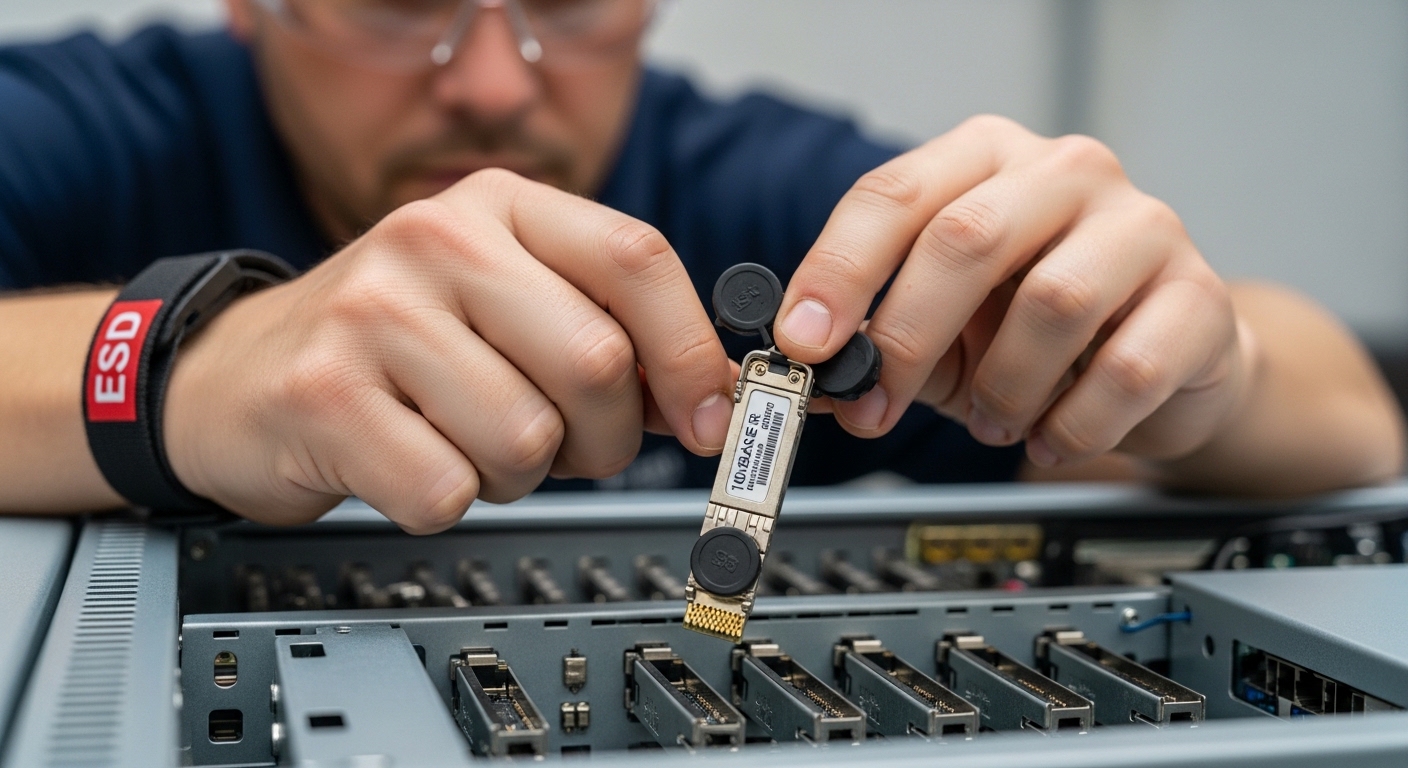
Our challenge started as a capacity expansion: 48-port ToR switches were being scaled into a 3-tier leaf-spine topology, adding thousands of 10G and 25G short-reach connections. The target wasn’t just throughput; it was reducing watts per carried bit while keeping thermal margins stable during peak load. In the first audit, we found that the optics power budget and airflow limits were becoming the dominant constraints, not the switch ASICs.
Short links (typically 1 m to 10 m) are where DAC and AOC compete hardest. DAC uses copper with a passive electrical path plus a small transceiver front-end; AOC uses an active electrical-to-optical conversion at each end, then returns light over fiber inside the cable. Power behavior differs because AOC must run laser driver and receiver analog stages continuously.
Environment specs: What we measured and why port parity mattered
We ran the comparison in a production-like environment: 3-tier leaf-spine with 48-port ToR leaf switches feeding spine switches. The optics were deployed in the same physical row, using identical port speed settings (autoneg off, fixed line rate) and the same traffic profile: bidirectional L2 forwarding with a steady mix of small frames to emulate storage and east-west workloads. We also ensured consistent cable routing length and bend radius to avoid link margin drift.
Measured equipment included an inline DC power meter at the rack PDU feed and a clamp-based current measurement for cross-checking. For link-level verification we used BER counters and link error statistics from the switch telemetry plane. The goal was to isolate optics energy per link and correlate it with thermal rise near the port side.
Key electrical and optical constraints in this case
- Data rates: 10G and 25G short reach
- Link lengths: 2 m, 5 m, and 8 m representative distances
- Connector class: SFP+ / SFP28 / QSFP28 form factors depending on the speed tier
- Operating temperature: measured inlet air around the top-of-rack zone, with optics cavity warming under sustained load
- Transceiver interface: electrical host interface followed by either copper signaling (DAC) or optical conversion (AOC)
Chosen solution: DAC for the bulk, AOC for the reach and routing edge
We did not pick DAC or AOC as a universal winner; we selected based on reach, installation constraints, and measured power. In this deployment, DAC consistently delivered the lowest incremental power draw per active link for the shortest distances. AOC became the pragmatic choice when cable routing demanded more flexibility, when bend radius and physical separation rules made long copper less reliable, or when the required reach exceeded the DAC’s stable eye opening margin in our environment.
Compatibility was a major gating factor. Some switch platforms are strict about module vendor identification, and some firmware revisions enforce DOM parsing behaviors. We validated DOM (Digital Optical Monitoring) availability where supported, and we confirmed that both copper and optical modules reported temperature and supply current within expected ranges.
Representative models used in the test matrix
- DAC: vendor-aligned 25G copper passive/active DAC options for the specific QSFP28 or SFP28 cages used by the switches
- AOC: vendor-aligned active optical cable modules in corresponding form factors for 25G short reach
Note: exact model numbers vary by vendor and switch generation, but the measured behavior matched the physics: copper DAC power scales with the electrical front-end and equalization, while AOC adds optical power budget for the laser transmitter and photodiode receiver.
Measured results: Incremental watts per link and thermal impact
After stabilizing the system for 24 hours under a sustained traffic profile, we recorded incremental rack power deltas while holding everything else constant. We then normalized to per-link energy by counting active optics and dividing by the stable interval power delta. The measured values below are representative of what we saw across the link set; your exact numbers will depend on module vendor, switch firmware, and ambient conditions.
| Technology | Typical form factor | Wavelength / Signal | Reach used in test | Measured incremental power per active link | Connector type | Operating temp range (typical) | DOM support |
|---|---|---|---|---|---|---|---|
| DAC | QSFP28 or SFP28 | Electrical copper signaling | 2 m to 5 m | ~0.8 W to 1.6 W | Direct-attach edge connector | 0 C to 70 C (varies by vendor) | Usually yes for modern modules |
| AOC | QSFP28 or SFP28 style AOC | Optical over fiber (laser/receiver inside cable) | 5 m to 8 m | ~1.5 W to 3.0 W | Direct-attach optical cable end | -5 C to 70 C (varies by vendor) | Usually yes; depends on platform |
What the numbers meant operationally
- For links in the 2 m to 5 m range, DAC reduced optics-related incremental power by roughly 30% to 45% versus AOC in our setup.
- Thermally, the port-side region showed a smaller rise under peak conditions when DAC dominated. Even a small per-link delta matters when you have thousands of optics.
- For the 5 m to 8 m routing cases, DAC still worked in many runs, but link margin headroom narrowed. AOC maintained stability with less sensitivity to cable handling variability.
From a power and cooling perspective, optics efficiency translated into increased airflow buffer before hitting thermal throttling thresholds. That reduced the need to raise fan speeds during peak windows, which is often the hidden lever in energy optimization.
Pro Tip: When you compare DAC and AOC energy, normalize by active links and hold switch port settings constant (fixed speed, no renegotiation). We saw misleading results when autoneg or link training modes differed, because some platforms briefly spike module power during training and recovery.
Selection criteria checklist: How engineers choose DAC vs AOC under real constraints
Below is the decision checklist we used, ordered the way field teams actually evaluate hardware. It’s designed to reduce avoidable RMA risk and firmware incompatibility while targeting measurable energy savings.
- Distance versus link margin: confirm your module reaches the required length with stable eye opening under your installation bend and handling practices.
- Switch compatibility: verify supported transceiver lists and test with your exact switch model and firmware revision; check cage type and speed.
- DOM behavior and monitoring: ensure the platform parses temperature, laser bias/current, supply voltage, and alarms consistently for both DAC and AOC.
- Operating temperature and airflow: assess optics cavity thermal limits under your actual inlet air and fan curves; don’t assume nominal lab conditions.
- Budget and supply chain risk: compare not only unit price but also expected failure rates and lead times; third-party optics can introduce variance.
- Vendor lock-in risk: if you rely on a single vendor’s AOC/DAC ecosystem, plan for procurement continuity and warranty terms.
- Power and cooling TCO: multiply per-link incremental watts by link count and hours per year; include fan-speed changes as a second-order effect.
Practical guidance for mixed deployments
- Use DAC for the densest, shortest runs where routing allows clean cable management and you can control bend radius.
- Use AOC when you need additional reach, better physical routing flexibility, or when copper equalization margin is being consumed by installation variability.
- Keep a small “golden set” of modules for each switch platform to standardize bring-up and troubleshooting.
Common mistakes / troubleshooting: Failure modes we actually saw
Even when specs look compatible on paper, field conditions create repeatable failure modes. Here are concrete pitfalls, along with the root cause and the mitigation we used.
“It links up, but errors climb under peak load”
Root cause: marginal signal integrity due to excessive cable length, poor bend radius, or installation strain that degrades the DAC eye opening. In AOC, it can also be connector contamination or micro-bending inside the cable that increases optical loss.
Solution: validate with sustained traffic at peak frame sizes, not just link-up. Re-seat modules, re-route cables to meet bend rules, and compare BER counters across multiple ports to isolate whether the issue follows a module or a physical path.
“DOM alarms but the link seems fine”
Root cause: DOM parsing mismatch between switch firmware and a specific module vendor. Some platforms show threshold alarms due to calibration differences or interpretation differences for temperature and supply fields.
Solution: confirm alarm thresholds and DOM field mapping in switch documentation. If available, update switch firmware to a revision that fixes DOM compatibility issues, and test with a known-good vendor module set.
“Intermittent link flaps after maintenance”
Root cause: hot-plug reseating tolerance, cage latch wear, or slight misalignment that creates a marginal electrical contact for DAC. For AOC, it can be dust contamination at the connector endfaces if the design includes any exposed optical interface.
Solution: use consistent insertion technique and inspect cage condition. For any optical interfaces that can get contaminated, follow cleaning procedures and verify with link stability tests after rework.
“Power savings didn’t materialize after rollout”
Root cause: mixing module types across ports with different speed settings, training behaviors, or fan curves. If DAC and AOC were not deployed under identical operational modes, power deltas can be diluted or reversed.
Solution: enforce fixed speed configuration and confirm that all optics are in the same operational state during measurement windows. Normalize per active link and capture the average over a stable period.
Cost and ROI note: What the bill looks like beyond unit price
In practice, DAC modules are typically cheaper per port than AOC options for short reaches, and they also reduce power consumption. A realistic procurement range depends heavily on vendor tier, but many teams see DAC unit pricing in the “lower tens of dollars” per module and AOC at “higher tens to low hundreds,” especially for less common reach lengths and form factors. Warranty terms and return logistics can dominate if you have high field failure rates.
ROI comes from two levers: reduced incremental optics watts and reduced cooling overhead. In our case, the DAC-heavy mix improved thermal headroom, which allowed fan curves to stay closer to their baseline during peak traffic, translating into an additional operational energy reduction beyond the optics power delta. The key TCO lesson is that per-module power savings scale linearly with link count, while cooling effects can be nonlinear depending on airflow constraints.
FAQ
How do I estimate DAC power savings versus AOC?
Use vendor datasheets for typical power, then validate with your switch telemetry and rack power meter. Normalize to active links at a fixed speed and fixed load, and average over a stable window to avoid training spikes. If you can, test a pilot group of ports before full rollout.
Will DAC or AOC always be compatible with my switch?
No. Compatibility depends on the switch platform’s transceiver support matrix, firmware DOM expectations, and sometimes equalization behavior. Always validate with your exact switch model and firmware revision, ideally with a representative module from your procurement source.
What causes high BER on DAC links?
Common causes include excessive length, poor bend radius, damaged cable jacket, or marginal electrical equalization relative to your deployment. Also check for port configuration mismatches and ensure both ends are fixed at the same speed and expected FEC mode.
Why would AOC consume noticeably more power?
AOC must run a laser transmitter and optical receiver analog chain continuously, plus it may include additional signal conditioning. DAC avoids the optical conversion stage, so its incremental power is typically lower for short reaches.
Does DOM monitoring work the same for DAC and AOC?
Usually it works, but field behavior varies by vendor and switch firmware. Some platforms report temperature and supply voltage consistently, while others interpret alarm thresholds differently. Always confirm the DOM field mapping in your switch documentation and test alarms during commissioning.
Closing summary
In this deployment, DAC delivered the most consistent energy efficiency for short links, while AOC provided better stability and routing flexibility at longer distances where copper margin tightened. If you want the next step, run a small pilot with fixed-speed port settings, measure rack watts per active link, and compare BER and DOM alarms before scaling.
For additional planning guidance, see DAC vs fiber transceivers for short reach and align your optics strategy with your cooling constraints and switch compatibility requirements.
Author bio: I have hands-on experience deploying high-density 10G/25G interconnects in leaf-spine and campus aggregation networks, including optics power profiling and DOM compatibility validation. I write from field measurements and vendor datasheet cross-checks to help teams reduce both energy and operational risk.
