
In a 5G backhaul and data center interconnect, LAG fiber optic links built with LACP can look “healthy” while silently degrading performance or triggering flap storms. This reference helps field engineers and network planners select compatible fiber transceivers, validate optical and electrical constraints, and troubleshoot the most common failure modes. It focuses on practical steps for leaf-spine, edge aggregation, and radio access transport where timing, optics, and switch behavior all interact.
How LAG fiber optic behaves with LACP and why optics matter
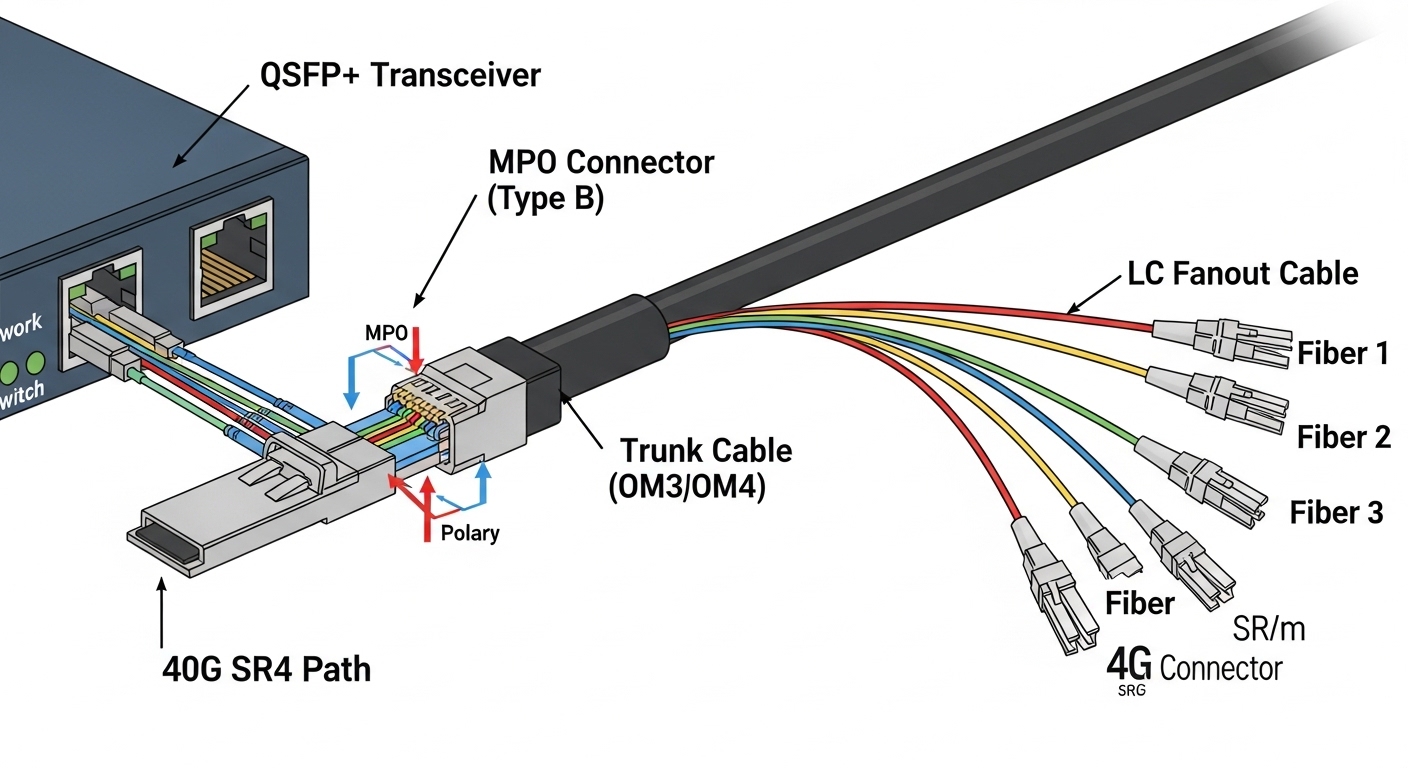
LAG fiber optic (typically Ethernet Link Aggregation Group) with LACP distributes frames across member links using a hashing algorithm (often based on MAC, VLAN, and sometimes IP/port). The key operational point is that all member links must be “equivalent” from the perspective of the switch: same speed, same duplex, compatible FEC mode, compatible link coding, and stable optical receive levels. If you mix transceiver families or misalign FEC expectations, you can create asymmetric error rates that cause retransmissions, microbursts, and measurable jitter on latency-sensitive paths.
From a field perspective, I treat LAG member ports as a single logical interface that must remain consistent under maintenance events. For example, during a planned transceiver swap in an edge aggregation room, we replace optics in pairs and verify DOM telemetry, link counters, and FEC/PCS status before returning the bundle to production. This reduces the risk of one member link entering a degraded state while LACP still reports it as active.
Transceiver compatibility requirements for LAG member links
Before you build or expand a LAG fiber optic bundle, check that each member port uses the same optics class and that the switch supports the transceiver’s electrical and optical features. For common 10G/25G/100G families, differences in FEC mode (or “Auto” behavior), vendor-specific implementation quirks, and DOM parsing can break the expected symmetry across members.
Minimum checks that prevent most LAG optics incidents
- Same nominal data rate across all members (for example, 10G-SR vs 10G-LR is not “close enough”).
- Same connector and fiber type (LC duplex with OM3/OM4 vs OS2 single-mode), including patch panel loss and bend radius.
- Same FEC capability and configuration (especially on 25G/50G/100G optics). If your platform exposes FEC selection, lock it.
- Consistent DOM support: confirm the switch can read temperature, bias current, and received power; ensure alarms are mapped correctly.
- Power budget parity: compare received power at the far end; target similar Rx levels across members.
Key specifications comparison (typical short-reach optics)
The table below shows representative constraints you should validate against your switch and cabling plan. Always use the exact vendor datasheets for final acceptance criteria.
| Optics / Interface | Wavelength | Typical Reach | Connector | Data rate | DOM | Operating temp |
|---|---|---|---|---|---|---|
| 10G SR (SFP+) | 850 nm | 300 m (OM3), 400 m (OM4) | LC duplex | 10.3125 Gbps | Yes (SFF-8472) | 0 to 70 C typical |
| 25G SR (SFP28) | 850 nm | 100 m (OM3), 150 m (OM4) | LC duplex | 25.78125 Gbps | Yes (SFF-8431) | -5 to 70 C typical |
| 100G SR4 (QSFP28) | 850 nm | 100 m (OM3), 150 m (OM4) | LC | 4x25G lanes | Yes (QSFP28) | 0 to 70 C typical |
| 100G LR4 (QSFP28) | 1310 nm | 10 km class (distance varies) | LC duplex | 4x25G lanes | Yes (QSFP28) | -5 to 70 C typical |
For concrete examples, engineers often deploy Cisco SFP-10G-SR, Finisar/FS optics such as FTLX8571D3BCL (model naming varies by vendor catalog), or FS.com compatible modules like FS SFP-10GSR-85. Treat them as “candidates,” not guarantees: you must validate behavior on your specific switch OS build and optics compatibility matrix.
[[IMAGE:Photorealistic close-up of an open 19-inch telecom switch chassis in a data center rack, showing two adjacent fiber transceiver ports with LC duplex connectors labeled A and B, a technician hand holding a handheld optical power meter, cool blue LED lighting, shallow depth of field, high detail, realistic reflections]
Field-ready build steps for LAG fiber optic with LACP
Use a repeatable checklist when bringing up LAG fiber optic groups. In practice, I prefer to configure LACP first at the switch, then validate optics and counters on each member link before enabling traffic hashing at scale.
Ordered deployment checklist
- Confirm switch capability: verify LACP mode (active/passive) and whether the platform supports “LAG with mixed optics” policies or strict equivalence requirements.
- Lock optics class: same transceiver part number family across members; if you must mix, ensure identical wavelength, reach class, and DOM behavior.
- Validate optical budget: measure end-to-end loss and confirm Rx power targets at the receiver. Typical acceptance windows are vendor-specific; keep margin for aging and temperature swings.
- Check FEC alignment: if the switch supports explicit FEC selection, set it consistently on all member ports.
- Bring up one member at a time: confirm link up/down stability, then check interface counters (CRC, FCS, symbol errors) while generating controlled traffic.
- Enable LACP bundle: add remaining members only after the first link shows stable error rates for several minutes.
- Verify hashing behavior: test traffic flows that should distribute (for example, multiple TCP sessions) and ensure no single member saturates unexpectedly.
Pro Tip: In many switches, LACP may keep a member in the bundle even when it is experiencing elevated FEC/PCS error recovery. The bundle looks “up,” but latency and throughput fluctuate. Always correlate LACP state with per-port optical DOM alarms and error counters during acceptance testing.
[[IMAGE:Clean vector illustration showing a LAG fiber optic bundle with three parallel member links, each labeled with DOM telemetry blocks (temperature, bias current, Rx power), arrows into an LACP hash engine, minimal color palette, technical iconography, white background, crisp lines, infographic style]
Decision checklist: choosing the right LAG fiber optic optics
When selecting transceivers for LAG fiber optic, engineers weigh more than reach. The goal is predictable equivalence and operational safety under maintenance and environmental variation.
Ordered selection criteria
- Distance and fiber grade: OM3/OM4/OS2 match, plus patch panel loss and connector insertion loss.
- Optics reach class and power margin: keep a buffer for aging, dust, and temperature drift; do not size to the minimum.
- Switch compatibility: confirm the transceiver is supported on your exact switch model and OS version; check vendor compatibility tables where available.
- DOM and alarm behavior: ensure the switch parses DOM correctly and that threshold alarms are consistent across members.
- Operating temperature and airflow: edge rooms and cabinets can exceed expectations during heat waves; verify transceiver temperature telemetry under load.
- Vendor lock-in risk: third-party optics can be cost-effective, but validate during a staged rollout to avoid surprise incompatibilities.
- Operational spares strategy: keep the same part number for all members when possible so you can hot-swap without re-validation cycles.
Reference guidance: consult IEEE Ethernet standards and transceiver interface specs, and use vendor datasheets for electrical/optical limits. Useful starting points include IEEE 802.3 for PHY behavior and transceiver interface requirements, plus transceiver spec families for DOM and electrical characteristics. [Source: IEEE 802.3] [Source: SFF-8472 / SFF-8431 documentation from SFF committees as referenced in vendor datasheets] [Source: vendor transceiver datasheets for DOM and FEC notes]
Common mistakes and troubleshooting tips for LAG fiber optic
Below are real failure modes I have seen in operational networks. Each includes root cause and a practical fix.
Mixed transceiver families causing silent error-rate imbalance
Symptoms: LACP bundle stays up, but throughput drops and packet loss appears on one member. CRC/FCS counters climb intermittently.
Root cause: different FEC behavior or optical power thresholds between transceiver types; DOM thresholds may differ.
Solution: standardize transceiver part numbers across all LAG members; align FEC configuration; compare per-port error counters and DOM Rx power at steady state.
Patch panel loss or dirty connectors leading to marginal Rx power
Symptoms: link flaps during temperature changes or after maintenance; higher BER during peak hours.
Root cause: connector contamination, damaged ferrules, or underestimated patch loss creating insufficient optical margin.
Solution: clean with approved fiber cleaning tools and re-measure with an optical power meter; replace suspect jumpers; verify bend radius and cable management.
Inconsistent speed or auto-negotiation edge cases during upgrades
Symptoms: one member comes up at a different speed, or LACP does not form as expected; logs show negotiation or capability mismatch.
Root cause: switch port configuration differs (speed, FEC, or admin settings) or optics are not truly equivalent for the targeted mode.
Solution: enforce consistent port configuration on all members; lock speed and FEC where supported; stage upgrades and validate each member before adding it to the bundle.
Hash distribution assumptions fail for single-flow traffic
Symptoms: only one member saturates under a few long-lived flows; operators think LAG is “broken.”
Root cause: LACP hashing may not include fields that vary for the traffic pattern (for example, single source/destination pairs).
Solution: verify hashing algorithm and test with multiple flows; if needed, adjust application traffic patterns or (where supported) hashing settings.
Cost and ROI note for LAG fiber optic transceivers
In many deployments, transceivers dominate optics spend for scale. OEM optics commonly cost roughly 1.5x to 3x third-party compatible units, but they can reduce integration risk and shorten troubleshooting time when compatibility is tightly controlled. Total cost of ownership depends on failure rates, warranty terms, and how quickly you can validate optics after replacements. A practical ROI approach is to standardize on one qualified part number per link type, maintain spares, and budget labor for validation using DOM and optical measurements rather than assuming “plug and play.”
[[IMAGE:Concept art scene of a maintenance engineer in a dim network operations center, overlay graphics showing red and green per-link health indicators for a LAG fiber optic group, animated-style glow effects, cinematic lighting, dark background, high-tech HUD aesthetic]
FAQ
What does LAG fiber optic require for member link equivalence?
Member ports must match in speed, duplex, and (critically) optical/FEC behavior. In practice, use identical transceiver part numbers and validate DOM and error counters across all members before enabling full traffic.
Can I mix OEM and third-party fiber transceivers in the same LAG fiber optic bundle?
It can work, but it is not guaranteed. Differences in DOM thresholds, FEC behavior, and switch compatibility can create asymmetric errors; standardize whenever possible and validate in a staged test.
How do I confirm the transceivers are truly compatible with LACP?
Bring up each member link individually, confirm stable link state, then check per-port error counters while generating traffic. After that, enable the LACP bundle and monitor LACP membership and optics telemetry for at least several minutes.
What DOM metrics matter most for LAG fiber optic health?
Focus on received power (Rx), laser bias current, and temperature, plus any vendor-exposed alarm states. Pair DOM telemetry checks with interface error counters such as CRC/FCS or symbol errors.
Why does my LAG fiber optic bundle show up but performance is worse than expected?
Common causes include marginal Rx power on one member, FEC mismatch, or traffic hashing that does not spread flows. Validate optics margin, align FEC settings, and test with multiple concurrent sessions.
Where should I start if the bundle flaps after a transceiver swap?
Start with connector cleaning and optical power re-measurement, then verify port configuration consistency (speed/FEC). Finally, compare DOM values and error counters between the swapped port and the remaining members.
For next steps, use a repeatable acceptance workflow and keep optics standardized so maintenance does not change behavior unexpectedly; see 5G backhaul optics acceptance workflow for a field-oriented procedure.
Author bio: Telecom field engineer specializing in 5G fronthaul and backhaul transport, optical DWDM and Ethernet LAG design, with hands-on troubleshooting across edge aggregation cabinets. I document operational checks using vendor datasheets, DOM telemetry, and per-port counter validation to reduce outage risk.
