
High-density deployments fail in predictable ways: the wrong optics for the fiber plant, power budgets that silently break cooling plans, and transceiver compatibility quirks that surface only after cutover. This article helps data center and network engineering leaders design, standardize, and govern optical modules for leaf-spine and spine-core fabrics. You will get practical selection criteria, a cost and ROI lens, and troubleshooting patterns from real-world installs. Update date: 2026-05-03.
Direct attach copper vs optical modules: performance and power tradeoffs
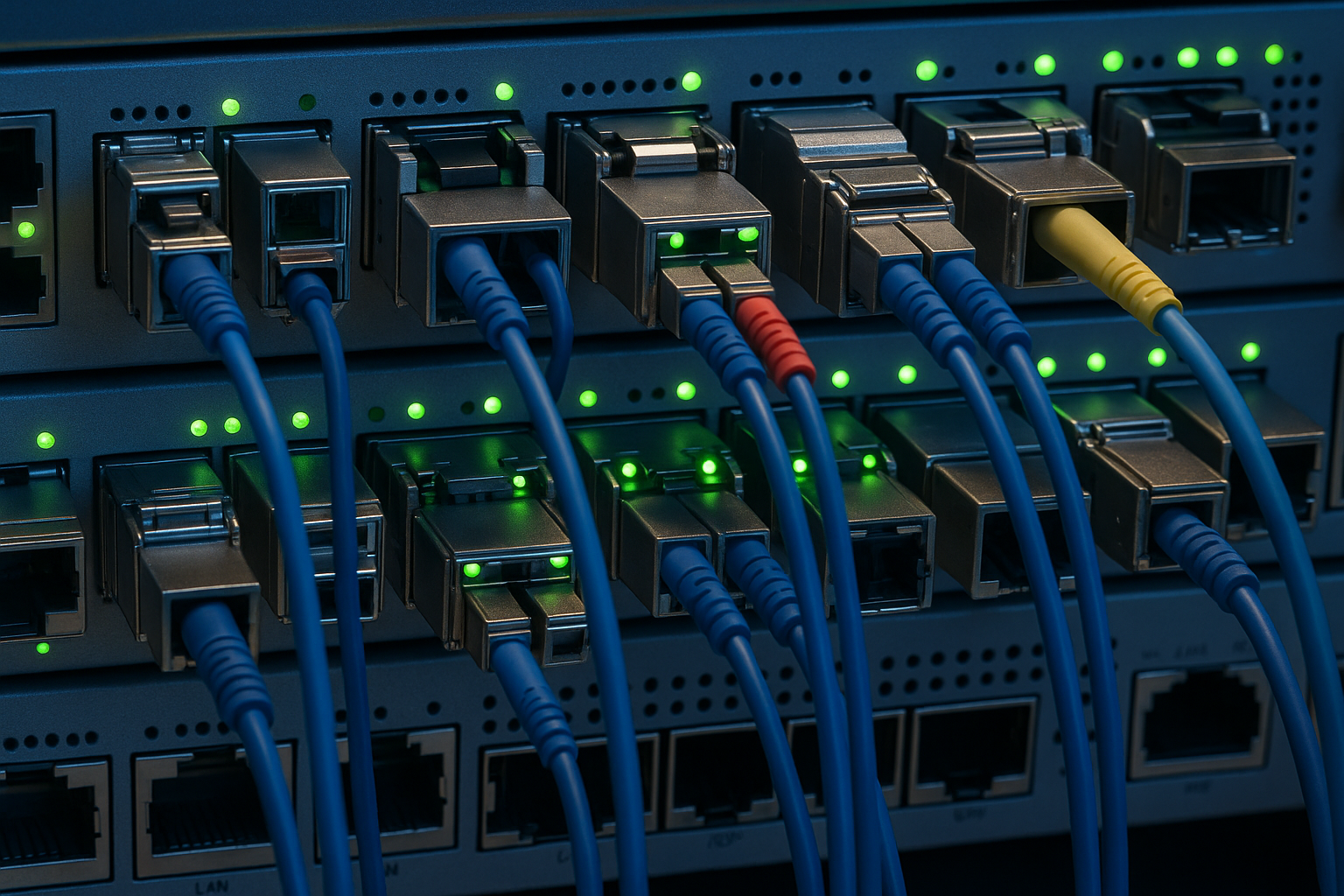
When you scale port density, you must decide whether to run short-reach links as copper or fiber using optical modules. Direct attach copper (DAC) is often cheaper per port and simpler to deploy in the first kilometer, but it becomes less attractive as reach, lane count, and thermal constraints rise. For leaf-spine designs, optical modules typically dominate when you need predictable reach across structured cabling, patch panels, and longer cross-connect runs. IEEE 802.3 link budgets and vendor datasheets define the operating limits, but your actual plant loss and connector quality decide whether links come up reliably. IEEE 802.3
In practice, optical modules also shift your risk profile. DAC failures are often connector or cable-related, while optical modules introduce optical power and receiver sensitivity constraints. A field engineer usually checks DOM telemetry (Digital Optical Monitoring) to confirm Tx power and Rx power are inside spec before declaring a fiber issue. If you standardize on a single optical module family across a fabric, you reduce integration variance and speed incident response.
Pro Tip: In dense racks, treat DOM telemetry as part of your change management. Before and after any firmware or optics swaps, export Tx bias current and received power thresholds; if you see a slow drift toward the vendor’s minimum Rx power, you can schedule cleaning and patch changes before you hit a hard outage.
High-density optics selection: comparing common wavelengths, reach, and interfaces
High-density deployments usually converge on 25G, 40G, 100G, and 200G optics depending on switching silicon and cabling standards. Your selection must match the wavelength, fiber type, and physical connector style to the existing plant. For multimode fiber (MMF), common choices include 850 nm VCSEL-based short reach optics; for single-mode fiber (SMF), 1310 nm or 1550 nm optics support longer spans. IEEE 802.3 and IEC/ANSI cabling practices inform the base link behavior, while vendor module datasheets specify real operating temperature range and power consumption. IEEE 802.3 working group resources
The table below compares typical families you will see in modern data centers. Exact values vary by vendor and part number, so always validate with the switch vendor compatibility list and the specific module datasheet.
| Optical module type | Data rate / interface | Wavelength | Typical reach | Fiber type | Connector | Power (typ.) | Operating temp (typ.) |
|---|---|---|---|---|---|---|---|
| QSFP28 SR | 100G (4x25G) | 850 nm | 70-100 m (MMF) | OM3/OM4 | LC | ~3-5 W | 0 to 70 C |
| QSFP28 LR | 100G (4x25G) | 1310 nm | 10-20 km (SMF) | OS2 | LC | ~4-7 W | -5 to 70 C |
| OSFP DR1/DR4 (400G SR) | 400G (16x25G) | ~850 nm class | 100-150 m (MMF) | OM4/OM5 | LC (or MPO) | ~10-18 W | 0 to 70 C |
| SFP+ SR (legacy) | 10G | 850 nm | 300-400 m (MMF class) | OM3/OM4 (varies) | LC | ~1-2 W | 0 to 70 C |
| SFP-10G-SR family example | 10G | 850 nm | 300 m (OM3) | OM3/OM4 | LC | ~1-2 W | 0 to 70 C |
For concrete product examples, you may encounter Cisco-branded and compatible third-party optics such as Cisco SFP-10G-SR and Finisar families like FTLX8571D3BCL depending on switch generation. For 10G SR-class modules, third-party part numbers are common in procurement, but you must confirm DOM behavior and firmware acceptance on your specific switch OS. Cisco product documentation
Deployment strategies: rack-level density, thermal envelopes, and cable plant governance
High-density optical modules are as much an electrical and mechanical governance problem as a fiber optics problem. Start with the switch thermal envelope and airflow model: a 400G transceiver family can draw significantly more power than older 10G optics, which changes how you plan front-to-back cooling and fan profiles. In a typical 48-port 100G leaf switch build, engineers often discover that raising link count increases not only power but also the steady-state temperature inside the module cage. That can push marginal optics toward lower performance margins under sustained load.
Then govern the cable plant. For MMF SR optics, your effective reach is dominated by total link loss: fiber attenuation, patch cord loss, connector insertion loss, and any additional splice or end-face damage. If you are using OM4, measure end-to-end with an OTDR or certified link tester and store results in your DCIM or infrastructure repository. For SMF LR optics, you must validate OS2 handling, connector cleanliness, and any bend radius compliance during installation. ANSI/TIA cabling guidance and field testing practices matter more than theoretical reach. ANSI/TIA resources
Operational pattern that scales
In a large fabric roll-out, I have standardized on a single optic SKU per link class: one SR MMF SKU for leaf-to-spine within the structured cabling limit, and one LR or DR SKU for any longer hops. During staging, we run a burn-in and optics inventory capture: DOM reads, link up/down counters, and optic temperature telemetry at steady state. We also enforce a connector cleaning SOP with a microscope check at first install and during failures. This reduces “it works on my bench” incidents and makes post-mortem analysis repeatable.
Compatibility and governance: avoiding transceiver rejection and firmware drift
Optical modules can be electrically compatible but still be rejected by a switch due to vendor-specific authentication, EEPROM configuration, or optics capability flags. Many enterprise platforms support DOM and standards-based identification, but the acceptance logic can vary by switch model and OS version. Governance is therefore mandatory: maintain an approved optics matrix per switch family, OS release, and optic type. Treat optics like software dependencies: freeze versions for major change windows and test in a controlled staging environment before broad deployment.
In daily operations, you can reduce incidents by enforcing two practices. First, log transceiver inventory and DOM readings to a centralized telemetry system so you can detect drift after upgrades. Second, define an incident triage playbook that starts with verifying DOM values against expected ranges before blaming fiber. This is especially critical in high-density racks where removing and reseating a module can temporarily disturb adjacent optics and connectors.
- Distance and reach budget: confirm total link loss with certified measurements, not only vendor reach specs.
- Switch compatibility: validate against the vendor compatibility list for your exact switch model and OS version.
- Fiber type and connector standard: match MMF vs SMF, OM3/OM4/OM5, LC vs MPO, and polarity conventions.
- DOM support and telemetry: ensure DOM reads (Tx power, Rx power, temperature, bias current) are supported and correctly interpreted.
- Operating temperature and airflow: check the module operating range and confirm your rack thermal design meets steady-state conditions.
- Vendor lock-in risk: decide whether you will standardize on OEM optics or allow third-party with contractual compatibility guarantees.
Common mistakes and troubleshooting patterns in dense optics deployments
Even disciplined teams hit predictable failure modes when optical modules are deployed at scale. Below are field-proven pitfalls with root causes and fixes, written for engineers who must restore service quickly and prevent recurrence.
Pitfall 1: Links flap after cutover due to polarity or MPO mapping errors
Root cause: MPO polarity mismatch on pre-terminated trunks or incorrect patch cord mapping leads to intermittent Rx/Tx alignment. In some cases, the link comes up at low power then drops under load. Solution: verify polarity method end-to-end (MPO key orientation, polarity adapter usage), then retest with a certification workflow and confirm DOM Rx power is within the vendor’s operating window.
Pitfall 2: “Works in one rack, fails in another” due to plant loss variance
Root cause: reach assumptions based on spreadsheet margins ignore connector quality, additional patch panels, or mixed fiber grades. OM4 and OM3 can be confused in inventory, and a single high-loss connector can collapse the optical budget. Solution: re-certify the exact link paths using a link tester, and inspect connectors with a microscope; clean and replace any ferrule with visible contamination.
Pitfall 3: Silent performance degradation after firmware upgrades
Root cause: optics capability parsing or threshold calibration changes in the switch OS can alter how DOM alarms are triggered or how the PHY negotiates parameters. Solution: stage upgrades, compare DOM baseline metrics pre/post, and update your runbooks to reflect new alarm thresholds; if needed, reselect optics SKUs that are explicitly validated for the new OS release.
Pitfall 4: Thermal stress from insufficient airflow behind high-port-density modules
Root cause: fan curves or blocked airflow paths increase cage temperature, reducing optical output margin and raising error rates. Solution: measure cage temperature and module temperature telemetry under load; fix airflow obstructions and align fan profiles to the vendor thermal guidance for your chassis model.
Cost and ROI: budgeting optical modules without underestimating TCO
Budgeting optical modules is not just a unit price exercise. OEM optics can cost more up front than third-party equivalents, but they can reduce integration risk, RMA cycles, and downtime during staged rollouts. In many enterprise deployments, the total cost of ownership improves when you include operational overhead: time spent validating optics, incident response, and the cost of failed cutovers. A realistic planning assumption is that third-party optics may be 10 to 30 percent cheaper per module, but you should reserve budget for compatibility testing and spares strategy.
From a power and cooling perspective, higher-density optics can increase rack power draw. Even a few additional watts per module across dozens of ports can affect PUE-sensitive designs. For ROI, quantify the avoided outages: if standardized optics reduce mean time to repair and avoid even one major incident, the savings often outweigh price differences. Finally, consider failure rates and warranty terms; vendor datasheets and RMA policies vary widely. For purchase planning, require DOM support documentation and a compatibility statement for your switch model. FCC equipment compliance resources
Head-to-head decision matrix: which deployment option fits your environment
Use this matrix to decide between optic classes and deployment patterns. It is designed to align with enterprise architecture governance: predictable compatibility, measurable reach, and manageable thermal impact.
| Decision factor | MMF SR optical modules | SMF LR/ER optical modules | Third-party compatible optics | OEM optics |
|---|---|---|---|---|
| Typical best use | Leaf-spine within structured cabling | Longer spans, campus/core interconnect | Cost-optimized standardized builds | Risk-managed enterprise fabrics |
| Reach predictability | High if plant is certified to OM targets | High across longer distances with clean SMF | Medium; depends on switch acceptance | High; validated with vendor OS |
| Compatibility risk | Medium if connector polarity policies differ | Low if OS supports the optic family | Higher without strict validation | Lower due to formal qualification |
| Power/thermal impact | Moderate; varies by generation | Moderate to higher; depends on optics design | Varies; confirm thermal specs | Varies; confirm thermal specs |
| Procurement and spares | Manage SKU sprawl by standardizing SKUs | Plan for higher-cost spares | Need SKU governance and testing | Simpler spares and RMA flows |
| ROI profile | Strong when plant is already OM-ready | Strong when SMF is available and distance demands it | Strong if compatibility testing is rigorous | Strong when uptime risk dominates |
Real-world deployment scenario: leaf-spine with staged optics rollout
In a 3-tier data center leaf-spine topology with 48-port 100G top-of-rack switches, we deployed 100G QSFP28 SR optics for leaf-to-spine links limited to 85 m after accounting for patch cords and two consolidation points. The structured cabling used OM4 with certified end-to-end testing recorded per link; during acceptance, we required each link to meet an Rx power margin threshold and DOM telemetry stability after 24 hours. We staged the rollout by replacing optics in one pod at a time, collecting DOM snapshots and link error counters before and after. This approach exposed a single polarity misconfiguration in one patch field that caused intermittent flaps; after correction, the remaining pods stabilized with no further link churn. The measurable win was reduced troubleshooting time because DOM readings pointed to optical power drift rather than random negotiation failures.
Which Option Should You Choose?
If you run mostly within structured cabling distances and your fiber plant is OM4 or OM5, choose MMF SR optical modules to maximize cost efficiency and simplify reach planning. If your topology requires longer spans or you must traverse campus routes, choose SMF LR/ER optical modules and invest in disciplined SMF handling and certification. For optics sourcing, choose OEM optics when uptime risk is highest or when you cannot enforce a strict compatibility test gate; choose third-party compatible optics only if you have an approved optics matrix, DOM validation workflow, and a testing process tied to each switch OS release.
FAQ
What are optical modules in a data center, and why do they matter for density?
Optical modules are transceivers that convert electrical signals to optical signals for fiber links. In high-density designs, they determine reach, link stability, power draw, and thermal behavior inside switch cages, so they directly impact both uptime and cooling efficiency.
How do I calculate whether an optical module will work over my fiber plant?
Use a link budget approach based on certified measurements: fiber attenuation, connector insertion loss, patch cord loss, and any splice losses. Then validate expected Tx/Rx margins using DOM telemetry once the link is live, because theoretical reach can fail due to plant variance.
Can I mix OEM and third-party optical modules in the same switch?
Yes, but only if the switch OS accepts each module type and the vendor compatibility matrix supports it. Mixing is usually safe when the optics are from approved SKUs and DOM telemetry behaves consistently, but it increases governance complexity during upgrades.
What is DOM support, and how should operations use it?
DOM is Digital Optical Monitoring, which reports optical and thermal telemetry from the module. Operations should baseline Tx power, Rx power, temperature, and bias current during stable periods, then alert on drift rather than waiting for link failures.
Why do I sometimes see link flaps even when the link comes up?
Common causes include polarity errors, marginal optical power due to connector contamination, or temperature-induced performance changes. Start with DOM comparisons and connector inspection before reseating multiple adjacent modules.
Are higher-speed optical modules always better for ROI?
Not automatically. Higher-speed optics can reduce the number of ports needed, but they may increase power draw and require different cabling and switch licensing. ROI is best when you match optics speed to traffic demand and keep a standardized optics governance model.
Author: I have led field deployments of high-density transceiver and fiber plants across enterprise fabrics, focusing on compatibility testing, DOM telemetry baselining, and operational runbooks. My work emphasizes measurable uptime outcomes, not vendor claims, and aligns optics procurement to architecture governance and TCO controls.
Next step: review your standards for optics selection and lifecycle governance using related topic: transceiver governance and optics compatibility.
