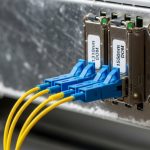
In factory applications, a single optical link outage can stop an entire production line. This article helps plant network engineers and integrators compare common transceiver types and industrial optics choices under real constraints: temperature swings, EMI, vibration, and maintenance windows. You will get a practical head-to-head comparison, a selection checklist, and troubleshooting tips grounded in IEEE Ethernet optics practice and vendor datasheets.
Factory applications reality check: performance under heat, vibration, and dust

Industrial environments stress transceivers beyond office conditions. Typical failure contributors include connector oxidation, dust contamination on fiber endfaces, and optical power degradation from thermal cycling. For field reliability, engineers should verify operating temperature, DOM (Digital Optical Monitoring) support, and the module’s compliance with the relevant Ethernet physical layer. IEEE 802.3 defines the electrical/optical behaviors for Ethernet PHYs, but vendors specify practical limits in their datasheets. For reference on Ethernet physical layer intent, see IEEE 802.3 overview.
Industrial temperature and link budget basics
In a typical plant, cabinet air can swing from -20 C to +60 C (or higher near heaters). Industrial optics often target extended ranges (for example, -40 C to +85 C) to reduce derating risk. Link budget is then constrained by fiber attenuation, connector loss, and transceiver launch/receive power. In practice, short multimode runs can still fail due to dirty connectors or mismatched optics types, not just power.
Pro Tip: Before swapping hardware, clean and inspect fiber endfaces under magnification. In factory applications, the most frequent “bad transceiver” returns are actually connector contamination causing elevated error rates and apparent link instability.
SFP/SFP+ vs SFP28 vs QSFP: performance comparison for industrial Ethernet
This section compares optics families by how they behave in factory applications at the hardware level: data rate, reach, connector ecosystem, and monitoring. The key tradeoff is not only speed, but also whether the switch port and optics vendor support your operating envelope and DOM expectations. Many “it should work” failures come from mismatched port signaling, transceiver EEPROM behavior, or DOM interpretation by the switch.
Head-to-head comparison table (common choices)
Use the table as a starting point for selecting industrial optics across typical Ethernet speeds. Exact values vary by vendor and part number, so always confirm against the datasheet for your module.
| Module type | Typical data rate | Wavelength | Typical reach (MM/SM) | Connector | DOM | Operating temperature (example industrial) |
|---|---|---|---|---|---|---|
| SFP (10G) | 10G | 850 nm (MM) or 1310/1550 nm (SM) | MM up to ~300 m (50/125 OM3) or ~400 m (OM4); SM varies by SKU | LC | Often supported | Common industrial: -40 C to +85 C |
| SFP+ (10G) | 10G | 850 nm (MM) or 1310 nm (SM) | MM up to ~300 m (OM3) or ~400 m (OM4) | LC | Often supported | Common industrial: -40 C to +85 C |
| SFP28 (25G) | 25G | 850 nm (MM) or 1310 nm (SM) | MM commonly ~100 m class (varies by fiber grade); SM varies by SKU | LC | Often supported | Common industrial: -20 C to +70 C or extended options |
| QSFP+ / QSFP28 | 40G/100G (varies) | 850 nm or 1310/1550 nm (varies) | Varies widely with optics and fiber type | LC (MM/SM breakouts) | Usually supported | Varies by vendor; confirm industrial grade |
Concrete example part numbers engineers commonly test
In pilot deployments, engineers often trial known-compatible optics. For instance, Cisco-branded 10G SR optics such as Cisco SFP-10G-SR are widely used in data center-like wiring, while third-party industrial optics may target similar wavelengths and reach with extended temperature and DOM behavior. As examples of widely referenced 10G SR optics, Finisar parts such as FTLX8571D3BCL and FS.com industrial-style optics like SFP-10GSR-85 are frequently evaluated for compatibility and thermal headroom. Always verify that the switch model accepts the transceiver’s EEPROM ID and that DOM readings match what your monitoring stack expects; vendor acceptance can differ even when the wavelength and reach are identical.
Compatibility showdown: switch port behavior, DOM, and vendor lock-in risk
For factory applications, compatibility is often more critical than theoretical reach. Many industrial plants mix legacy switches with newer aggregation layers, and that increases the chance of transceiver acceptance issues. Engineers should check whether the switch firmware enforces strict vendor IDs, whether it supports DOM for non-OEM modules, and whether the optics are rated for your temperature range. Even when both sides are “10G SR,” a switch may reject a module if it does not match expected EEPROM fields.
How to validate compatibility safely
- Confirm the switch model and port speed mode (for example, 10G vs auto-negotiation behavior on downlinks).
- Verify DOM support and confirm what your NMS reads (some systems expect thresholds or specific DOM registers).
- Run a controlled acceptance test: insert the module, verify link up, then measure optical RX power and error counters for at least 30 minutes under normal traffic.
- Check thermal cycling behavior by monitoring link stability during HVAC changes or planned heater-on intervals.
OEM vs third-party tradeoffs
OEM optics can reduce acceptance and support friction, but they are often priced at a premium. Third-party optics can be cost-effective, especially for spares, yet they may introduce higher variance in DOM behavior and acceptance across firmware versions. In industrial uptime terms, the “cheapest module” can be the most expensive if it causes prolonged troubleshooting or RMA delays.
Cost and ROI: choosing optics that minimize downtime, not just purchase price
In factory applications, total cost of ownership (TCO) is dominated by downtime risk, labor hours, and spare management. As a rough market reality, OEM 10G SR optics are frequently several times the price of comparable third-party modules, while industrial-rated third-party modules often sit between. The ROI improves when extended temperature and better monitoring reduce failure rates and speed up diagnostics. Also consider power and cooling indirectly: a stable link avoids repeated reconvergence, error bursts, and unnecessary retransmissions.
TCO model engineers can actually use
- Spare strategy: keep a small pool of tested spares per switch model and optics family.
- Labor cost: estimate technician time for swap, fiber inspection, and post-change validation.
- Failure rate and mean time to repair: industrial optics with extended temperature can reduce early-life and thermal-cycle failures.
- Monitoring value: DOM helps predict degradation before a hard outage.
Selection checklist for factory applications (ordered decision guide)
Use this ordered checklist to reduce trial-and-error during procurement and commissioning.
- Distance and fiber type: confirm MM vs SM, fiber grade (OM3/OM4), and expected attenuation including connectors.
- Data rate and switch port support: match SFP vs SFP+ vs SFP28 (and expected speed modes).
- Operating temperature: verify industrial rating for your cabinet and ambient conditions.
- Connector and polarity: LC vs other connector types, and correct Tx/Rx polarity to avoid silent link failures.
- DOM support: ensure your platform reads and logs DOM data you can alert on.
- Compatibility and lock-in risk: test acceptance on your exact switch firmware; document part numbers that pass.
- Regulatory and safety constraints: validate any required compliance for your region and facility standards.
Common mistakes and troubleshooting tips in factory applications
Below are frequent failure modes seen during commissioning and maintenance, with root causes and fixes.
Link flaps only in hot or after HVAC changes
Root cause: thermal stress causing marginal optical power or connector contact resistance. Solution: verify module temperature rating, reseat the transceiver, clean connectors, and measure RX power at the switch while the cabinet temperature changes.
“Link up” but high CRC or FCS errors
Root cause: dirty fiber endfaces, slight fiber geometry mismatch, or wrong optics pairing for the fiber type. Solution: inspect and clean endfaces, confirm fiber grade (OM3 vs OM4) and that both ends use the correct wavelength class; then check interface error counters and optical levels.
Non-OEM module rejected after a firmware update
Root cause: stricter transceiver EEPROM validation or altered DOM expectations in new switch firmware. Solution: re-validate compatibility after updates, maintain a tested optics matrix per firmware version, and prefer modules with documented EEPROM behavior matching your switch family.
Silent distance mismatch
Root cause: exceed reach due to higher-than-assumed attenuation from poor patch panel polishing, dirty connectors, or extra mated pairs. Solution: measure link budget using conservative margins, and verify actual optical power levels rather than relying on nominal reach.
Decision matrix: which optics option fits your factory constraints
Use this matrix to quickly map requirements to module choices. It assumes typical Ethernet transceivers for factory applications, not specialized solutions.
| Reader type / constraint | Best-fit choice | Why | Main caveat |
|---|---|---|---|
| Legacy 10G access, short MM runs | SFP+ 10G SR (850 nm) | Cost-effective for typical OM3/OM4 cabinet-to-cabinet runs | Reach depends heavily on connector quality and fiber grade |
| Upgrade to 25G aggregation without rewiring to SM | SFP28 25G MM or SM (per distance) | Higher throughput while reusing existing fiber where feasible | MM reach may be shorter than 10G SR assumptions |
| High-temperature cabinets and harsh dust | Industrial-rated optics with extended temperature and DOM | Reduces thermal-cycle risk and speeds diagnostics | Must still validate switch acceptance for the exact part |
| Strict maintenance windows and limited downtime tolerance | OEM or pre-qualified third-party modules with spares | Lower acceptance variance and faster changeout | Higher unit cost |
| Budget-sensitive scaling across many sites | Third-party industrial modules, but pre-qualified per firmware | Lower procurement cost with controlled risk | Requires a documented compatibility test matrix |
Which option should you choose?
If your factory applications primarily run 10G over short multimode links, start with SFP+ 10G SR that is rated for your ambient temperature and supported by DOM in your switch. If you are pushing higher capacity in constrained spaces, choose SFP28 25G only after confirming real MM reach and error counter stability during temperature transitions. For the harshest cabinets, prioritize industrial-rated optics with extended temperature and monitoring, and pre-qualify either OEM or a specific third-party part number against your switch firmware