
Your 800G transition will stall if optics, transceiver standards, and switch firmware are mismatched. This enterprise buying guide helps data center and network operations teams choose 800G pluggable optics and cabling with measurable targets for reach, power, and temperature margins. It is aimed at engineers planning leaf-spine upgrades, upgrading from 400G, and procurement teams managing multi-vendor risk.
What changes in the 800G transition (and why it affects procurement)
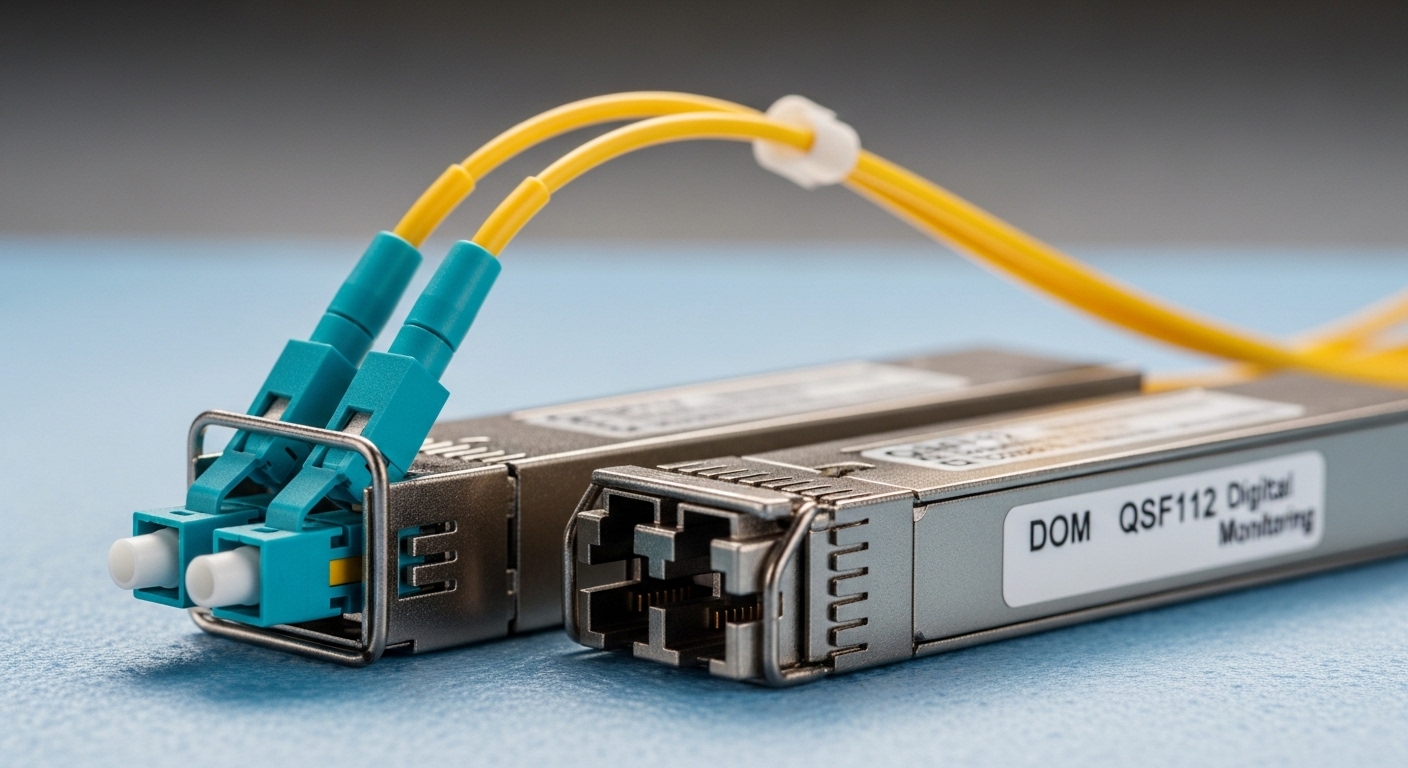
At 800G, the “it fits the port” assumption becomes risky because optics form factors, digital diagnostics, and lane mapping must align with the switch line card. Most enterprise deployments follow IEEE 802.3 specifications for 800G Ethernet, but vendors implement additional requirements in optics qualification and firmware gating. Practically, the failure mode is not only link loss; it can be unstable training, CRC errors, or optics not initializing due to DOM thresholds. Before buying, confirm that your switch model and software release explicitly support the target 800G optics type and reach.
Quick compatibility checks before you quote optics
- Verify switch line card model and software version (for example, release notes that list supported 800G optics or “optics compatibility matrix”).
- Confirm transceiver type: 800G SR8 (multi-fiber short reach) versus 800G DR8/FR8 (longer reach) depending on your fiber plant.
- Require vendor qualification for third-party optics and confirm whether DOM is supported end-to-end.
- Check power and thermal headroom: your airflow design must sustain the optics module operating temperature.
800G optics selection: specs that actually decide pass/fail
Engineers should select by reach class, fiber type, connector standard, and optical power budget margins, not by headline “800G” alone. Even within the same reach category, vendor-specific implementation details (laser safety class, FEC requirements, and DOM behavior) can affect interoperability. For procurement, require a spec sheet that lists wavelength band, nominal transmit power, receiver sensitivity, and operating temperature range. Use a single spreadsheet to standardize these values across vendors and lots.
Representative 800G module parameters to compare
Below is a practical comparison template for SR8 versus DR8 class optics. Exact values vary by vendor and revision; treat this as a checklist, then verify against datasheets and switch compatibility documentation.
| Parameter | 800G SR8 (Short reach) | 800G DR8 (Long reach) |
|---|---|---|
| Typical wavelength | ~850 nm (MMF) | ~1310 nm (SMF) |
| Target reach | ~70 m over OM4 (varies by plant) | ~500 m over SMF (varies by plant) |
| Fiber type | OM4/OM5 multi-mode | Single-mode fiber |
| Connector | MPO/MTP (typically) | LC (commonly) or MPO depending on design |
| Data rate | 800G Ethernet (8 lanes) | 800G Ethernet (8 lanes) |
| Module power | Typically higher than 400G; confirm per datasheet | Confirm per datasheet; may differ by wavelength band |
| Operating temperature | Confirm extended industrial ranges if needed | Confirm extended industrial ranges if needed |
| DOM / diagnostics | Require supported DOM fields and thresholds | Require supported DOM fields and thresholds |
Real-world deployment scenario: leaf-spine upgrade with measured targets
In a 3-tier data center leaf-spine topology with 48-port 10G/25G ToR replaced by 25G-to-800G uplinks, one enterprise ran a staged upgrade: two spine rows first, then leaves. They used 800G SR8 for leaf-to-spine where the distance was under 50 m across OM4 cabling, and reserved 800G DR8 for a subset of cross-row links at 300 to 450 m on SMF. They set acceptance criteria in advance: link must come up within a specified time window after insertion, DOM thresholds must remain within vendor-recommended bounds, and error counters must remain at baseline for 24 hours. This prevented “works in the lab” optics from becoming production instability.
Operational numbers field teams track
- Insertion and link-up time: define a maximum acceptable training window per switch platform.
- Optics temperature and threshold events: watch for DOM warnings during traffic peaks.
- Signal integrity: monitor CRC/FEC-related counters and link flaps after maintenance events.
Pro Tip: In many 800G rollouts, the biggest hidden risk is not fiber loss; it is connector cleanliness and MPO polarity handling. Even when optical budgets look “in spec,” dirty endfaces and mis-seated MPO/MTP connectors can trigger training failures that resemble firmware incompatibility. Use a microscope check and standardized re-termination workflow before assuming an optics mismatch.
Selection criteria checklist (ordered for fast procurement decisions)
- Distance and fiber plant: map each link length to SR8 or DR8/FR8 classes using measured attenuation and patch panel loss.
- Switch compatibility: confirm the exact switch model and software release supports the optics SKU and reach type.
- Connector and polarity: ensure MPO/MTP polarity conventions match your patching plan; define a labeling standard.
- DOM support and thresholds: require diagnostics fields used by your monitoring (temperature, bias current, optical power).
- Operating temperature and airflow: verify module operating range matches your in-rack ambient and airflow constraints.
- Power and thermal budget: include module power in your thermal model and maintenance margin.
- Vendor lock-in risk: assess whether third-party optics are qualified and whether replacements can be sourced during shortages.
- Warranty and RMA logistics: ensure turnaround time and cross-shipping options align with your change windows.
Common mistakes and troubleshooting tips (what actually breaks)
Many 800G failures look like optics incompatibility but originate elsewhere. Use the following fault tree to reduce mean time to repair (MTTR).
- Mistake: Buying SR8 optics for links that exceed the real patch-panel and splice loss budget.
Root cause: Datasheet reach assumes ideal conditions; real plants have connector aging and extra mated interfaces.
Solution: Verify with OTDR or certified attenuation measurements end-to-end; include patch cords and jumpers in the calculation. - Mistake: Reversing MPO polarity (or using mismatched polarity types) during patching.
Root cause: Transmit/receive lane mapping is polarity-sensitive, especially for multi-lane optics.
Solution: Standardize polarity labeling, use consistent MPO polarity adapters, and validate with link establishment plus optical power readings. - Mistake: Assuming all third-party optics with “800G” branding are equivalent.
Root cause: Switch platforms may enforce optics qualification lists or firmware-specific DOM behavior.
Solution: Require the switch vendor compatibility statement or run a pilot batch with the exact software version before bulk procurement. - Mistake: Ignoring thermal margins during high-density installs.
Root cause: Insufficient airflow can push modules near threshold, causing intermittent training or increased error rates.
Solution: Measure in-rack ambient, confirm airflow direction, and compare module DOM temperature against thresholds during peak traffic.
Cost and ROI note for enterprise buying decisions
Typical pricing varies by vendor, lead time, and qualification status, but enterprises often see 800G optics cost several multiples of 400G per link, with SR8 generally cheaper than long-reach variants due to optics complexity and fiber requirements. Operational TCO should include: installation labor (cleaning, polarity work), spare-module stocking strategy, and expected RMA rates under your change cadence. For ROI, prioritize minimizing truck rolls and link downtime; a slightly higher module unit cost can be justified if it reduces incompatibility incidents and accelerates rollout windows.
FAQ
Which 800G optics should we standardize for leaf-spine?
Most teams standardize on 800G SR8 for intra-row or short leaf-to
