
In modern data centers, link power is no longer a rounding error: every 10G, 25G, 100G, and 400G port contributes to rack-level cooling load and operational cost. This article helps network and infrastructure leaders evaluate energy efficiency when selecting Direct Attach Copper (DAC) and Active Optical Cable (AOC), with practical deployment details, electrical and optical constraints, and governance-ready decision criteria. You will also get a troubleshooting playbook for the most common field failures that quietly negate energy savings.
Why energy efficiency shifts when you move from copper to optical
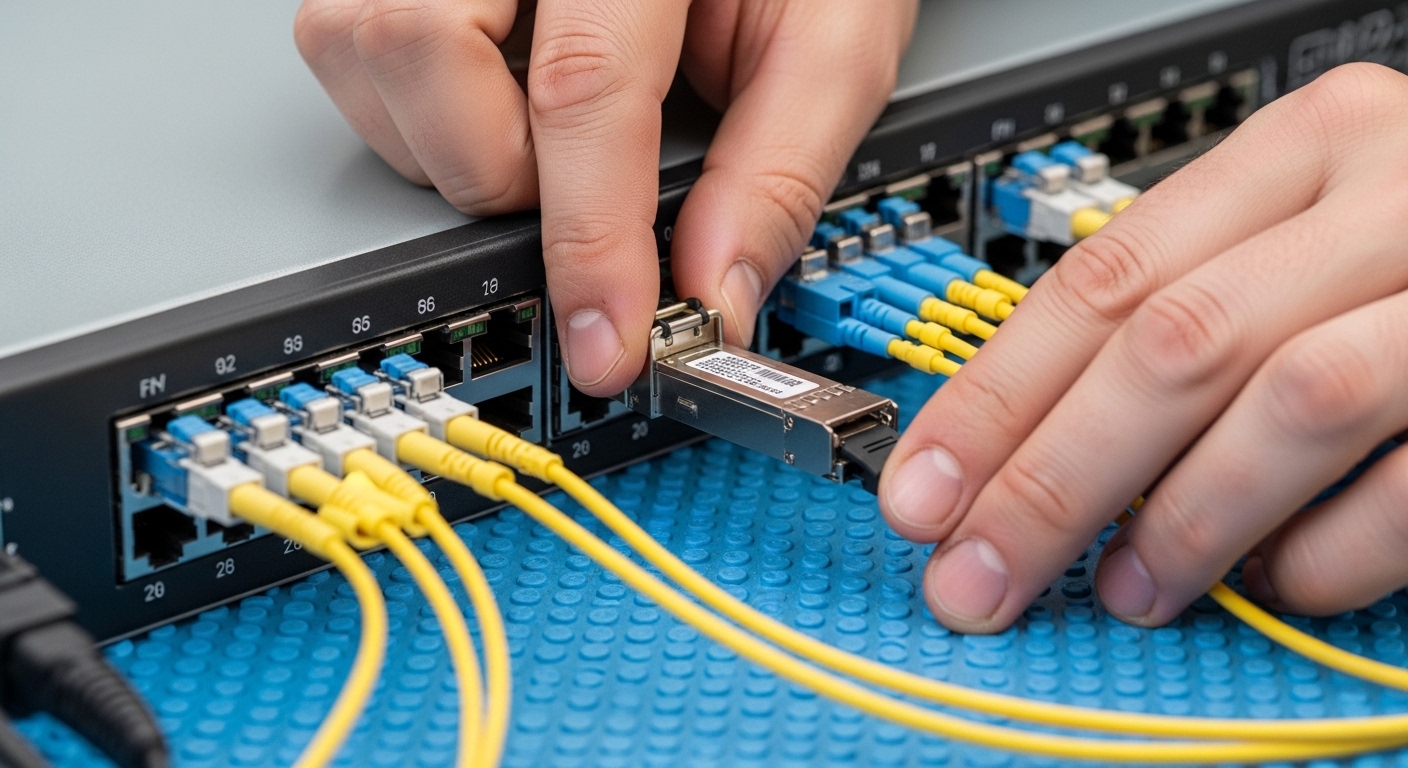
Energy efficiency in interconnects is driven by more than raw module watts. For DAC, the dominant factors are the passive electrical channel losses, the serializer/deserializer (SerDes) operating mode, and the heat dissipation profile inside the switch port. For AOC, power is typically higher than passive copper because the cable includes active optical transmit and receive electronics, but total system impact can still be favorable due to lower host-side equalization effort and improved link reliability at longer reaches.
At the rack level, the “real” cost often comes from cooling. A typical facility power model uses a Power Usage Effectiveness (PUE) target; for example, if your PUE is 1.3, then 1 kW of IT power can translate to about 1.3 kW at the meter. Since transceivers and cables dump heat locally, the heat load directly increases air conditioning work, especially in high-density leaf-spine designs where exhaust temperatures are tight.
From a standards standpoint, DAC and AOC choices map to IEEE and industry electrical/optical link behaviors. Ethernet PHYs for modern speeds follow IEEE 802.3 clauses for optical and electrical interfaces, while vendor implementations define exact power, eye margin, and thermal limits. For optical link optics and safety, also consider IEC laser safety guidance and SFF multi-source agreements that standardize mechanical form factors. References: IEEE 802.3 standard and SFF Committee.
DAC vs AOC: power, reach, and optics explained with comparable specs
Direct Attach Copper (DAC) typically uses twinax copper conductors with an integrated connectorized form factor (commonly SFP/SFP+ style for lower rates, QSFP/QSFP-DD styles for higher rates). Because DAC is passive, it relies on the switch port PHY for equalization. Active Optical Cable (AOC) uses an optical transceiver-like function embedded in the cable, usually with multimode fiber (MMF) optics for short reach and sometimes single-mode (SMF) options depending on the speed grade and vendor SKU.
For energy efficiency evaluation, the engineer’s goal is to compare module power, link reach capability, and system-level thermal impact under the same network topology. The table below summarizes representative specifications you will encounter in the field. Exact values vary by vendor and temperature, so treat them as decision anchors rather than guarantees.
| Attribute | 10G DAC (Twinax) | 25G DAC (Twinax) | 100G AOC (Typical) | 200G/400G AOC (Typical) |
|---|---|---|---|---|
| Target data rate | 10GBASE-R / 10G Ethernet | 25GBASE-R / 25G Ethernet | 100G Ethernet (varies) | 200G or 400G Ethernet (varies) |
| Representative reach | Up to 7 m typical | Up to 5 m typical | Up to 100 m on MMF | Often 100 m on MMF (SKU dependent) |
| Representative average module power | ~0.5 to 1.5 W (passive, depends on port mode) | ~1 to 2.5 W (passive twinax) | ~2 to 6 W (active electronics in cable) | ~5 to 12 W (higher-rate active optics) |
| Optical wavelength | N/A (electrical) | N/A (electrical) | Often 850 nm for MMF | Often 850 nm for MMF (vendor dependent) |
| Connector type | SFP+ style (varies) | SFP28 / QSFP28 style (varies) | QSFP28 / QSFP56 style (varies) | QSFP-DD / OSFP style (varies) |
| DOM / telemetry | Often supported via vendor EEPROM (module ID) | Often supported | Usually includes DOM (Tx bias, Rx power) | Usually includes DOM (Tx/Rx diagnostics) |
| Operating temperature | Commonly 0 to 70 C | Commonly 0 to 70 C | Commonly 0 to 70 C and some extended options | Commonly 0 to 70 C and some extended options |
| Governance implication | Lower power, but limited reach and equalization burden | Lower power, but sensitive to routing and bend quality | Better reach; includes diagnostics for proactive ops | Higher power; strong diagnostics; plan cooling and port budgets |
In practice, energy efficiency comparisons should be normalized per useful transported bit across the required distance. A DAC that forces you to shorten the run can increase the number of intermediate switches or patching tiers, which can erase energy savings. Conversely, an AOC with higher per-link watts can still reduce total system power if it eliminates extra switching hops or supports a more efficient cabling layout.
Pro Tip: When you model energy efficiency, include the port operating mode. Many switches dynamically adjust SerDes equalization and transmitter settings based on link quality; a “compatible” DAC can still trigger higher-power modes if the channel margin is tight. In the field, this shows up as higher measured draw than the module datasheet suggests, especially after cable moves or patch panel rework.
Real-world deployment scenario: energy efficiency across a leaf-spine upgrade
Consider a 3-tier data center leaf-spine topology where 48-port 25G ToR switches connect to a pair of spine switches. The environment has 2.5 m typical patch distances from leaf to top-of-rack patch panels, but some rows require 6 m runs due to aisle constraints and cable tray routing. During an upgrade from 10G to 25G, the team standardizes on DAC for the short runs and AOC for the longer runs to avoid additional patching and slack that would harm electrical channel quality.
In this scenario, engineers measure actual power at the rack PDU and compare it to baseline. Suppose the switch chassis draws 1.8 kW at steady state, and the incremental difference between DAC-only and mixed DAC/AOC configurations is 110 W across 96 active high-speed ports. With a PUE of 1.3, that becomes roughly 143 W of facility draw. If the migration reduces link errors by keeping link margins healthy (fewer retransmits and less “link flapping”), the operational savings can show up as reduced troubleshooting time and fewer dispatches, even when the AOC module itself uses more watts than the DAC.
For governance, the team also captures telemetry. AOC links with DOM can be monitored for Tx bias and Rx power trends. Over a quarter, they detect a patch panel contamination pattern as a gradual Rx power drop and replace one connectorized segment before it causes outages. That proactive maintenance improves reliability and helps preserve energy efficiency by avoiding fallback behaviors and link renegotiations that can cause temporary higher-power signaling.
Selection criteria checklist for energy efficiency and governance
To choose DAC or AOC responsibly, engineers should evaluate the decision factors in a consistent order. This prevents “it works on the bench” outcomes that later fail under thermal stress or after cable routing changes. The checklist below is the one I use when drafting a selection memo for architecture review and procurement.
- Distance and link budget: Confirm the required reach with margin. For DAC, ensure the twinax length is well within the vendor’s supported range and that the channel is not degraded by tight bends or poor routing.
- Switch compatibility: Validate vendor interoperability lists and confirm the switch port supports the exact form factor and speed grade (for example, QSFP28 vs QSFP-DD). Some platforms have stricter requirements for power class and DOM behavior.
- Energy efficiency impact: Compare measured or vendor-characterized module power at the expected operating temperature. Then model facility power using your PUE and rack cooling assumptions.
- DOM and telemetry support: Prefer AOC when you need Tx/Rx diagnostics, thresholds, and alerting for proactive maintenance. For DAC, DOM support may be present but less granular.
- Operating temperature and thermal headroom: Ensure modules are within specified ranges, and account for airflow restrictions near dense rows of ports.
- Vendor lock-in risk: Evaluate OEM versus third-party. Third-party optics may be electrically compatible but can have different DOM calibrations or threshold defaults.
- Lifecycle and spares strategy: Plan for replacement lead times and test procedures. If the cable is a structured assembly, validate return policies and warranty terms.
- Cabling governance: Require standardized labeling and patching workflows. Most energy regressions happen after “quick fixes” that alter routing and reduce channel margin.
How to translate specs into a budget-ready model
Start with the switch port count and expected utilization. If you expect 96 active ports per rack at peak and you know the incremental module power difference between DAC and AOC, you can estimate rack IT power delta. Then multiply by your PUE and annual operating hours to estimate annual facility energy cost. Include a conservative failure and replacement allowance in TCO, because downtime and emergency shipping are often more expensive than the cable unit cost difference.
Common pitfalls and troubleshooting tips that erase energy efficiency gains
Even when you select the “more efficient” option on paper, real operations can negate the savings. Below are failure modes I have seen during deployments, along with root causes and fixes that restore both reliability and the intended energy profile.
Pitfall 1: Tight bends and cable routing degrade DAC channel margin
Root cause: Twinax copper is sensitive to bend radius and mechanical stress. After a cable move, the eye diagram margin can collapse, pushing the switch PHY into less efficient equalization or causing intermittent errors.
Solution: Enforce minimum bend radius and route cables with gentle curves. After changes, run link diagnostics and check error counters. If needed, switch the longer run to AOC to reduce channel equalization strain.
Pitfall 2: DOM thresholds mismatch between third-party optics and the switch
Root cause: Some third-party AOC products provide DOM data with different calibration or threshold defaults. The switch may raise warnings early or fail to alert at the right moment, leading to either unnecessary replacements or missed degradation.
Solution: Validate DOM behavior during acceptance testing. Confirm that the switch alarms map correctly to Rx power and Tx bias trends. Align monitoring thresholds in your NMS so alerts correlate with real link behavior.
Pitfall 3: Thermal hotspots near high-density port banks trigger higher-power operation
Root cause: In dense racks, airflow can be uneven. Higher module temperature can force the PHY and optics into power or safety derating behaviors, which can change actual consumption and increase error rates.
Solution: Measure inlet and outlet temperatures at the rack row. Adjust cable placement, improve front-to-back airflow paths, and ensure blank panels are installed. Re-test link stability after thermal remediation.
Pitfall 4: Mismatched speed grade or incorrect transceiver mode selection
Root cause: Some ports support multiple profiles. If the switch negotiates an unexpected mode, the module may operate in a less optimal configuration that increases power and reduces headroom.
Solution: Lock the intended speed profile where supported, and confirm negotiated settings from switch logs. Standardize port configuration templates during rollout.
Cost and ROI note: unit price is only half the story
DAC cables are often cheaper per link than AOC, and they usually have lower average power because they are passive. In typical enterprise procurement, you may see DAC pricing that is noticeably lower than AOC for the same nominal speed, but the gap depends heavily on reach and vendor tier. For example, third-party 10G DAC assemblies can be far below OEM pricing, while AOC pricing varies by wavelength grade and optics density.
However, ROI should include three cost drivers: (1) energy and cooling, (2) operational risk from link instability, and (3) serviceability. If an AOC reduces retransmits and avoids field dispatches, the avoided labor and downtime can outweigh a higher module unit cost. Also remember that cooling energy scales with heat dissipation, so even modest per-port power differences can become meaningful at scale. For guidance on energy and efficiency measurement, see IEEE resources and facility modeling practices referenced in industry energy audits.
In TCO terms, I recommend building three scenarios: conservative (no reliability delta), base (small reliability improvement), and aggressive (measurable error reduction and reduced incident count). Use measured rack delta from your first pilot rack rather than relying solely on datasheet wattage.
FAQ: choosing DAC or AOC with energy efficiency in mind
Which is more energy efficient for short runs, DAC or AOC?
For very short distances within the vendor’s supported DAC reach, DAC is often more energy efficient because it is passive and relies primarily on the switch PHY. That said, if DAC routing reduces link margin and forces higher-power equalization, measured system power can converge toward AOC. Pilot with real error counters and rack-level power measurements.
Does AOC always consume more power than DAC?
Typically, yes at the module level because AOC includes active transmit and receive electronics. But the relevant metric is system-level energy efficiency per delivered bit across the required distance and topology. If AOC prevents extra hops or reduces retransmits, the overall ROI can still be favorable.
What should I verify for compatibility with my switch ports?
Confirm the exact form factor and speed grade supported by each port (for example, QSFP28 versus QSFP-DD) and validate interoperability with the vendor’s list. Also verify DOM behavior and whether the switch expects specific threshold ranges. Run a short acceptance test that includes link stability across temperature changes.
How do I monitor energy efficiency impact after deployment?
Use rack PDU measurements and correlate them with link state and error counters. If your switch supports telemetry export, track link retries, CRC errors, and optical Rx power trends for AOC. For DAC, track link error counters and any renegotiation events.
Are third-party DAC and AOC reliable enough for enterprise governance?
They can be, but you must govern them with acceptance testing and monitoring validation. The biggest risk is not basic electrical compatibility; it is consistent DOM telemetry behavior and predictable thermal performance across firmware and temperature. Establish a qualification process and standardize replacement procedures.
What is the fastest way to troubleshoot link instability?
First, check physical routing and confirm no connector strain or bend radius violations for DAC. Next, review switch logs for speed profile changes and check error counters. For AOC, inspect DOM alerts for Rx power and Tx bias trends, then compare to a known-good baseline module.
If you want energy efficiency gains that survive real operations, treat DAC and AOC as a systems decision: model rack power, validate link margin, and govern telemetry and routing. Next, review transceiver selection governance to build a repeatable standard for procurement, acceptance testing, and lifecycle monitoring.
Author bio: I am an IT infrastructure director who has deployed leaf-spine upgrades and power-aware transceiver standards in production data centers. I write from field experience, focusing on measured outcomes, interoperability governance, and practical troubleshooting.
