
Edge computing deployments live under tight constraints: limited rack space, harsh temperatures, and strict latency or power budgets. This purchasing guide helps network and field teams choose the right optical modules for uplinks and access links in real sites. You will get a top list of module options, a spec comparison table, and a practical decision checklist grounded in IEEE Ethernet standards and vendor datasheets.
Top 8 optical module choices for edge computing
10G SFP+ SR multimode for short runs
When your edge site uses multimode fiber inside a local facility, 10G SFP+ SR is often the fastest path to dependable links. It typically targets 850 nm over OM3/OM4 multimode. In many leaf-spine edge pods, engineers use it for server-to-switch and top-of-rack uplinks across a few dozen meters.
Key specs to verify: distance rating for your fiber (OM3 vs OM4), receiver sensitivity, and whether your switch supports SFP+ SR optics with required vendor ID/DOM handling. Common parts include Cisco SFP-10G-SR and Finisar/FS-branded 10G SR optics (verify exact reach and DOM).
Best-fit scenario: A warehouse edge room with two 48-port 10G ToR switches, patch panel runs of 35 to 70 m on OM4, and strict cost control for internal connectivity.
- Pros: Lowest cost per port for short reach; widely supported in enterprise and SMB switches.
- Cons: Not for long haul; sensitive to connector cleanliness and multimode cabling quality.
10G SFP+ LR singlemode for longer edge uplinks
For edge sites that must reach a regional aggregation point over singlemode fiber, 10G SFP+ LR is a common choice. It uses 1310 nm optics and is designed for longer reach than SR. This is valuable when the edge enclosure is far from the nearest splice or when trenching constraints limit fiber replacement.
Key specs to verify: nominal reach (often up to 10 km for LR variants), transmit power and receiver sensitivity class, and whether the link budget meets your actual plant. Use vendor link-budget guidance and confirm with OTDR traces if available.
Best-fit scenario: A retail edge with a PoP cabinet connected by singlemode fiber spanning 6.5 km to a metro aggregation switch, with 2 connector pairs and ~0.7 dB/km attenuation.
- Pros: Better reach; less sensitive to multimode cabling quality.
- Cons: Higher cost than SR; requires singlemode certification and careful loss budgeting.
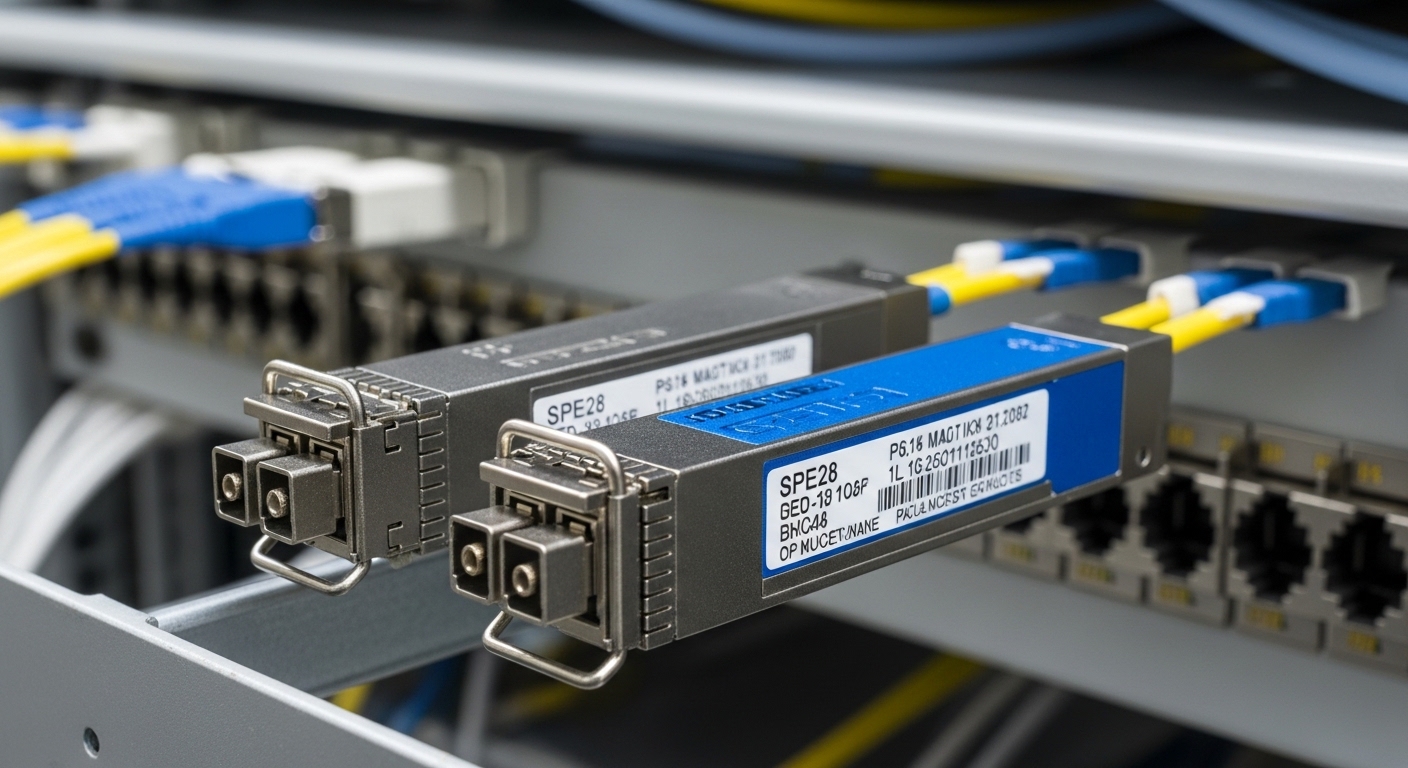
25G SFP28 SR for cost-efficient 25G in edge racks
As edge computing scales, 25G often becomes the sweet spot for throughput without jumping to full 100G. 25G SFP28 SR optics at 850 nm work well with OM4 for short-to-medium distances and reduce oversubscription pressure. Teams often deploy them for NIC-to-switch and ToR-to-spine within an edge footprint.
Key specs to verify: rated distance on OM4, compliance with IEEE 802.3 Ethernet PHY requirements for 25GBASE-SR, and DOM support if your NOC uses real-time telemetry. Example families include FS.com SFP-25G-SR and Finisar/other vendor equivalents (confirm exact reach and DOM).
Best-fit scenario: A micro data center edge with 25G server NICs, OM4 runs of 60 to 100 m, and power-limited switch fan trays where lower line-rate power matters.
- Pros: Strong performance-to-cost; efficient for dense racks.
- Cons: Still limited by multimode reach; connector contamination causes intermittent errors.
25G SFP28 LR for singlemode reach without QSFP28 complexity
When you need singlemode reach but want to avoid QSFP28 form factor complexity, 25G SFP28 LR is a practical option. It uses 1310 nm and supports edge uplinks where fiber plants are already singlemode. This helps keep edge upgrade steps incremental while preserving capacity.
Key specs to verify: LR reach target, transmitter/receiver power levels, and whether the switch port expects specific SFP28 optical parameters for margin. Confirm DOM thresholds if your monitoring triggers alarms on low power.
Best-fit scenario: A campus edge aggregator with 3 km singlemode uplinks from multiple smaller sites, aggregated into a central edge switch.
- Pros: Good balance of reach and cost; simpler than QSFP28 in many switches.
- Cons: Requires link budget discipline; LR optics cost more than SR.
40G QSFP+ SR for mature 40G edge backbones
Many existing edge deployments still run 40G backbones, especially where prior upgrades standardized on QSFP+. 40G QSFP+ SR uses 850 nm multimode and is suitable for in-building or nearby facility links. It can be attractive when you inherit older gear and need to maintain continuity.
Key specs to verify: QSFP+ port support, lane mapping behavior, and whether the switch supports DOM and correct threshold handling. Ensure your multimode fiber class (OM3 vs OM4) matches the datasheet distance.
Best-fit scenario: An industrial edge control room that already has 40G QSFP+ uplink ports, with 80 m OM3 cabling and a maintenance window that cannot accommodate hardware swaps.
- Pros: Maintains compatibility with legacy 40G designs; efficient for local backbones.
- Cons: Some platforms are aging; future upgrades may shift to 100G/50G.
100G QSFP28 SR4 for high-bandwidth edge aggregation
When edge computing needs high uplink bandwidth—like video analytics or distributed storage—100G becomes necessary. 100G QSFP28 SR4 typically operates at 850 nm using four lanes, enabling high throughput over OM4 within a data center or nearby campus fiber plant.
Key specs to verify: SR4 reach on OM4, whether the switch supports 100GBASE-SR4, and lane-level mapping. Also check whether your optics support DOM and whether your platform enforces digital diagnostics compliance.
Best-fit scenario: A smart city edge aggregation node with two 100G uplinks from a video processing cluster, using OM4 runs under 100 m to a nearby aggregation switch.
- Pros: High capacity without long-haul singlemode complexity.
- Cons: Multimode reach and fiber quality become critical; optics can be sensitive to dirty connectors.
100G QSFP28 FR4 for long-reach edge uplinks on singlemode
For singlemode long-reach at 100G, FR4 is frequently selected when you need a practical distance while keeping QSFP28 form factor. It uses 1310 nm nominal operation across multiple wavelengths (per lane), supporting longer links compared with SR4. This is useful when the edge site is not in a central data hall.
Key specs to verify: rated FR4 reach, transmitter power, receiver sensitivity, and whether your plant loss plus aging margin fits the link budget. Confirm you have proper dispersion and connector cleanliness handling practices.
Best-fit scenario: A remote edge PoP with 9 to 11 km singlemode fiber to a regional core, using 100G QSFP28 FR4 optics.
- Pros: Reaches farther than multimode; leverages QSFP28 density.
- Cons: Higher optics cost and stricter plant requirements.
100G CWDM4 for wavelength-division edge links with routing flexibility
When your edge architecture benefits from wavelength diversity—such as multiple services sharing a fiber—100G CWDM4 optics can provide operational flexibility. CWDM4 uses multiple wavelengths across a single fiber pair (details vary by vendor and wavelength grid), enabling parallel logical links. This can reduce fiber count and support phased expansions.
Key specs to verify: the CWDM wavelength grid compatibility, required filters at the receive side, and whether the optics are specified for your exact grid. Also confirm DOM behavior and whether your monitoring expects specific diagnostic fields.
Best-fit scenario: A multi-tenant edge corridor where one fiber pair must carry several aggregated services, each provisioned on separate wavelengths.
- Pros: Better fiber utilization; flexible scaling with fewer physical fibers.
- Cons: Requires correct wavelength filtering and disciplined provisioning.
Optical module spec comparison you can use in purchasing
Below is a quick reference for typical parameters engineers validate before ordering. Always confirm exact reach and supported standards in the specific vendor datasheet and your switch line card documentation.
| Module type | Typical wavelength | Reach class | Connector / media | Data rate | Operating temp (typ.) | DOM |
|---|---|---|---|---|---|---|
| 10G SFP+ SR | 850 nm | ~300 m (OM3) / ~400-450 m (OM4, varies) | LC duplex / OM3-OM4 | 10GBASE-SR | 0 to 70 C (commercial) or -40 to 85 C (extended) | Commonly supported |
| 10G SFP+ LR | 1310 nm | ~10 km (varies by power class) | LC duplex / singlemode | 10GBASE-LR | -40 to 85 C (many telecom options) | Commonly supported |
| 25G SFP28 SR | 850 nm | ~70-100 m on OM4 (varies) |
.wpacs-related{margin:2.5em 0 1em;padding:0;border-top:2px solid #e5e7eb}
.wpacs-related h3{margin:.8em 0 .6em;font-size:1em;font-weight:700;color:#374151;text-transform:uppercase;letter-spacing:.06em}
.wpacs-related-grid{display:grid;grid-template-columns:repeat(auto-fill,minmax(200px,1fr));gap:1rem;margin:0}
.wpacs-related-card{display:flex;flex-direction:column;background:#f9fafb;border:1px solid #e5e7eb;border-radius:6px;overflow:hidden;text-decoration:none;color:inherit;transition:box-shadow .15s}
.wpacs-related-card:hover{box-shadow:0 2px 12px rgba(0,0,0,.1);text-decoration:none}
.wpacs-related-card-img{width:100%;height:110px;object-fit:cover;background:#e5e7eb}
.wpacs-related-card-img-placeholder{width:100%;height:110px;background:linear-gradient(135deg,#e5e7eb 0%,#d1d5db 100%);display:flex;align-items:center;justify-content:center;color:#9ca3af;font-size:2em}
.wpacs-related-card-title{padding:.6em .75em .75em;font-size:.82em;font-weight:600;line-height:1.35;color:#1f2937}
@media(max-width:480px){.wpacs-related-grid{grid-template-columns:1fr 1fr}}

🍪 We use cookies to improve your browsing experience and analyse site traffic.
Privacy Policy
|