
High-density optics are where modern data center fabrics win capacity and lose patience: one marginal transceiver, flipped polarity, or incompatible DOM can collapse a leaf-spine link budget. This article helps network engineers and IT directors troubleshoot high-density optical transceivers in next-gen environments using repeatable checks across optics, cabling, firmware, and governance. You will get a head-to-head comparison of common module types, a decision checklist, and concrete failure modes with root causes and fixes.
QSFP28, SFP28, and OSFP: which fails differently under density pressure?
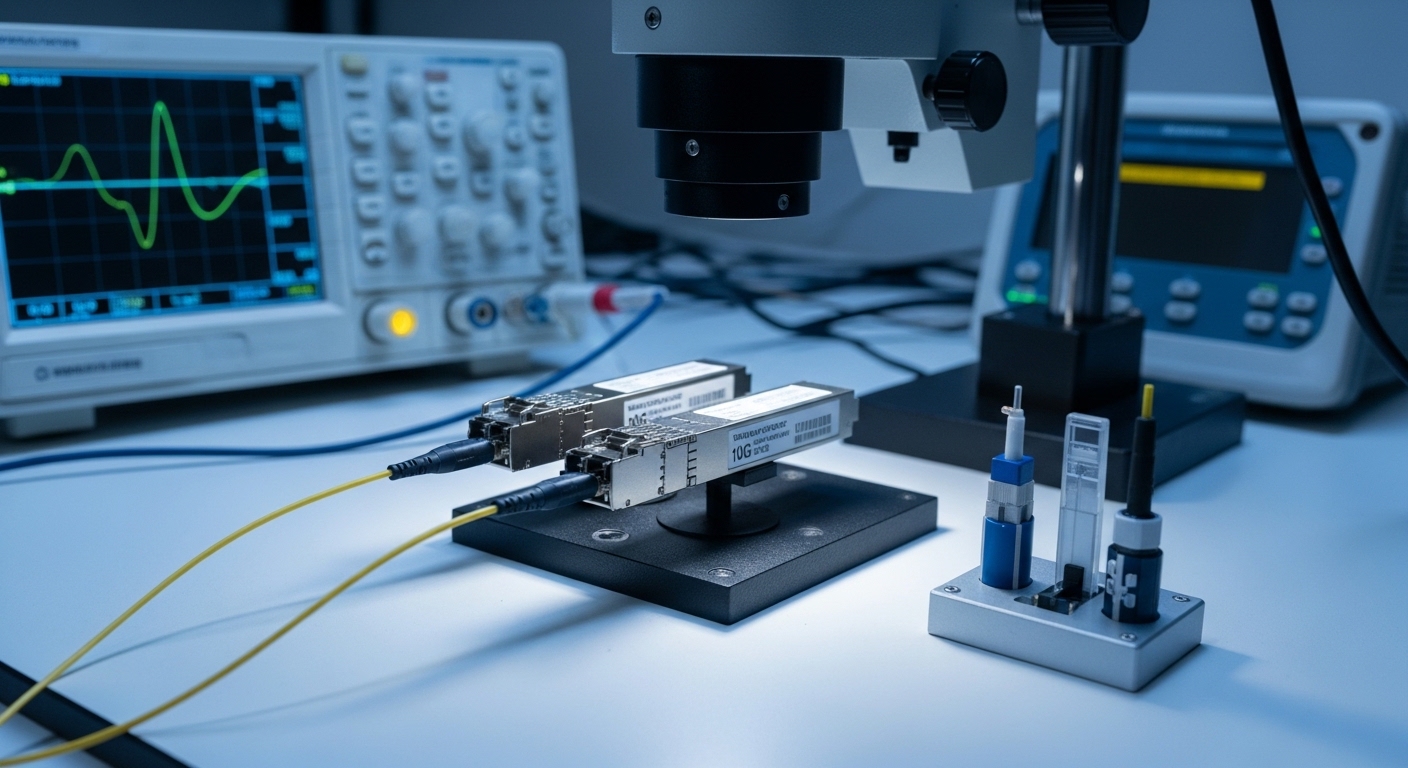
In next-gen data center designs, the module form factor dictates failure modes because of transmitter power, receiver sensitivity, and thermal behavior. QSFP28 (for 25G to 100G per lane aggregation) and OSFP (for higher lane counts and power envelopes) often run closer to platform thermal limits at full port density. SFP28 modules can be more forgiving thermally but may expose stricter compatibility expectations for certain switch ASICs and optics management policies.
IEEE 802.3 defines Ethernet physical-layer requirements, while vendor datasheets define the operational envelope, including launch power, receiver sensitivity, and DOM behavior. When you see link flaps or CRC spikes, the goal is to separate “optical budget failure” from “management plane mismatch” and from “cabling/polarity defects.”
| Module type | Typical data rate | Wavelength | Reach (common) | Connector | Power class (typical) | Operating temperature | DOM support |
|---|---|---|---|---|---|---|---|
| QSFP28 SR4 | 100G (4 lanes x 25G) | 850 nm | Up to 70 m on OM3 / ~100 m OM4 (varies by vendor) | LC | ~3.5 W typical | 0 to 70 C (commercial) or -5 to 85 C (some extended) | Yes (I2C per MSA) |
| SFP28 SR | 25G (1 lane) | 850 nm | Up to 100 m on OM4 (vendor dependent) | LC | ~1.0 to 2.0 W | 0 to 70 C typical | Yes (I2C per MSA) |
| OSFP SR4 / SR8 | 100G to 400G (lane dependent) | 850 nm | ~70 to 100 m class on OM4 (lane and power dependent) | LC (or MPO variants) | ~8 to 15 W typical depending on configuration | 0 to 70 C typical; must validate airflow | Yes (I2C per vendor) |
Operational implication: QSFP28 and OSFP modules amplify thermal and power-supply sensitivity at high density, so you must correlate optical metrics with switch temperature telemetry, not just fiber distance. For standards references, see IEEE 802.3 and vendor optics governance guidance in your switch datasheets.
Pro Tip: In high-density deployments, “DOM looks fine” does not mean the optical link is healthy. DOM typically reports temperature, bias, and receive power, but it cannot detect a polarity reversal that still yields non-zero optical power; you need interface counters (FEC/CRC/BER) plus optics diagnostics to confirm the actual error rate. This is a common cause of persistent CRC spikes after “successful” port bring-up.
Compatibility and governance: why the same fiber works with one vendor module
Switch vendors increasingly enforce optics governance (sometimes called “optics validation” or “DOM policy”), which can block or degrade links when module firmware, thresholds, or supported features differ. Even if a transceiver is physically compatible, governance mismatches can manifest as intermittent link negotiation resets, reduced lane alignment reliability, or conservative receiver settings.
On the governance axis, engineers should validate three layers: (1) physical compatibility (form factor and lane mapping), (2) electrical compatibility (signal detect thresholds, host retimer behavior), and (3) management compatibility (DOM I2C register expectations). Many operators maintain an internal optics allowlist to reduce risk, but that can increase procurement lead times and vendor lock-in.
Concrete compatibility checks
- DOM register sanity: Use the switch CLI to read vendor ID, part number, temperature, bias current, transmit power, and receive power. Compare against the module datasheet thresholds for your exact model, not “SR generic.”
- Lane mapping and breakout mode: For MPO-based links, confirm polarity and lane ordering. A single mis-ordered lane can pass link-up yet fail on high traffic with elevated error counters.
- Firmware and platform support: Confirm the switch software version supports the specific optics family. Some platforms require a minimum release for newer OSFP/400G optics.
Troubleshooting workflow: isolate optical budget, polarity, and thermal issues in minutes
When a data center link flaps at high density, the fastest path is a structured workflow that minimizes guesswork. Start with what the switch knows (link state, alarms, error counters, DOM), then validate the fiber path and polarity, and finally check environmental telemetry. This order matters because a thermal problem can masquerade as a marginal optical budget during peak utilization.
Step-by-step runbook (field-tested)
- Capture symptoms and counters: Record link up/down events, CRC/FCS errors, and if applicable FEC/RS counters. Note whether errors spike immediately after interface up or only under load.
- Verify DOM optics: Compare TX power and RX power against the expected ranges for your module type and reach. If RX power is near the vendor minimum sensitivity, treat it as an optical budget issue first.
- Check polarity and MPO/LC orientation: For MPO, verify polarity using a known-good reference patch cord and confirm the correct polarity method (for example, standard “A-to-B” conventions used in many data center cabling standards). For LC, confirm correct TX-to-RX pairing.
- Validate temperature and airflow: Read module temperature and chassis inlet/outlet temperatures. If module temperature is elevated (common near top-of-rack blocks with blocked airflow), retest after restoring airflow.
- Eliminate “bad patch” quickly: Swap the transceiver with a known-good one of the same exact part number and speed class. Then swap the patch cord to isolate whether the fault follows the module or the fiber path.
For optical budget verification, your cabling plant documentation and attenuation measurements matter. Use OTDR or a qualified loss test method compatible with your fiber type (OM3/OM4) and connector style. If you do not have recent loss results, you must assume additional margin consumption from aged connectors and patch panel remating.
Common mistakes and troubleshooting tips that actually resolve high-density failures
Most “mystery” data center transceiver problems are deterministic once you map them to the right failure mode. Below are concrete mistakes engineers make, with root causes and solutions.
Failure mode 1: Polarity reversal with deceptive link-up
Root cause: TX and RX fibers are swapped, or MPO polarity is inconsistent with the patching method. Some optics will still detect signal enough to bring the link up, but errors rise under load.
Solution: Use a polarity verification tool and re-terminate or repatch using the correct polarity orientation. Confirm by monitoring CRC/FCS counters during a traffic test after repatch.
Failure mode 2: Optical budget marginality from connector rework and aging
Root cause: Patch cords or connector ends exceed your expected loss budget, especially after frequent remating. Receiver sensitivity margins shrink when platforms apply conservative thresholds or when temperature rises.
Solution: Perform end-to-end loss testing and replace the worst patch segments. Compare RX power to module datasheet minimums at the current operating temperature.
Failure mode 3: Governance mismatch causing intermittent resets
Root cause: The switch platform may accept the module for basic detection but apply different equalization or DOM threshold logic, leading to periodic re-initialization under specific traffic patterns.
Solution: Validate switch software compatibility with the exact optics part number. If governance is enabled, add the module to the allowlist or use an officially supported transceiver SKU.
Failure mode 4: Thermal throttling at peak density
Root cause: Insufficient airflow or recirculation near dense port banks increases module temperature, pushing bias conditions out of the ideal operating region.
Solution: Restore airflow, verify fan tray operation, and retest under sustained traffic. Watch for RX power drift correlating with temperature.
Cost and ROI: what transceiver choices do to TCO in production
Transceiver pricing varies widely by vendor and form factor, but you can plan in ranges for data center budgeting. OEM QSFP28 SR optics frequently cost more upfront than third-party, but they reduce governance friction and RMA cycle time. Third-party can be cost-effective if you have strong acceptance testing and allowlist governance, yet it increases operational overhead for qualification and incident response.
Typical price ranges (ballpark, varies by volume and region): QSFP28 SR4 modules often land in the low-hundreds USD for OEM and somewhat lower for third-party; SFP28 SR modules are usually cheaper per port; OSFP optics for 400G-class designs can be materially higher due to higher power and more complex lane mapping. TCO includes not only module cost but also labor time for swaps, outage risk, and the cost of testing/qualification. In practice, reducing “unknown unknowns” via supported SKUs and consistent patching standards often beats marginal per-unit savings.
Decision matrix: pick the option that matches your fabric and risk tolerance
Use this matrix to choose between optics families and governance strategies for a next-gen data center rollout.
| Decision factor | OEM optics | Third-party optics | Mixed sourcing |
|---|---|---|---|
| Switch compatibility risk | Low | Medium to high (varies) | Medium |
| Qualification effort | Low | High | Medium |
| Upfront cost | Higher | Lower | Balanced |
| Operational incident rate | Lower in governed environments | Can be higher without strict controls | Depends on allowlist maturity |
| Thermal envelope predictability | High (datasheet-aligned) | Variable | Variable |
| Governance compliance | Best match | May require allowlisting | Managed via policy |
Which option should you choose?
If you run a tightly governed data center network with strict optics validation, choose OEM optics for the initial deployment and for any ports serving latency-sensitive workloads. If you have a mature acceptance lab, detailed DOM baselining, and a disciplined allowlist process, third-party optics can deliver ROI by reducing per-module cost while maintaining stability. If you are mid-migration, mixed sourcing can work, but only if you enforce consistent part numbers, standardized patching polarity, and a rollback plan that eliminates “unknown behavior” during incidents.
FAQ
Q: What are the first counters I should check when a high-density optical port flaps?
Start with interface up/down events, CRC/FCS errors, and any FEC/BER-related counters exposed by your platform. If errors only appear under load, suspect budget marginality or polarity, not a complete transceiver failure.
Q: How do I confirm whether the problem is the module or the fiber?
Swap the transceiver with a known-good unit of the same exact part number and speed class, then swap the patch cord. The fault follows the module if DOM optics and error counters move with the transceiver; it follows the fiber if errors persist across module swaps.
Q: Can DOM readings be misleading during troubleshooting?
Yes. DOM can show “reasonable” temperature and optical power while polarity or lane mapping issues still cause elevated BER under traffic. Always correlate DOM with error counters and traffic behavior.
Q: Are OM3 and OM4 intermixing safe for SR optics in a data center?
It can be safe only within the specified reach and budget for your exact module and link type. You still need end-to-end loss measurements because connector and patch panel loss can dominate the budget regardless of fiber grade.
Q: What governance settings increase transceiver troubleshooting time?
Allowlist-only policies, strict vendor ID enforcement, and firmware-dependent DOM threshold handling can all turn a simple optical issue into a platform-level incident. Align your optics catalog with the switch software version and document the approved SKUs.
Q: How should we structure an optics qualification test for third-party modules?
Qualify per exact part number, validate DOM baselines across temperature ranges, and run sustained traffic tests while monitoring error counters. Include patch cord polarity verification and connector loss testing as part of acceptance criteria.
For a next step, align your transceiver and cabling standards with your fabric rollout by reviewing data center fiber cabling best practices.
Author bio: I have deployed and troubleshot high-density Ethernet optics in leaf-spine data centers, using DOM telemetry, OTDR loss testing, and platform governance controls to cut mean time to recovery. I write from an IT director perspective, balancing operational risk, TCO, and enterprise architecture constraints.


