
In telecom applications, choosing between Direct Attach Copper (DAC) and Active Optical Cable (AOC) can swing your project budget by thousands per rack and affect outage risk. This article helps network planners, field engineers, and procurement teams compare total cost of ownership (TCO) with practical numbers: reach limits, power draw, DOM visibility, connector handling, and failure modes. You will leave with a decision checklist you can apply to leaf-spine, aggregation, and fronthaul transport designs.
Why DAC and AOC costs diverge in telecom applications
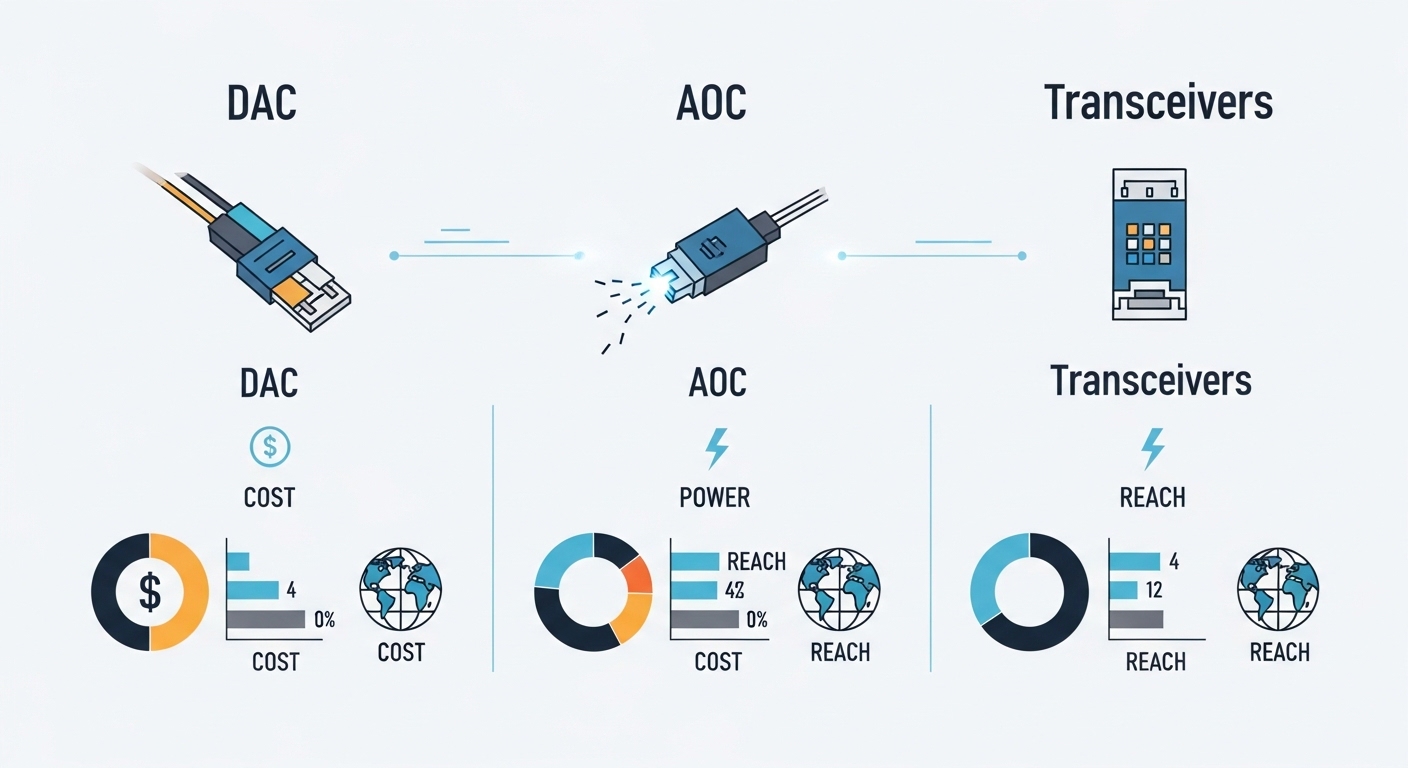
DAC typically wins when you only need short reach within the same row or pod, because copper transceivers or integrated cables are inexpensive and simple. AOC can win when you need optics-like reach flexibility or want lower EMI sensitivity and easier cable management, especially in dense sites with strict bend radius rules. The cost gap is not only purchase price; it is also installation labor, power usage, spares strategy, and how often you will swap parts during thermal cycling.
From a field perspective, I have seen teams budget for 10G to 100G optics and then get surprised by hidden costs: extra patch panel adapters, time spent reseating connectors, and the operational overhead of mismatched vendor optics. In telecom applications, where uptime is measured in hours per year, a “cheap” link can become expensive if it increases troubleshooting time.
Technical specs that drive cost: reach, optics behavior, and power
Cost comparisons are meaningful only when the optics class matches the link. DAC is generally limited to short distances due to electrical loss, while AOC uses optical signaling and can support longer reaches with fewer attenuation penalties. The key is to align the transceiver/cable type with IEEE-compliant electrical/optical signaling and the switch port requirements.
Most modern telecom switching ports support common data rates, but compatibility varies by vendor and optics diagnostics. For AOC, DOM support usually includes temperature, supply voltage, and optical power; for DAC, DOM is often limited but may still report link metrics. Always validate with your switch vendor’s optics interoperability matrix and confirm optical budget assumptions before procurement.
| Spec | DAC (Direct Attach Copper) | AOC (Active Optical Cable) |
|---|---|---|
| Typical data rates | 10G, 25G, 40G, 100G (varies) | 10G to 400G (varies by product line) |
| Typical reach | ~1 m to ~7 m (common for 25G/100G) | ~10 m to 100 m+ (depends on fiber type and wavelength) |
| Wavelength / medium | Electrical copper over twin-ax | Optical (often 850 nm multimode) |
| Connectorization | Integrated ends; often no fiber connectors | Integrated cable ends; fiber connectors integrated |
| Power draw (rule of thumb) | Often higher per watt than optics at longer reach not applicable | Can reduce power vs some active copper, varies by vendor |
| Diagnostics (DOM) | May support limited DOM | Often supports fuller DOM telemetry |
| Operating temperature | Typically 0 to 70 C (check datasheet) | Often -5 to 70 C or similar (check datasheet) |
When selecting for telecom applications, benchmark against real vendor parts you can source. For example, optics-like modules such as Cisco SFP-10G-SR or Finisar FTLX8571D3BCL exist for comparison, but AOC pricing usually targets cable-in-one-piece deployments rather than discrete transceivers.
Authority references to anchor standards and behavior: IEEE 802.3 Ethernet physical layer definitions and vendor guidance on optics and diagnostics are critical for avoiding “it negotiated but is unstable” outcomes. [Source: IEEE 802.3 Ethernet standards] and [Source: vendor datasheets and compatibility guides]
Cost model: purchase price, installation labor, and power
To estimate TCO, separate the line item into three buckets: (1) hardware purchase, (2) installation and spares, and (3) energy and downtime risk. Purchase price depends on whether you buy DAC by length or AOC as a complete active cable. Installation labor depends on cable routing complexity, connector accessibility, and whether you need patch panels or fiber management. In telecom applications, downtime risk is often the largest non-obvious cost.
Illustrative example for a 100G leaf-to-spine deployment: assume you need 200 links per rollout phase. If DAC costs $80 to $140 per link installed-hardware equivalent and AOC costs $130 to $220 per link, the raw delta might be $10,000 to $18,000 for the phase. However, if AOC reduces installation time by even 15 minutes per link due to simpler routing, and your labor rate is $100 per hour, you save 200 x 0.25 x 100 = $5,000 in labor alone. If AOC also lowers rework due to connector strain, the “soft cost” can outweigh the purchase difference.
Decision checklist for telecom applications (DAC or AOC)
Use this ordered checklist during design and procurement. It prevents the classic mistake of comparing prices without validating link budgets and operational constraints.
- Distance and reach margin: Include worst-case path length, patch panel slack, and connector loss; do not plan at the maximum rated reach.
- Switch compatibility: Confirm the port supports the cable type and data rate; verify interoperability with your specific switch model and firmware.
- DOM support needs: If your NMS relies on telemetry, ensure DOM fields exist and match your monitoring expectations.
- Operating temperature and airflow: Validate cable spec for the cabinet’s measured inlet temperature; AOC performance can degrade if thermal margin is too thin.
- Budget and spares strategy: Plan sparing based on failure likelihood and expected swap time during maintenance windows.
- Vendor lock-in risk: If you standardize on one vendor’s AOC ecosystem, confirm sourcing continuity and lead times for future expansions.
Pro Tip: In telecom applications, the fastest way to cut total cost is often not “buy the cheapest cable,” but to standardize on a telemetry-friendly choice. When DOM telemetry is consistent, you reduce mean time to repair (MTTR) because you can isolate optical power drift or thermal events before a full outage.
Common mistakes and troubleshooting tips
1) Selecting reach at the limit. Root cause: planners choose a rated length without accounting for patch panel loss, bend radius, or temperature effects. Solution: add a 20% reach margin and validate with vendor optical budget guidance for AOC.
2) Ignoring DOM behavior differences. Root cause: monitoring systems alert on missing or differently named DOM fields, leading to false positives or blind spots. Solution: test in a staging rack, confirm DOM telemetry mapping, and align with your NMS templates.
3) Overlooking connector handling and strain. Root cause: repeated reseating, tight cable bends, or tugging on fiber ends during moves causes intermittent link flaps. Solution: train technicians, enforce bend radius rules, and use proper cable management with strain relief.
4) Assuming all switches treat the same cable “equally.” Root cause: firmware and port diagnostics can reject certain cable types at boot or downgrade link parameters. Solution: confirm firmware compatibility and run link bring-up tests with error counters under load.
Cost and ROI note: what usually pays back
If your telecom applications are strictly short-reach within a rack or adjacent rows, DAC often provides the best cost-to-performance ratio. If you face frequent moves, complex routing, or you need consistent optics-like telemetry at longer reach, AOC can deliver better operational ROI even when purchase price is higher. In my experience, the ROI hinges on labor and MTTR: a small reduction in troubleshooting time across hundreds of links can eclipse the initial spend.
For realistic pricing, expect wide variance by data rate and supplier, but a reasonable planning band is $80 to $220 per link for 10G to 100G class deployments, excluding install labor. TCO should also include failure and replacement logistics: shipping, onsite swap time, and the cost of having the wrong spare type.
FAQ
Q: Are DAC and AOC both valid for telecom applications at 10G and 25G?
A: Yes, both are commonly used, but the reach limits differ. Validate switch port support and ensure the cable type meets the required physical layer for your exact data rate.
Q: Does AOC always provide better diagnostics than DAC?
A: Not always, but AOC products more often include richer DOM telemetry.
