
When a leaf-spine fabric looks healthy at idle but collapses under synchronized traffic bursts, engineers often suspect “bad hashing” or oversubscription. In practice, many failures trace back to how bonded fiber links are built with LAG/LACP and fiber transceivers: mismatched optics, uneven loss, inconsistent DOM readings, or overlooked physical-layer constraints. This article helps data center and campus network operators validate bonded links end-to-end, from optics selection to LACP counters and post-install measurements.
Problem, environment specs, and why LACP-bonded fiber breaks
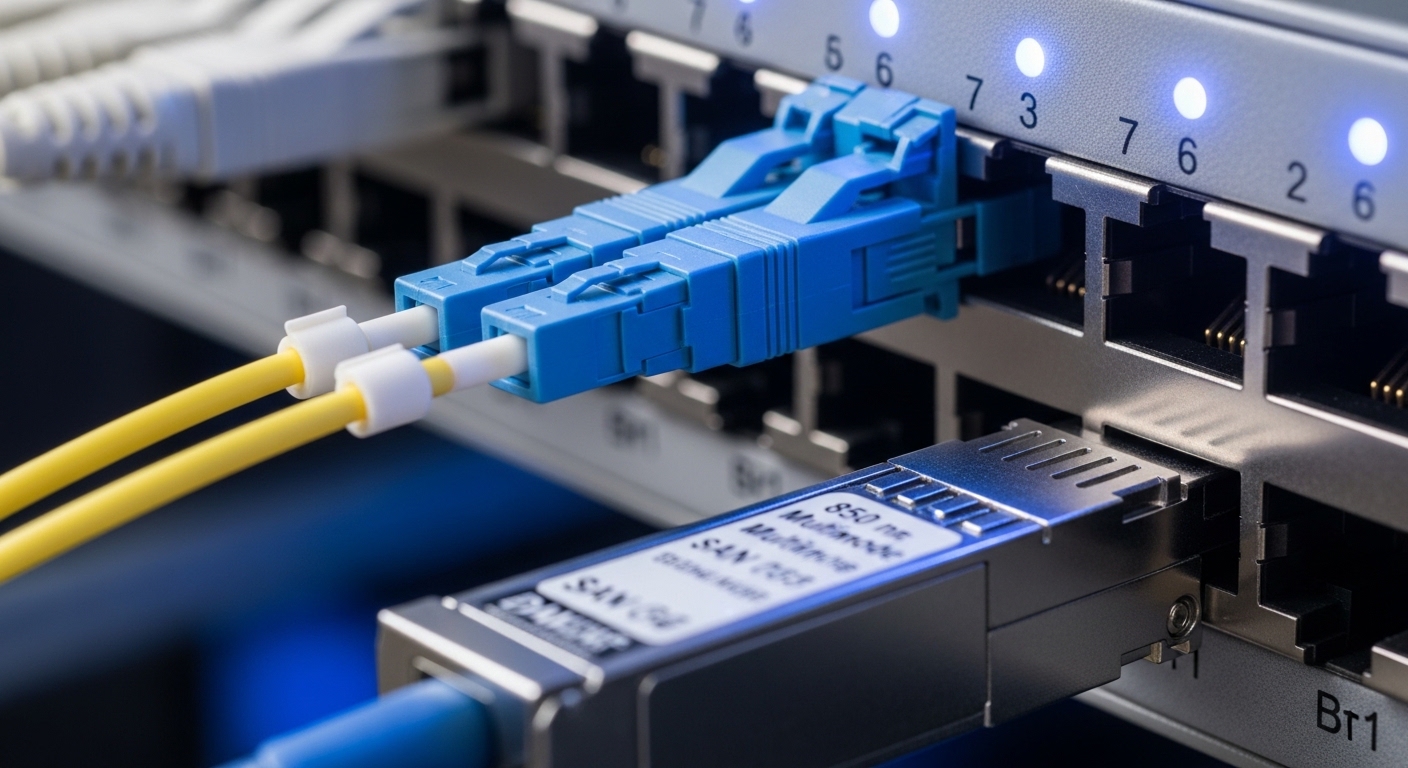
In a 3-tier data center with 48-port 10G ToR switches per pod and 2 spine pairs, we deployed LACP between each ToR and the spines using two 10G SR uplinks per bundle. The challenge started after a storage migration: during snapshot replication, throughput oscillated between 6 and 9 Gbps per flow group, while link utilization hit 95%+ and microbursts triggered application timeouts. Packet captures showed frames were redistributed by hashing, but retransmissions increased and optical power drift differed between the two member links.
Environment specifics mattered. We ran multimode fiber (OM4) from patch panels to transceiver cages, with ~38 m average length and frequent re-termination during phased cabling. The ToR and spine vendors supported LACP, but they applied different defaults for LACP timers and required consistent optics type and DOM reporting for accurate diagnostics. IEEE behavior also matters: LACP is specified in IEEE 802.1AX and LAG behavior in IEEE 802.3 for Ethernet PHY operation; the physical layer must still meet the transceiver’s link budget requirements. Source: IEEE 802.1AX
Chosen solution: bonded fiber links built from matched transceivers
We replaced the original mixed optics (one OEM and one third-party) with matched, vendor-documented transceivers across all members of each LACP bundle. For 10G SR over OM4 at ~40 m, we used Finisar FTLX8571D3BCL style 850 nm multimode modules where supported, and in other racks we standardized on Cisco SFP-10G-SR equivalents to avoid vendor diagnostic mismatches. The critical point was not brand alone; it was ensuring same wavelength class, same reach class, and consistent DOM parameters so each member link stayed within the same optical operating window.
Key specifications we verified against vendor datasheets included wavelength, nominal reach, optical power class, receiver sensitivity, connector type, and operating temperature. We also checked whether the switch enforced DOM presence and whether it refused “unknown” module types for diagnostics. Vendor datasheets and transceiver compatibility notes are the most reliable sources for these constraints. Source: Cisco SFP module documentation
| Spec | 10G SR (850 nm MMF typical) | What we validated in bonded fiber links |
|---|---|---|
| Data rate | 10.3125 Gbps (10G Ethernet) | Switch port speed forced to 10G on both members; no auto-neg mismatch |
| Wavelength | 850 nm | Same wavelength class across all LACP members to keep loss comparable |
| Reach (OM4) | Typically ~300 m class | Budgeted for patch panel loss and bends; used link margin targets |
| Connector | LC | Consistent LC polarity and identical patch lead types |
| DOM support | Commonly includes temperature, voltage, bias, Tx/Rx power | Verified DOM readings stable and within alarm thresholds |
| Operating temperature | Commercial/industrial variants vary; often 0 to 70 C | Checked cage airflow during summer; avoided marginal modules |
Pro Tip: In bonded fiber links over MMF, the most common “LACP looks fine but performance is bad” cause is not LACP at all. It is unequal optical loss and retransmissions between member links, often triggered by different patch lead types, connector contamination, or mixed optics that report DOM differently. Always compare Tx/Rx power and error counters per member, not only bundle-level utilization.
Implementation steps: from optics to LACP counters and acceptance tests
We treated the deployment like an optical acceptance test plus an LACP validation. First, we built an inventory: for every bundle, both member ports were mapped to identical transceiver part numbers and type codes, then labeled at the cage. Second, we cleaned every LC connector using appropriate cleaning tools and inspected under magnification; we repeated this after any re-termination. Third, we set port parameters explicitly: speed and duplex fixed at 10G full, LACP mode set to active on both ends, and timers aligned to avoid asymmetric churn.
Operational checks engineers should run
- DOM alignment: Confirm Tx power and Rx power are within the vendor’s expected range and that alarms are clear on both members.
- Error counters per member: Track FCS errors, CRC errors, and interface drops individually; bundle-level counters can hide a “sick” member.
- LACP state: Verify both links are in the “selected” state for the aggregator on both ends; confirm consistent actor/partner system IDs.
- Hash behavior sanity check: Run controlled traffic streams and observe whether flows spread across both member links without excessive imbalance.
Measured results and lessons learned from the migration
After standardizing transceivers and cleaning/re-terminating OM4 patch paths, the same snapshot replication workload stabilized. Per-bundle throughput increased from 6–9 Gbps oscillation to a steady 9.6–10.1 Gbps with reduced retransmissions. CRC and FCS errors dropped to near-zero, and interface drops ceased during peak windows. LACP selection remained consistent; both members stayed selected for the full test period.
We also learned that bonded fiber links fail in ways that look like routing or application issues. The original mixed-optics set produced different Rx power readings under the same patch path conditions, and one member flirted with receiver sensitivity during temperature swings. Standardizing on identical transceiver models reduced that variance, and aligning LACP configuration prevented churn when optical alarms briefly triggered.
Selection criteria checklist for bonded fiber links with fiber transceivers
Use the following ordered factors when selecting optics for LACP bundles. This is the same sequence we used during rollout planning and it reduces late-stage rework.
- Distance and optical budget: Ensure the transceiver reach class exceeds measured fiber length plus patch panel, connector, and splice losses.
- Wavelength and fiber type match: Confirm 850 nm for SR MMF or the correct wavelength for LR/ER; avoid “works on one rack” assumptions.
- Switch compatibility: Validate module type acceptance and whether the platform enforces DOM presence or specific vendor IDs.
- DOM support and alarm thresholds: Compare DOM fields and verify that both member links report meaningful Tx/Rx power and temperature.
- Operating temperature and airflow: Check switch cage airflow; avoid pushing optics near upper temperature limits.
- Vendor lock-in risk: OEM optics may simplify diagnostics; third-party can be cost-effective but must be tested per platform and per cage population.
Common mistakes and troubleshooting tips
Below are frequent failure modes we saw with bonded fiber links and how to fix them. Treat each as a root-cause hypothesis, then validate with per-member telemetry.
-
Mistake: Mixing transceiver vendors or part numbers within the same LACP bundle.
Root cause: Different laser bias behavior and DOM reporting can lead to unequal Rx margin, increasing CRC/FCS errors on one member.
Solution: Standardize to identical part numbers or at least identical wavelength and reach class; then verify Tx/Rx power alignment under load. -
Mistake: Assuming LACP bundle counters reflect link health.
Root cause: One member can experience higher loss or contamination while the aggregator still forwards traffic, masking retransmissions.
Solution: Inspect per-port counters (CRC/FCS, drops) and DOM alarms for each member independently. -
Mistake: Re-terminating patch leads without re-cleaning connectors.
Root cause: Film residue on LC endfaces increases insertion loss and can cause receiver sensitivity issues.
Solution: Clean and inspect with magnification before reconnecting; replace suspect patch cords and confirm polarity. -
Mistake: Leaving port settings to auto-neg or mismatched LACP timer defaults.
Root cause: Asymmetric behavior can cause aggregator re-selection events or inconsistent member participation under transient errors.
Solution: Force speed/duplex, align LACP mode/timers, and confirm both ends keep members selected.
Cost and ROI note for bonded fiber links
Typical street pricing for 10G SR optics often falls in a broad range depending on OEM vs third-party sourcing and warranty terms. In many deployments, OEM modules can cost roughly 2x to 3x compared to third-party equivalents, but reduce the risk of incompatibility and shorten troubleshooting time when optics-related alarms appear. Total cost of ownership also includes rework: if a mixed-optics bundle causes intermittent CRC bursts, engineer hours and downtime can outweigh any per-module savings.
For ROI, treat optics as part of a reliability system. If you standardize on matched optics and enforce cleaning/inspection, you can reduce mean time to recovery and lower the probability of “mystery performance” incidents that consume change windows and operational staff time.
FAQ
Do bonded fiber links require identical optics models on both member ports?
For best results, yes. LACP will aggregate links even when optics differ, but unequal loss and receiver margin can cause retransmissions on one member. Standardizing part numbers (or at least wavelength and reach class) keeps Tx/Rx power behavior more consistent.
How can I confirm LACP is actually using both members?
Check the switch’s LACP aggregator status and verify both member ports are in the selected state. Then confirm per-port traffic counters increase during a controlled test; bundle totals alone can hide imbalance.
What DOM metrics matter most for troubleshooting bonded fiber links?
Focus on Tx power, Rx power, and temperature, plus any module alarms. If one member shows consistently lower Rx power or rising error counters, treat it as a physical-layer issue first.
Can third-party fiber transceivers work reliably in LACP bonded setups?
They can, but you must validate compatibility with your specific switch models and confirm DOM behavior. Test optics in the same cage population and airflow conditions, and avoid mixing part numbers within a bundle.
What is the fastest way to troubleshoot intermittent CRC errors on one LACP member?
Inspect connector cleanliness and patch lead condition, then compare DOM Rx power and per-port CRC/FCS counters. If errors correlate with temperature or specific patch paths, re-terminate or replace the affected fiber components.
Does IEEE 802.1AX guarantee performance distribution across LACP members?
IEEE 802.1AX defines LACP behavior and negotiation, but it does not guarantee per-flow or per-packet perfect balance. Distribution depends on the switch’s hashing scheme and the traffic pattern, so validate with real workloads.
Bottom line: bonded fiber links succeed when optics, optics health, and physical-layer cleanliness are treated as first-class engineering inputs, not afterthoughts. If you want the next practical step, review your LACP configuration and hashing expectations using link aggregation LACP best practices for fiber networks.
Author bio: I’m a field-focused photographer and network reliability writer who documents how optics and cabling choices affect real traffic. I work with engineers on measurable acceptance tests, including DOM telemetry, LACP state validation, and optical error counter analysis.
