
In edge deployments, every cabling decision affects uptime, cooling, and upgrade speed. This article helps SMB engineers and IT managers choose between AOC and DAC for short-reach links in leaf-spine, campus, and industrial sites. You will get concrete engineering criteria, real module examples, and troubleshooting patterns you can apply during installs and audits.
Why edge links feel different: power, vibration, and upgrade cadence
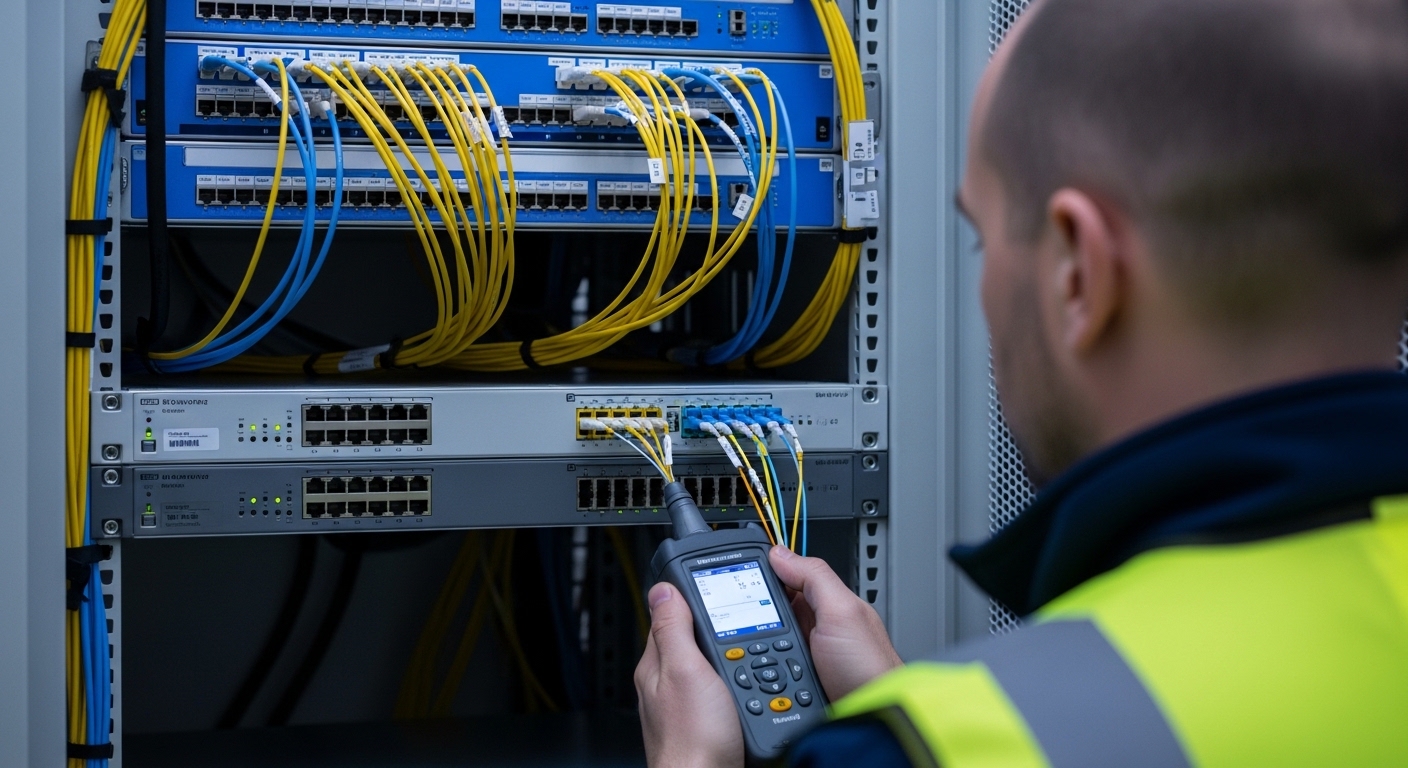
In a traditional data center, DAC and AOC are often treated as interchangeable short-reach optics. In edge computing, constraints change: racks may be enclosed, power budgets tighter, and physical access limited by shipping, vibration, or ongoing operations. AOC (Active Optical Cable) moves the “active” electronics into the cable assembly, reducing copper loss and easing cable management through fiber. DAC (Direct Attach Copper) keeps everything as a passive copper assembly, which can be cheaper but more sensitive to reach, EMI, and connector health.
From a standards perspective, Ethernet optics behavior is governed by electrical and optical interface requirements described by IEEE 802.3 for link rates and coding, while the physical layer implementation details are vendor-specific. For optical transceivers and cabling, you will also see references to ANSI/TIA-568 fiber cabling practices for installation quality, and vendor datasheets for thermal and DOM (Digital Optical Monitoring) behavior. In practice, your decision hinges on whether you need the fiber “system benefits” of AOC without committing to full transceiver-based optics.
DAC vs AOC in edge computing: specs that actually change outcomes
Both DAC and AOC can support 10G/25G/40G/100G Ethernet short reach, but the trade space differs. DAC typically uses copper twinax with a fixed reach and strict signal integrity margins. AOC uses optical transmission with an integrated transmitter and receiver, so it handles higher attenuation and reduces the impact of copper bend radius and electromagnetic interference. The “edge win” for AOC is often operational: fewer field failures tied to copper corrosion and easier cable routing when racks are crowded.
Typical module and cable characteristics you should compare
Below is a representative comparison using common enterprise and SMB-compatible parts. Actual compatibility depends on your switch vendor’s optics matrix and firmware (especially for vendor-locked transceiver authentication and DOM support), but these parameters are a strong starting point for procurement and lab validation.
| Attribute | DAC (Direct Attach Copper) | AOC (Active Optical Cable) |
|---|---|---|
| Medium | Copper twinax | Fiber (usually multimode) |
| Common Ethernet rates | 10G, 25G, 40G (varies by vendor) | 10G, 25G, 40G, 100G (varies by vendor) |
| Reach class | Often 1 m to 7 m (fixed by SKU) | Often 10 m to 100 m (SKU dependent) |
| Connector type | Typically fixed ends (no separate transceiver) | Fixed ends or transceiver-like ends (vendor dependent) |
| Wavelength | N/A | Multimode often 850 nm |
| Optical monitoring | N/A or limited | Often supports DOM (varies) |
| Power profile | Lower per link in many cases | Typically higher than DAC but can reduce system power via fewer retransmits |
| Installation sensitivity | High signal integrity sensitivity to bend and connector wear | Less sensitive to EMI; still needs clean fiber handling |
| Temperature range | Varies by SKU (often 0 to 70 C) | Varies by SKU; many are 0 to 70 C, some higher for industrial |
Real examples engineers commonly stock
On the AOC side, SMBs often find 25G and 40G multimode AOCs easiest for edge access control and patch-panel workflows. Examples of widely referenced optics families include Cisco-compatible 10G SR optics such as Cisco SFP-10G-SR and third-party multimode optics like Finisar FTLX8571D3BCL and FS.com SFP-10GSR-85, though those are transceivers rather than AOC cables. For AOC assemblies, the key is the exact cable SKU: it may be 850 nm multimode, a specific length, and a defined temperature grade per vendor datasheet.
For DAC, you will see many SKUs labeled by exact length (for example, 1 m, 3 m, 5 m, or 7 m) and sometimes by reach compliance class. The edge reality is that a “close enough” length substitution can degrade link margin and cause intermittent drops that only appear under load.
Pro Tip: In field audits, engineers often discover that “works on day one” is not the same as “stable at 24/7 utilization.” For DAC, a slightly longer-than-rated twinax or a connector that has been reseated too many times can push the link into a marginal equalization regime, producing rare CRC spikes that show up only after traffic bursts.
Selection criteria checklist: how SMB teams decide without lab time
If you cannot run a full optical link validation lab, you still can make a disciplined choice. The goal is to select the AOC or DAC that matches your physical topology and operational risk profile, then verify with basic monitoring after installation.
- Distance and margin: confirm the exact SKU reach class (DAC is usually fixed by length; AOC varies by cable design). If you expect cable slack changes, AOC is often more forgiving.
- Switch compatibility and optics mode: check your switch vendor’s compatibility list for the specific AOC/DAC cable type. Some platforms require DOM behavior or specific vendor authentication.
- Connector and maintenance model: DAC frequently uses fixed ends; if you must rework frequently, fiber patch workflows with AOC can simplify replacement.
- DOM and telemetry needs: if your edge site uses monitoring dashboards, prefer AOC assemblies that expose DOM so you can track optical power and error counters.
- Operating temperature and airflow: edge enclosures can exceed 35 C during peak loads. Use datasheets for the temperature range and derating guidance.
- EMI environment: near motors, variable frequency drives, or industrial power cabling, DAC can show more sensitivity. AOC typically reduces copper EMI coupling.
- Vendor lock-in risk: evaluate whether third-party AOC/DAC is accepted and stable on your switch model. Plan spares that you can deploy quickly.
- Failure mode tolerance: if downtime costs are high, consider AOC even if unit cost is higher, because fiber routing and monitoring can reduce “mystery outages.”
Decision shortcut for common edge topologies
For rack-to-rack links where you need 10G/25G across moderate distances and cable management matters, AOC is often the pragmatic default. For very short runs (for example, from ToR to an adjacent server row within 1 m–3 m), DAC can be cost-effective and quick to deploy—provided you follow bend radius guidance and avoid repeated reseating.
Real-world deployment scenario: SMB edge with 48-port 25G ToR
Consider a retail distribution site running edge compute for inventory analytics. The network uses a 3-tier design: access switches feed a small spine pair, and compute nodes connect via ToR switches. In one rollout, the SMB deployed two 48-port 25G ToR switches, each with server and storage uplinks. Uplinks to the spine were routed through a partially enclosed aisle with limited airflow; average ambient temperature was 38 C during business peaks.
Initially, the team used DAC for the uplinks at 3 m because it matched the shortest inventory SKU. After two months, they observed intermittent link resets during afternoon traffic bursts, and the switch logs showed rising CRC and link flaps. They replaced the uplinks with 25G 850 nm multimode AOC assemblies at the same lengths, and also enabled optics/port monitoring. The change reduced physical connector wear, improved routing flexibility, and provided clearer monitoring signals; the link resets stopped, and the team standardized on AOC for all uplinks longer than 2 m.
Cost, TCO, and ROI: when AOC wins despite higher unit price
Unit pricing varies widely by region, vendor, and volume, but you can use realistic planning ranges. DAC cables are often cheaper upfront, especially for 1 m–3 m runs; AOC typically costs more per link because it includes optical transceiving electronics inside the cable. However, total cost of ownership can flip when you include labor time, spares strategy, and reduced troubleshooting.
In a typical SMB edge deployment, the TCO drivers are:
- Spare readiness: AOC often comes in standardized lengths that can be swapped quickly without re-terminating fiber.
- Lower field failure rates: copper connectors can suffer from mechanical wear, oxidation, and repeated handling; fiber assemblies avoid many of these issues.
- Operational visibility: DOM telemetry (when supported) can reduce time-to-isolation for marginal links.
- Power and retransmit effects: while AOC may use more power than DAC, stable links can reduce retransmissions and CPU overhead from error recovery.
Budgeting approach: if downtime is expensive or troubleshooting windows are short, AOC’s higher purchase price can be ROI-positive within a single incident avoided. If your edge is extremely cost constrained and distances are always within the tight DAC spec, DAC can still be the right answer—just pair it with a strict installation checklist.
Common mistakes and troubleshooting tips in the field
Edge installations fail in predictable ways. Below are frequent DAC vs AOC pitfalls, including root cause and what to do next.
Using the wrong DAC length or ignoring bend radius
Root cause: Twinax equalization is margin-limited; a slightly longer cable or excessive bending can reduce signal quality, causing CRC spikes and intermittent link drops.
Fix: Replace with the exact vendor-rated length; route with gentle bends; avoid tight loops near power rails; verify link counters after a full traffic soak.
Assuming “multimode works” without checking connector cleanliness
Root cause: With AOC and fiber-based links, dust on optical interfaces can attenuate the signal, leading to link instability that looks like “random packet loss.” Even if the cable is new, transport vibration can contaminate ends.
Fix: Inspect and clean using approved fiber cleaning tools; replace dust caps only when ready to connect; verify with port optical power or error counters if DOM is available.
Buying AOC/DAC that is not compatible with the exact switch model
Root cause: Some switches enforce optics compatibility rules, including DOM format expectations or module identification behavior. Incompatibility can cause ports to stay down or run with degraded settings.
Fix: Use the switch vendor’s compatibility list where available; test one link in a maintenance window; keep a known-good spare for rollback.
Overlooking temperature and airflow around the cable assembly
Root cause: Edge enclosures can trap heat. If the cable’s operating range is exceeded, optical power and electrical drive currents can drift, raising BER and causing retransmits.
Fix: Check thermal maps; improve airflow or add a targeted fan; confirm the module temperature grade in the datasheet; monitor error counters over a week, not just minutes.
FAQ
Is AOC always better than DAC for edge computing?
No. For very short runs and strict cost targets, DAC can be more economical and fast to deploy. AOC becomes compelling when distances are less predictable, EMI is present, or you want better monitoring and easier cable management.
What wavelength should I expect for common AOC in SMB networks?
Most short-reach AOC deployments in enterprise settings use 850 nm multimode. The exact wavelength and fiber type must match the cable SKU and your existing fiber plant. Always confirm in the vendor datasheet.
Do AOC cables support DOM on edge switches?
Many AOC assemblies support DOM-like telemetry, but support is not universal and depends on the switch and cable design. If you need monitoring for troubleshooting, verify DOM support in the switch compatibility guidance and vendor documentation.
Can I mix AOC and DAC on the same switch without issues?
Usually yes, but compatibility still matters. The switch may treat different optics differently for thresholds and diagnostics, so validate at least one link per type and monitor CRC, BER, and link stability.
What is the fastest way to validate link health after installation?
Enable interface statistics and error counters, then run a controlled traffic test that matches peak workload patterns. Leave the test running long enough to catch intermittent issues, and compare counters before and after the swap.
How should SMBs plan spares for edge optics?
Stock spares by exact length and exact rate, plus one known-good rollback option. If your monitoring depends on DOM, stock spares that provide the same telemetry behavior so your incident response stays consistent.
In edge computing, choosing AOC vs DAC is less about theoretical reach and more about operational stability: monitoring, installation realities, and repeatable maintenance. If you want the next step, review your current cabling plan and map it to a standardized optics policy using fiber cabling and link budgeting basics.
Author bio: I have deployed and troubleshot Ethernet optics in production edge racks, validating link stability with interface counters and optical telemetry under real traffic loads. I write with an operator mindset: measured constraints, compatibility caveats, and practical spares planning.
