
High-speed links fail in frustrating ways: flakey ports, link training timeouts, and “it works on the bench, not in production” surprises. This article helps network builders and field engineers choose between AOC and DAC for short- to mid-reach designs, with hands-on selection steps, compatibility checks, and troubleshooting patterns. You will get a practical decision checklist, a specs comparison table, and realistic cost and ROI expectations for 25G, 40G, 100G, and beyond.
Step-by-step prerequisites before you compare AOC and DAC
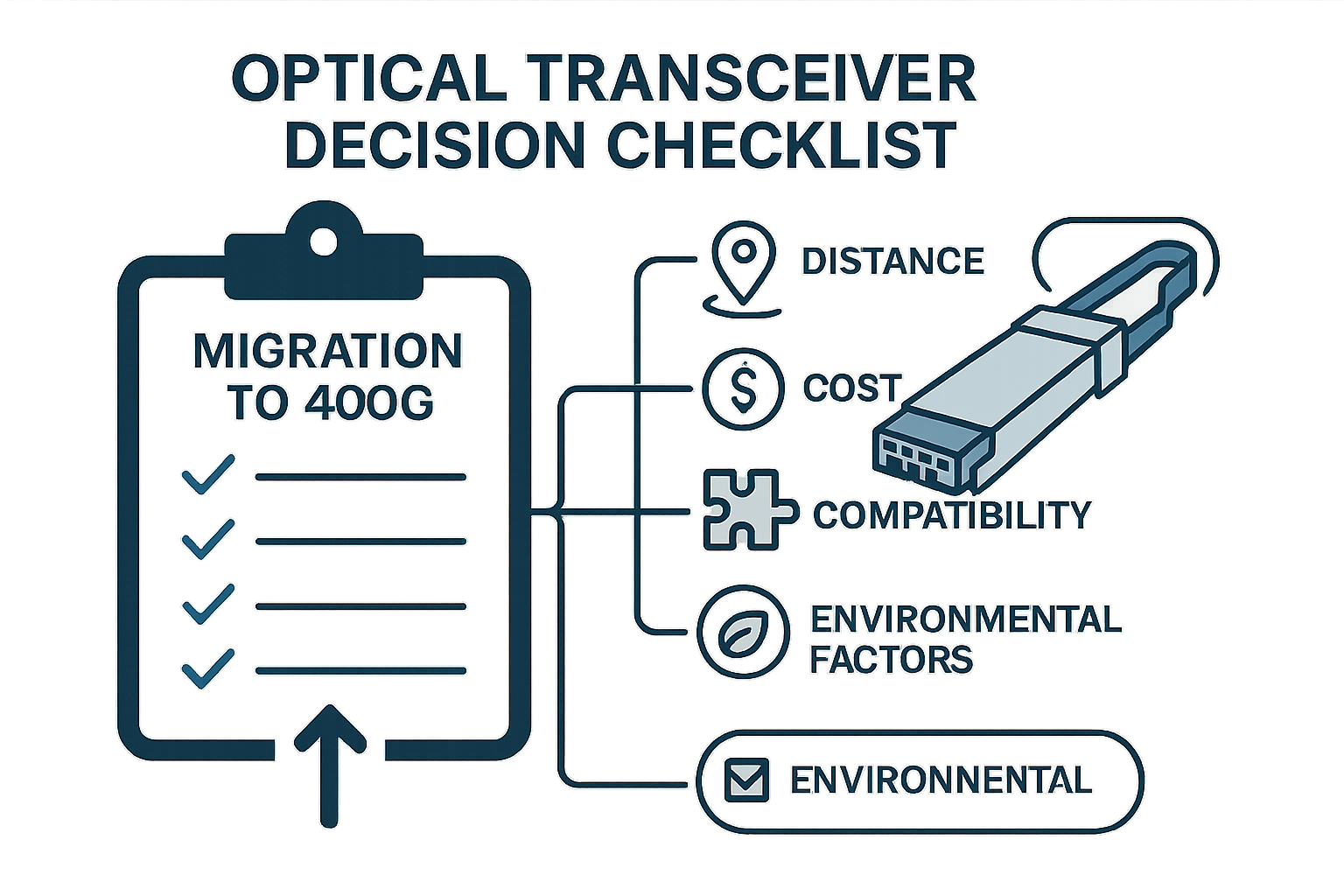
Before you even open a datasheet, align the physical layer plan with the switch and optics ecosystem. DAC and AOC both carry electrical-to-optical or fully electrical signaling depending on form factor, so the compatibility story is as important as the raw reach rating. Treat this as a commissioning checklist: gather port type, speed, lane mapping, connector standard, and optical budget assumptions.
Prerequisites checklist (do this first)
- Confirm the target interface: e.g., QSFP28, SFP28, OSFP, QSFP-DD, or CXP. Record the exact port type on your switch model.
- Lock the line rate: 25G, 40G, 100G, 200G, 400G. Verify whether the platform supports native mode only or also supports breakout (for example, 100G to 4x25G).
- Check optics support and DOM behavior: see whether the switch requires Digital Optical Monitoring, and whether it expects specific vendor ID behavior.
- Measure the path: use a tape measure and route map. For fiber, count bends and estimate effective loss; for DAC, account for cable routing constraints and minimum bend radius.
- Define environmental limits: rack ambient temperature, airflow, and any vibration exposure. Many modules specify a temperature operating range and a derating curve.
Expected outcome: you will know which connector standard and speed profile you are targeting, and you will avoid the most expensive failure mode: buying the wrong form factor or unsupported DOM behavior.
How AOC works (and why it changes the link budget)
An AOC (Active Optical Cable) is an integrated optical transceiver system: a short optical cable with built-in transmit and receive electronics. Unlike a DAC, which is purely copper electrical signaling, AOC uses optical signaling to reduce electrical loss over distance and to improve EMI behavior. In practice, this means AOC often behaves more “fiber-like” in reach and signal integrity, while still being a cable you can plug in without separate transceivers.
Key technical parameters that matter
When comparing AOC to DAC, focus on the physical layer constraints that affect link training, error rates, and operational stability. Look for wavelength, connector type, reach class, power consumption, and whether the module provides DOM data. Also confirm the speed and modulation scheme align with IEEE and vendor requirements for the specific port generation.
Real-world deployment scenario
In a 3-tier data center leaf-spine topology, a team runs 48-port 25G ToR switches to a spine using 10G/25G uplinks across a mix of short and medium runs. In one pod, the uplink paths are about 18 m from top-of-rack to a patch panel and another 3 m to the spine, with tight cable trays and frequent maintenance access. They initially used DAC on the shortest links and AOC on the longer ones; after an airflow upgrade raised rack ambient from 23 C to 31 C, they saw fewer intermittent CRC drops on AOC links compared to marginal DAC runs routed around sharper corners. The lesson: routing geometry and thermal conditions can make DAC behave worse than its datasheet reach suggests.
AOC vs DAC: the specs comparison engineers actually use
Specs are not just marketing numbers; they drive compatibility, installation success, and operational cost. Below is a practical comparison for typical enterprise and data center use cases. Always validate against your switch vendor’s supported optics list, but this table gives you a baseline for what to ask for.
| Spec | AOC (Active Optical Cable) | DAC (Direct Attach Copper) |
|---|---|---|
| Typical data rates | 25G to 400G by platform | 10G to 400G by platform |
| Signaling type | Optical (integrated Tx/Rx) | Electrical copper twinax |
| Wavelength | Common multimode: 850 nm (model dependent) | N/A (copper) |
| Typical reach | Often 3 m to 100 m+ (model dependent) | Often 0.5 m to 7 m (model dependent) |
| Connector style | Usually fixed cable end to QSFP28/SFP28/OSFP, etc. | Fixed cable end to QSFP/QSFP28, etc. |
| DOM / monitoring | Often includes DOM via module EEPROM | Often includes cable/ID data; DOM-like behavior varies |
| Power draw | Typically higher than DAC but lower than separate transceivers | Lower per link in many short-run cases |
| Operating temperature | Commonly 0 C to 70 C class, verify per model | Commonly 0 C to 70 C class, verify per model |
| EMI behavior | Better immunity due to optical path | More sensitive to electrical noise and routing |
Expected outcome: you can translate the spec sheet into installation reality: reach class, optical wavelength expectations, and monitoring behavior that affects “link up” reliability.
Pro Tip: If your switch logs show “link training failed” or “high BER then recover,” do not assume the optics are bad. For DAC, check routing geometry first: minimum bend radius, cable twist, and proximity to power busbars can shift the effective channel loss profile. For AOC, verify that the selected model matches the platform’s expected optical type (for example, multimode 850 nm vs other variants) and that DOM reads cleanly during link bring-up. [Source: IEEE 802.3 Ethernet physical layer requirements]
Decision checklist: when AOC beats DAC (and when DAC wins)
Use this ordered checklist during planning and procurement. The best choice depends on distance, installation constraints, and the switch vendor’s compatibility rules.
- Distance and margin: if you are approaching the DAC reach edge, AOC typically gives you more signal integrity margin.
- Routing constraints: tight trays, sharp turns, and frequent rework favor AOC because optical links are less sensitive to electrical channel effects.
- Budget and power targets: DAC often costs less per link and can draw less power for very short runs; AOC may still win on total cost of downtime and fewer field swaps.
- Switch compatibility: confirm the exact transceiver/cable family supported by your switch. Many vendors publish a optics compatibility list.
- DOM support and behavior: some platforms require specific DOM fields or vendor ID patterns for stable telemetry.
- Operating temperature and airflow: if rack ambient is high or airflow is restricted, choose the module with the best proven thermal performance for your model.
- Vendor lock-in risk: third-party AOC can work well, but validate return terms, lead time, and whether the platform rejects unrecognized DOM.
Concrete selection examples
If you are running 25G uplinks over 10 m to 25 m in a dense tray, AOC is often the pragmatic choice. If you need a 1 m to 2 m patch from a short patch panel to a ToR switch, DAC can be the cost-efficient option—especially when you have strong cable management and stable airflow. For 100G and above, compatibility and reach margins become more sensitive, making AOC attractive when you cannot guarantee perfect routing geometry.
Common pitfalls and troubleshooting tips (the field failures)
Even experienced teams get burned. These are the top failure patterns I see during bring-up, along with root causes and fixes. Treat this as a rapid triage script before you escalate to vendor support.
Failure point 1: Link won’t come up after swapping modules
Root cause: incompatible speed profile or wrong form factor for the port generation (for example, QSFP28 vs QSFP+ expectations, or a platform that requires a specific optics type). Sometimes it is also a DOM compatibility mismatch where telemetry fields do not match what the switch expects.
Solution: confirm the port supports the exact interface type at the target rate. Check the switch optics status page for DOM read errors. If supported, try a known-good module from the same vendor family and confirm link negotiation logs. [Source: Cisco and Arista optics compatibility documentation, vendor datasheets]
Failure point 2: High CRC or packet drops that worsen under load
Root cause: DAC channel loss due to routing geometry (tight bends, cable not properly seated, or proximity to noisy power conductors). For AOC, a mismatch of optical type or a marginal optical component can produce elevated BER.
Solution: reroute DAC with proper bend radius and separation from power bundles; reseat connectors and inspect for mechanical strain. For AOC, verify the wavelength class and model number, and test the same link with a different known-good AOC of the same specification.
Failure point 3: Intermittent disconnects during thermal spikes
Root cause: operating outside the module’s temperature assumptions or poor airflow around the port area. Both DAC and AOC can show instability when heat soak increases oscillator drift and receiver sensitivity margins.
Solution: measure rack inlet/outlet temperatures and ensure airflow paths are unobstructed. If the environment is consistently high, prefer modules with verified operating temperature headroom and consider airflow redesign.
Cost and ROI: what to budget for AOC vs DAC
In many procurement cycles, DAC looks cheaper on day one, but AOC can win on installed reliability and reduced field rework. Typical street pricing varies by speed and reach, yet a practical range for planning is often $20 to $80 per DAC for short runs, while AOC for mid-reach can land around $50 to $200 per link depending on data rate and brand. Total cost of ownership should include swap labor, downtime risk, and the cost of troubleshooting time when link issues appear after deployment.
For power and cooling, the difference is usually smaller than the cost of a single maintenance event. If your AOC selection reduces CRC-related escalations and shortens mean time to repair, it can pay back quickly even if the per-link purchase price is higher. Use your vendor’s warranty and return policies as part of ROI math; third-party optics can be cost-effective, but confirm compatibility and failure handling before scaling.
FAQ: AOC buying questions from real network teams
When should I choose AOC instead of DAC?
Choose AOC when you need more reach margin, have complex routing, or want better EMI immunity. If your design is near the DAC reach limit or cables will experience frequent maintenance moves, AOC typically reduces link instability risk.
Do I need DOM with AOC?
Many switch platforms benefit from DOM telemetry for monitoring and troubleshooting, especially during operations. Some platforms may still link without full telemetry, but you should verify DOM requirements in your switch documentation and test in staging.
Can I mix brands of AOC on the same switch?
Often yes, but compatibility is platform-specific. Validate that the switch recognizes the module ID behavior and that the wavelength and speed profile match the port expectations.
What wavelength is typical for AOC in data centers?
For common short- to mid-reach multimode designs, 850 nm is typical, but exact wavelength depends on the product family. Always match the AOC model number to your switch and expected optical type.
How do I troubleshoot elevated errors quickly?
Start with mechanical checks: reseat, confirm connector seating, and verify cable routing and bend radius for DAC. Then isolate by swapping the module at one end and testing the same link path with a known-good reference.
Are third-party AOC modules reliable?
Many third-party modules work well when they are properly specified for your platform and validated before rollout. The risk usually shows up as DOM incompatibility or inconsistent quality across batches, so prioritize return terms and run a staged burn-in test.
Choosing AOC vs DAC is less about “which is better” and more about reach margin, routing realities, and switch compatibility. Next, compare your planned link distances and connector types against your switch’s optics matrix using optics compatibility and DOM testing.
Author bio: I build and troubleshoot high-speed Ethernet links in live racks, focusing on measurable link margin, thermal behavior, and field reliability. I document what works in commissioning so you can deploy faster with fewer surprise escalations.
References & Further Reading: IEEE 802.3bs 400GbE Task Force | OIF 400G Technical Specs | Fiber Optic Association
