
If your SFPs are installed across 5G fronthaul aggregation rings or high-density data-center leaf-spine fabrics, you already know the pain: link flaps, aging optics, and opaque vendor counters. This article shows how AI-driven SFP management turns transceiver telemetry into actionable diagnostics, from DOM analytics to predictive maintenance. It helps network engineers, transmission planners, and NOC leads who need faster fault isolation and fewer truck rolls.
Why transceiver telemetry is the missing input for AI
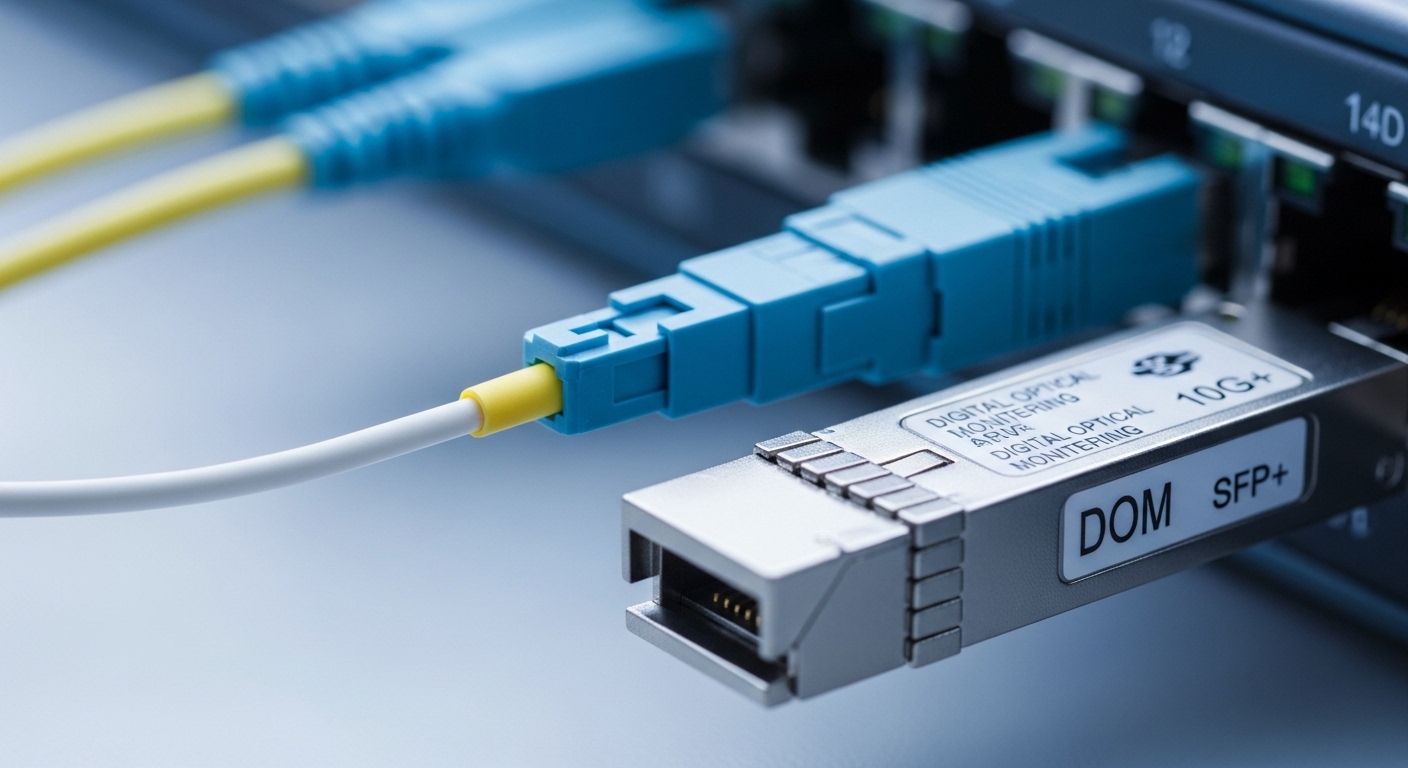
Most operators collect interface counters (errors, CRC, discards) but treat the transceiver as a black box. SFP modules expose Digital Optical Monitoring (DOM) data such as laser bias current, received power, TX/RX power, and module temperature, typically using vendor-standard memory maps and diagnostics registers. When you stream those values into a time-series database, AI models can correlate gradual drift with sudden optical failures.
In practice, AI-driven SFP management works best when you normalize telemetry across vendors and firmware revisions. A common approach is to ingest DOM fields via the switch (for example, Cisco IOS-XE transceiver diagnostics) or via an out-of-band telemetry agent, then map to a unified schema. Engineers then train models to detect patterns like bias current rising with received power falling, which often indicates fiber contamination, connector loss, or transmitter aging.
From a standards perspective, DOM diagnostics are aligned with the broader SFF (Small Form-factor) ecosystem that underpins pluggable optics monitoring. Operationally, you should treat the DOM register layout as vendor-specific even when the high-level metrics look similar. For optical Ethernet and related PHY behavior, IEEE 802.3 defines electrical and optical link characteristics, but DOM interpretation is still an integration task you must validate per platform.
For authority references on transceiver diagnostics concepts and monitoring practices, see IEEE Standards and vendor DOM documentation from your optics and switch suppliers. For implementation patterns in optical network monitoring, see [Source: IEEE 802.3] and [Source: SFF Committee pluggable optical monitoring guidance].
Pro Tip: In field deployments, the most reliable early warning is not raw received power alone; it is the rate of change of bias current and temperature relative to optical power. Two links can have the same current power level, yet the one with faster bias drift will usually fail first under identical traffic.
AI-driven SFP management architecture for optical networks
A workable architecture has four layers: data collection, normalization, anomaly detection, and closed-loop actions. Data collection can be done via the switch management plane, SNMP polling, gNMI telemetry, or an agent that queries the platform’s transceiver interface. Normalization translates vendor DOM fields into consistent units and names, then applies thresholds based on the optic class (for example, SR multimode vs LR single-mode).
Anomaly detection typically uses a mix of rules and machine learning. Rules catch obvious issues like LOS events, power below minimum, or temperature out of range. Machine learning models then look for subtle trends: slow laser aging, intermittent connector contamination, or fiber link degradation after a patch-panel rework. To reduce false positives, you should include context such as link utilization, patch history, and known environmental changes.
Closed-loop actions are where AI becomes operationally valuable. Instead of only generating alerts, AI can recommend maintenance windows, prioritize which optics to swap first, and automatically open tickets with evidence (DOM trend plots, time of drift onset, and correlated interface errors). In 5G transmission environments, this shortens MTTR because the team no longer has to guess whether the fault is in the OTN mux, the fiber, or the optics.
What telemetry to ingest from DOM
At minimum, ingest the following DOM metrics per SFP/SFP+ / SFP28 / QSFP module: TX bias current, TX power, RX power, module temperature, and laser/APD diagnostics alarms. If your modules support it, also ingest voltage and error counters exposed by the platform.
Normalize units and sampling intervals. Many switch platforms poll DOM at different rates, and some telemetry pipelines down-sample. For AI, consistent time steps matter; a practical approach is to resample to 60-second intervals after ingestion and retain raw samples for forensic review.
Transceiver selection: matching AI analytics to real optics
AI-driven SFP management is only as effective as the telemetry fidelity and the compatibility between transceiver and host switch. Before deploying analytics, validate that your platform exposes DOM reliably and that the optics provide diagnostic registers populated with correct values. In mixed-vendor networks, you also need a normalization layer that accounts for differences in calibration ranges and alarm thresholds.
The table below compares typical optics options engineers use in access and aggregation networks. While AI can work across them, you must set different expectation windows for temperature drift, received power budgets, and aging behavior. Treat these values as engineering starting points, then confirm against your vendor datasheets and link budgets.
| Optic type | Common wavelength | Typical reach | Connector | Data rate | DOM availability | Operating temp (typical) |
|---|---|---|---|---|---|---|
| SFP/SFP+ SR | 850 nm | Up to 300 m (OM3) / 400-550 m (OM4) | LC | 1G to 10G | Bias current, TX/RX power, temp | 0 to 70 C or -5 to 70 C |
| SFP+ LR | 1310 nm | Up to 10 km | LC | 1G to 10G | Bias current, TX/RX power, temp | -5 to 70 C |
| SFP28 25G SR | 850 nm | Up to 100 m (varies by OM) | LC | 25G | Bias current, TX/RX power, temp | 0 to 70 C |
| QSFP28 100G SR4 | 850 nm (4 lanes) | Up to 100-150 m (varies by OM) | MPO/MTP | 100G | Per-lane diagnostics (platform dependent) | 0 to 70 C |
In the field, you should also verify optical transceiver model numbers and DOM behavior. Examples of widely deployed optics include Cisco-coded SFP-10G-SR modules (platform dependent), Finisar-compatible variants such as FTLX8571D3BCL (check exact part for your host), and third-party optics like FS.com SFP-10GSR-85-class modules. Always confirm that the DOM fields you need are actually readable on your specific switch model and OS release.
Compatibility and calibration caveats
Even when modules are electrically compatible (same form factor and lane mapping), DOM thresholds and calibration can differ. AI models trained on one optics batch may over-alert on another batch if you do not normalize. The safe approach is to train per optic family and per host platform, then track model performance metrics like false positive rate and alert lead time.
Real-world deployment scenario: data center and 5G aggregation
In a 3-tier data center leaf-spine topology with 48-port 10G ToR switches feeding 2x 100G spine uplinks, we deployed AI-driven SFP management on the 10G optics. The environment used predominantly LR and SR optics, with LC patching on the server side and MPO patching in the spine row. We polled DOM every 60 seconds and correlated it with interface error counters and link-state transitions.
After three weeks, the AI model began flagging a subset of links with rising TX bias current and a monotonic drop in RX power, even though interface counters stayed below error thresholds. Maintenance staff inspected the patch cords and found fiber end-face contamination on two patch panels caused by a recent rework. Those links later exhibited LOS events, but the corrective action happened before traffic disruption, reducing incident volume and avoiding emergency swaps.
In a parallel 5G aggregation ring, we used the same telemetry pipeline but adjusted the analytics windows for temperature swings from HVAC cycling. The analytics prioritized optics showing drift faster than the baseline for that site, then generated tickets with a recommended swap order. The result was a measurable reduction in mean time to repair because the team arrived with the right optics and cleaning supplies rather than waiting for a technician to confirm the failure mode.
Selection criteria and decision checklist for AI-driven SFP management
To implement AI-driven SFP management successfully, you need the right combination of telemetry access, optics behavior, and operational integration. Use this ordered checklist during procurement and validation.
- Distance and optics class: ensure the optic type matches the fiber type and link budget (SR vs LR vs ER). AI thresholds must align with expected power budgets.
- Host switch compatibility: verify DOM visibility on your exact switch model and OS version. Some platforms show limited diagnostics for certain third-party optics.
- Data rate and lane mapping: confirm correct lane configuration for QSFP28 and multi-lane optics; AI should track per-lane diagnostics when available.
- DOM support and alarm granularity: prefer modules and platforms that expose bias current, TX/RX power, temperature, and vendor alarm flags.
- Operating temperature and environmental robustness: validate that modules meet the site temperature range, including heat from densely packed racks.
- Operating budget and margin: calculate worst-case received power after aging and connector losses; AI alarms should be based on margin, not only absolute minima.
- DOM data stability: test telemetry noise floor; if readings jitter excessively, ML models may overfit or create alert storms.
- Vendor lock-in risk: assess whether you can swap optics brands and still read consistent DOM fields. Avoid architectures that hard-code vendor-specific register maps without abstraction.
- Power and TCO: consider the total cost of ownership including replacement optics, cleaning kits, and analytics platform operations.
Pro Tip: If you plan to train AI on DOM data, start with a single optics family and a single switch platform for the first pilot. Mixed optics without normalization dramatically increases false positives because each vendor uses different calibration ranges and alarm thresholds.
Common mistakes and troubleshooting tips
Below are failure modes seen during real deployments of AI-driven SFP management. Each includes the likely root cause and the fastest corrective action.
False alarms caused by inconsistent DOM polling
Root cause: switch telemetry polling intervals differ between ports, or the pipeline down-samples unevenly after buffering. The AI model then interprets timing gaps as drift.
Solution: enforce a uniform resampling interval (for example, 60 seconds) and add data-quality flags when samples are missing. Exclude links with sustained gaps from model training.
“Healthy” received power but rising bias current ignored
Root cause: teams alert only on RX power thresholds. In aging optics, bias current can increase before RX power drops significantly.
Solution: include rate-of-change features (bias current slope, temperature slope) and correlate with historical drift for that optic family. Use a multi-signal scoring model rather than single-metric alarms.
LOS events misattributed to optics when the fiber path is the culprit
Root cause: connector contamination or patch-panel misalignment causes intermittent optical loss. The optics may still be within spec, but the link budget collapses intermittently.
Solution: correlate LOS with patch change timestamps and environmental events. Send cleaning workflows and visual inspection checklists before swapping optics. In MPO systems, always verify polarity and ensure correct keying and dust protection.
Third-party optic compatibility gaps on specific switch OS releases
Root cause: some optics register pages or diagnostic fields are not exposed consistently due to platform support differences. AI then trains on partial data and produces unreliable alerts.
Solution: run a compatibility matrix test: for each switch OS release, validate DOM field completeness across optic models you plan to stock. Lock the OS version during the initial pilot.
Cost and ROI considerations for AI-driven SFP management
Cost varies widely based on telemetry access and whether you build or buy the analytics layer. For optics, third-party modules often cost less upfront than OEM-coded optics, but total cost depends on compatibility, replacement rate, and time spent during troubleshooting. In many deployments, the analytics platform cost is small relative to labor, because each avoided truck roll can outweigh several optics swaps.
Typical price ranges (market dependent) for common optics are roughly: 10G SR often in the tens of dollars per module for third-party sourcing, 10G LR often higher due to single-mode components, and 100G SR4 QSFP28 generally the highest due to multi-lane optics and MPO complexity. TCO should include power draw (usually modest per module but significant at scale), spares inventory, cleaning consumables, and the operational overhead of managing multiple optic families.
ROI improves when AI reduces MTTR and prevents repeat incidents. The strongest business case appears in environments with frequent re-cabling, high density ports, or strict maintenance windows, such as 5G transmission shelters and data halls with constrained change windows.
FAQ
What does AI-driven SFP management actually monitor?
It monitors transceiver DOM telemetry such as TX bias current, TX power, RX power, and module temperature, then correlates these signals with interface errors and link state changes. The AI layer detects patterns like slow aging drift or intermittent optical loss before hard failures occur.
Do I need OEM optics for the analytics to work?
Not necessarily, but you must validate that your switch platform exposes consistent DOM fields for the optic models you plan to deploy. Without reliable diagnostics, AI models will generate incomplete or misleading alerts.
Which standards or references should I rely on?
Use IEEE 802.3 for Ethernet PHY and optical link behavior expectations, and rely on vendor datasheets for the specific DOM register behavior and optical power budgets. Also confirm platform documentation for how transceiver diagnostics are surfaced via CLI, SNMP, or telemetry APIs. IEEE Standards
How do I prevent alert storms when many ports drift together?
Implement data-quality controls, uniform sampling, and normalization per optic family. Then use multi-signal scoring and site-aware baselines so environmental changes (like HVAC cycles) do not trigger mass false positives.
Can this help with 5G fronthaul and not only data centers?
Yes. 5G aggregation and transport environments benefit from early warning because link maintenance windows can be constrained and fiber paths can be complex. The key is to tailor thresholds to the optics reach and the site temperature and vibration profile.
What is the fastest pilot approach?
Start with a single switch platform and one optic family, instrument telemetry at a consistent interval, and run for 2 to 4 weeks. Focus on correlating AI alerts with confirmed root causes such as connector contamination or patch changes, then expand coverage once false positive rates are acceptable.
AI-driven SFP management becomes truly valuable when DOM telemetry is normalized, correlated with link behavior, and tied to operational workflows. If you want to extend this into broader optical visibility, see 5G optical network management.
Author bio: I am a telecom engineer focused on 5G fronthaul and backhaul transport, DWDM, SDH modernization, and PON operations, with hands-on experience integrating optical telemetry into NOC workflows. I have deployed transceiver analytics pilots across mixed-vendor optics environments and validated DOM behavior against real link budgets and failure cases.
