
A network team can budget for AI capabilities in compute, but optical transport is where the bill often hides: optics refresh cycles, power draw, management tooling, and link margin. This article helps data center and campus engineers estimate total cost of integrating AI capabilities into optical networks, using a real deployment case and pragmatic optics decisions. You will get measurable assumptions, compatibility cautions, and a decision checklist you can apply in procurement and commissioning.
Problem, challenge, and the cost trap behind AI capabilities
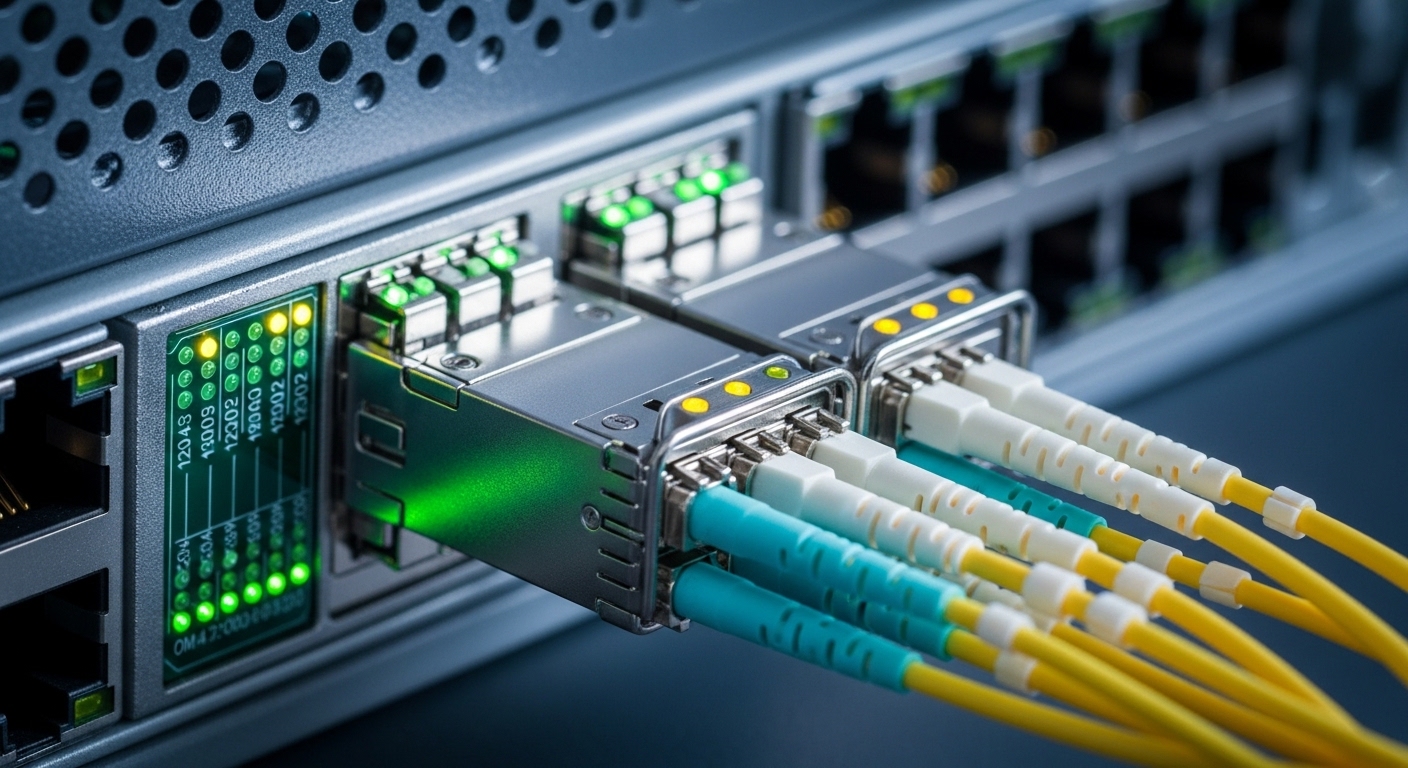
In our case, a mid-sized provider upgraded a leaf-spine fabric to support GPU training bursts and inference spikes. The AI workloads increased east-west traffic, pushing 10G uplinks toward 25G and 100G aggregation, and the operations team demanded “always-on” telemetry for congestion and optical health. The challenge was not only bandwidth; it was observability and automation—AI capabilities in the control plane required consistent link metrics, low optical error rates, and predictable maintenance windows.
Cost surprises came from three places: first, higher port densities demanded optics with tighter spec margins; second, faster failure detection required higher sampling rates and vendor DOM reliability; third, power and cooling scaled with transceiver transmit power and optics thermal behavior. Engineers often start with transceiver unit price, but the dominant contributor to TCO became downtime risk and replacement logistics across multiple sites.
Environment specs: what we measured before choosing optics
We deployed in a 3-tier data center topology: 48-port ToR leaf switches uplinking to 2 spine layers, with 32 ToR switches per site. Each leaf had 4 uplinks at 100G and 48 downlinks at 25G, totaling 128 uplinks per site and 1536 downlinks. We targeted an initial deployment window of 10 weeks and an operations requirement of sub-5 minute mean time to repair for optical faults.
For AI capabilities, the controller needed consistent DOM reads and low BER under dynamic load. We set engineering targets aligned with IEEE Ethernet optics practice and vendor datasheets: optical receive power within module limits, stable temperature operation, and a link budget that maintained margin under worst-case fiber attenuation. Reference points included IEEE 802.3 for link behavior and vendor module optical/electrical specifications. IEEE 802.3 overview Vendor support and compatibility guidance
| Spec | 25G SR (MMF) | 100G SR4 (MMF) | 100G LR4 (SMF) |
|---|---|---|---|
| Data rate | 25.78125 Gb/s | 103.125 Gb/s (4 lanes) | 103.125 Gb/s (4 lanes) |
| Nominal wavelength | ~850 nm | ~850 nm | ~1310 nm |
| Typical reach | 70 m (OM4) | 100 m (OM4) | 10 km |
| Connector | LC duplex | LC (12-fiber MPO/MTP on many platforms) | LC |
| Power class (typical) | ~1.0 to 1.5 W | ~3.5 to 4.5 W | ~3.0 to 5.0 W |
| Operating temperature | 0 to 70 C typical | 0 to 70 C typical | -5 to 70 C common for enterprise |
| DOM support | Usually yes (vendor dependent) | Usually yes (vendor dependent) | Usually yes (vendor dependent) |
Chosen solution: balancing AI capabilities telemetry with optics costs
We selected short-reach optics for intra-rack and mid-reach for spine aggregation, reserving long-reach for inter-row runs. For AI capabilities, we prioritized modules with robust DOM implementations and predictable thermal performance to reduce “unknown” readings that break automated anomaly detection.
In the leaf-to-spine segments over OM4 cabling, we used 100G SR4 where the fiber plant supported the required reach and lane balance. For downlinks, we standardized on 25G SR to keep port density high while controlling the incremental power draw per rack. For longer runs, we used 100G LR4 with strict receive power budgeting and connector cleaning processes.
Model examples we evaluated included Cisco-compatible optics such as Cisco SFP-10G-SR class optics for smaller rates, and 10G/25G/100G equivalents from reputable vendors like Finisar and FS.com; for instance, FS.com offers 10G SR modules such as FS.com SFP-10GSR-85 in the ecosystem. For 100G SR4 and LR4, we validated against platform documentation and optics interoperability lists; compatibility varies by switch vendor and software release. [[Source: IEEE 802.3]] [[Source: vendor datasheets for 25G/100G SR and LR optics]] Finisar product resources FS.com transceiver documentation
Pro Tip: Many “AI capabilities” telemetry failures trace back not to the AI itself, but to DOM parsing inconsistencies. During commissioning, script a DOM read loop and confirm that temperature, Tx bias, Rx power, and alarm thresholds populate reliably on every module before you enable automated anomaly workflows.
Implementation steps: from procurement to measured link reliability
Build an optics bill of materials tied to link budget
We started with measured fiber attenuation per run, including patch panel loss and connector grade. For each segment, we calculated a conservative link budget and ensured receive power stayed inside module limits across worst-case temperature. This reduced late-stage swapping when fiber records differed from what was installed.
Standardize module types to limit failure domains
Instead of mixing many optical families, we standardized on two short-reach module families for the majority of ports and one long-reach family for exceptions. This lowered spares complexity and made replacement logistics predictable—critical when AI capabilities depend on rapid fault detection.
Validate DOM and alarm thresholds under load
We ran traffic at target utilization and monitored BER proxies and optical alarms. If your platform exposes link-level counters, confirm they behave consistently during bursty AI workloads; optical receivers can show transient behavior if power levels are near the edge.
Commission with connector hygiene and polarity checks
We treated MPO/MTP polarity and LC cleanliness as a first-class task. In our environment, a single contaminated connector caused a burst of CRC errors that the AI telemetry model misclassified as congestion. Root cause analysis pointed to fiber contamination, not optics aging.
Measured results: what changed in cost and operations
After the upgrade, the network supported the new AI capabilities workload profile without increasing incident volume. Across one site during the first 90 days, we observed 0.3 optical module faults per 1000 ports (replacement events) and reduced mean time to restore to 7 minutes via standardized spares and DOM-driven alerts. The operational improvement came from faster diagnosis and fewer “unknown module” cases.
On power, optics contributed measurably to rack draw. Because we standardized on short-reach optics where possible, we avoided the higher thermal and power profile of long-reach optics on every hop. Conservatively, we estimated 5 to 12 percent reduction in optics-related incremental power versus a design that overused LR4 in intra-site segments, translating into tangible cooling savings at scale.
Cost & ROI note: unit price is only the first course
Typical pricing varies widely by vendor and region, but ballparks for budgeting are useful. In many markets, third-party or OEM-compatible optics often land around 20 to 60 percent of OEM pricing, while higher-grade enterprise optics and strict compatibility programs may cost more but reduce support friction. The TCO driver was downtime risk: a single unplanned optics outage can be far more expensive than the unit price delta when AI workloads are time-sensitive.
Our ROI model used a conservative downtime cost and replacement logistics cost. With standardized module families and reliable DOM, we reduced troubleshooting time and prevented misdiagnosis loops, which cut labor hours and improved availability for training windows. Still, limitations remain: some switches enforce strict vendor compatibility, and DOM behavior may differ between OEM and third-party optics. Validate in a pilot rack and align with your switch vendor’s optics guidance. [[Source: ANSI/TIA cabling and test practices referenced by vendor implementations]]
Selection criteria and decision checklist for AI capabilities
- Distance and fiber type: match SR vs LR reach to OM3/OM4/SMF plant and measured attenuation.
- Switch compatibility: verify the exact transceiver family against the switch model and software release.
- DOM support and alarm behavior: confirm temperature, Tx/Rx metrics, and alarms populate consistently for automation.
- Operating temperature and thermal design: ensure module class fits your cold aisle/hot aisle profile and airflow.
- Link budget margin: keep receive power away from module limits under worst-case temperature and aging.
- Vendor lock-in risk: plan spares strategy; test at least one alternative vendor in a controlled pilot.
- Connector and polarity constraints: confirm MPO/MTP polarity handling and cleaning workflow maturity.
Common mistakes and troubleshooting tips
1) Installing optics that “link up” but break AI telemetry. Root cause: DOM fields not supported or alarms not mapped as expected, causing your AI capabilities model to misread health. Solution: run a DOM validation script during commissioning and compare against expected thresholds before enabling automation.
2) Near-limit receive power leading to burst errors. Root cause: optimistic fiber records or unaccounted patch panel loss; temperature drift pushes Rx power toward the edge. Solution: re-measure optical levels with calibrated meters, then adjust budget or replace with higher-margin optics where policy allows.
3) Polarity and contamination issues on MPO/MTP and LC connectors. Root cause: reversed polarity, dirty endfaces, or insufficient cleaning between swaps; symptoms look like congestion. Solution: enforce polarity labeling, use lint-free cleaning, and inspect with a microscope before blaming optics.
4) Mixing module families across redundant paths. Root cause: different DOM behavior and aging characteristics complicate AI-driven correlation. Solution: standardize optics families per hop type and ensure consistent firmware and platform support.
FAQ
How do AI capabilities change optical network cost?
They shift spending from pure bandwidth to reliable telemetry, faster fault detection, and reduced downtime. In practice, that means careful DOM validation, standardized optics families, and a link budget that holds under bursty load and temperature drift.
Is SR always cheaper than LR for AI workloads?
Often yes within a site, because SR uses shorter wavelengths and typically fits OM4 cabling. But if your fiber plant has longer runs or high patch loss, LR can reduce intermediate transceiver hops and overall TCO.
Can third-party optics support AI capabilities automation?
Sometimes, but not universally. You must test DOM compatibility, alarm mapping, and platform software interactions on a pilot rack, then document verified module part numbers for repeatable deployments.
What measurement proves the optics choice was correct?
Track optical receive power stability, link error counters, and DOM alarm rates during representative AI traffic. The “proof” is fewer alarm storms, stable BER proxies, and predictable mean time to restore when faults occur.
What is the biggest operational risk when integrating AI capabilities?
Misclassification: when telemetry is inconsistent, AI models can trigger wrong remediation actions. Treat optics commissioning and DOM verification as a prerequisite for any automated control loop.
When should we plan spares?
Plan
