
Your network is either gliding toward higher throughput or doing the classic “why is latency spiking again” dance. This article helps network engineers and data center operators choose between active and passive optical modules to improve network efficiency—measured as utilization, power per bit, and operational stability. You will get practical selection criteria, a spec comparison table, real deployment math, and troubleshooting fixes you can apply the same day.
Why network efficiency depends on the module type
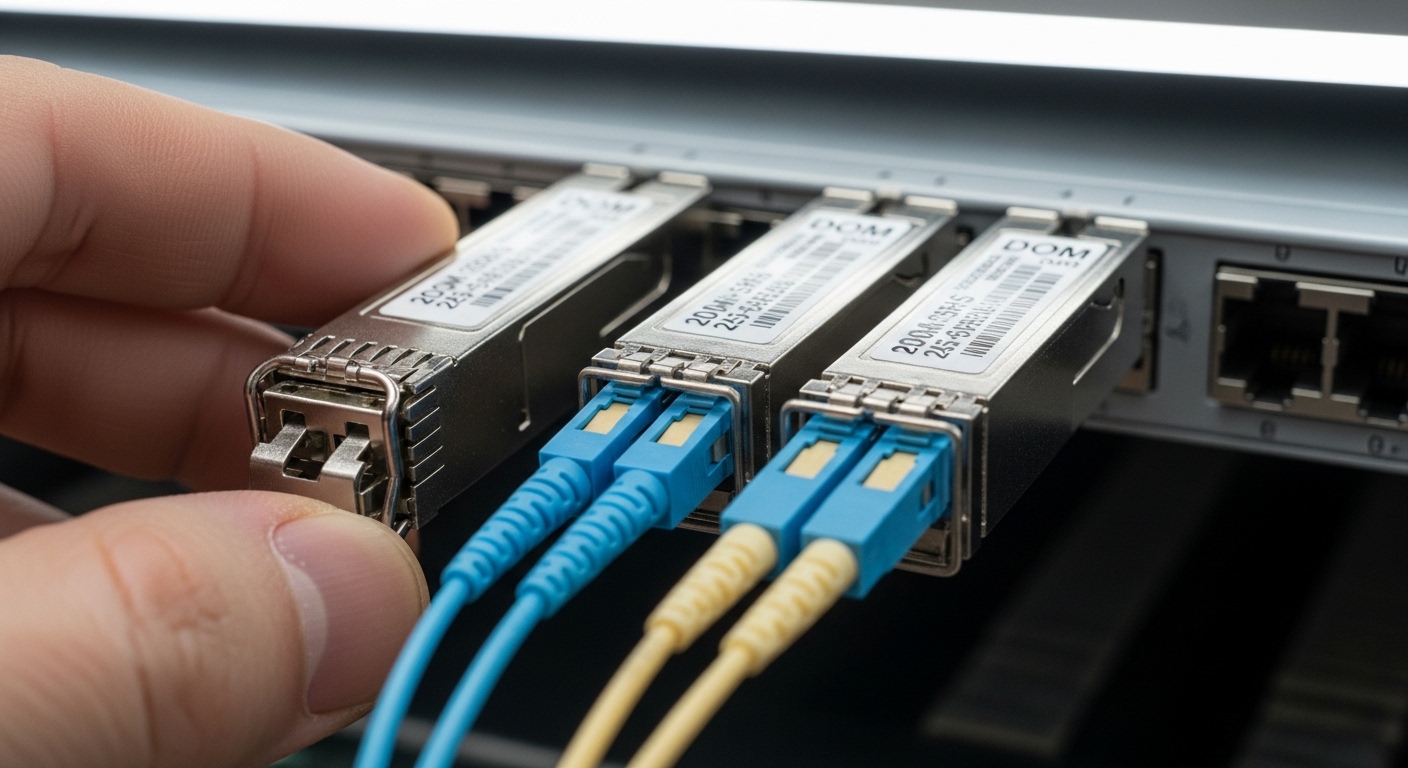
Optical modules are not just “fiber adapters with attitude.” They influence link budget, power consumption, thermal behavior, maintenance cycles, and even how reliably your optics report diagnostics. In most Ethernet environments aligned to IEEE 802.3 physical layer requirements, the module determines the optical/electrical interface characteristics that drive throughput and error rates. When you improve signal margin and reduce retransmits, network efficiency rises because the network spends less time correcting mistakes and more time doing useful work.
In practical terms, active optics (typically with integrated electronics such as lasers and transceiver control) can provide higher design flexibility, better diagnostics, and often cleaner system performance across temperature and aging. Passive optics (for example, passive optical splitters and combiners, or passive “optical module” concepts like media converters depending on architecture) can reduce electronics power and sometimes lower maintenance overhead—but they can shift complexity into the system design and require careful loss budgeting. If your goal is to maximize utilization while keeping power and downtime under control, you need to pick the module architecture that matches your reach, split ratio, and monitoring expectations.
Define “efficiency” like a grown-up (not a brochure)
Engineers usually evaluate network efficiency using a few measurable signals:
- Throughput efficiency: payload rate vs line rate, and how often retransmits or FEC corrections grow under stress.
- Power efficiency: watts per gigabit delivered at the rack level (including optics and any supporting electronics).
- Operational efficiency: time-to-diagnose using digital optical monitoring (DOM) and how quickly replacements restore service.
- Link reliability: BER trend, error counters, and whether margin collapses during temperature swings.
Active vs passive optics: what actually changes at Layer 1
At Layer 1, the key difference is where the “intelligence” lives. Active optical modules contain the transmit/receive components (laser/photodiode and control circuitry) that convert electrical signals to optical and back, often with integrated diagnostics. Passive optical components do not generate or detect optical signals themselves; instead, they route or split light, so the system must provide the transmit and receive functions elsewhere.
Typical active transceiver examples used in real networks
Active modules commonly appear as SFP+, SFP28, QSFP+, QSFP28, and QSFP56 transceivers for Ethernet. Examples engineers actually buy include Cisco SFP-10G-SR, Finisar FTLX8571D3BCL (10GBASE-SR style), and FS.com SFP-10GSR-85 for short-reach multimode. For longer reach or different wavebands, you will see LR/ER or CWDM/DWDM variants depending on the system.
Passive optics where they matter most
Passive architectures are often present in the distribution layer: optical splitters, combiners, and passive optical networks (PON) depending on the design. Even if your “module” is not an active transceiver, the passive elements still affect network efficiency because they increase insertion loss and reduce optical power margin. In a switched Ethernet data center, passive splitters are less common for leaf-spine uplinks, but they show up in specific designs such as broadcast distribution, lab/test setups, or certain campus aggregation patterns.
Specs comparison that impacts network efficiency
Below is a practical comparison of active transceiver behavior vs passive optical loss impacts. Exact performance depends on the fiber type, launch conditions, and your switch’s PHY implementation, but the categories below are what drive day-to-day engineering decisions.
| Category | Active Optical Module (Transceiver) | Passive Optical Element (Splitter/Combiner) |
|---|---|---|
| Primary role | Electro-optical conversion with laser/receiver electronics | Routes/splits/composes optical power without active generation |
| Wavelength examples | 850 nm (SR on MMF), 1310 nm (LR), 1550 nm (ER/LR on SMF) | Varies by component design; loss spec given per band |
| Reach (typical) | 10G SR: tens to ~300 m on OM3/OM4 depending on optics; 40G/100G SR depends on MMF and lane rate | Reach is effectively “unlimited” for routing, but split ratio increases loss and reduces usable power margin |
| Power draw | Usually several watts per module (varies by standard and vendor) | Near-zero optical power consumption (no electronics), but system power may rise to overcome link budget loss |
| Connector/interface | LC/SC depending on form factor; digital interface for DOM (e.g., I2C) | Often LC/SC pigtails or bare fiber; no DOM on passive element itself |
| Diagnostics | DOM: temperature, laser bias/current, received power, voltage; faster fault isolation | Limited; you infer health via end-to-end optical power measurements |
| Temperature behavior | Laser output varies with temperature; modules compensate, but margin can shrink with aging | Loss can drift slightly; main impact is insertion loss and connector cleanliness |
| Temperature range | Commonly industrial ranges like -5 C to 70 C; extended options vary by vendor | Depends on component; typically designed for network environments |
| System efficiency impact | Higher reliability and monitoring can reduce retransmits and downtime; power per bit must be managed | Lower component power, but higher optical loss can force higher transmit power or shorter reach |
Link budget math: the invisible tax on passive designs
Passive loss is the silent efficiency killer. If you use a splitter with, say, 3 dB base split loss plus additional insertion loss from the device and connectors, your available optical budget shrinks quickly. That shrink can force you to pick a different module class, reduce split ratio, or shorten reach, all of which affect overall network efficiency. Active modules typically handle variability through transmitter control, but they still cannot break physics: if the budget is negative, you will see higher error rates and possibly link flaps.
Pro Tip: In the field, the most useful “network efficiency” metric is not raw BER from a datasheet—it is your end-to-end received power trend over time. If you log DOM received power daily (or with your NMS polling interval) and correlate drops with error counters, you can predict optics aging weeks before links become “mysteriously flaky.”
Real deployment scenario: leaf-spine data center optics choice
Consider a 3-tier data center leaf-spine topology with 48-port 10G ToR switches feeding 2x 40G spine uplinks per leaf. Suppose each leaf has 24 active 10G links to servers and 4 uplinks using 40G QSFP optics, and you run OM4 multimode within 100 to 200 meters for most paths. In this environment, active transceivers with DOM support typically reduce troubleshooting time: when a port starts incrementing FCS/CRC errors, the switch can immediately show received power and temperature drift. Replacing one failed module restores service faster, which improves operational efficiency even if the active module uses extra watts.
Now compare a passive split architecture in a campus aggregation segment where you need to distribute one optical feed to multiple endpoints. If you introduce a 1:8 splitter, the theoretical split loss alone is about 9 dB (10 log10(8)), before you add insertion loss, patch cords, and connector loss. That budget pressure can force you from a higher-margin SR design to a different reach class, or it can lead to a higher error rate under temperature swings. The passive approach may reduce module electronics power, but the system often compensates by changing optics selection, shortening reach, and increasing replacement frequency—so your overall network efficiency may not improve.
Selection criteria checklist for network efficiency
Use this ordered list the way an engineer would in a change window: quickly, logically, and with receipts.
- Distance and optical budget: calculate budget using vendor-recommended link loss formulas, including connector loss, patch cord attenuation, splice loss, and passive insertion loss.
- Fiber type and lane rate: confirm OM3 vs OM4 vs SMF, and match standard (10GBASE-SR, 40GBASE-SR4, 100GBASE-SR4, etc.) to your PHY expectations.
- Switch compatibility and vendor behavior: verify transceiver compatibility lists and whether the switch enforces vendor SFP/QSFP authentication. (Some platforms are picky; some are not.)
- DOM support and monitoring: if you want fast fault isolation, choose active optics with reliable DOM behavior over I2C and consistent thresholding.
- Operating temperature and airflow: ensure module temperature rating fits your rack thermal profile; passive elements also need to survive the environment without excess loss drift.
- Power per bit target: compare module power draw (watts per transceiver) and estimate rack-level power impact across the port count.
- DOM and alarm thresholds: confirm how the switch reports received power and alarm states; miscalibrated thresholds can cause noisy alerts.
- Vendor lock-in risk: evaluate OEM optics vs third-party. Third-party optics can lower cost, but confirm support for your exact switch model and firmware version.
Active vs passive decision shortcuts
- If you need fine-grained monitoring and fast troubleshooting, active transceivers usually win.
- If you need distribution via split ratios, passive elements can work, but only after you budget every dB and validate with real link measurements.
- If your network is already power constrained, passive components can help—until you realize you may need higher-power transmit optics or shorter reaches to stay within BER targets.
Common mistakes and troubleshooting tips
Even smart teams trip over the same optical gremlins. Here are concrete failure modes that directly hurt network efficiency, with root causes and fixes.
Mixing OM3 and OM4 assumptions
Root cause: Engineers assume “multimode is multimode,” then deploy optics rated for OM4 performance on cabling that is actually OM3 or has non-ideal launch conditions. The result is reduced margin and higher error counts as temperature changes.
Solution: Verify fiber type in documentation and with labeling audits. Where possible, measure link performance and received power using DOM, then adjust optics choice or shorten patch paths. If you inherited the cabling from a previous life, test it before the production cutover.
Dirty connectors causing intermittent link flaps
Root cause: Passive or active paths both suffer when LC/SC endfaces are contaminated. The link may work “most of the time,” which makes the issue feel haunted.
Solution: Clean connectors with approved procedures and inspect with a fiber microscope. After cleaning, re-seat and retest. For passive splitter deployments, even one dirty pigtail can knock out multiple downstream paths.
Ignoring DOM thresholds and misreading received power
Root cause: Teams watch “link up/down” but ignore the received power trend. In some cases, transceiver alarms are configured but not surfaced in the monitoring workflow, so you lose early warning.
Solution: Configure NMS thresholds for DOM received power and correlate with interface error counters. Log values at a consistent interval, and set alerting that triggers before error counters rise.
Passive splitter budget surprises from connector math
Root cause: The splitter insertion loss is known, but the team undercounts connectors, patch cords, and splices. For high split ratios, those “small” losses add up fast.
Solution: Build a full budget spreadsheet that includes every patch cord and connector interface. Validate with an optical power meter and, if available, an OTDR for fiber health. Then lock the design with acceptance tests.
Cost and ROI: where network efficiency money actually goes
Let’s talk numbers without pretending we are fortune tellers. OEM optics often cost more than third-party equivalents; typical street prices for 10G SR transceivers can range from roughly $40 to $150 depending on brand, warranty, and temperature grade. Passive components like splitters are usually cheaper per unit, but the system-level cost can rise because you may need different optics classes, additional patching, and more careful testing.
TCO reality check: If passive loss forces shorter reach, you may need more spares, more patching labor, and more frequent troubleshooting. Active optics with DOM can reduce downtime time-to-repair, which is often the biggest ROI driver. For example, if a failed optics replacement takes 45 minutes with DOM guidance versus 4 hours without it, the labor and service disruption cost can dwarf the optics price difference—especially when you multiply by dozens of links. Also consider failure rate and warranty terms; third-party optics can be cost-effective, but confirm compatibility and DOM behavior on your exact switch models.
For standards alignment, review IEEE 802.3 for Ethernet optical PHY requirements and vendor datasheets for exact power and diagnostics behavior. [Source: IEEE 802.3] [Source: Vendor transceiver datasheets and compatibility guides]
FAQ
Which is better for network efficiency: active or passive?
It depends on what you mean by efficiency. Active transceivers usually improve operational efficiency via DOM and faster troubleshooting, while passive optics can reduce component power but often increases optical loss, which can lower reliability or force shorter reach. Choose based on your link budget, monitoring requirements, and downtime cost.
Do passive splitters reduce throughput?
They can indirectly reduce throughput by shrinking optical margin and increasing error rates if the budget is not designed correctly. If the signal stays within acceptable BER/FEC targets, throughput may remain stable. The key is verifying end-to-end performance after installation.
Will third-party active optics work with my switch?
Sometimes, but not always. Many platforms support third-party optics, but some enforce compatibility rules or have strict DOM and alarm behavior expectations. Check your switch vendor compatibility list and test in a lab or during a low-risk maintenance window.
How do I measure whether optics are hurting network efficiency?
Track received power trends (DOM) and interface error counters over time. Correlate rising CRC/FCS errors or link renegotiations with thermal events, cleaning cycles, and received power drops. This approach catches aging and marginal links before they become outages.
What is the biggest “gotcha” for passive optical designs?
Underestimating loss beyond the splitter itself. Connector loss, patch cord attenuation, splices, and even cleanliness issues can erase your margin. Use a full budget and validate with optical power measurements at acceptance testing.
Where should I start if I need an efficiency upgrade quickly?
Start by auditing optics type, received power baselines, and error counters on the worst-performing links. Then compare active optics with strong DOM against alternatives, and only introduce passive changes after redoing the link budget. If you already have DOM visibility, you can often improve efficiency without touching cabling.
If you want network efficiency gains, treat optics as an engineering system: budget the dB, monitor the DOM, and design for maintainability—not just “it lights up.” Next, explore optical transceiver compatibility and DOM troubleshooting for practical steps to reduce downtime and avoid surprise incompatibilities.
Author bio: I have deployed and troubleshot 10G to 100G optical links in leaf-spine data centers, including DOM-based failure prediction and link budget validation. I write like a field engineer because uptime is the only metric that matters when the lights are already on.
