
In modern data centers and campus networks, network efficiency depends on more than raw bandwidth. Engineers must choose between active optical modules (with electronics) and passive optical modules (optics only), balancing power draw, reach, optics budget usage, and operational risk. This article helps network architects, field engineers, and procurement teams evaluate tradeoffs using IEEE-aligned Ethernet optics practices and vendor datasheet constraints.
What “network efficiency” means for optical modules in practice
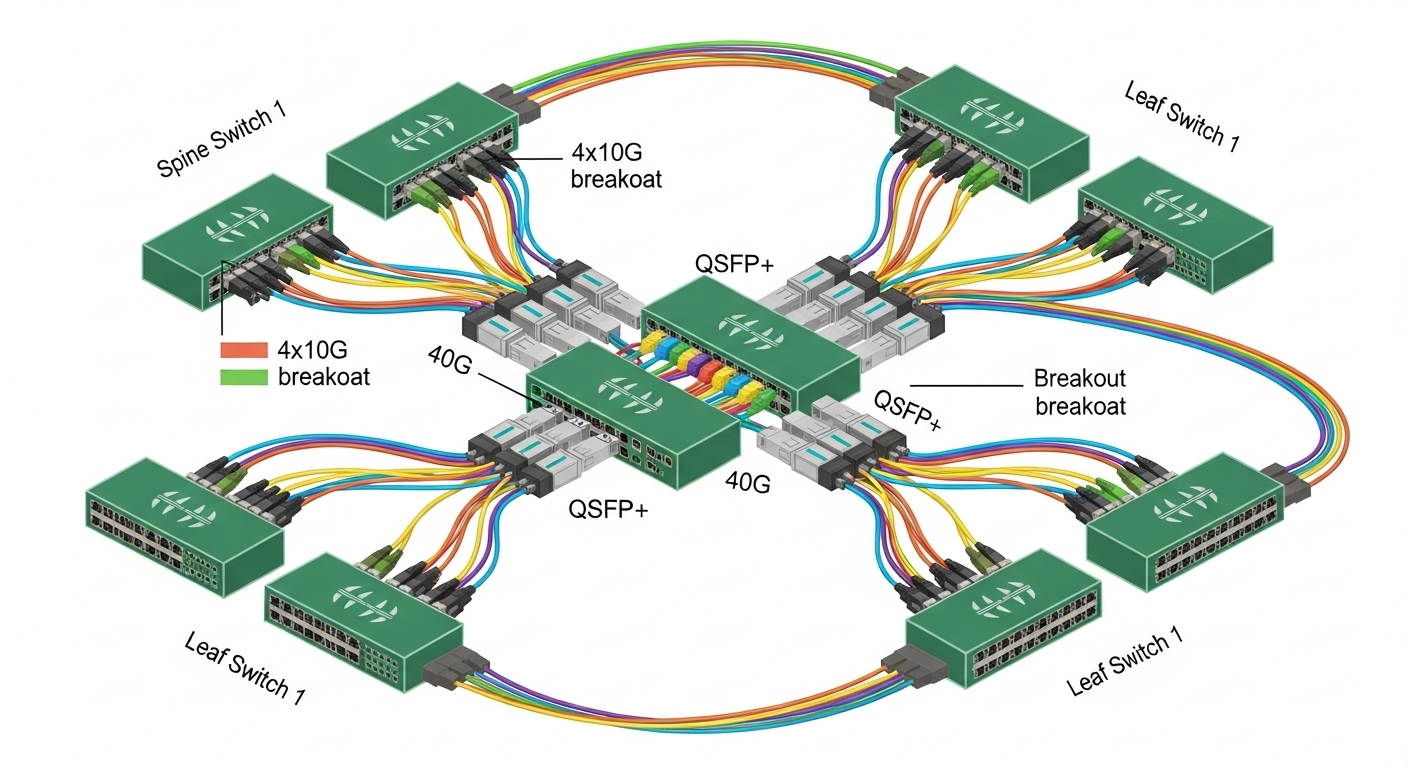
For engineers, network efficiency is the ratio of useful throughput to real operational cost: watts per delivered gigabit, rack density impact, and the time-to-repair when optics fail. Active modules typically include laser drivers, limiting amplifiers, and signal conditioning, which can improve link margin stability across temperature and aging. Passive modules shift more signal processing to the host transceiver or line card, which can reduce power inside the module but increase reliance on host analog front-end quality.
From an optics standpoint, efficiency also tracks optical power budget and receiver sensitivity. Passive designs often use fixed optical components (splitters, combiners, or wavelength-specific optics), while active designs must meet transmitter spectral masks, relative intensity noise, and eye diagram targets required by Ethernet PHYs per IEEE 802.3 link specifications. Field experience shows that margin is where “theoretical reach” becomes “installed reach.” anchor-text IEEE 802.3 optics references
Active vs passive: performance and link budget comparison
Active optical modules usually target higher performance consistency for short-reach and mid-reach Ethernet links by integrating electronic amplification and equalization. Passive optical modules can be efficient when the host already provides strong transmit conditioning and receive sensitivity, such as when the architecture uses centralized optics or optimized line cards.
In deployment, the decisive factor is the end-to-end link budget: transmitter output power, fiber attenuation, connector and splice loss, and receiver sensitivity. For example, 10GBASE-SR style links are common targets for short-reach, but exact performance depends on the module family and DOM behavior (digital optical monitoring). A practical comparison is below.
| Category | Typical Design | Wavelength | Reach (typical) | Optical Power Budget / Margin Impact | Power in Module | Connector / Form Factor | Operating Temperature |
|---|---|---|---|---|---|---|---|
| Active optical module | Laser + driver + receiver electronics (on-module) | 850 nm (common short reach), or 1310 nm/1550 nm (depending on class) | ~70 m (50/125 OM3, varies by spec) to 2 km+ (single-mode variants) | Often more stable margin due to integrated conditioning; still budget-limited by fiber and connectors | Higher than passive, but predictable at the module level | LC duplex or MTP/MPO (depends on SKU) | Commonly -5 to 70 C or wider per datasheet |
| Passive optical module | Optics only; relies on host PHY and line card analog front-end | Varies by optics (fixed wavelength or wavelength-specific components) | Often constrained by host sensitivity and system design | Margin depends heavily on host electronics; no on-module equalization | Lower module power; system-level savings may be offset by more host power or tighter margins | LC/MPO depending on passive component type | Depends on integrated optics and enclosure |
Field reality: active modules can reduce “mystery failures” after maintenance because the signal conditioning is standardized inside the module. Passive paths can be extremely efficient, but when margin is tight, small changes in patch cord cleanliness or connector polish can push the link into intermittent errors.
Pro Tip: If you see rising CRC errors after patching work, do not assume the fiber is “mostly fine.” Cleanliness and connector geometry can shift insertion loss by fractions of a dB that matter most when the system is already operating near its receiver sensitivity threshold. Use DOM telemetry (when available) to correlate optical power changes with error bursts.
Cost and TCO: where network efficiency actually wins
Active modules typically cost more per unit because they include laser and electronic components. Passive components may have a lower bill of materials, but total cost of ownership depends on system integration: host line cards, optics budget headroom, and the operational overhead of troubleshooting marginal links.
In a 100G or 400G environment, power and cooling become part of TCO. Even modest per-port watt differences matter when you scale to hundreds of ports. As an example, OEM active optics can run roughly $200 to $900 per transceiver depending on reach and vendor; comparable third-party optics may be $80 to $500 but can carry higher compatibility risk and different warranty terms. Passive optical assemblies can be cheaper upfront, yet can require specialized host support and may not provide DOM, reducing your ability to detect degradation early.
Compatibility and lifecycle risk are often the hidden cost. Vendor lock-in risk increases when a passive approach depends on specific host analog behavior or when active modules must meet strict firmware and transceiver qualification rules.
Compatibility and operational limits engineers must verify
Active and passive choices are not interchangeable across platforms. Many switches enforce transceiver identification (EEPROM fields) and require DOM support for alarm thresholds and monitoring. Some hosts also enforce lane-level compliance for multi-lane optics, and passive designs may not meet the expected electrical characteristics if the host assumes certain equalization.
When selecting, verify these items against your switch and NIC vendor documentation: transceiver form factor (SFP, SFP+, QSFP+, QSFP28, OSFP), lane count, target Ethernet rate (10G/25G/40G/100G/200G/400G), and whether DOM is required for your monitoring workflow. For active modules, confirm wavelength class and compliance with the relevant IEEE Ethernet optics class; for passive optics, confirm the host supports the required receiver sensitivity and any system-defined optical budget.
Common concrete SKUs engineers reference include active optics such as Cisco SFP-10G-SR, Finisar FTLX8571D3BCL, or FS.com SFP-10GSR-85, which are typically validated for specific switch families. For passive approaches, the “SKU” is often the optical assembly plus host support, so validation is system-level rather than module-level.
Selection criteria checklist for network efficiency
- Distance and fiber type: confirm OM3/OM4/OS2, connector type, and expected patch cord lengths; compute an end-to-end optical budget with margin.
- Budget headroom: ensure receiver sensitivity margin accounts for worst-case aging and dirty connectors; avoid operating near the minimum allowed power.
- Switch compatibility: confirm transceiver qualification, EEPROM requirements, and whether the platform rejects unsupported optics.
- DOM and monitoring needs: if you rely on telemetry for proactive maintenance, prioritize DOM-capable active modules; verify alarm thresholds and supported fields.
- Operating temperature and airflow: validate module temperature range and the enclosure thermal profile; measure switch inlet temperature during peak load.
- Vendor lock-in risk: assess warranty, firmware coupling, and whether third-party optics are covered by your support model.
Common mistakes and troubleshooting outcomes
Mistake 1: Assuming “same wavelength” guarantees compatibility. Root cause: different optics classes and electrical interface expectations can violate host lane compliance. Solution: verify exact Ethernet rate class, form factor, and DOM support requirements against the switch transceiver matrix.
Mistake 2: Ignoring connector cleanliness and insertion loss variation. Root cause: contaminated MPO/LC endfaces can add loss that pushes the link over the sensitivity cliff. Solution: inspect with a fiber microscope, clean with validated procedures, and re-measure link power and error counters after patch changes.
Mistake 3: Treating “installed reach” as static. Root cause: temperature swings and aging can reduce optical power or increase noise, especially in tight-budget designs. Solution: trend DOM readings over time and set proactive thresholds for optical power deviation and error-rate slope.
Mistake 4: Using third-party optics without a rollback plan. Root cause: intermittent incompatibility can appear after warm restarts or specific traffic patterns. Solution: stage a pilot, capture logs, and keep OEM spares for rapid containment.
Decision matrix: active vs passive for network efficiency
| Priority | Active optical modules | Passive optical modules |
|---|---|---|
| Highest link stability under variable conditions | Favored (integrated conditioning) | Only if host margin is generous |
| Lowest module power draw | Typically higher | Often lower, but validate system-level impact |
| Best observability (DOM telemetry) | Often stronger (depends on SKU) | May be limited or absent |
| Fast troubleshooting after moves/adds | Favored with DOM and standardized behavior | More dependent on host diagnostics |
