
Modern smart manufacturing plants are pushing more telemetry, machine vision, and digital twin updates through the same network that used to carry only control traffic. When you move from 100G and 200G uplinks to 800G, the right transceiver and cabling choices can cut latency and reduce oversubscription—yet they can also increase troubleshooting risk if you ignore compatibility constraints. This article helps plant IT and network teams evaluate build vs buy decisions for 800G technology, focusing on operational details that matter on the floor.
800G in smart manufacturing: performance that shows up on the line
In smart manufacturing, the benefit of 800G is not just “more bandwidth.” It is the ability to consolidate traffic from edge compute, quality inspection, and OT-to-IT gateways without forcing aggressive oversubscription at the aggregation layer. For example, a single vision system can stream 20 to 40 Gbps of processed frames (compressed or near-real-time) plus metadata, while conveyors and robotics add additional telemetry bursts. With leaf-spine architectures, 800G uplinks help keep queuing delay lower during peak shifts because they provide headroom for synchronized production events.
At the PHY layer, 800G Ethernet commonly maps to 800GBASE-ER8 or 800GBASE-SR8 style optics in IEEE implementations, and many deployments use 8-lane optics with 100G per lane signaling. The key operational constraint is that optics and switch ports must agree on lane mapping, forward error correction (FEC) behavior, and supported reach. If you mismatch module type to switch optics settings, you can end up in link flaps or degraded FEC counters that only show up after hours of load.
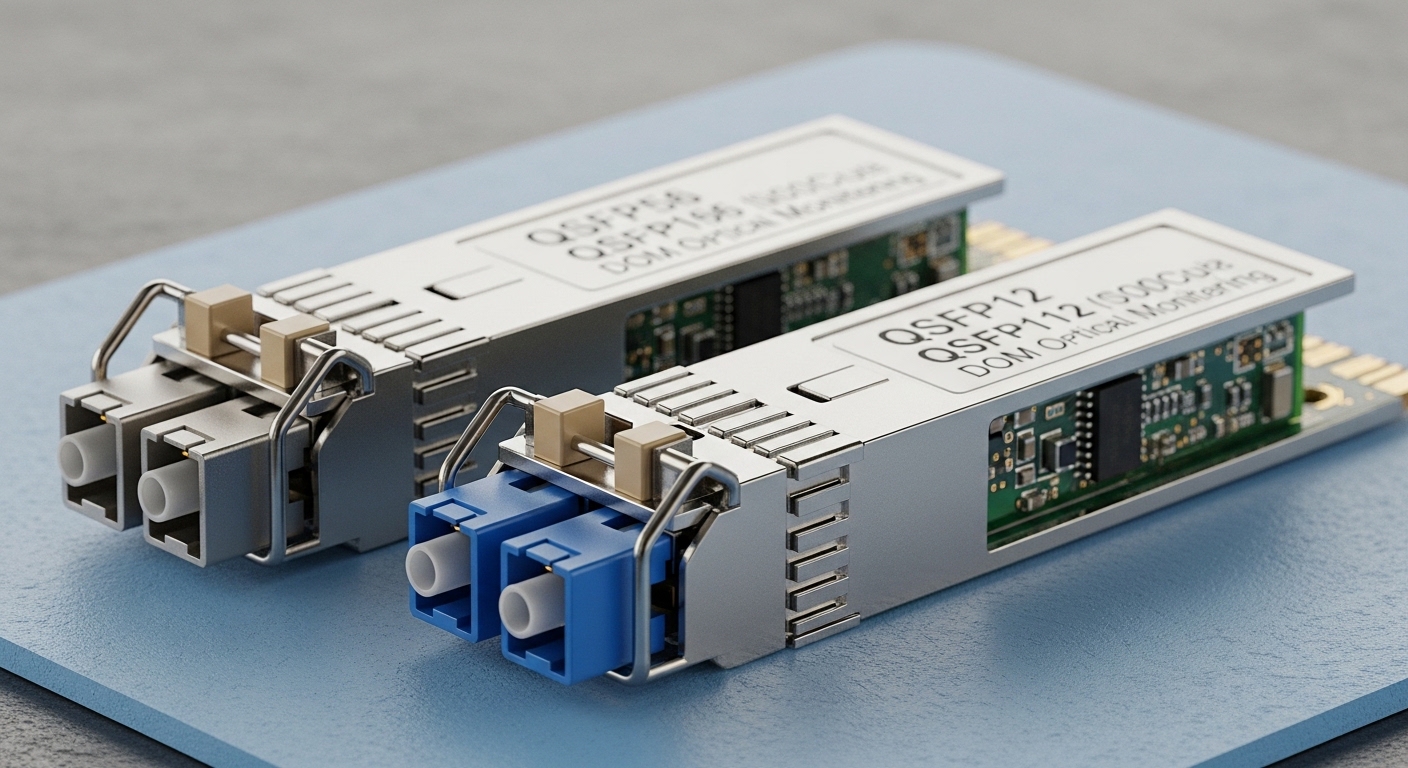
When teams talk about “800G technology,” they are usually deciding between coherent vs direct-detect optics, pluggable form factors (QSFP-DD, OSFP, or similar), and vendor-specific DOM and diagnostic behaviors. In plants, the practical question becomes: can the transceivers survive your thermal and dust conditions, and will you get consistent monitoring for proactive maintenance?
Performance head-to-head: SR8 vs ER8 for plant topology
Most smart manufacturing networks split into two distance zones: short-reach links inside machine halls and longer reach between buildings, data rooms, and aggregation closets. That is where SR8 and ER8 choices matter. SR8 (short reach) typically uses multi-mode fiber (MMF) with higher tolerance to budget constraints but shorter reach. ER8 (extended reach) typically uses single-mode fiber (SMF) and supports longer spans, but it increases cabling and connector discipline requirements.
| Spec category | 800GBASE-SR8 (direct-detect) | 800GBASE-ER8 (direct-detect) |
|---|---|---|
| Typical fiber | MMF (OM4/OM5) | SMF (9/125 micron) |
| Wavelength / lanes | 8 lanes, short-wave optics | 8 lanes, extended reach optics |
| Reach (typical) | ~70 m to ~300 m class (depends on MMF type) | ~40 km class (depends on implementation) |
| Connector styles | Commonly MPO/MTP (12-fiber) or equivalent | LC duplex (often) depending on module design |
| Power / cooling impact | Moderate; still meaningful in dense racks | Higher optical power budget; careful airflow planning |
| Operating temperature | Often industrial or commercial variants exist | Often industrial or commercial variants exist |
| Monitoring (DOM) | Vendor-dependent thresholds and alarms | Vendor-dependent thresholds and alarms |
In practice, you will see SR8 dominate inside facilities where rack-to-row distances are predictable and MPO patching is already standardized. ER8 is the “bridge” option for inter-building links where running long SMF is cheaper than adding intermediate aggregation closets. Both can support smart manufacturing workloads, but SR8 deployments tend to be faster to scale because the cabling plant is already in place.
Build vs buy: what teams actually control at 800G scale
For smart manufacturing, “build vs buy” is less about writing software and more about who supplies the transceivers, optics diagnostics, and support tooling. Buying from the switch vendor can reduce integration risk because optics compatibility matrices are well documented for their exact port configurations. Buying third-party optics can cut upfront cost, but it shifts the work to your validation lab and your change-management process.
Option A: Buy vendor-certified 800G optics
This path is usually the safest for plants that cannot afford extended downtime during production runs. Vendor-certified modules tend to match the switch’s optics firmware expectations for FEC mode, lane mapping, and DOM alarm thresholds. In real rollouts, field teams often report smoother bring-up and fewer “mystery” link instability events after a firmware upgrade because the vendor has already tested the optics profile.
Option B: Buy third-party optics with documented compatibility
Third-party optics can be a strong fit when your plant runs multiple switch families or when you need to standardize quickly across sites. However, you must treat compatibility as a lifecycle problem. A module that works on day one can behave differently after a switch OS update if the vendor changes optics negotiation behavior or tightens diagnostics.
Pro Tip: In 800G deployments, the biggest operational surprise is not reach—it is how DOM thresholds and FEC counters are interpreted by the switch. Before scaling, validate that your monitoring stack (telemetry or SNMP/streaming telemetry) correctly maps DOM fields and that your alert thresholds match the module vendor’s calibration. Otherwise, you will either miss early degradation or flood the on-call team with false positives.
Compatibility and governance: how to avoid “it linked yesterday” failures
Smart manufacturing networks are mission-critical during shifts, so compatibility governance must be explicit. Start with the switch model and software version you will run during the rollout window. Then confirm the exact transceiver form factor and optics type supported by that port. For example, some switch platforms support specific 800G pluggables only in certain port breakout modes, and some require explicit optics settings to enable the correct FEC profile.
Also check vendor documentation for DOM and diagnostics. Many modules provide temperature, laser bias current, received power, and fault flags, but the scaling and field names can differ. If your NOC dashboard expects a field that the module reports differently, you lose early warning signals. For compliance, align with ANSI/TIA-568 cabling practices and IEEE 802.3 Ethernet physical-layer expectations, and record your acceptance tests as part of change control.
Cost and ROI: where savings are real and where they backfire
In most smart manufacturing environments, 800G optics represent a significant but manageable portion of the total network refresh budget. Typical pricing ranges vary widely by reach and vendor, but teams often see vendor-certified 800G optics in the ballpark of $1,500 to $4,000 per module, while third-party options may land around $800 to $2,500 depending on SR8 vs ER8 and whether they are guaranteed compatible. The ROI calculation should include not only purchase price, but also the cost of validation downtime, spare inventory, and the risk of escalations during link issues.
For TCO, include power and cooling. 800G optics increase rack-level thermal load, and if you compensate with additional cooling capacity, the “cheap transceiver” can become expensive. Also consider failure rates and lead times; plants that keep spare modules reduce mean time to repair during peak production. The smart move is to standardize your SKU list per site and keep at least a small pool of spares for the most common optics type.
Selection criteria checklist for 800G in smart manufacturing
Use this ordered checklist during procurement and validation. It is designed to keep engineering time low while minimizing operational risk.
- Distance and fiber type: choose SR8 for intra-hall links and ER8 for inter-building reach; verify MMF grading or SMF loss budget.
- Switch compatibility: confirm the switch model, port type, and OS version support for the exact 800G optics family.
- Connector and patching standard: MPO/MTP polarity and cleanliness for SR8; LC cleanliness and patch loss for ER8.
- DOM support and monitoring mapping: ensure telemetry fields align with your monitoring platform and alert thresholds.
- Operating temperature: select industrial-grade variants when equipment is near high ambient zones; confirm derating behavior.
- FEC and link training behavior: validate error counters under load and confirm expected FEC mode.
- Vendor lock-in risk: decide whether you can tolerate vendor-certified-only optics or if you need third-party options.
- Spare strategy: define a minimum spare count per site and per optics type based on lead times.
Common pitfalls and troubleshooting tips in 800G rollouts
Below are frequent failure modes that field engineers encounter when deploying smart manufacturing networks with 800G optics. Each includes the likely root cause and what to do next.
Pitfall 1: Link flaps after a firmware upgrade
Root cause: the switch OS changes optics negotiation, FEC selection, or DOM interpretation. Third-party optics may still pass basic insertion tests but behave differently under the new profile. Solution: freeze the switch OS during the optics validation window, then run a controlled upgrade in the lab with representative modules and load profiles. Record before/after FEC counters and DOM alarms.
Pitfall 2: “Up” links with rising error counters under peak load
Root cause: marginal fiber cleanliness or patch loss that only becomes visible at higher utilization. MPO polarity errors or slightly dirty connectors can create intermittent receive power dips. Solution: clean connectors with validated procedures, re-terminate if needed, and measure optical power with a calibrated meter. Confirm MPO polarity and lane mapping end-to-end.
Pitfall 3: Unexpected thermal throttling in dense racks
Root cause: airflow restrictions, blocked vents, or optics operating near the upper temperature limit during production heat. Some modules derate performance earlier than expected. Solution: verify rack airflow paths, add or adjust baffles, and monitor module temperature via DOM. Rebalance optics placement or reduce adjacent heat sources if thermal margins are tight.
Pitfall 4: Monitoring gaps due to DOM field mismatches
Root cause: your telemetry collector assumes a specific DOM schema, but the module reports a different field set or units. This can suppress early warning alerts. Solution: run a DOM schema validation test and update your monitoring mappings. Keep a small “known-good” module as a reference for troubleshooting.
Decision matrix: choose the right path for your plant
Use this matrix to decide between vendor-certified and third-party optics, and to decide whether SR8 or ER8 is the dominant choice for each zone.
| Scenario | Distance profile | Recommended optics | Buy approach | Why |
|---|---|---|---|---|
| Same-hall leaf-spine uplinks | Short, predictable | 800GBASE-SR8 | Either, after validation | Lower cabling friction; faster patching; prioritize monitoring compatibility |
| Inter-building connections | Long reach | 800GBASE-ER8 | Vendor-certified first | Optical budget discipline; higher integration risk; prioritize stability |
| Multi-site rollout with tight downtime windows | Mixed | SR8 + ER8 by zone | Vendor-certified for first wave | Reduce bring-up time; build a compatibility baseline before scaling |
| Budget-constrained modernization | Mostly short reach | SR8 | Third-party with strict acceptance tests | Cost savings can be real if you enforce DOM and error-counter validation |
| Harsh ambient environments | Any | Industrial-grade variants | Vendor-certified or top-tier third-party | Thermal derating and reliability matter more than unit price |
Which option should you choose?
If you run smart manufacturing with limited maintenance windows and cannot tolerate prolonged troubleshooting during peak shifts, choose vendor-certified 800G optics for your first wave, especially for ER8 inter-building links. If your plant has strong engineering support, a lab validation process, and a monitoring stack that you can tune for DOM differences, third-party optics for SR8 can deliver meaningful savings without sacrificing reliability.
As a practical next step, pick one site and one topology zone, validate SR8 and ER8 candidates against your exact switch model and OS version, then standardize your SKU list and alert thresholds before scaling. For broader planning around plant connectivity, review industrial ethernet for smart manufacturing to align your network design with OT traffic patterns.
FAQ
Is 800G worth it for smart manufacturing right now?
It is worth it when you have bandwidth-heavy workloads like machine vision, edge analytics uploads, or frequent digital twin synchronization. If your network is still mostly control traffic with low utilization, you may not need 800G yet.
SR8 vs ER8: which should I standardize in my plant?
Standardize SR8 for intra-hall links where distances are within the MMF reach limits and patching is already established. Use ER8 for inter-building or longer closet-to-closet runs where SMF loss budgets are more predictable.
Can I mix vendor and third-party 800G optics in the same switch?
Yes in many cases, but you must validate compatibility and monitoring behavior. The risk is not only link establishment; it is how DOM and FEC counters behave under load and after OS changes.
What should I test during acceptance before mass deployment?
Test link stability under sustained load, verify FEC and error counters, and confirm that your telemetry collector correctly ingests DOM fields. Also run temperature and thermal airflow checks if your racks sit near high ambient zones.
How do I reduce downtime if an optics module fails?
Keep spares for the most common optics type per site and maintain clean connector procedures. During rollout, stage spare modules in the same rack region so replacement is quick and consistent.
Do I need to worry about fiber polarity with 800G SR8?
Yes. MPO/MTP polarity and lane mapping errors can produce intermittent errors that worsen under peak utilization. Follow strict polarity labeling and verify end-to-end with appropriate testing tools.
Author bio: I lead network and platform strategy with hands-on deployments in industrial environments, focusing on optics compatibility, telemetry correctness, and reliability under production constraints. I help teams reduce tech debt by standardizing validation pipelines and build-vs-buy decisions for next-gen Ethernet in smart manufacturing.
