
When a wastewater SCADA network goes unstable, the failure is rarely “mystical.” It is usually traceable to a specific fiber transceiver mismatch: wrong wavelength, weak link budget, poor temperature tolerance, or optics that cannot survive plant humidity. This article helps water and wastewater engineers, field technicians, and integrators compare transceiver options for fiber runs that monitor lift stations, aeration basins, and chemical dosing. You will leave with a practical checklist, troubleshooting patterns, and a clear decision matrix for selecting the right water treatment fiber hardware.
SCADA link reality check: what the transceiver must survive
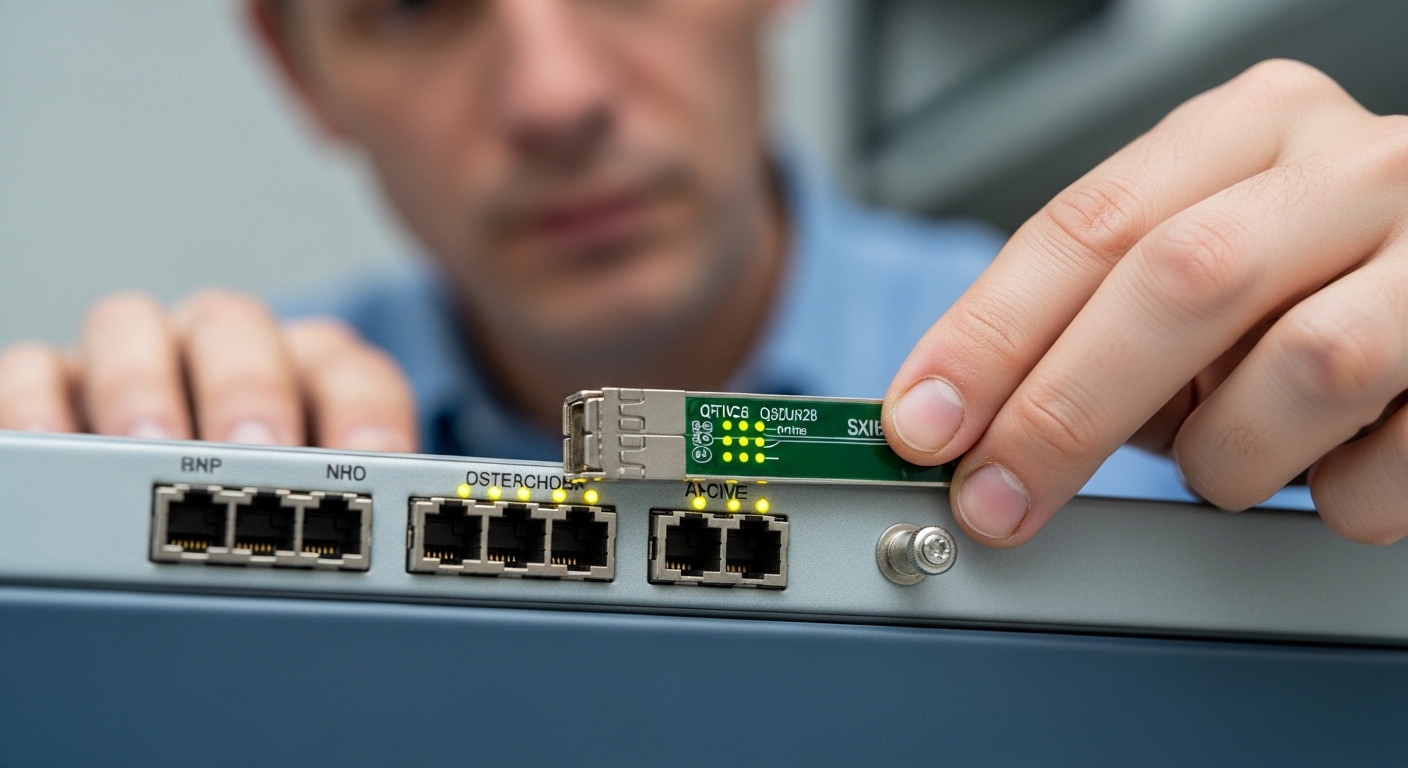
Wastewater treatment environments stress optics differently than typical enterprise wiring. You may deploy near chemical dosing skids, wet wells, and outdoor pump stations where condensation cycles, vibration, and electromagnetic noise are common. SCADA traffic also tends to be bursty: status polls every second, alarms on thresholds, and occasional firmware or configuration updates. That pattern means the link must be both stable at steady state and tolerant to short bursts without triggering CRC storms.
From a standards perspective, your fiber transceiver selection is constrained by the Ethernet PHY expectations defined in IEEE 802.3 for the relevant data rate and optical interface. For example, 10GBASE-SR uses multimode fiber at a nominal 850 nm wavelength, while 10GBASE-LR uses single-mode at 1310 nm. Vendor modules then implement those standards through specific laser technology, optics tolerances, and safety classifications.
Operationally, engineers track three practical limits. First is optical budget: transmit power minus receive sensitivity plus any fiber attenuation and connector losses. Second is jitter and signal integrity, which can be affected by patch panel cleanliness and aging. Third is thermal performance: many “office-grade” optics pass bench tests but drift out of spec during long, humid hot-cold cycles.
Head-to-head: SR vs LR for water treatment fiber SCADA
In most wastewater SCADA designs, the decision often collapses to whether you should use multimode (SR) or single-mode (LR) optics. Multimode SR transceivers are typically cheaper and easier for short distances inside control buildings. Single-mode LR transceivers cost more but scale better across long runs between pump stations and the central SCADA master.
The table below compares common 10G optics you will encounter in industrial designs, including typical models engineers deploy in the field. Exact parameters vary by vendor, but these ranges reflect how teams plan link budgets and thermal margins.
| Option | Typical data rate | Wavelength | Fiber type | Nominal reach | Connector | Operating temperature | DOM / monitoring | Example module models |
|---|---|---|---|---|---|---|---|---|
| 10GBASE-SR | 10G | 850 nm | OM3/OM4 multimode | 300 m on OM3 (typical), 400-550 m on OM4 (varies) | LC | Commercial or industrial variants (check datasheet) | Often available; depends on vendor | Cisco SFP-10G-SR, Finisar FTLX8571D3BCL, FS.com SFP-10GSR-85 |
| 10GBASE-LR | 10G | 1310 nm | Single-mode (OS2) | 10 km (typical) | LC | Industrial variants available | Often available; depends on vendor | Finisar FTLX1471D3BCL, Cisco compatible LR options |
| 1GBASE-SX / LX (lower cost SCADA) | 1G | 850 nm (SX) or 1310 nm (LX) | MMF or SMF | 300-550 m (SX) or 10 km (LX) | LC | Commercial or industrial variants | Varies by module | Common industrial SFP/SFP-GE optics from major vendors |
Note the nuance: your “reach” is not the same as your “usable reach.” In wastewater plants, connector contamination and patch panel rework are frequent, so teams often design with a conservative margin of 3 to 6 dB beyond the theoretical budget. If you cannot measure with an OTDR and power meter, you should assume extra loss from field changes and splices.
Pro Tip: In SCADA deployments, the most expensive failure mode is not total link loss; it is intermittent link flapping caused by marginal optical power during temperature swings. Choose industrial-rated modules with DOM support, so you can trend Tx bias current and optical power in real time before the link crosses the receiver sensitivity threshold.
Compatibility and monitoring: DOM, vendor lock-in, and switch behavior
After you pick SR vs LR, compatibility becomes the deciding factor. Many switches and media converters enforce optics requirements using EEPROM data and diagnostic registers. If you use third-party optics, you may face “unsupported module” alerts or link negotiation quirks, especially with certain SFP+ and SFP28 platforms.
DOM (Digital Optical Monitoring) is a major advantage for water treatment fiber SCADA because you can detect degradation early. With DOM, the platform can read per-laser transmit power, receive optical power, and temperature. In practice, integrators often configure alerts when receive power drops by a set percentage over a week or when temperature exceeds a threshold. That turns silent degradation into actionable maintenance.
However, DOM is not guaranteed across all module types and data rates. Always verify that the optics support the same diagnostic interface expected by your switch. In addition, check the switch’s optics compatibility list if it exists, and test one module before scaling to an entire fleet.
What to verify in the field before accepting a module
- EEPROM and DOM diagnostics: confirm the switch reads Tx power, Rx power, and temperature without “DOM mismatch” events.
- Speed and FEC behavior: ensure the port profile matches the module’s capabilities at your configured data rate.
- Laser safety class: confirm the module is appropriate for your installation practices and local safety procedures.
- Connector cleanliness: verify LC endfaces are polished and protected during maintenance.
Deployment comparison: which transceiver fits which wastewater topology
Not every SCADA link is created equal. Some are short runs between cabinets inside the same building; others bridge across yards or between treatment units separated by hundreds of meters. The right water treatment fiber choice depends on distance, fiber type availability, and whether you can standardize patching practices.
Scenario: leaf-spine data hall meets remote lift stations
Consider a 3-tier wastewater SCADA network: a central SCADA server rack uses two 10G uplinks to a core switch, while multiple pump-station RTUs connect through aggregation switches. In one deployment, the integrator used 10GBASE-SR within the central control building for runs up to 120 m over OM4, then switched to 10GBASE-LR for a remote lift station located 6.5 km away over OS2. The team validated optical budgets with measured receive power at commissioning, targeting a minimum margin of 4 dB under worst-case patch panel loss. After six months, DOM trending helped pinpoint a connector contamination event when Rx power dropped gradually before the alarms triggered.
Scenario: brownfield retrofits where fiber type is already fixed
In brownfield plants, you may inherit a mix of legacy multimode and newer single-mode strands. If the existing multimode fiber is OM3 and the distance is borderline for SR, it is often cheaper to upgrade the optics and keep the existing fiber than to reopen trenches. But if you anticipate future expansion or need stable long-term performance, standardizing on OS2 with LR reduces uncertainty and makes maintenance simpler across sites.
Selection checklist: decide like an engineer, not like a reseller
When teams choose water treatment fiber optics for SCADA, they run a consistent decision process. Use the ordered checklist below to avoid hidden costs and compatibility surprises.
- Distance and link budget: compute transmit power minus receiver sensitivity, subtract fiber attenuation, connectors, and splices; include a 3 to 6 dB margin for field conditions.
- Wavelength and fiber type: match 850 nm (SR/SX) to multimode and 1310 nm (LR/LX) to single-mode OS2.
- Switch compatibility: confirm SFP/SFP+ form factor and that the platform accepts the module EEPROM/DOM correctly.
- DOM and alerting: require DOM if you want predictive maintenance and alarm-based operations.
- Operating temperature and humidity tolerance: prioritize industrial temperature ranges; verify the module remains within spec during plant duty cycles.
- Connector and cleaning workflow: ensure your maintenance team can follow an endface cleaning procedure and that you have inspection tools.
- Vendor lock-in risk: weigh OEM compatibility assurance against third-party pricing; consider running a pilot test on spare ports.
Common mistakes and troubleshooting in wastewater SCADA fiber links
Even with correct design, field realities cause failure. Below are recurring pitfalls engineers report and the root causes behind them.
“Compatible on paper, fails in the cabinet”
Root cause: The switch reads DOM or EEPROM fields differently than expected, or a port profile does not match the transceiver’s supported mode. Sometimes the module is electrically compatible but not operationally accepted.
Solution: Test the exact module model in a spare port before rollout. Check platform release notes and optics compatibility lists if available. If DOM triggers alarms, confirm diagnostic support and update firmware if the switch vendor recommends it.
Intermittent link flaps after maintenance
Root cause: Connector endfaces were reconnected without proper cleaning, leaving micro-contamination that increases insertion loss and causes marginal receivers to fall below sensitivity during temperature changes.
Solution: Institute an endface inspection step using a fiber scope, and standardize cleaning kits. Replace damaged patch cables or connectors rather than repeatedly “re-seat” them. Track Rx power trends with DOM to confirm remediation.
Overestimating reach due to unmeasured patching losses
Root cause: The design assumed “typical” attenuation, but patch panels, additional jumpers, and splice loss are higher after rework. In wastewater plants, frequent cabinet changes add extra mated pairs.
Solution: Commission with measured receive power and document the final link budget. If you cannot measure, reduce the assumed reach and plan for a conservative margin. For long runs, prefer single-mode LR with OS2 and fewer intermediate patching points.
Temperature-induced degradation ignored until failure
Root cause: A commercial-temperature module is installed outdoors or near heat sources. Laser bias current drift reduces optical output over time.
Solution: Use industrial temperature-rated modules and verify placement constraints (airflow, enclosure rating). Enable DOM-based alarms for Tx optical power and module temperature.
Cost and ROI: what you really pay over five years
Cost is not only the module price. For water treatment fiber SCADA, the total cost of ownership includes labor for swaps, downtime risk, and the probability of repeat failures due to connector handling or marginal optics. OEM modules often cost more but can reduce compatibility troubleshooting time. Third-party modules can be cost effective if they pass compatibility tests and you maintain a clean connector workflow.
In typical procurement patterns, 10G SR modules (SFP+ class) often fall into a wide range depending on vendor and temperature grade, with field prices commonly ranging from roughly $30 to $120 per module for bulk purchases, while industrial-rated optics can be higher. 10G LR modules are commonly more expensive, often in the $80 to $250 range depending on brand and diagnostics support. Over five years, the ROI usually depends on whether you can avoid truck rolls and repeated connector-related outages.
Power savings are usually minor at the system level because transceivers draw only a few watts each. The bigger financial lever is maintenance reliability: modules with DOM reduce mean time to repair by pinpointing optical degradation before total outage. If your SCADA downtime has a measurable operational cost, investing in industrial temperature ratings and monitoring often pays back quickly.
Decision matrix: SR, LR, and lower-rate options compared
The matrix below helps you choose between SR, LR, and lower-rate optics based on distance, maintenance posture, and compatibility risk. Treat it as a starting point, then validate with your switch and measured link budget.
| Reader type | Recommended optics | Why | Key caveat | Success condition |
|---|---|---|---|---|
| Short indoor runs inside one building | 10GBASE-SR (850 nm) on OM4 | Lower cost and simpler optics; adequate reach for typical cabinet-to-cabinet links | Requires clean MMF patching and correct OM grade | Measured Rx power margin and DOM monitoring |
| Long cross-site links between pump stations and central SCADA | 10GBASE-LR (1310 nm) on OS2 | Best scalability and more forgiving maintenance over distance | Higher module cost and careful alignment of single-mode cabling | OTDR-confirmed OS2 route and conservative link budget |
| Budget-constrained SCADA where traffic is mostly polling | 1GBASE-SX or LX depending on fiber | Cheaper optics and often simpler compatibility | May bottleneck if you add video, historian bursts, or firmware updates | Traffic sizing plus future growth plan |
| Teams prioritizing predictive maintenance | Modules with DOM and stable industrial temperature specs | Enables trending of Tx/Rx power to prevent outages | Must match switch DOM expectations | Validated DOM alarms in commissioning |
Which option should you choose?
If your wastewater SCADA links are under 200 m and you have OM4 multimode already, choose 10GBASE-SR with industrial temperature-rated optics and DOM support to reduce operational risk. If you have long runs like 3 to 10 km or you need a consistent maintenance experience across sites, choose 10GBASE-LR on OS2, and validate the route with OTDR and measured receive power. If your network is mostly status polling and you are cost constrained, consider 1GBASE-SX/LX but only after traffic sizing confirms you will not hit throughput limits during alarm storms or configuration pushes.
Next, align your transceiver choice with your broader plant network design by reviewing fiber optic troubleshooting for the exact commissioning and maintenance steps that prevent the most common outages.
FAQ
What does water treatment fiber mean in SCADA networks?
In this context, it refers to the fiber optic cabling and the transceiver modules used to carry Ethernet traffic between SCADA components in wastewater environments. The key is not only connectivity, but stability under humidity, temperature swings, and frequent maintenance operations.
Should I use multimode SR or single-mode LR for pump stations?
Use SR for short indoor runs over OM3/OM4 multimode, and LR for longer cross-site links over OS2 single-mode. If you cannot measure and you expect future expansion, LR is often the safer operational choice because it reduces uncertainty in link performance.
Do I really need DOM on industrial transceivers?
DOM is strongly recommended for SCADA if you want predictive maintenance and faster fault isolation. Without DOM, you often discover degradation only after outages or error bursts appear in logs.
Will third-party SFP or SFP+ modules work with my industrial switch?
They can, but compatibility depends on the switch platform, firmware version, and the module’s EEPROM/DOM behavior. The safest approach is to pilot one module in a spare port, confirm link stability and DOM readings, then standardize after successful commissioning.
What is the most common cause of intermittent SCADA link outages?
Connector contamination after maintenance is a top cause, followed by underestimated patching losses that reduce optical margin. The remedy is disciplined endface inspection and cleaning plus commissioning measurements with a conservative margin.
How do I estimate total cost of ownership for transceivers?
Include module purchase price, expected replacement cycles, labor for swaps, and downtime risk. In many plants, the ROI comes from reduced truck rolls and quicker repair when DOM data helps pinpoint optical degradation early.
Expert bio: I have deployed industrial Ethernet and fiber links for SCADA in water and wastewater facilities, where commissioning measurements and DOM-based monitoring directly reduced outage duration. I write from field experience with optical link budgets, switch compatibility validation, and maintenance workflows that technicians can actually follow.
