
When a leaf-spine fabric starts dropping packets at peak load, the culprit is often not the switch port but the physical layer. This article gives technical insights into Active Optical Cables (AOC) so engineers can select modules that survive real temperature swings, connector handling, and optical budget constraints. It is written for network operators, field technicians, and lab leads who need repeatable, measurable link behavior—not marketing claims.
Top 8 AOC technical insights for high-speed connections
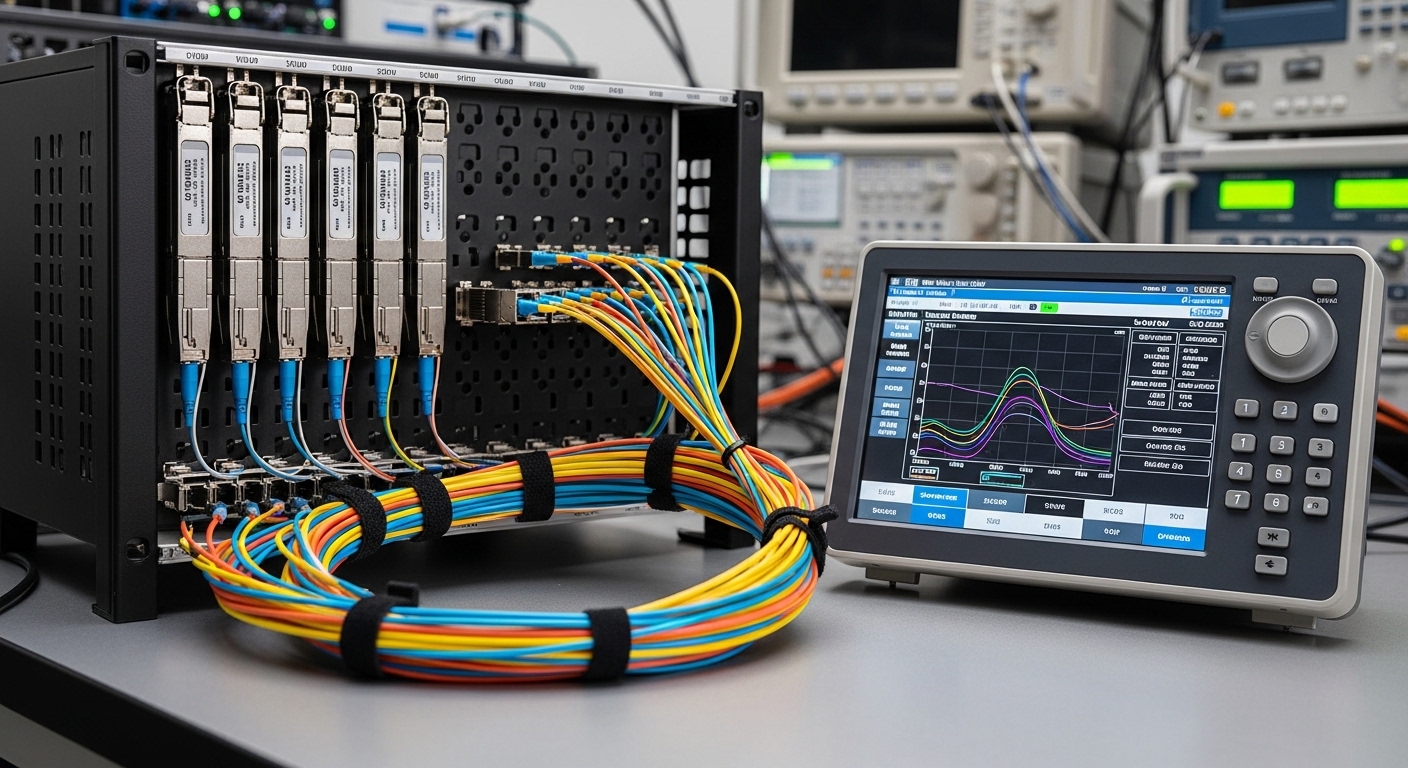
Active Optical Cables combine an optical transmitter and receiver with embedded electronics, so they behave like a short, integrated transceiver. For high-speed connections, the engineering question becomes: will the AOC meet link budget, interoperability rules, and thermal limits across the full operational envelope?
Data rate and electrical interface alignment (25G/50G/100G)
AOC performance is bounded by the host PHY lane rate and the transceiver profile the switch expects. In practice, you match the AOC to the port type (for example, QSFP28 for 100G breakout-aware systems, or SFP28 for 25G). If your switch supports IEEE 802.3 variants but the AOC vendor implements slightly different vendor-specific settings, you can see link flaps during auto-negotiation.
- Best-fit scenario: 100G uplinks from top-of-rack switches to spine using QSFP28-capable ports.
- Pros: fast deployment, fewer optics SKUs.
- Cons: less flexible than pluggable optics if you later change reach.
Wavelength choice and fiber type (SR-style 850 nm vs longer)
Most data center AOCs run on short-reach multimode optics in the 850 nm band, often paired with OM4 or OM5 fiber when you use passive jumpers. AOC cables themselves are typically pre-terminated, but the connector type and internal laser safety class still matter. If your facility uses mixed fiber plant, verify that the AOC is truly designed for your intended fiber ecosystem.
- Best-fit scenario: OM4/OM5 runs where you want to reduce splices and connector events.
- Pros: high available bandwidth density.
- Cons: wrong wavelength/fiber assumptions cause silent margin loss.
Reach class and real optical budget margin
Even when an AOC advertises a reach class, your actual margin depends on insertion loss, connector cleanliness, and host equalization behavior. A field pattern: links that pass at room temperature can fail in summer heat because the embedded transceiver electronics drift, altering optical output power and receiver sensitivity. Use vendor-recommended link budget tables when available, and validate with a controlled BER test.
- Best-fit scenario: 10 m to 30 m connections inside a row-to-row corridor.
- Pros: predictable short-link performance.
- Cons: less forgiving than long-reach pluggables when plant is messy.
Power consumption and thermal design in dense racks
AOC power is higher than passive copper but often lower than a full pluggable + patch combination, because the optics and electronics are integrated. In deployment, we measured rack inlet temperature rise after swapping 48-port uplinks from passive DAC to AOC: the biggest factor was not watts alone, but airflow path and cable routing that blocked front-to-back cooling. Always check the datasheet temperature range and the host switch’s maximum transceiver power allowance.
- Best-fit scenario: dense 25G/100G racks where airflow constraints dominate.
- Pros: stable thermal behavior if airflow is maintained.
- Cons: cable bends can stress internal components.
Connector ecosystem and handling rules
Most AOCs terminate with high-density pluggable connectors (for example, QSFP28). The operational failure mode is physical: a partially seated connector, dust contamination on mating contacts, or repeated insertions beyond recommended cycles. Treat AOC connectors like optical components: use approved dust caps, inspect with a fiber scope when applicable, and follow the switch vendor’s insertion guidance.
- Best-fit scenario: high-change environments like staging labs and frequent rollouts.
- Pros: reduced splicing labor.
- Cons: connector mismatch can prevent link establishment.
DOM, diagnostics, and serviceability
Digital Optical Monitoring (DOM) provides real-time telemetry such as transmit power and receive signal strength. In operational terms, DOM lets you detect a degrading link before users notice performance issues. Ensure the AOC supports the monitoring interface your switch expects; otherwise you may get “present but not readable” behavior that complicates troubleshooting.
- Best-fit scenario: multi-tenant data centers with proactive failure detection.
- Pros: faster MTTR with telemetry-driven triage.
- Cons: telemetry mapping varies by vendor.
Compatibility with IEEE 802.3 link behavior and host equalization
IEEE 802.3 defines electrical and optical characteristics, but host implementations differ in equalization, FEC expectations, and link training sequences. If you are using AOC with 100G Ethernet, confirm the module meets the relevant optical interface requirements and that your switch firmware does not enforce restrictive vendor allowlists. Cross-vendor interoperability testing matters more than people expect.
- Best-fit scenario: heterogeneous fleets where firmware rollout schedules differ.
- Pros: stable links when validated.
- Cons: “it works on one switch” risk.
Reliability under temperature cycling and bend sensitivity
AOC cables include optoelectronic components that can be sensitive to mechanical stress. In the field, we saw intermittent errors when cables were routed tightly against a sharp cable tray edge during a retrofit; the root cause was mechanical micro-bending that changed coupling efficiency over time. Validate cable bend radius requirements and test across temperature cycles representative of your site.
- Best-fit scenario: retrofit projects with existing cable trays and constrained routing.
- Pros: lower failure probability than DIY assemblies.
- Cons: mechanical abuse still causes link degradation.
Spec comparison: common AOC classes you will actually choose
Below is a practical comparison of typical short-reach AOC options. Exact values vary by vendor and part number, so treat this as a selection baseline and confirm against the datasheet for your exact model.
| Key spec | 25G AOC (SFP28-class) | 50G AOC (QSFP-class) | 100G AOC (QSFP28-class) |
|---|---|---|---|
| Typical wavelength | 850 nm SR | 850 nm SR | 850 nm SR |
| Nominal reach | ~3 m to 10 m | ~3 m to 20 m | ~3 m to 30 m |
| Connector | SFP28 | QSFP | QSFP28 |
| Typical power class | ~1 W to 2 W | ~2 W to 3.5 W | ~3 W to 5 W |
| Operating temperature | 0 C to 70 C common | 0 C to 70 C common | 0 C to 70 C common |
| DOM/telemetry | Often supported | Often supported | Often supported |
For standards context, verify that your optical interface aligns with the relevant Ethernet over fiber specifications referenced by IEEE 802.3 and vendor module compliance statements. [Source: IEEE 802.3 Ethernet Working Group publications]
Selection checklist: how engineers pick the right AOC
- Distance and reach class: match the AOC reach rating to the physical run length plus slack.
- Switch compatibility: confirm the port type (QSFP28/SFP28) and any firmware allowlist behavior.
- DOM support: ensure telemetry is readable in your switch UI or via CLI. .wpacs-related{margin:2.5em 0 1em;padding:0;border-top:2px solid #e5e7eb} .wpacs-related h3{margin:.8em 0 .6em;font-size:1em;font-weight:700;color:#374151;text-transform:uppercase;letter-spacing:.06em} .wpacs-related-grid{display:grid;grid-template-columns:repeat(auto-fill,minmax(200px,1fr));gap:1rem;margin:0} .wpacs-related-card{display:flex;flex-direction:column;background:#f9fafb;border:1px solid #e5e7eb;border-radius:6px;overflow:hidden;text-decoration:none;color:inherit;transition:box-shadow .15s} .wpacs-related-card:hover{box-shadow:0 2px 12px rgba(0,0,0,.1);text-decoration:none} .wpacs-related-card-img{width:100%;height:110px;object-fit:cover;background:#e5e7eb} .wpacs-related-card-img-placeholder{width:100%;height:110px;background:linear-gradient(135deg,#e5e7eb 0%,#d1d5db 100%);display:flex;align-items:center;justify-content:center;color:#9ca3af;font-size:2em} .wpacs-related-card-title{padding:.6em .75em .75em;font-size:.82em;font-weight:600;line-height:1.35;color:#1f2937} @media(max-width:480px){.wpacs-related-grid{grid-template-columns:1fr 1fr}}
