
When 400G investments meet real switch constraints, procurement can stall: optics may not negotiate correctly, power budgets can be exceeded, or fiber reach turns out shorter than the design. This article helps data center network leaders, architects, and field engineers plan 400G transceiver procurement with fewer surprises. You will get a practical spec comparison, a decision checklist, and troubleshooting patterns pulled from deployment work.
Where 400G investments fail in procurement workflows
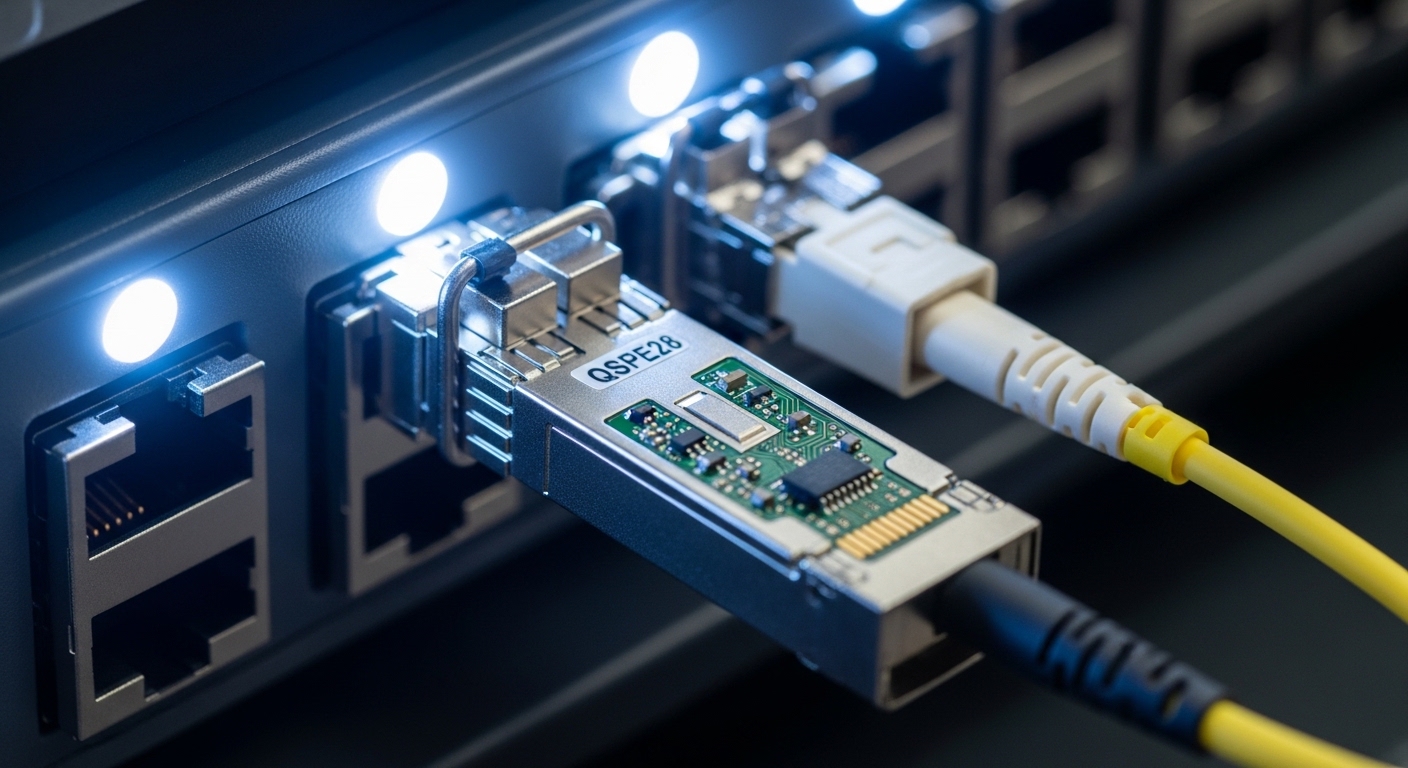
In many rollouts, the technical risk is not the line rate itself; it is the integration details around IEEE 802.3 and vendor-specific optics behavior. Common failure modes include mismatched optics types, missing digital diagnostics support, and unexpected thermal throttling in high-density cages. A procurement plan should treat transceivers as engineered components with measurable operating limits, not interchangeable “parts.”
For context, 400G Ethernet typically maps to QSFP-DD or OSFP form factors depending on the switch platform, with optical interfaces often using 400GBASE-SR8 style multimode approaches or long-reach variants like 400GBASE-LR8 over single-mode fiber. Always validate against your switch interoperability matrix and the vendor datasheet for the exact transceiver SKU (for example, Cisco QSFP-DD optics and third-party equivalents such as Finisar or FS.com models).
Optics landscape for 400G: SR8 vs LR8 and power/thermal realities
Choosing between multimode and single-mode options drives both capex and operational risk. Multimode SR8 often uses MPO/MTP cabling with multiple lanes and is sensitive to connector cleanliness and patch panel loss. Single-mode LR8 or ER8 typically uses LC pairs and supports longer reach, but it can increase fiber infrastructure cost and spares complexity.
From an engineering standpoint, you must check wavelength, reach, interface type, connector, typical optical power, and operating temperature. For QSFP-DD and OSFP modules, also confirm DOM support (Digital Optical Monitoring) and whether your switch reads thresholds correctly. The procurement target should be “spec match plus platform validation,” not “spec match alone.”
| Parameter | 400GBASE-SR8 (Example) | 400GBASE-LR8 (Example) | Notes for 400G investments |
|---|---|---|---|
| Typical data rate | 400G | 400G | Confirm switch supports the exact lane mapping |
| Fiber type | OM4/OM5 multimode | Single-mode (OS2) | MMF is cheaper but less forgiving on loss |
| Wavelength | ~850 nm band | ~1310 nm band | Verify optics are matched to the fiber plant |
| Reach (typical) | Up to ~100 m class (MM) | Up to ~10 km class (SM) | Use link budget, not marketing reach |
| Connector | MPO/MTP (often 8-fiber) | LC duplex (often 8 lanes via internal mapping) | MPO handling skills matter for SR8 |
| DOM | Commonly supported | Commonly supported | Needed for proactive failure detection |
| Operating temperature | Commercial and extended options exist | Commercial and extended options exist | Pick based on airflow and mezzanine conditions |
| Form factor | QSFP-DD or OSFP depending on switch | QSFP-DD or OSFP depending on switch | Never assume cross-platform compatibility |
For authoritative baseline specs, align to IEEE Ethernet optics references and vendor module datasheets. [Source: IEEE 802.3 Ethernet physical layer specifications] and [Source: Cisco transceiver datasheets for QSFP-DD/OSFP optics].
Pro Tip: In the field, many “bad optics” returns are actually connector cleanliness plus patch panel overage. For SR8 MPO/MTP links, perform endface inspection and verify insertion loss on every MTP-to-MTP segment before blaming the transceiver.
Procurement decision checklist for 400G investments
Use this ordered checklist to reduce rework and shorten commissioning cycles. It is designed for procurement teams working with network engineers and cabling contractors.
- Distance and link budget: measure actual patch cord lengths and include connector and splice loss assumptions.
- Switch compatibility: confirm the module SKU appears on the switch vendor interoperability list for your exact model and OS version.
- Form factor and cage fit: validate QSFP-DD vs OSFP requirements and verify any required airflow baffles.
- DOM and telemetry: ensure the switch reads temperature, bias current, and optical power thresholds; confirm alert thresholds are usable for operations.
- Operating temperature: select modules rated for your measured port-side temperatures; do not rely on “room average” values.
- Vendor lock-in risk: compare OEM lead times and warranty terms against third-party options, but require platform validation and a clear RMA pathway.
- Spare strategy: stock by reach type and by connector family (MPO vs LC) to avoid “wrong spares” during incident response.
- Power and cooling impact: confirm module electrical power fits switch power budgets and that airflow meets vendor minimums.
Real-world deployment scenario: leaf-spine with mixed reach
Consider a 3-tier data center leaf-spine topology with 48-port 400G capable ToR switches and a spine layer using 400G uplinks. The design uses SR8 for ToR-to-row spine within 70 m of fiber plant reach (including patching), and LR8 for cross-row links up to 3.5 km. In commissioning, the team budgets 1.5 dB for connectors and 0.5 dB for patch cords per segment, then validates with OTDR and endface inspection. During rollout, they standardize DOM telemetry collection so that optical power drift and high-temperature alarms are visible in the first 72 hours, not after month-end escalations.
As a procurement tactic, they order optics in two waves: wave one covers the first rack rows with SR8 and includes additional MPO cleaning supplies; wave two covers LR8 with pre-tested LC patch cords. This reduces both cabling rework and optics returns, improving schedule predictability for 400G investments.
Common pitfalls and troubleshooting patterns
Pitfall 1: Wrong optics type for the fiber plant. Root cause: SR8 optics paired with a single-mode plant or mixed OM4/OM5 assumption leading to unexpected link errors. Solution: enforce a labeling rule for every patch panel and run a pre-commission acceptance test for each optics-to-fiber pairing.
Pitfall 2: DOM mismatch or unreadable telemetry. Root cause: third-party modules that do not fully implement the expected diagnostics interface behavior for the switch OS. Solution: validate DOM reads in a staging rack and confirm alarm thresholds map correctly before broad deployment.
Pitfall 3: Overlooking temperature and airflow constraints. Root cause: high-density port utilization with reduced front-to-back airflow causes module temperature rise and intermittent link flaps. Solution: measure port-side temperatures during worst-case load, then select extended temperature optics and verify fan tray settings.
Pitfall 4: MPO handling errors. Root cause: polarity mistakes, damaged endfaces, or mis-terminated trunks cause high insertion loss and intermittent training failures. Solution: add an inspection step with magnification, confirm keying/polarity, and clean before any optical power measurements.
Cost and ROI note for 400G investments
Pricing varies widely by reach and form factor, but a practical range for budgeting is often roughly USD 400G optics: hundreds to over a thousand dollars per module depending on OEM vs third-party, reach class, and warranty. OEM modules may cost more but can reduce integration risk through guaranteed compatibility and faster RMA handling. Third-party modules can lower capex, yet total cost can rise if additional staging time, failed interoperability tests, or higher return rates occur.
ROI should include: rework labor, downtime risk, spare inventory accuracy, and the cost of cabling re-inspection. In many deployments, the biggest cost lever is not the transceiver price; it is avoiding commissioning delays by validating switch compatibility and link budget early.
FAQ
Which 400G optics should we prioritize for initial 400G investments?
Start with the reach
