
At 800G, the smallest mismatch in optics, fiber, and timing can degrade signal integrity and trigger intermittent link flaps. This article helps data center and telecom engineers choose 800G optical transceivers with practical checks you can run during rollout. You will get a field-style comparison, a decision checklist, common failure modes, and a final ranking table to guide procurement.
Top 1: Coherent vs. PAM4: choose the physics that match your reach
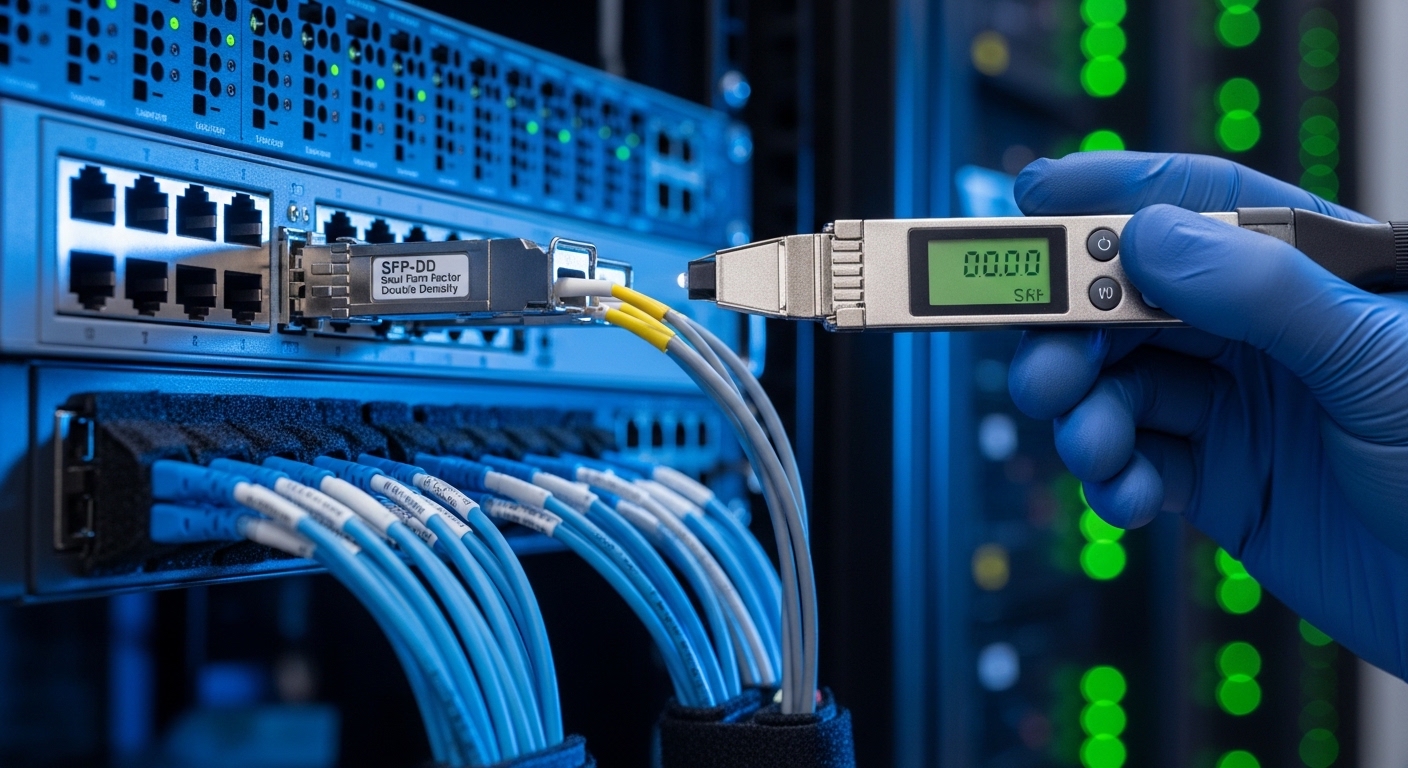
Engineers often start with “can it reach the distance,” but the deeper question is how the receiver reconstructs the waveform. For 800G, many deployments use coherent optics (with DSP-based equalization) or direct-detect approaches depending on the vendor and platform. Coherent systems typically offer more link budget flexibility and better tolerance to impairments, which directly supports signal integrity under real-world fiber conditions.
Key specs to watch: wavelength band, modulation format, typical OSNR/SNR requirements, and whether the transceiver supports forward error correction (FEC) appropriate for the platform. If your fabric uses tight latency and you need higher resilience to dispersion, coherent is often the safer architectural choice—if power and DSP complexity are acceptable.
- Best fit scenario: metro aggregation where fibers vary by splice age and you need stability over 10–80 km class distances.
- Pros: strong DSP equalization; better impairment tolerance.
- Cons: higher cost and power; must match coherent-capable optics and firmware.
Top 2: Wavelength and optics type: keep your link budget honest
Signal integrity is fragile when optical power and noise margin are near the edge. For 800G, you may see choices like SR8-style short reach (direct detect) or long-reach coherent modules depending on the target distances. Even within “short reach,” differences in center wavelength, receiver sensitivity, and launch power can change the effective margin you have after connector loss and patch panel attenuation.
What to validate: vendor datasheet values for transmit optical power, receiver sensitivity, and supported fiber type. Verify whether the module is tuned for singlemode fiber and whether the system expects a particular grid or channel plan for coherent optics.
In a rollout, I’ve seen “it worked on the bench” failures traced to patch cords with higher-than-expected insertion loss, collapsing the remaining margin and degrading signal integrity until the receiver hit its sensitivity knee.
- Best fit scenario: leaf-spine fabrics using singlemode trunks where patch panel loss varies across floors.
- Pros: predictable if you model margins; easier operational tuning for direct detect.
- Cons: margin collapse if fiber plant loss is underestimated.
Top 3: Connector and fiber plant: the hidden aggressor of signal integrity
Beyond the transceiver, the fiber plant often dominates impairment. Polishing quality, connector grade, and cleanliness directly affect return loss and reflected light, which can create receiver noise and timing jitter. At 800G, the system’s tolerance for random reflections is low because equalization has less “room” when SNR drops.
Field checklist: inspect endfaces with a microscope, confirm IEC/TIA cleaning practices, and measure link loss with an OTDR or certified optical power meter. Use consistent patch cord lengths and confirm whether the vendor spec assumes a particular number of mated connectors.
- Best fit scenario: enterprises upgrading from 400G to 800G where patch panels were built for older traffic.
- Pros: large reliability gains from cleaning and certification.
- Cons: time cost for certification and rework if issues are found.
Top 4: DOM and diagnostics: prevent silent degradation
DOM support is not just “monitoring”; it’s how you detect early signal integrity degradation before it becomes an outage. Digital Optical Monitoring (DOM) typically exposes laser bias current, transmit power, receive power, temperature, and sometimes bias/aging indicators. When you correlate these metrics with link error counters, you can detect a failing fiber path, a dirty connector, or a drifting transceiver.
What to confirm: whether the module is compatible with your switch’s transceiver management (vendor-specific PHY expectations), and whether DOM alarms are mapped into your telemetry stack. In practice, I like setting thresholds on receive power and laser bias slope, then alerting on sustained trends rather than single spikes.
Pro Tip: If your platform exposes FEC corrected/uncorrected counters, treat rising corrected errors as a “signal integrity early warning.” By the time uncorrected errors appear, you have already lost margin and may be past the point where simple cleaning fixes it.
- Best fit scenario: multi-site deployments where you cannot inspect every patch panel weekly.
- Pros: faster root cause; proactive maintenance.
- Cons: telemetry integration work; mismatched DOM handling can hide errors.
Top 5: Electrical interface and equalization: match the module to the host PHY
Even if optics are perfect, the electrical interface can harm signal integrity. For 800G systems, the host ASIC/retimer and the transceiver’s internal equalization must align with the expected lane mapping, modulation format, and clocking. If the host expects a particular FEC mode, symbol mapping, or lane polarity convention, you may see high error rates despite “link up.”
Validate: lane assignment, polarity settings, and whether the module supports the exact rate/bandwidth profile. Check whether the vendor provides host compatibility guidance for your switch model and firmware release.
- Best fit scenario: upgrades where you reuse existing optics cages but change transceiver families.
- Pros: fewer surprises during bring-up; stable BER behavior.
- Cons: compatibility constraints; sometimes firmware gating is required.
Top 6: Temperature and power: protect the jitter budget
Temperature swings affect laser output, receiver sensitivity, and internal DSP behavior. Many 800G modules specify an operating temperature range and may derate performance outside that band. If you run dense racks with poor airflow, you can see gradual performance loss that looks like “fiber problems,” but the root cause is thermal.
Action: confirm the module temperature spec, verify cage airflow direction, and correlate module temperature with error counters. I’ve seen stable links at first, then a slow rise in corrected errors during summer peaks after adding new top-of-rack units.
- Best fit scenario: high-density cabinets with seasonal HVAC changes.
- Pros: stable long-term performance with correct airflow.
- Cons: requires thermal audits and disciplined rack layout.
Top 7: Choose by standards and interoperability realities
Standards guide interoperability, but vendor implementation details still matter for signal integrity. IEEE 802.3 defines Ethernet physical layers and optics interfaces for many rates and reach classes; however, the practical behavior depends on host PHY, FEC mode, and module firmware. Use standards as a baseline, then verify real compatibility with your switch vendor’s optics matrix.
Sources to anchor your evaluation: IEEE 802.3 Ethernet physical layer definitions and vendor datasheets for specific reach classes. For optical cabling, align with ANSI/TIA guidance on fiber performance testing and certification practices. anchor-text: IEEE 802.3 standards
- Best fit scenario: procurement for mixed-vendor environments where you need predictable behavior.
- Pros: fewer surprises; clearer compliance story.
- Cons: “standards compliant” still needs host-level verification.
Top 8: Cost and ROI: buy margin, not just optics
Price differences between OEM and third-party modules can be tempting, but the TCO is dominated by downtime risk, replacement logistics, and compatibility churn. In typical enterprise and carrier environments, third-party 800G optics may be 15%–40% cheaper upfront, yet a small compatibility issue can erase savings through extended troubleshooting. OEM modules often cost more, but they may reduce integration time and provide stronger DOM/FEC behavior alignment.
ROI model I use: estimate expected failures per year, mean time to replace, and the cost of an out-of-service window. If your operations team spends hours per incident, “cheaper” optics can become expensive quickly.
- Best fit scenario: stable, well-documented host platforms where compatibility is proven.
- Pros: better margin management; budget control.
- Cons: hidden integration and validation costs.
Comparison table: key 800G optics specs that affect signal integrity
Because “800G” can map to multiple optical architectures, use this table as a decision scaffold. Always confirm exact values in the module datasheet for your SKU.
| Spec | Short-reach direct detect (example class) | Coherent long-reach (example class) |
|---|---|---|
| Typical wavelength | Multi-lambda in short-reach bands (vendor-specific) | C-band or tuned coherent band (vendor-specific) |
| Reach | ~100 m to 2 km class, depends on module | ~10 km to 80 km+ class, depends on OSNR |
| Receiver sensitivity / OSNR need | Power-budget driven; sensitive to connector loss | OSNR driven; DSP equalization tolerance varies |
| Connector type | Commonly MPO/MTP for dense short reach | Often LC or MPO depending on vendor form factor |
| Operating temperature | Typically 0°C to 70°C class (confirm) | Often broader vendor options; confirm SKU |
| DOM / alarms | Common; track RX power, temperature, bias | Common; track OSNR-related metrics when exposed |
| Signal integrity sensitivity | High impact from patch panel loss and reflections | High impact from OSNR, dispersion, and channel plan |
Selection criteria checklist: engineers decide in this order
- Distance and reach class: model fiber loss, connector counts, and patch cord length.
- Budget margin: ensure you have headroom for aging and cleaning variability.
- Switch compatibility: verify transceiver type, lane mapping, and firmware/FEC mode support.
- DOM support and telemetry: confirm alarms feed into your monitoring system.
- Operating temperature: validate airflow and module derating behavior.
- Vendor lock-in risk: weigh OEM vs third-party validation time and warranty terms.
Common mistakes and troubleshooting tips
These are failure modes I’ve seen repeatedly when signal integrity is compromised after an 800G upgrade.
-
Mistake: Assuming fiber certification from a prior generation still applies.
Root cause: patch panels or connectors were reworked, increasing insertion loss or reflections.
Fix: re-certify with an OTDR/power meter for the exact link and connector count; clean endfaces and re-seat MPOs. -
Mistake: Mixing transceiver families without confirming host PHY and FEC compatibility.
Root cause: symbol mapping, lane polarity, or FEC mode mismatch causes high corrected error rates.
Fix: consult the vendor compatibility matrix and update switch firmware before testing; align FEC settings. -
Mistake: Ignoring thermal headroom in dense cabinets.
Root cause: laser bias drift and receiver sensitivity
