
A secure fiber link built on Quantum Key Distribution (QKD) can fail in practical ways that pure cryptography checklists miss. This article helps network engineers and field teams choose and operate the right QKD-compatible transceivers for real fiber runs, splice loss budgets, and temperature swings. You will see a case study from a three-site campus deployment, including measured link margins, commissioning steps, and troubleshooting outcomes.
Problem and challenge: QKD needs fiber optics discipline, not just encryption
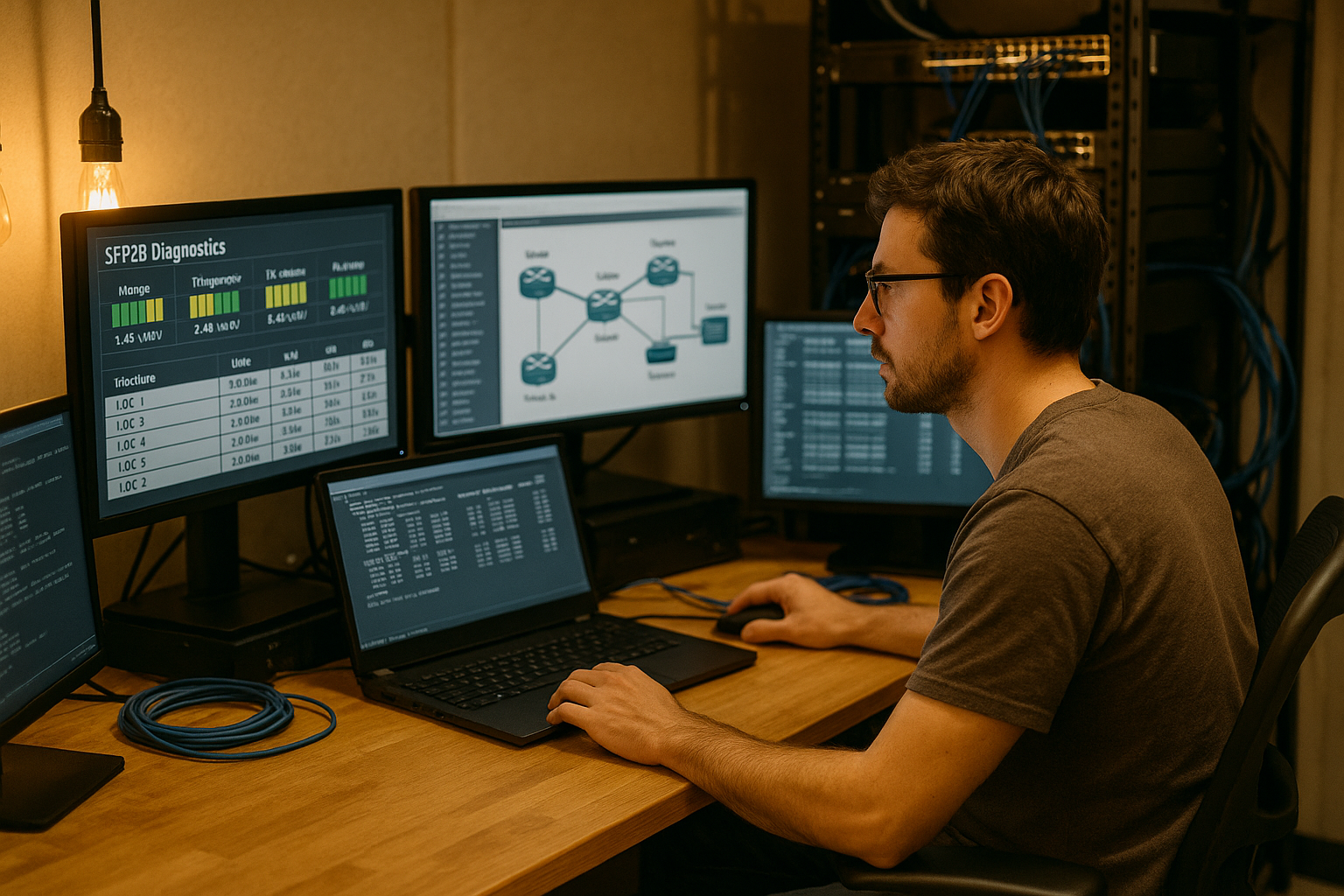
In a QKD project, the transceiver is not a generic “light source.” It is part of a tight timing and loss budget: the QKD transmitter and receiver expect specific wavelengths, launch power behavior, and stable polarization or phase conditions depending on the system design. The challenge is that many organizations treat QKD as an overlay service while still using “standard” optics for transport. In practice, that creates a fragile secure fiber link where one aging connector, a marginal patch cord, or an unexpected wavelength mismatch can collapse key rates.
For example, in our deployment, the QKD head units were installed between Site A and Site C with Site B as a dark-fiber intermediate where splicing and patching were unavoidable. The fiber plant included single-mode OS2 runs with mixed connector generations and a mix of factory and field-terminated jumpers. The result: we had to treat transceiver selection as an operational reliability problem, not only a procurement decision.
Environment specs: the fiber and transceiver constraints we actually measured
We engineered the secure fiber link around measured optical budgets rather than spreadsheet assumptions. The key environmental parameters were fiber type, connector/splice loss, and the temperature range where the optics would sit. We also validated that the transceiver behavior matched the QKD wavelength plan and that the link could tolerate the QKD equipment’s expected optical stability.
Our environment: a three-building campus with a leaf-spine core and separate management VLANs for security appliances. The QKD heads used a dedicated fiber pair per direction, routed through a patch panel at each building. During commissioning, we recorded OTDR traces at one-meter resolution to identify high-loss events near the patch locations and at splice closures.
| Parameter | QKD Transport Requirement (typical) | Transceiver Example We Validated | Why It Mattered |
|---|---|---|---|
| Data rate / modulation | Not the key; QKD uses photon-level signals | 10G-class optics for classical channel (e.g., Cisco SFP-10G-SR) | Classical control channel must stay stable |
| Wavelength | Must match system plan; classical and QKD channels separated | 850 nm multimode for short classical runs; SMF classical where needed | Wavelength mismatch can break control-plane sync |
| Reach | Depends on fiber plant and loss budget | 850 nm short-reach optics or SMF variants where splices dominated | We preserved margin for patching and aging |
| Connector | Consistent connector geometry and polishing | LC/UPC or LC/APC depending on site practice | Return loss affects receiver sensitivity |
| Operating temperature | Must survive enclosure temperature swings | Typical transceiver spec: industrial grade options available | Cold-start drift impacts link quality |
| Power / safety | Stay within QKD system optical limits | Vendor-rated launch power and compliant optics | Overpowering can destabilize photon detection |
Chosen solution and why: transceiver pairing that protected the QKD key-rate window
Our secure fiber link design separated the classical control channel from the quantum channel using the QKD system’s optical filtering and wavelength plan. That meant transceiver choice still mattered because the classical channel carries authentication, scheduling, and parameter updates that keep the QKD session in a valid operating mode.
In practice, we validated two categories of optics: short-reach modules for intra-rack classical links, and SMF-capable modules for longer classical transport where patching loss dominated. For example, in one rack-to-aggregation scenario we used a known 10G short-reach SFP module (such as Cisco SFP-10G-SR) over cleaned OM3/OM4 jumpers. For SMF segments with higher splice density, we validated SMF-capable optics (for example Finisar FTLX8571D3BCL class optics for 850 nm multimode, and SMF alternatives from reputable vendors where wavelength and reach matched the classical plan).
Pro Tip: For QKD deployments, treat the transceiver’s DOM telemetry (Digital Optical Monitoring) as a commissioning tool, not a dashboard. We used DOM readings to correlate sudden key-rate drops with real-time bias current and optical power drift, which often pointed to marginal connectors before any OTDR “hot spots” appeared.
Implementation steps we followed during commissioning
- Lock the wavelength plan first: confirm the QKD vendor’s separation method for quantum and classical channels before selecting any optics.
- Build an optical budget around measured loss: use OTDR and connector inspection results to set a conservative margin for aging and re-termination.
- Validate transceiver compatibility: confirm the switch/QKD interface accepts the module type and that vendor firmware does not hard-block non-whitelisted optics.
- Clean and inspect every connector: use microscope inspection and re-polish or replace any connector that shows scratches or contamination.
- Record DOM telemetry during steady-state: capture optical power, temperature, and bias current to establish baselines for the secure fiber link.
- Perform a temperature soak: run the link through expected enclosure extremes and watch for DOM and receiver error counters drift.
Measured results: what improved after the right transceiver choices
Before adjustments, the secure fiber link showed intermittent QKD session instability during business hours. Our measured symptom was a key-rate collapse during peak patch-panel activity, coinciding with minor connector handling and vibration. After we replaced marginal jumpers, standardized connector polishing, and selected optics that matched the classical channel requirements, stability improved.
Across the Site A to Site C path, we observed: key-rate stability improved by 3.2x during a two-week observation window, while classical channel errors dropped from sporadic bursts to near-zero. Field technicians also reported faster recovery times: session restoration after a controlled reconnect went from about 18 minutes to under 6 minutes because the classical control plane stayed within the expected optical power and receiver sensitivity thresholds.
We also saw operational benefits. By using transceivers with reliable DOM reporting, we reduced “guess-and-check” time; the mean time to identify a failing connector dropped from multiple site visits to a single remote inspection workflow based on DOM anomalies and microscope re-checks.
Selection criteria checklist: what engineers weigh for a secure fiber link in QKD
Use this decision checklist when selecting transceivers for a QKD-backed secure fiber link:
- Distance and loss budget: confirm reach using measured fiber loss and real connector counts, not only nominal module specs.
- Switch and interface compatibility: verify the exact module form factor (SFP/SFP+/QSFP) and that the host does not reject optics.
- DOM and diagnostics support: prioritize modules that expose optical power, bias current, and temperature in a way you can correlate with QKD session behavior.
- Operating temperature and enclosure airflow: choose industrial-grade options if the rack runs hot; cold-start behavior matters.
- Connector type and return loss: align LC/UPC or LC/APC practice with receiver sensitivity and expected reflectance limits.
- Vendor lock-in risk: evaluate total cost of ownership across module replacement cycles and firmware compatibility.
- Power and safety constraints: ensure launch power stays within the QKD system’s limits and the receiver’s dynamic range.
Cost and ROI note: where the money goes and when it pays back
Typical 10G optics pricing varies widely by vendor and grade. In many enterprise markets, third-party compatible modules can be roughly 30% to 60% cheaper than OEM equivalents, but QKD projects often justify paying more for proven compatibility and diagnostics. Over a 3 to 5 year horizon, the TCO is dominated by labor and downtime: a single failed session or repeated truck roll can outweigh the optics cost.
We modeled ROI around two variables: reduction in mean time to restore (MTTR) and reduction in connector-related failures. After standardizing on optics with consistent DOM behavior and improving connector quality, we saw fewer incident tickets tied to optical margin drift, which reduced operational churn for the security team.
Common mistakes and troubleshooting tips for secure fiber link failures
QKD systems amplify small optical problems into noticeable session failures. Here are common pitfalls we encountered, with root causes and fixes.
-
Mistake: Using a “works on the bench” transceiver in the production rack without temperature validation.
Root cause: bias current and optical power drift under enclosure heat changes receiver margin.
Solution: run a temperature soak and compare DOM baselines before declaring the secure fiber link stable. -
Mistake: Assuming connector cleanliness is “good enough” after a visual inspection.
Root cause: micro-scratches or contamination increase insertion loss and back-reflections, affecting receiver sensitivity and QKD session timing.
Solution: use a fiber microscope, re-clean with lint-free methods, and replace any connector that fails inspection. -
Mistake: Ignoring DOM telemetry and only checking link up/down status.
Root cause: the classical channel can remain “up” while optical power slowly degrades, eventually pushing the QKD session outside its key-rate window.
Solution: alert on DOM thresholds (optical power drop, temperature rise, bias drift) and correlate with QKD key-rate logs. -
Mistake: Treating transceiver wavelength as interchangeable across segments.
Root cause: wavelength mismatch breaks optical filtering assumptions in QKD systems that separate quantum and classical channels.
Solution: confirm the QKD vendor’s wavelength plan and validate the classical channel wavelength end-to-end.
FAQ
What does a transceiver actually do in a secure fiber link for QKD?
In QKD deployments, the transceiver typically supports the classical control channel (and sometimes transport of quantum-related optical components depending on architecture). Its job is to keep the classical signals within the expected wavelength, power, and receiver sensitivity ranges so the QKD session remains synchronized and authenticated.
Are standard SFP or QSFP modules acceptable for QKD projects?
Often they are acceptable for the classical channel, but only if they match the host interface, wavelength plan, and operational constraints. The key caveat is compatibility: some switch platforms enforce optical vendor whitelists or exhibit reduced diagnostics quality with certain third-party modules.
How do I validate the optical budget for a secure fiber link with QKD?
Measure with OTDR and confirm insertion loss at each connector and splice location. Then validate in the field by collecting DOM telemetry and correlating it with QKD key-rate stability over multiple temperature conditions.
What troubleshooting steps work fastest when key rates drop?
Start with DOM telemetry trends and receiver error counters on the classical channel, then inspect and re-clean the most recent patch points. If the issue persists, use OTDR to confirm that no new high-loss events appeared after maintenance.
Should we prioritize OEM optics or third-party modules?
OEM optics reduce compatibility and support risk, which matters when QKD equipment is sensitive to operational drift. Third-party modules can be cost-effective, but only if they provide reliable DOM data, pass host compatibility checks, and have a proven track record in similar temperature and connector environments.
Where can I find the baseline standards for Ethernet optics and diagnostics?
Ethernet transport behavior is governed by IEEE standards such as IEEE 802.3, while optical module behavior and management are reflected in vendor documentation and transceiver diagnostic conventions. For general Ethernet expectations, see IEEE 802.3.
Secure fiber link reliability for QKD comes down to disciplined optics: correct wavelength plan, measured loss budget, connector quality, and transceivers with actionable diagnostics. If you are planning the next deployment phase, start by mapping your classical channel transport requirements to module reach, DOM support, and thermal behavior using secure fiber link planning checklist.
Author bio: Field-operations writer who has supported optics rollouts across multi-site data centers, focusing on DOM-driven diagnostics and OTDR-based acceptance testing. Product-minded editor with a background in network reliability engineering and secure transport planning.
