
Predictive Maintenance Transceiver Digital Twins for Real Optics Health
In modern data centers and industrial networks, transceivers fail in ways that look random until you connect optics telemetry to maintenance actions. This article explains how a predictive maintenance transceiver can be modeled as a digital twin using DOM data, error counters, and link performance history. It helps network reliability engineers and field teams decide when to replace optics, which signals matter, and how to validate the model against real outages.
How a predictive maintenance transceiver digital twin is built
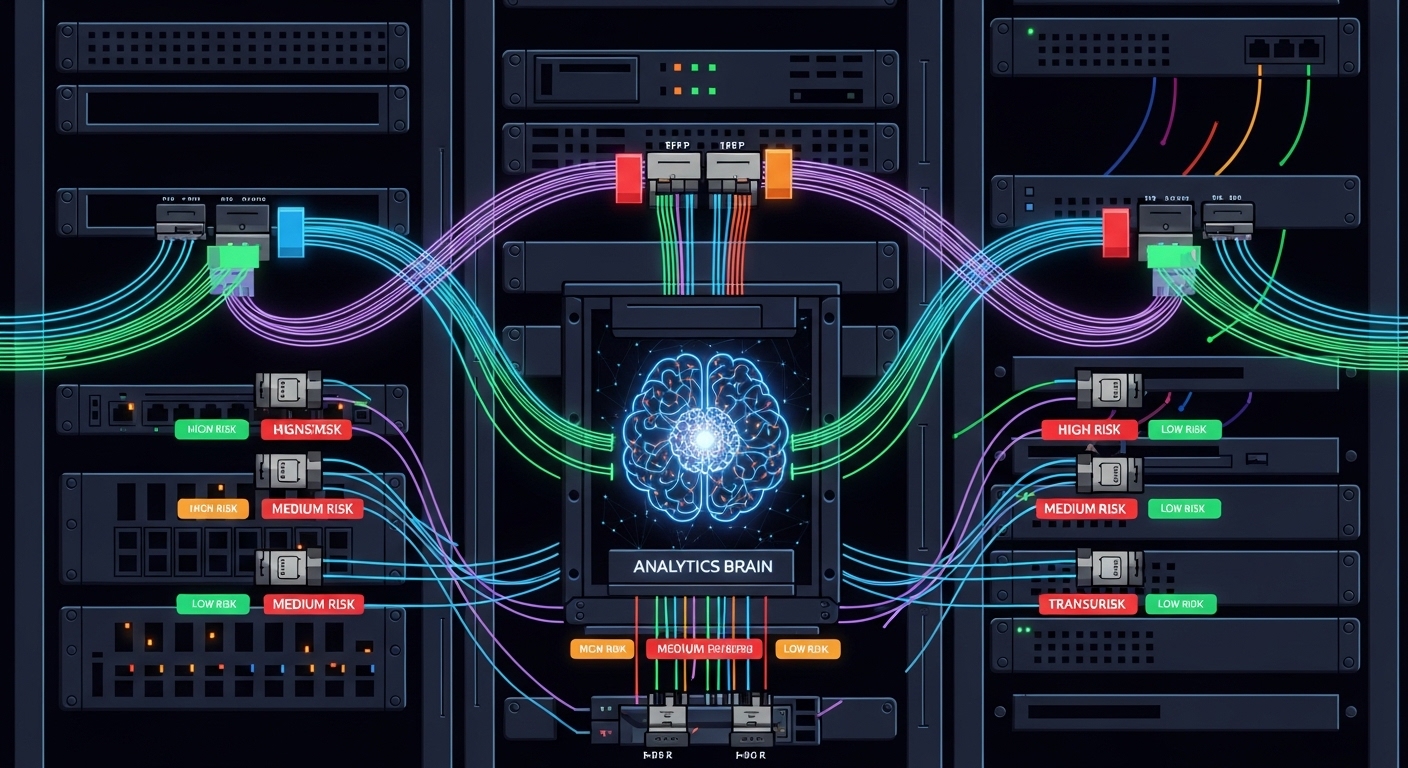
A transceiver digital twin is a software representation of an optic module’s physical state over time, driven by telemetry and link-layer evidence. Practitioners typically combine DOM readings (temperature, laser bias current, received power) with interface statistics (e.g., optical link errors, CRC/FEC counters, and packet drops). The key methodological point is that the twin should map telemetry to a health score and a remaining-use estimate, not just “monitoring dashboards.” For standards context, the host interfaces and optical behaviors are rooted in IEEE Ethernet optics specifications and module management conventions; DOM access is commonly implemented per vendor interpretations of SFF MSA management expectations. IEEE 802.3
Signals that correlate with failure modes
Field experience shows failures cluster around thermal stress, aging laser output, contamination in connectors, and intermittent fiber issues. A typical twin ingests: Tx bias current, Tx power, Rx power, module temperature, and—when available—alarm/warning flags. It also ingests link health such as FEC corrected/uncorrected counts for coherent or FEC-enabled optics, and system counters for CRC errors. Vendors document DOM scaling, units, and alarm thresholds in datasheets; you must align your model to those exact semantics.
Pro Tip: Digital twins work best when you normalize telemetry to the module’s operating class and your link budget, then model drift rather than absolute values. Two “same model” optics can show different raw Rx power because of patch cord aging and cleaning history; drift-in-context is the predictor.
Mapping telemetry to health: from DOM to maintenance decisions
Once telemetry is collected at a consistent cadence, you can build a state model that supports actionable decisions. A practical approach is to define health states (e.g., nominal, degrading, at-risk, failed) and train a classifier or regression model that estimates probability of near-term degradation. The twin should also store “events,” such as port flap timestamps, cleaning actions, and fiber re-termination, so the model learns which interventions reset the trajectory.
Operational validation against real incidents
In deployments, teams validate by correlating predicted risk spikes with maintenance tickets and RMA outcomes. For example, if the twin flags rising bias current plus falling Rx power while temperature remains stable, you can infer optical aging rather than connector contamination. Conversely, if Rx power drops sharply with no bias drift and FEC behavior worsens intermittently, you should suspect fiber contamination or a loose connection. This distinction is critical because the maintenance action differs: cleaning and re-seat versus planned replacement.
Comparing transceiver types for twin readiness and predictive signals
Not every optic supports the same richness of telemetry and error visibility. Before investing in a predictive maintenance transceiver program, assess what your platform exposes: DOM fields, alarm thresholds, and PHY-level error counters. The table below provides a field-oriented comparison for common Ethernet optics classes.
| Parameter | 10G SFP+ SR (MMF) | 25G SFP28 SR (MMF) | 100G QSFP28 SR4 (MMF) | 100G CFP2/Coherent (if used) |
|---|---|---|---|---|
| Typical wavelength | 850 nm | 850 nm | 850 nm (4 lanes) | Varies (often 1310/1550 nm) |
| Reach (typical) | ~300 m OM3 / ~400 m OM4 | ~100 m OM3 / ~150 m OM4 (varies by vendor) | ~100 m OM3 / ~150 m OM4 (varies) | km-class depending on optics |
| DOM telemetry | Temperature, bias, Tx/Rx power (vendor-specific) | Same categories | Same categories per module; lane-level may vary | Often richer diagnostics via vendor management |
| Error visibility | CRC/Fault counters; FEC may be limited | CRC and sometimes FEC depending on platform | CRC and often FEC/PHY counters | Coherent receivers expose detailed KPIs |
| Temperature range | Commercial often 0 to 70 C; industrial variants lower/higher | Often 0 to 70 C; check datasheet | Often 0 to 70 C; check datasheet | Varies by product class |
| Twin readiness | Good for drift-based aging | Good; higher telemetry density helps | Good but lane-level mapping may be required | Very good for advanced health scoring |
As concrete examples of widely deployed parts, teams often start with optics such as Cisco SFP-10G-SR, Finisar FTLX8571D3BCL (vendor naming varies by revision), or FS.com SFP-10GSR-85 for baseline telemetry. Always verify DOM field availability and units in the exact datasheet and firmware version used by your switch.
Budget and compatibility caveats
Some switches restrict optics compatibility via vendor whitelists or EEPROM checks. If you use third-party optics, confirm DOM support and whether alarm/warning thresholds are correctly reported. Also note that twin models trained on one vendor’s DOM scaling can misinterpret another vendor’s values unless you calibrate.
Selection criteria checklist for deploying predictive maintenance transceivers
Use this ordered checklist to decide whether your environment is ready and how to minimize operational risk.
- Distance and link budget: confirm required Rx power margin for your fiber type and patch cord losses; the twin needs headroom to detect drift before errors.
- Switch and platform compatibility: verify that DOM fields and PHY error counters are readable via your management stack.
- Data access and cadence: choose telemetry polling intervals that capture meaningful trends (commonly 1 to 5 minute sampling for DOM, faster if the platform supports it for error spikes).
- DOM and alarm semantics: align units, scaling, and warning thresholds with vendor documentation.
- Operating temperature: ensure module temperature stays within rated range; overheating can dominate failure causes and skew models.
- Vendor lock-in risk: evaluate whether you can swap optics without retraining or recalibrating the twin; prefer consistent DOM schemas.
- Maintenance workflow fit: confirm you can trigger real actions (cleaning, re-seat, spares replacement) and record them back into the twin.
Common mistakes and troubleshooting tips
Predictive programs often fail due to avoidable data and process issues. Here are common failure modes you can diagnose quickly.
- Mistake 1: Training on absolute thresholds only. Root cause: different vendors and links produce different baseline Rx power. Solution: model normalized drift versus an expected link budget and per-port baseline.
- Mistake 2: Ignoring connector cleanliness and patch cord history. Root cause: contamination causes abrupt Rx power drops and intermittent errors that look like “aging.” Solution: record cleaning and re-termination events; treat them as interventions that reset the trajectory.
- Mistake 3: Polling telemetry too slowly. Root cause: short-lived bias or temperature excursions are missed, while error spikes appear without correlating signals. Solution: increase sampling cadence where supported and capture PHY counters at a time-aligned interval.
- Mistake 4: Misreading DOM units or scaling. Root cause: DOM values can be vendor-specific in scaling and formatting. Solution: validate one module against datasheet values and confirm host parsing before training models.
Cost and ROI note for predictive maintenance transceiver programs
Typical optics replacement unit costs vary widely by speed and vendor, but many data centers see transceiver procurement in the range of tens to a few hundred USD per module depending on class and reach. The ROI comes from reducing unplanned outages, lowering “swap-and-pray” spares consumption, and improving maintenance scheduling efficiency. Total cost of ownership includes telemetry collection tooling, storage for time series, model maintenance, and validation labor. OEM optics can reduce compatibility and telemetry ambiguity but may raise per-unit cost; third-party optics can lower capex but require more upfront calibration and compatibility testing.
FAQ
What makes a predictive maintenance transceiver different from basic monitoring?
Basic monitoring shows current alarms and counters. A predictive maintenance transceiver digital twin adds time-series modeling that estimates degradation rate and near-term failure probability, then ties predictions to maintenance actions and outcomes.
Do I need lane-level telemetry for 100G optics to predict failures?
Lane-level data improves accuracy, but not all platforms expose it. Many teams start with module-level DOM plus aggregate PHY error counters, then upgrade to lane-level mapping when available.
Can I use third-party optics with a predictive maintenance transceiver model?
Yes, but you must calibrate DOM scaling and verify that alarms and thresholds are correctly reported. Also test compatibility with your switch firmware to ensure telemetry completeness and stable error counter access.
How do I prove the model is working before relying on it?
Run a shadow mode for several weeks: generate risk scores without acting, then compare predicted at-risk modules to subsequent error events and RMA outcomes. Use a measurable target such as improved lead time to intervention and reduced unplanned link drops.
What is the fastest first deployment scenario?
Start with a small set of high-importance ports (e.g., top-of-rack uplinks) where link failures have clear business impact. Collect DOM and error counters, define intervention rules, and only then scale to all ports.
Which standards or vendor documents should I consult?
Use IEEE 802.3 for Ethernet optical behavior context and vendor datasheets for DOM fields, electrical interface details, and optical specifications. For module management expectations, review the SFP/QSFP MSA documentation your vendor references. IEEE 802.3
