
AI clusters turn every watt into a scheduling constraint, so power analysis is no longer optional when choosing copper DAC or fiber AOC for high-density interconnects. This article helps network engineers and data center operators compare DAC and AOC tradeoffs using measurable electrical and thermal behavior, then translate the results into procurement decisions. You will get a practical checklist, a troubleshooting section built on real failure modes, and a cost and ROI lens that reflects how these optics behave over time.
Why power analysis matters more than headline watts
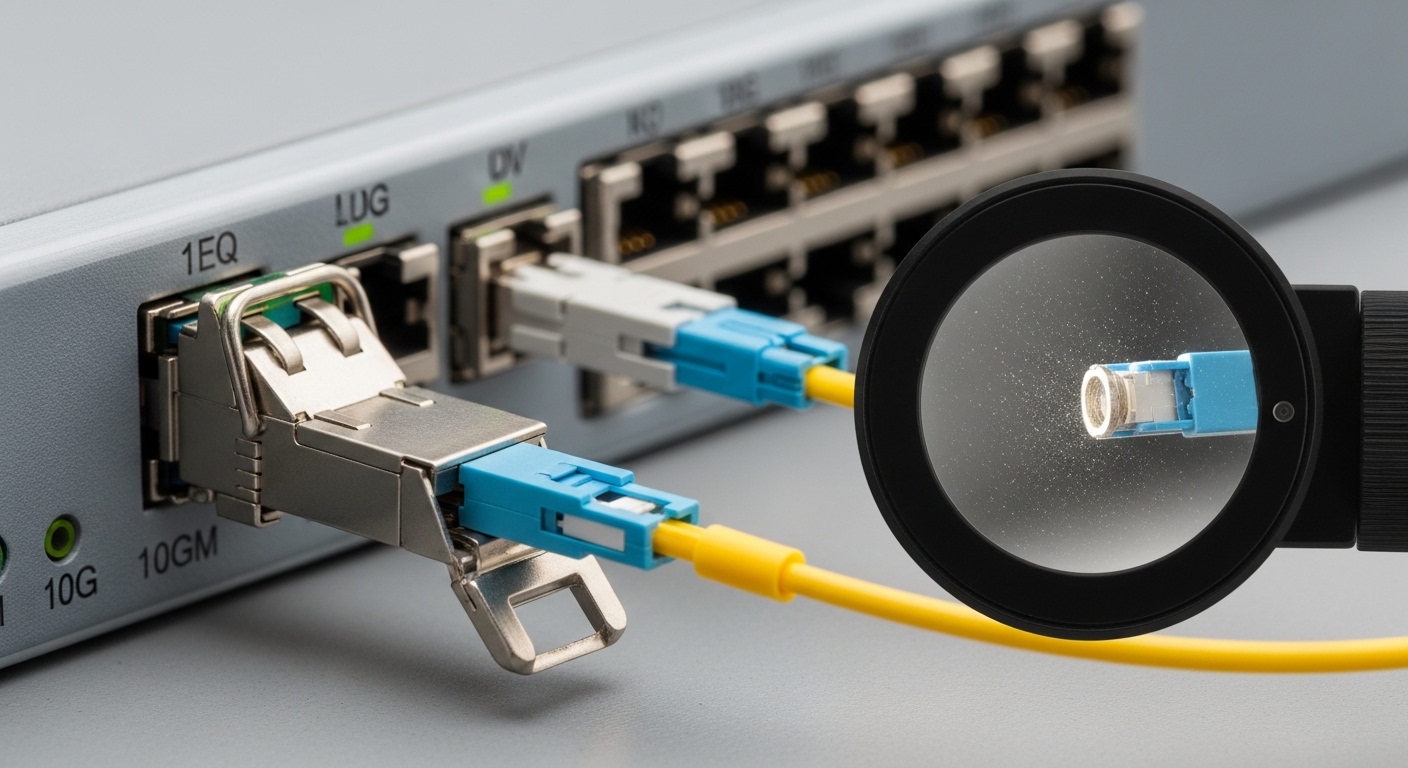
On paper, DAC and AOC can look similar because both are “active” link components with defined power ratings. In practice, system power depends on link power draw under load, connector losses, retimer behavior, airflow patterns, and how often the optics cycle during maintenance. Power analysis typically starts with module-level consumption (W per transceiver), then scales to racks and end-to-end link budgets by incorporating switch ASIC behavior and thermal derating.
For high-power AI environments, the key is to model energy per transferred bit rather than only average watts. AOC (Active Optical Cable) generally uses an optical transceiver inside the cable, while DAC (Direct Attach Copper) uses electrical signaling across a copper assembly with an integrated connector interface. IEEE Ethernet PHY implementations and vendor optics designs target specific electrical signal integrity margins, which can alter how much the module must “work” to maintain BER targets as temperature and aging shift.
When you run power analysis, capture at least three operating points: cold start (first minutes after boot), steady state (typical traffic), and elevated temperature (near maximum ambient). Field teams often discover that steady-state module power is not the same as the vendor “typical” number; the delta shows up once you account for airflow restrictions and port utilization patterns.
DAC vs AOC: measurable electrical and optical differences
The simplest way to compare DAC and AOC is to align them to the same Ethernet rate and reach class, then examine how each technology handles equalization, optical conversion, and thermal load. DAC relies on copper channel equalization and usually has higher sensitivity to insertion loss and crosstalk. AOC includes an optical transmitter and receiver, often improving reach and EMI behavior, but it introduces laser bias control and optical safety constraints.
Reference operating classes and what to compare
Engineers typically compare within a common family such as 10G/25G/40G/100G Ethernet or InfiniBand-compatible link speeds, and within a reach tier such as 3 m, 5 m, 10 m, or 30 m. If your deployment uses 400G (for example, QSFP-DD or OSFP-style implementations), power analysis must consider whether the optics are multi-lane (e.g., 8x50G) and how lane-level power scales with forward error correction (FEC) overhead.
Technical specifications comparison table
| Spec category | DAC (Direct Attach Copper) | AOC (Active Optical Cable) |
|---|---|---|
| Typical data rate classes | 10G, 25G, 40G, 100G (rate depends on platform) | 10G, 25G, 40G, 100G, often longer reach options |
| Wavelength | N/A (electrical copper link) | 850 nm (common for short-reach multimode) |
| Reach class (examples) | 0.5 m to 7 m typical; longer requires higher-grade channel design | ~3 m to 100 m depending on transceiver and fiber type |
| Connector style | Integrated DAC connectors (SFP/SFP28/QSFP variants depending on speed) | Integrated optics with QSFP/QSFP28/OSFP-style interface |
| Power draw (module-level) | Often a few watts to low teens W depending on speed and vendor | Often similar order of magnitude; may be higher due to optical conversion |
| Operating temperature | Typically industrial to commercial ranges; verify platform spec | Verify vendor temperature grade; many support 0 to 70 C for datacenter |
| EMI behavior | Conducted/radiated EMI depends on cable construction and shielding | Lower radiated EMI; still requires grounding and proper handling |
| Link budget sensitivity | Insertion loss and equalization margin are critical | Optical power, receiver sensitivity, and fiber attenuation dominate |
Measured power analysis approach engineers use
Do not rely only on “typical” power. Instead, use a repeatable measurement method: instrument the switch PSU rails feeding the rack, then correlate with port-level utilization and module telemetry (DOM where available). Many switches expose transceiver readings like temperature, supply voltage, and bias currents. If DOM is supported, you can pull real values via vendor APIs and compute W per active port and W per lane for multi-lane optics.
For example, in a 100G leaf-spine design using QSFP optics, you can compare a set of DAC assemblies versus AOC assemblies on identical ports and identical traffic profiles, then record average module temperature and measured supply current. The goal is to observe whether AOC’s optical conversion adds stable overhead or whether DAC’s equalization increases power under marginal signal integrity conditions.
When you run power analysis, remember that “link degraded” behavior can force higher internal drive levels. DAC links may increase equalizer activity or rely on more aggressive signaling to maintain BER, which can raise effective power. AOC links can face higher laser bias as optical conditions degrade, especially if the cable is near its rated reach or if connectors experience contamination.
Pro Tip: In field deployments, the biggest power swing often comes from “almost failing” signal integrity. If a DAC is just within its insertion loss margin, the PHY may spend extra power maintaining equalization, and the module temperature rises before you see user-visible errors.
Deployment scenario: comparing DAC and AOC in a 3-tier AI pod
Consider a 3-tier data center leaf-spine topology inside an AI training pod: 48-port 100G ToR switches connect to two spine layers, and each ToR carries heavy east-west traffic from GPUs. Suppose each ToR uses 24 active 100G uplink ports, and you must choose between 5 m DAC assemblies and 30 m AOC assemblies to accommodate cable routing constraints. The rack airflow is set for 27 C to 30 C ambient, but during maintenance the aisle temperature can spike to 33 C.
In this environment, power analysis typically shows that DAC may have lower steady-state power when signal integrity is comfortably within spec, but it can lose margin when routing forces tighter bends or when connectors are not seated perfectly. AOC may cost more per link, yet it often keeps module temperature more stable because optical power budgets tolerate routing variation better than copper insertion loss. Teams measure both module telemetry and rack PSU rail draw to compute net savings, then validate with BER counters and link error logs aligned to the same time windows.
For procurement, you can model a simple TCO: module cost plus expected failure cost (including downtime and labor), plus the incremental operational power. In many AI pods, the operational power dominates over a 3 to 5 year horizon, but only if you avoid premature failures from connector contamination and poor handling.
Selection checklist for power-aware DAC vs AOC procurement
- Distance and reach margin: verify you are not just inside the maximum reach; include a safety margin for routing bends and connector wear.
- Switch and platform compatibility: confirm your switch supports the specific optic type and speed mode; check vendor interoperability notes.
- DOM support and telemetry access: if DOM is available, ensure you can read temperature and bias values to support ongoing power analysis.
- Operating temperature grade: compare the module’s rated temperature range to your worst-case ambient, not just normal conditions.
- Power draw under realistic load: prioritize measured or vendor “max” power where possible, then validate with your own rack telemetry.
- Connector and cleanliness strategy: for AOC, plan cleaning and inspection for MPO-style interfaces or any fiber termination points in the path.
- Vendor lock-in risk: third-party optics can be cost-effective, but verify programmability and compatibility to avoid support escalations.
Common pitfalls in power analysis and troubleshooting
Power analysis can be misleading if your measurement and validation plan misses the real failure mechanisms. Below are frequent issues field teams encounter when comparing DAC and AOC.
Pitfall 1: Comparing “typical” power without matching load
Root cause: vendor typical power often assumes specific traffic patterns and stable temperature. If one set of optics runs with higher utilization or different FEC overhead, the effective power changes.
Solution: run an A/B test on identical ports with the same traffic generator, capture module telemetry and switch rail draw, then compute energy per bit over time.
Pitfall 2: Ignoring signal integrity margins for DAC
Root cause: copper DAC performance depends on insertion loss, return loss, and equalization capability. Tight bends, marginal seating, or damaged shielding can push the link toward the edge.
Solution: inspect and reseat connectors, verify bend radius compliance, and monitor link error counters. If possible, validate with vendor-recommended cable test methodology.
Pitfall 3: Assuming AOC reach is plug-and-play
Root cause: AOC optical performance depends on optical power and receiver sensitivity, which can be impacted by contamination at any mating interface in the path and by exceeding rated reach in high-loss environments.
Solution: follow cleaning procedures and inspect interfaces. Use optical receive power telemetry if supported, and keep within the rated reach including any margin for aging.
Pitfall 4: Overlooking temperature derating behavior
Root cause: both DAC and AOC modules can alter internal biasing with temperature. That can raise power and reduce link margin, especially during airflow disruptions.
Solution: replicate worst-case ambient conditions during validation and confirm your module temperature stays within the vendor datasheet limits.
Cost and ROI: where the numbers usually land
Typical street pricing varies by vendor, speed, and availability, but in many enterprise and datacenter procurement cycles, DAC modules often cost less per link than AOC for short reaches. AOC can be more expensive upfront because it integrates optical components and active electronics, but it may reduce installation and maintenance costs by tolerating routing constraints better.
For ROI, include three cost buckets: (1) purchase price, (2) operational power over the service life, and (3) failure and labor cost. If you estimate a delta of even 1 to 3 W per active link and you have thousands of active links across an AI cluster, the annual power difference can materially affect TCO. Also budget for replacement logistics: AOC failures can be rarer in some environments, but DAC failures tied to handling and seating are common when cable management is poor.
For standards context, Ethernet PHY behavior aligns with IEEE 802.3 link requirements, while optical parameters follow vendor-specific transceiver datasheets; always validate against the exact part numbers you plan to deploy. For example, verify compatibility and electrical/optical characteristics using vendor documentation and interoperability lists as referenced in [Source: IEEE 802.3].
FAQ
How do I start power analysis for DAC vs AOC in an AI rack?
Begin by collecting module telemetry (temperature, supply voltage, bias currents) and correlating it with measured switch rail draw while running identical traffic patterns. Then compute energy per bit for each cable type during cold start and steady state. If your switch supports DOM, use it to find whether power rises as temperature rises.
Is DAC ever more power efficient than AOC?
Yes, especially when your copper channel is comfortably within insertion loss and equalization margins. In that case, DAC can maintain stable signaling without pushing the PHY into higher compensation states. However, once you operate near the edge, real-world power can increase due to marginal signal integrity.
What should I verify for AOC compatibility with my switch?
Confirm the exact switch model and firmware support the AOC interface and speed mode. Also check whether the platform expects a specific DOM behavior and whether any vendor-specific safety or laser control features are required. Use the vendor interoperability matrix when available.
Which is more sensitive to temperature and airflow issues?
Both can be temperature sensitive, but the dominant factor differs. DAC is often more sensitive to signal integrity degradation that becomes worse at higher temperatures, while AOC can be sensitive to optical power budget and connector conditions. Validate under your worst-case ambient conditions.
Can third-party DAC or AOC improve ROI without increasing risk?
Often yes, but you must validate compatibility, DOM behavior, and performance margin on your specific platform. The risk usually shows up in support escalations and the time it takes to reproduce link issues. Mitigate by buying from vendors with clear datasheets, DOM documentation, and return policies.
Where do I find authoritative technical parameters for optics?
Use the IEEE Ethernet requirements for link behavior and vendor datasheets for transceiver electrical and optical specs. For general standards alignment, consult [Source: IEEE 802.3]. For module-specific power and reach, rely on the exact part number datasheet from the manufacturer or a reputable distributor.
In high-power AI data centers, power analysis should quantify energy per bit across real operating conditions, not just compare nominal module watts. Your next step is to take your switch model, port count, and routing distances, then run a controlled A/B test and compute TCO using measured telemetry with power monitoring for optics as your planning baseline.
Author bio: I design and validate high-speed network interconnects in production AI environments, using module telemetry and rack-level power measurements to guide optics selection. I also help teams translate IEEE-aligned link requirements into operationally safe procurement and troubleshooting playbooks.
