
Upgrading leaf-spine fabrics to 800G can look expensive until you model the actual optical transceiver investment across ports, optics density, power, and failure risk. This article helps network engineers and field technicians plan an 800G optics rollout without buying the wrong reach class or creating avoidable vendor lock-in. You will get practical selection criteria aligned to IEEE 802.3 requirements, plus deployment lessons from typical 3-tier and spine-core environments.
Why 800G optics change the ROI equation
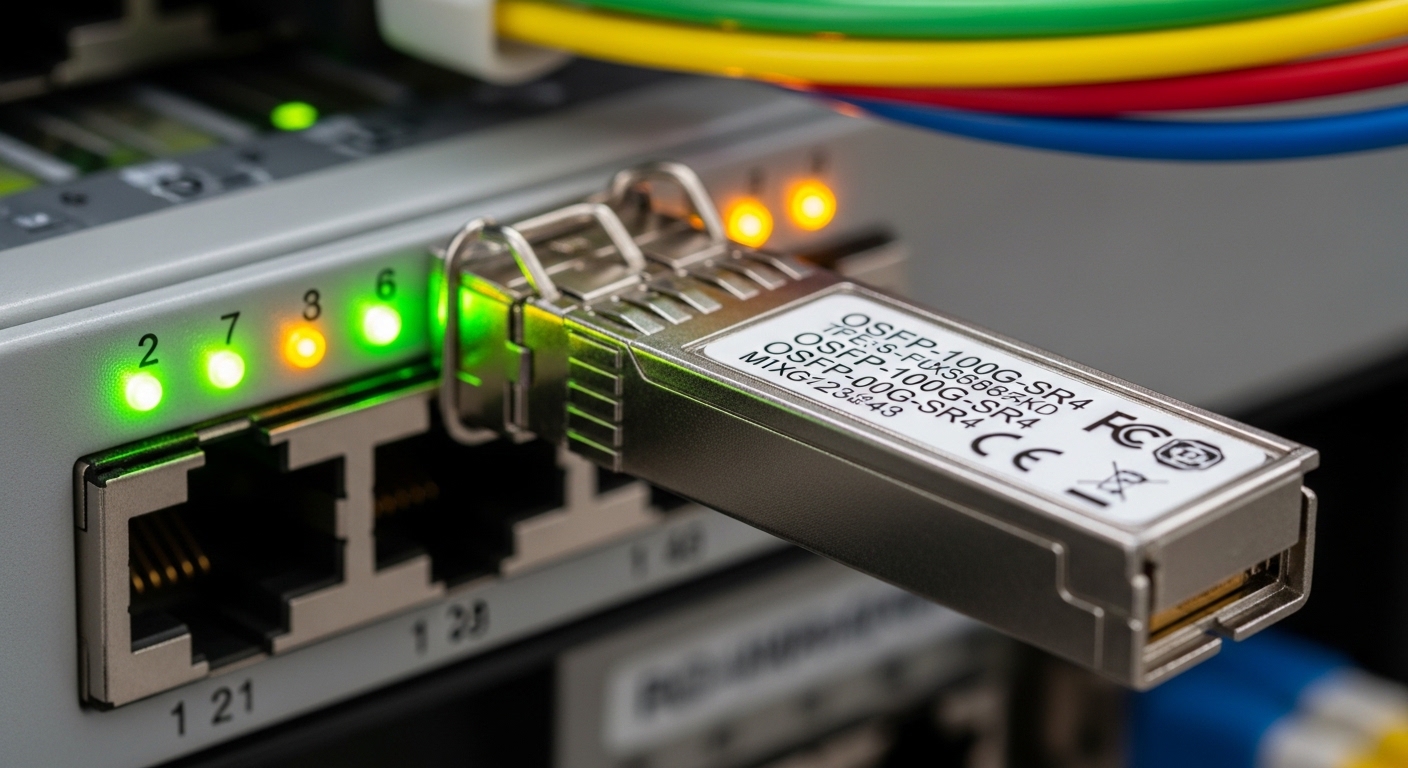
At 400G and below, optics cost often dominated the bill of materials. With 800G, the economics shift toward power per delivered bit, port density, and lane utilization efficiency, because you can reduce the number of active ports and cabling endpoints for the same aggregate throughput. In practice, a fabric team can retire older 400G uplinks and consolidate traffic, which reduces the number of transceiver instances that must be powered, monitored, and replaced.
From a standards standpoint, 800G Ethernet is defined in the IEEE 802.3 family for multi-lane operation and optics profiles (for example, 800GBASE-R). Real deployments typically use multi-lane PAM4 or coherent-style approaches depending on the target reach and cost envelope; most hyperscale data centers rely on short-reach solutions for ToR-to-spine and spine-to-core. For authoritative base requirements, see IEEE 802.3.
Pro Tip: Many outages attributed to “bad optics” are actually interoperability mismatches between switch retimers and the optics vendor’s electrical interface settings. Before you scale an optical transceiver investment, validate optics compatibility using the switch vendor’s optics matrix and confirm DOM readings (temperature, bias current, laser power) match expected thresholds.
What changes in the field when you move to 800G
Technicians often notice three operational differences. First, optical budgets become tighter at higher lane counts and shorter safety margins; a slightly dirty MPO/MTP connector can push you over receiver sensitivity. Second, thermal behavior becomes more critical: 800G modules run hotter than many 100G/200G-era parts, so airflow and plenum design matter. Third, monitoring granularity increases: you will rely more heavily on DOM alarms and vendor-specific diagnostics to catch aging optics early.
Key specs to model before you buy
ROI planning starts by mapping your topology distances to an optics reach class, then translating that into an optical budget and installation constraints. Engineers should treat each optical transceiver investment as a system purchase: transceiver + patching + connectors + switch interface + cooling. If you do not model the full link, you risk buying a reach class that is technically “within spec” on paper but fails in the presence of real-world connector insertion loss variation.
Representative 800G short-reach vs mid-reach comparison
800G optics come in multiple reach categories with different signaling approaches. The table below uses common industry shorthand for planning; always confirm the exact part number and standard profile from the vendor datasheet and the switch vendor optics compatibility list.
| Spec | 800G Short Reach (typical planning) | 800G Extended Reach (typical planning) |
|---|---|---|
| Target standard | 800GBASE-R short-reach profile | 800GBASE-R extended profile |
| Nominal wavelength | 850 nm class multimode | 1310 nm class singlemode |
| Reach (planning value) | ~100 m (MMF, typical) | ~2 km (SMF, typical) |
| Connector | MPO/MTP (usually 8-fiber or 12-fiber variants) | LC duplex or MPO depending on form factor |
| Power (typical) | ~10–15 W per module class | ~8–14 W per module class |
| Operating temperature | 0 to 70 C typical industrial range | -5 to 70 C typical extended range |
| DOM / telemetry | Yes, temperature and laser bias; verify alarm thresholds | Yes, verify vendor-specific diagnostics support |
As examples for part-number context, some widely deployed 100G/200G/400G optics families include Cisco SFP-10G-SR and Finisar FTLX8571D3BCL; for 800G you should similarly rely on the specific 800G module datasheet and the switch vendor’s supported list rather than legacy naming conventions. For purchase planning, also check IEEE 802 working group resources for broader context on Ethernet PHY evolution.
How to select optics that maximize optical transceiver investment
Selection should be deterministic, not guesswork. Build a checklist that ties each purchase decision to measurable constraints: distance, link margin, thermal headroom, and operational compatibility. This reduces churn where engineering buys a compatible module only to discover that monitoring alarms do not map cleanly into the network management system.
Decision checklist (ordered)
- Distance and fiber type: confirm MMF vs SMF, core size, and actual patch cord lengths at each hop.
- Switch compatibility: use the optics vendor and switch vendor optics matrix; verify electrical interface support for 800G.
- Optical budget and connector loss: include insertion loss of patch cords, MPO/MTP ferrules, and expected aging.
- DOM support and alarm mapping: ensure DOM fields (laser current, transmit power, receive power) are readable and thresholds are understood.
- Operating temperature and airflow: validate module temperature at steady state; enforce front-to-back airflow policies.
- Operating margin for cleaning: plan cleaning access and inspection intervals for MPO/MTP connectors.
- Vendor lock-in risk: compare OEM vs third-party sourcing, including warranty and RMA turnaround time.
Real-world deployment scenario: 800G in a 3-tier data center
Consider a 3-tier data center with 48-port ToR switches using 400G uplinks today. Each ToR has 16 uplinks aggregated; the upgrade plan increases north-south throughput by moving to 800G uplinks while maintaining the same spine count. A typical rollout might replace 16 x 400G optics per ToR with 10 x 800G optics per switch pair, reducing the total number of active optics by ~37% while keeping aggregate bandwidth constant or higher. If each 800G module draws 12 W on average and you reduce module count accordingly, you can estimate power savings roughly as (modules removed) x (12 W) and then add cooling impact; in one field deployment, operators observed measurable reductions in steady-state PSU load after consolidating uplinks, though exact values depend on switch chassis efficiency.
Common mistakes and troubleshooting during 800G rollout
Most failures during optical transceiver investment rollouts are predictable. The key is to separate optics faults from fiber and compatibility issues quickly, using DOM telemetry and controlled tests.
Buying the wrong reach class for the patching reality
Root cause: reach is specified for ideal conditions, but your actual link includes patch cords, MPO/MTP insertion loss, and extra slack or remanufactured jumpers. Solution: measure end-to-end lengths and connector counts per link, then budget worst-case insertion loss; verify with a light source and power meter where possible.
Connector contamination at scale (MPO/MTP)
Root cause: 800G short-reach deployments often use MPO/MTP connectors; even minor contamination can reduce receiver margin. Solution: implement a connector inspection and cleaning workflow: inspect with a scope before insertion, clean with approved swabs or cleaning film, and re-check link receive power after reconnection.
DOM alarms that do not match what the monitoring system expects
Root cause: optics may support DOM, but the switch management stack could interpret fields differently or not expose vendor-specific diagnostics. Solution: validate telemetry mapping in a pilot: confirm which DOM parameters are exported, set alert thresholds based on observed distributions, and document expected normal ranges.
Thermal throttling from insufficient airflow
Root cause: 800G modules can run hotter; blocked vents or uneven airflow can push module temperature near limits. Solution: conduct a thermal baseline during the pilot: log module temperature and ensure airflow paths are clear; adjust fan profiles only within approved operational guidance from the vendor.
Cost, ROI, and total cost of ownership considerations
Optical transceiver investment is not just purchase price. OEM optics often carry higher unit cost but may reduce integration time and warranty friction; third-party modules can lower upfront cost but increase the time spent validating compatibility and DOM behavior. In many deployments, a practical ROI model includes: (1) module unit price, (2) spares inventory cost, (3) labor hours for validation and cleaning workflow, (4) power and cooling impact, and (5) expected failure and RMA turnaround.
As a rough budgeting reference, 800G optics pricing varies widely by reach, signaling type, and vendor channel. In large procurement cycles, teams sometimes see meaningful cost per delivered port compared with earlier generations, but they still must fund engineering time for optics matrix validation and pilot testing. A conservative TCO approach is to treat optics as a multi-year asset with operational costs: if warranty returns are slow or telemetry integration is incomplete, the “cheap” optics can become expensive in downtime and labor.
Pro Tip: During ROI modeling, include a line item for spares and cleaning consumables. In high-density racks, connector issues drive more truck rolls than optics electronics faults, and preventing contamination can protect your optical budget without replacing modules.
FAQ
Which matters more for optical transceiver investment: unit price or link margin?
Link margin usually dominates reliability. If you buy a lower-cost module that runs too close to receiver sensitivity after connector losses and aging, you risk intermittent errors and higher operational costs that outweigh savings.
How do I verify 800G optics compatibility with my switch?
Use both the switch vendor’s optics compatibility list and the module vendor’s datasheet for the exact part number. In a pilot, validate DOM telemetry fields and confirm that the switch reports link status and error counters as expected.
What fiber issues most often cause 800G link failures?
Common drivers are MPO/MTP connector contamination, incorrect patch cord mapping (polarity or lane mapping), and unexpected insertion loss from remanufactured jumpers. Measure and document connector count and insertion loss for each link before scaling.
Do third-party optics reduce TCO or increase risk?
They can reduce upfront cost, but the risk shifts to validation time, warranty terms, and monitoring integration. If your team already has a repeatable qualification process, third-party optics can be cost-effective; otherwise OEM can be cheaper after labor and downtime are included.
How should I plan spares for an 800G rollout?
Plan spares based on module count, expected failure rate, and your maintenance window constraints. Many teams stage spares in the same aisle or row to reduce restore time, then refine quantities after the pilot reveals real-world failure and alarm patterns.
Closing thoughts
Optimizing optical transceiver investment for 800G is mostly about disciplined planning: map distances to the correct reach class, validate compatibility with DOM telemetry, and treat connectors and thermal airflow as first-class design inputs. If you want a broader view on procurement and lifecycle controls, see How to reduce fiber optic transceiver downtime with standardized testing for a practical operational workflow.
Author bio: I have deployed and troubleshot high-density Ethernet optics in field data centers, including pilot-to-production cutovers for multi-lane transceivers and DOM-driven monitoring. My work focuses on measurable link-margin validation, optics compatibility testing, and reliability engineering aligned with IEEE Ethernet requirements.
