
Open RAN rollouts fail in predictable places: the transceiver looks compatible on paper, but reach, DOM behavior, temperature headroom, or vendor timing mismatch breaks link bring-up. This guide helps network and procurement teams select optical networking transceivers that actually survive fronthaul and midhaul conditions in real deployments. You will get a spec comparison table, a selection checklist, and field troubleshooting patterns tied to IEEE 802.3 link budgets and vendor datasheets. Update date: 2026-05-02.
Why Open RAN changes the optical networking transceiver requirements
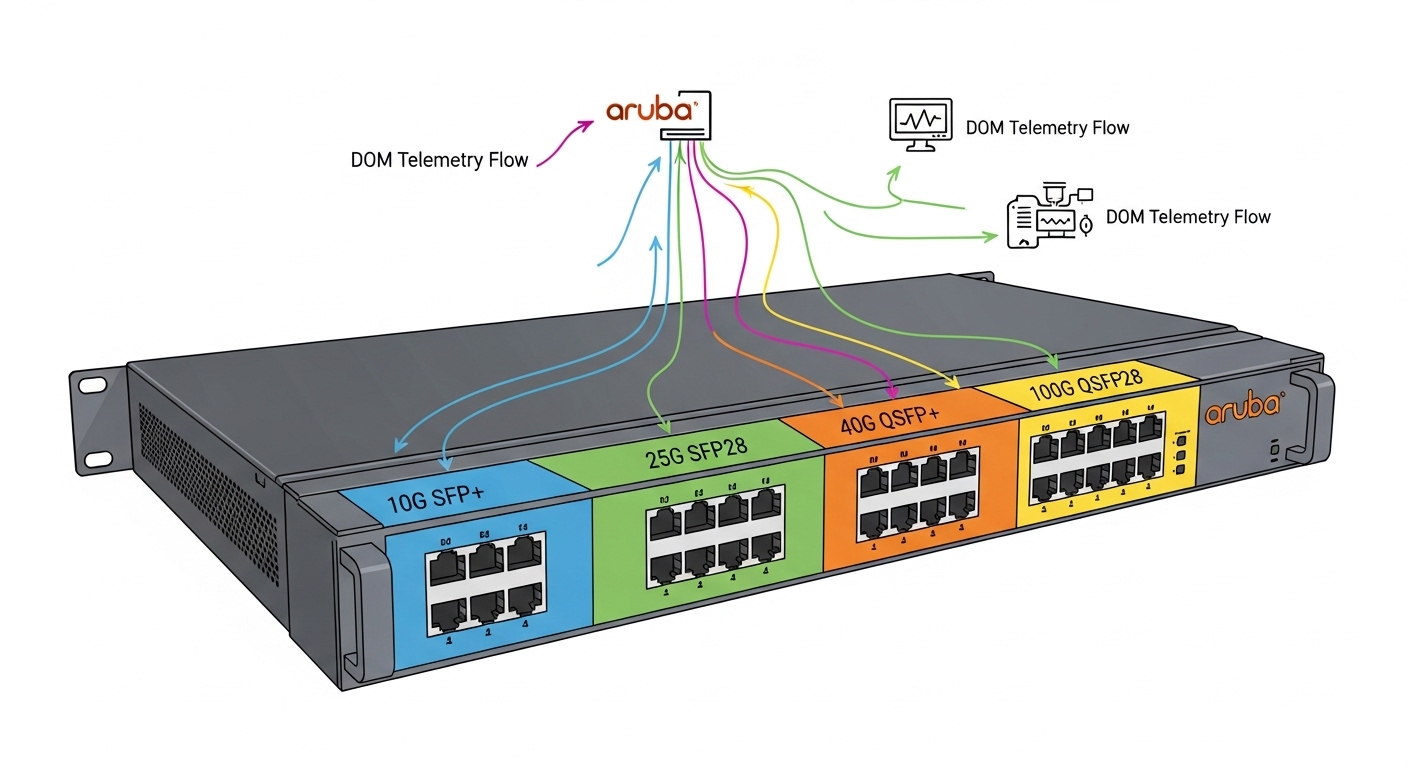
Unlike enterprise switching, Open RAN fronthaul has tight latency and strict optical budgets, and it often rides on dense leaf-spine or regional aggregation architectures. In practice, you must align transceiver selection with the radio unit (RU) interface expectations, fiber plant loss, and the switch or OTN transport behavior in your plant. Many deployments also rely on DOM for automated inventory, alarm thresholds, and optical power balancing. If DOM polling or alarm mapping is inconsistent, you can get “link up” but unstable traffic, especially during cold starts.
Start with the standard Ethernet line rate and coding requirements implied by IEEE 802.3 for the relevant PHY class, then map to the Open RAN functional split you are using. For example, higher functional splits typically move more bandwidth closer to the RU, which increases the number of 25G/50G/100G links and the likelihood of marginal optical power or connector loss. Procure with the assumption that you will have to validate a handful of modules end-to-end before you scale across multiple sites.
Transceiver spec comparison for fronthaul vs midhaul
Procurement teams often compare only wavelength and reach, but Open RAN selection hinges on the full operating envelope: transmitter launch power, receiver sensitivity, dispersion tolerance, connector type, and temperature range. Below is a practical comparison you can use when shortlisting optical networking transceivers for typical deployment patterns. Always confirm the module’s compliance to the host’s supported MSA and the platform vendor’s optics interoperability list.
| Category | Common module examples | Wavelength / Fiber | Reach (typical) | Data rate | Connector | DOM | Operating temp |
|---|---|---|---|---|---|---|---|
| Fronthaul short reach (SR) | Cisco SFP-10G-SR, Finisar FTLX8571D3BCL, FS.com SFP-10GSR-85 | 850 nm, MMF (OM3/OM4) | Up to ~300 m (10G SR typical) | 10G | LC | Yes (readable power/temp/alarms) | 0 to 70 C or -40 to 85 C (confirm grade) |
| Midhaul short reach (SR) at higher rates | FS.com QSFP-100GSR4 style, vendor QSFP28 SR4 | 850 nm, MMF | ~100 m to ~400 m depending on OM grade | 25G or 100G (4x25G) | LC | Yes (DOM over I2C) | -5 to 70 C typical; verify with datasheet |
| Midhaul extended reach (LR) | Vendor 1310 nm LR optics (SFP+/QSFP+ LR) | 1310 nm, SMF | ~10 km typical (varies by class) | 10G/25G | LC | Yes | -40 to 85 C options available |
| Longer reach (ER / ZR) | Vendor ER/ZR coherent or ZR optics | 1550 nm, SMF | 40 km to 80 km+ (depends) | 10G/100G coherent | LC duplex (varies) | Yes (enhanced telemetry) | -40 to 85 C common |
For procurement, the key is to treat “reach” as a budget calculation, not a promise. In Open RAN sites, you may have additional patch cords, splitters, and connector cleaning variability that can cut effective reach. Use vendor link budget tools and your site fiber records, then add a conservative margin for aging and cleaning practices. If you are using dark fiber, confirm attenuation per kilometer at your exact wavelength and patch cord composition.
Pro Tip: In fronthaul bring-up, many teams confirm only “RX power above threshold” but ignore DOM alarm thresholds and host-specific alarm mapping. If the host vendor expects particular alarm scaling or paging behavior, a third-party module can appear healthy while silently tripping link retrains under temperature swings.
Selection criteria checklist for Open RAN optical networking procurement
Use this ordered checklist so procurement and engineering make consistent decisions across sites. The goal is to reduce “last-mile incompatibility” and minimize RF-to-optics operational risk during scaling.
- Distance and fiber type: Confirm MMF vs SMF, OM3/OM4 grade, connector count, and measured attenuation at the wavelength. Require measured OTDR reports when possible.
- Data rate and PHY compatibility: Match the host port speed and optics form factor (SFP/SFP+/QSFP28/QSFP-DD) to the platform’s supported IEEE 802.3 PHY profiles. Reference the applicable IEEE 802.3 clause for link behavior.
- MSA compliance and vendor interoperability: Verify the optical networking transceiver supports the relevant MSA (for example, SFP MSA, QSFP28 MSA) and is listed on the host vendor interoperability matrix. Cross-check optics vendor part numbers, not just “SR/LR” labels.
- DOM and telemetry requirements: Confirm DOM availability, I2C access compatibility, alarm thresholds, and whether the host toolchain reads standard fields. If you use monitoring platforms, validate a sample batch.
- Operating temperature and power constraints: For outdoor cabinets or near-RU equipment, prefer modules with extended temperature grades and ensure your enclosure airflow supports the module’s maximum allowed case temperature.
- Vendor lock-in and supply continuity: Ask about lead times, allocation policies, and whether replacements remain compatible after firmware or platform updates. Consider multi-sourcing strategies with documented equivalency testing.
- Compliance, warranty, and traceability: Require lot traceability, burn-in test evidence, and a warranty that covers premature failures. For regulated deployments, request compliance statements relevant to your region.
For external authority, use vendor datasheets for electrical/optical specs and IEEE 802.3 for PHY behavior. Recommended references include IEEE 802.3 standard pages and vendor optics documentation from the module manufacturer and host platform vendor. [Source: IEEE 802.3 overview pages; Source: vendor QSFP28/SFP datasheets]
Deployment scenario: fronthaul in a leaf-spine Open RAN fabric
In a 3-tier data center leaf-spine topology supporting an Open RAN deployment, you may have 48-port ToR switches aggregating into 96-port spine switches, with RU connections concentrated on a dedicated fronthaul VLAN. Suppose each ToR hosts 24 RU uplinks at 25G and uses QSFP28 SR4 optics into MMF trunks. The fiber plant is OM4 with patching that totals roughly 3.5 dB of connector and splice loss per link, and measured trunk attenuation is 2.5 dB for the expected span. During commissioning, you need link budgets that still clear receiver sensitivity across cold mornings down to -10 C cabinet conditions.
In this scenario, procurement should require extended temperature optics grade, verified DOM telemetry compatibility with the switch OS, and a documented cleaning and inspection process for LC connectors. Field engineers typically perform a quick “power + errors” validation: check DOM Rx power, verify link stability over a 15 to 30 minute stress window, and confirm zero CRC spikes at the switch interface counters. If you are mixing OEM and third-party optics, validate one full batch per site rather than assuming equivalence across lots.
Cost, lead time, and supply chain risk in Open RAN optics
Pricing for optical networking transceivers varies heavily by form factor, reach class, and whether you buy OEM vs third-party. As a practical range, short-reach OEM optics for enterprise-grade switches often land in the $200 to $800 per module range for common 10G/25G families, while higher-density or extended-temperature variants can be higher. Third-party alternatives can be meaningfully cheaper, sometimes 10% to 40% lower, but you must price in integration engineering time and the risk of incompatibility during scaling.
Lead time is the hidden cost. OEM allocations during telecom refresh cycles can stretch to 6 to 16 weeks in peak demand, while third-party distributors may offer faster availability but with more variability in lot-to-lot DOM behavior. Procurement should negotiate for advance replacements or vendor-managed inventory, especially when you have a multi-site rollout schedule tied to construction milestones. Track failure rates via warranty claims and require burn-in evidence or test reports for each lot when you are deploying at scale.
Total cost of ownership should include: power draw differences (often small but relevant at scale), connector cleaning consumables, and the time spent on optical troubleshooting. A single “marginal receiver” incident can cost more than the optics price difference if it triggers re-cabling, site visits, or delayed RU commissioning. [Source: vendor warranty policies and field service cost observations from enterprise telecom operations]
Common mistakes and troubleshooting for optical networking links
Below are concrete failure modes that repeatedly show up in Open RAN optical networking deployments. Each includes the root cause and a field-tested correction workflow.
Link up but traffic flaps (intermittent CRC or retrains)
Root cause: DOM alarm threshold mismatch, marginal optical power due to connector contamination, or host OS behavior with non-interoperable DOM fields. In some cases, the module passes basic link training but trips on burst errors during temperature transitions.
Solution: Clean and inspect LC connectors with proper inspection scope, then compare Rx power and error counters before and after cleaning. Validate with a known-good reference module from the same vendor family, and confirm the host OS reads DOM fields without raising “unsupported module” warnings.
“No light” or consistently low Rx power
Root cause: Wrong fiber polarity (Tx/Rx swapped), incorrect patch cord type, or an OM grade mismatch against the transceiver’s expected loss budget. This is common when technicians re-terminate patch panels during parallel construction.
Solution: Verify polarity using standard fiber labeling practice, then re-map patch cords to ensure Tx-to-Rx alignment. Re-check OTDR attenuation and connector loss against the link budget. If using MMF SR optics, confirm OM4 compatibility and that you did not introduce an OM2 patch cord segment.
Sudden failures in outdoor cabinets or warm enclosures
Root cause: Temperature grade mismatch or inadequate airflow causing the module to exceed its rated operating range. Optical power can drift, and receiver sensitivity can worsen as temperature rises.
Solution: Require extended temperature-rated optics (or confirm actual case temperature with a sensor). Improve cabinet airflow and ensure the module cage is not blocked by cabling. During acceptance testing, run a temperature soak test at the expected enclosure conditions and monitor DOM temperature telemetry.
Repeatable incompatibility after platform upgrades
Root cause: Host firmware updates can tighten optics validation logic or change how DOM alarms are interpreted. A module that worked under one software version may behave differently under another.
Solution: Before a fleet upgrade, test optics compatibility with a representative module set in a staging environment. Lock the optics bill of materials per software release and document the supported combinations for future audits.
FAQ for Open RAN teams selecting optical networking transceivers
What optical networking reach class should I prioritize for fronthaul?
Start by mapping your fiber distance and the functional split requirements to the expected link rate. For many fronthaul designs using MMF, SR optics at 850 nm are common, but only after you confirm measured attenuation and connector loss. If distance or patching complexity exceeds the SR budget, move to an LR-class design on SMF and re-calculate.
Can I mix OEM and third-party optical transceivers?
Yes in many cases, but you should treat it as a compatibility project, not a procurement shortcut. Validate DOM telemetry, host alarm behavior, and error performance using a staged sample across representative ports and temperatures. If your host vendor has an interoperability list, prioritize parts listed there.
How do DOM differences affect Open RAN operations?
DOM differences can show up as missing telemetry fields, different alarm threshold interpretations, or “unsupported module” warnings that trigger monitoring noise or operational overrides. Even when the link comes up, mismatched alarm scaling can hide early degradation. Require a sample validation that includes DOM reads and sustained traffic under expected thermal conditions.
What lead-time strategy reduces optical networking supply chain risk?
Use multi-site staging with safety stock for critical spares and negotiate allocation clauses with your primary supplier. If you plan to use third-party modules, request lot traceability and burn-in evidence, then qualify at least one lot per module family. Align purchase orders with your construction milestones to avoid last-minute substitutions.
Which standards should procurement reference in RF-to-optics reviews?
Use IEEE 802.3 for PHY behavior and vendor datasheets for optical/electrical parameters like transmitter launch power and receiver sensitivity. For interoperability, rely on the host switch or router vendor’s optics guidance and the module manufacturer’s MSA compliance statements. [Source: IEEE 802.3; Source: vendor transceiver datasheets]
What is the most common field troubleshooting mistake?
Assuming reach is the only constraint and skipping connector inspection and polarity checks. Many “mystery” failures are caused by dirty LC endfaces or swapped Tx/Rx polarity after re-cabling. Make inspection and cleaning a mandatory step before you replace modules.
If you want to tighten your procurement process further, review your optical networking acceptance test plan and align it to your host platform’s optics behavior using the internal resource optical transceiver acceptance testing checklist. The fastest path to stable Open RAN operations is disciplined validation: calculate budgets, qualify telemetry, and test across temperature and software versions.
Author Bio: I have hands-on experience deploying and validating optical networking transceivers in Open RAN and enterprise fabrics, including DOM telemetry checks and link-budget commissioning. I also support procurement decisions using interoperability documentation, lead-time risk modeling, and failure-rate tracking from field returns.
