
If your multi-cloud connectivity stalls because optics don’t match the switch or the link budget, you lose time twice: once in troubleshooting and again in delayed deployments. This article helps network and field teams choose the right fiber transceivers (SFP, SFP28, QSFP28, QSFP-DD) for interconnects that span vendors, distances, and operating temperatures. You will get decision criteria, real deployment math, and the failure modes that show up in the field.
Why multi-cloud optics fail in the real world
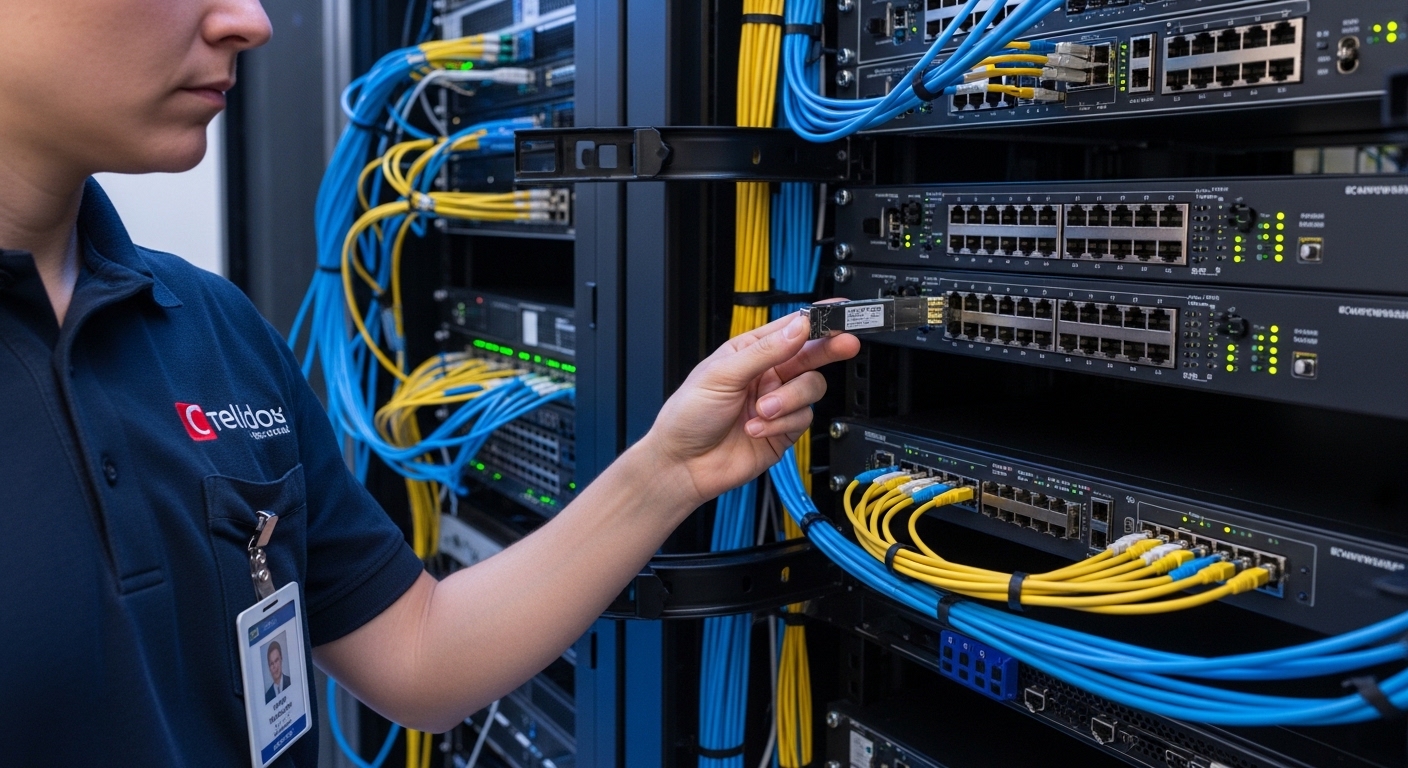
Multi-cloud architectures mix hardware generations across tenants, regions, and cloud providers, so optical compatibility becomes the hidden dependency. Even when data rates match, optics can fail due to wavelength mismatch, incorrect connector type (LC vs MPO), or DOM handling differences that break monitoring workflows. IEEE 802.3 defines electrical and optical interfaces, but vendors still diverge on thresholds, diagnostics, and supported optics lists. [Source: IEEE 802.3-2022 Ethernet standards]
For example, a leaf switch might accept 10GBASE-SR optics for 300 m links over OM3, but your multi-cloud path could require 400 m over OM4, or it might be running at 850 nm with a different launch condition. In practice, teams validate with a link budget and with vendor-qualified transceivers, then verify with optics telemetry (DOM) once the link is live.
Key transceiver specs that map to multi-cloud link budgets
Optical selection starts with the physical layer standard and the fiber grade. SR (850 nm) is common for data center distances, while LR (1310 nm) extends reach over single-mode fiber. Below is a practical comparison of common pluggables used in multi-cloud interconnects.
| Transceiver type | Standard / rate | Wavelength | Typical reach | Connector | Optical power class | DOM / diagnostics | Operating temp |
|---|---|---|---|---|---|---|---|
| SFP-10G-SR | 10GBASE-SR | 850 nm | ~300 m (OM3) / ~400 m (OM4) | LC | ~-7.3 to -1 dBm transmit (varies by vendor) | Usually supported | 0 to 70 C (commercial) or -40 to 85 C (extended) |
| SFP-10G-LR | 10GBASE-LR | 1310 nm | ~10 km (SMF) | LC | ~-8.2 to 0 dBm transmit (varies) | Usually supported | -40 to 85 C common for enterprise |
| QSFP28-25G-SR | 25GBASE-SR | ~850 nm | ~70 m (OM3) / ~100 m (OM4) | MPO (8-fiber) | Class varies | Usually supported | 0 to 70 C common; extended available |
| QSFP28-100G-LR4 | 100GBASE-LR4 | ~1310 nm (4 wavelengths) | ~10 km (SMF) | LC or MPO (depends on model) | Class varies | Usually supported | -40 to 85 C common |
Concrete examples you can reference when scoping procurement: Cisco SFP-10G-SR modules are widely validated in enterprise switches, while Finisar models such as FTLX8571D3BCL are common for 10G SR optics. Third-party options like FS.com SFP-10GSR-85 also exist, but you must confirm compatibility with your switch vendor and firmware. [Source: Cisco SFP module datasheets; Source: Finisar/II-VI product datasheets; Source: FS.com transceiver specifications]
Pro Tip: In multi-cloud rollouts, treat DOM telemetry as a commissioning gate. If the transceiver reports abnormal bias current or optical power drift at startup, you can catch marginal fiber cleanliness or connector contamination before users notice packet loss.
Deployment scenario: leaf-spine to cloud edge across 3 distance tiers
Consider a 3-tier data center leaf-spine topology feeding a multi-cloud gateway stack. You deploy 48-port 10G ToR switches at the leaf, uplinking to spine switches over 10G SR for 220 m runs on OM4. For regional edge aggregation, you use 10G LR optics over SMF for 6.5 km to a metro interconnect room. Finally, to connect into a cloud provider’s transport POP, you run 100G LR4 between aggregation switches over 8 km of SMF, with QSFP28 optics carrying four wavelengths.
Operationally, a field engineer confirms that the SR links negotiate at 10G with the expected lane mapping, then checks DOM thresholds for TX power and RX power. For the LR and LR4 links, you verify dispersion tolerance and ensure the fiber is truly single-mode (core/cladding compliance) rather than “marketing SMF.” This workflow reduces repeat truck rolls because you catch the “looks compatible on paper” cases early.
Selection checklist engineers use for multi-cloud optics
When procurement and engineering disagree, it usually comes down to missing constraints. Use this ordered checklist before you buy or swap modules.
- Distance and fiber grade: pick SR vs LR vs LR4 based on OM3/OM4 or SMF reach and your measured end-to-end attenuation.
- Switch and port compatibility: confirm the exact transceiver type supported by your switch model and firmware (especially for QSFP-DD lane modes).
- Connector standard: LC for single links, MPO for multi-fiber trunks; verify polarity and pinout when using MPO.
- DOM support and monitoring: ensure the module exposes temperature, bias current, and optical power via the same diagnostics interface your NMS expects.
- Operating temperature: validate whether the environment is in the 0 to 70 C band or requires -40 to 85 C modules for hot aisles and near power supplies.
- Vendor lock-in risk: weigh OEM-qualified optics lists against third-party options; run a pilot with a small batch and measure link stability.
- Optical safety and power class: ensure the transceiver’s transmit power stays within your system’s receiver sensitivity limits.
Cost, ROI, and total cost of ownership for multi-cloud optics
Pricing varies by speed and reach, but realistic procurement ranges help decision-makers. OEM 10G SR SFP+ modules often cost more than third-party equivalents, while QSFP28 LR4 100G modules typically carry the highest unit cost. For TCO, include labor time for swaps, failure rate history, and the cost of downtime during maintenance windows.
A practical ROI model: if an OEM module costs 20 to 50 percent more but reduces failed link bring-ups and avoids rework, the payback is often measured in saved hours. Power consumption differences are usually small per port, but eliminating repeated troubleshooting can dominate TCO. Also budget for spares: multi-cloud deployments benefit from stocking the exact optics used in each distance tier to avoid emergency compatibility delays.
When comparing OEM vs third-party, insist on datasheet alignment (wavelength, reach, DOM behavior) and run a controlled acceptance test: insert, confirm link negotiation, monitor DOM for stability over 24 to 72 hours, and validate BER/PCS counters where supported. [Source: Vendor transceiver datasheets and switch compatibility guides]
Common mistakes and troubleshooting tips
These are the issues that repeatedly hit multi-cloud rollouts, even for teams with strong documentation.
- Mistake: Using the right wavelength but wrong fiber type. Root cause: OM3 vs OM4 mismatch or incorrect SMF labeling. Solution: verify with fiber certification results (attenuation and bandwidth) and run an OTDR spot check on critical runs.
- Mistake: MPO polarity or cleaning shortcuts. Root cause: inverted polarity or dirty endfaces cause high attenuation and intermittent errors. Solution: enforce connector cleaning and polarity verification; use a proper polarity adapter and inspect with a fiber microscope.
- Mistake: Assuming DOM works the same across vendors. Root cause: diagnostics thresholds and data formats differ, causing NMS alarms or “unsupported module” events. Solution: test DOM visibility in a staging rack; map your monitoring system to the module’s diagnostic outputs.
- Mistake: Temperature and airflow mismatch. Root cause: transceiver exceeds spec in hot aisles, leading to power drift and link flaps. Solution: measure inlet temps, ensure correct cage airflow, and choose extended-temperature modules when needed.
FAQ for multi-cloud optical transceiver buying
Q: What optics should I standardize on for multi-cloud?
Many teams standardize on SR for short datacenter tiers and LR/LR4 for longer interconnects, then keep a strict compatibility matrix by switch model. If you expect vendor mixing, standardize connector types (LC vs MPO) and DOM behavior requirements first.
Q: How do I confirm compatibility beyond the datasheet?
Use your switch vendor’s transceiver compatibility list and validate in a staging rack. Then run a 24 to 72 hour stability test that checks link counters and DOM telemetry for drift.
Q: Can third-party optics work in multi-cloud networks?
Yes, but only after a pilot. Differences in DOM thresholds, optical power classes, and firmware interactions can create intermittent issues that are hard to diagnose at scale.
Q: What is the fastest way to troubleshoot intermittent link drops?
Start with fiber cleanliness and connector inspection, then check DOM for optical power and bias current anomalies. If DOM looks healthy, move to checks on airflow, temperature, and whether the switch port is experiencing marginal signal conditions.
Q: Are SR modules enough for cloud edge links?
Not usually. SR is typically for shorter reaches over OM3/OM4, while cloud edge and metro transport commonly require LR or LR4 over SMF.
Q: Should I buy OEM or extended-temperature modules?
If your environment runs hot or variable, extended-temperature modules can reduce link flapping and improve uptime. For OEM vs third-party, choose based on pilot results and the cost of downtime during multi-cloud maintenance windows.
Multi-cloud optical success comes from disciplined spec matching, fiber verification, and commissioning using DOM telemetry. Next, align your transceiver choices with a broader standards view using fiber link budget and optical standards to make every deployment repeatable.
Author bio: I work with network teams on field deployments of Ethernet optics, validating link budgets, DOM telemetry, and switch compatibility under real airflow and cabling constraints. I also evaluate vendor and third-party transceivers for measurable uptime and total cost of ownership in multi-cloud environments.
