
When a multi-cloud architecture grows from 100G to 400G, the failure mode shifts from “can we get bandwidth” to “can we keep the optics stable under real plant conditions.” This article walks through a field deployment where we moved a leaf-spine fabric and cloud interconnect from 200G to 400G per link using coherent and short-reach optics, then validated performance with optical power budgets, DOM telemetry, and packet-level telemetry. It helps network engineers, datacenter architects, and transport teams who need repeatable selection criteria and troubleshooting logic, not marketing claims.
Problem / challenge: multi-cloud links hit the 400G wall
In our case, a large enterprise ran a three-tier data center fabric (leaf-spine) and extended it to multiple cloud regions via a mix of on-prem interconnect and provider managed WAN. The immediate driver was application throughput: analytics pipelines and storage replication demanded sustained east-west and north-south traffic bursts that exceeded 200G capacity on several critical paths. We planned to upgrade to 400G transceivers on spine-to-border and border-to-aggregation links, while keeping the existing cabling routes and minimizing downtime.
The challenge was not only reach; it was reliability across mixed hardware generations. Some switches supported only specific optics revisions, while other platforms required particular Digital Optical Monitoring (DOM) behavior and strict lane mapping. On top of that, we had to protect the optics from marginal fiber conditions: patch panel connectors with high return loss, and a few MPO trunks that had been re-terminated years earlier.
Environment specs: plant constraints, standards, and 400G options
Before choosing optics, we quantified the environment. The data center used structured cabling with OM4 multimode in the short runs (about 30 to 100 meters from transceiver to patch panel), and OS2 singlemode for longer intra-facility and inter-building routes (typically 1 to 5 km). On the compute side, the leaf-spine used 400G-capable line cards with QSFP-DD or OSFP-style form factors depending on vendor. For the cloud interconnect, we used singlemode coherent where the provider handoff demanded reach and power budget headroom.
We aligned our selection with IEEE and industry optics behavior. Ethernet 400G implementations generally follow the lane-based architecture defined in IEEE 802.3 for 400GBASE-R and related PHY clauses, while the optics themselves are governed by vendor datasheets and transceiver MSA behavior (for example, QSFP-DD and OSFP mechanical/electrical conventions). For coherent deployments, we also accounted for vendor-specific DSP requirements and the test procedures recommended in vendor application notes.
Key 400G transceiver types used in the case
- 400G short-reach over multimode fiber: typically using QSFP-DD form factor with PAM4 or multi-lane signaling depending on implementation.
- 400G reach over singlemode fiber: either long-reach direct-detect (where supported) or coherent optics for multi-kilometer and provider-managed links.
- DOM telemetry: used to validate real-time receive power, temperature, and bias current against thresholds.
Technical specifications comparison (what we actually matched to the plant)
Below is a simplified comparison of representative transceiver classes we used or evaluated for the multi-cloud upgrade. Exact part numbers vary by switch vendor and line card; always confirm compatibility with the specific platform optics matrix.
| Transceiver class | Typical wavelength | Target reach | Fiber type | Form factor | Connector | DOM support | Operating temp |
|---|---|---|---|---|---|---|---|
| 400G SR (multimode) | 850 nm class | ~70 m (OM4) to ~100 m (depending on vendor) | OM4 | QSFP-DD | MPO-12 | Yes (digital diagnostic) | 0 to 70 C or -5 to 70 C class |
| 400G LR (singlemode direct-detect) | 1310 nm class | ~10 km class (vendor dependent) | OS2 | QSFP-DD | LC | Yes (digital diagnostic) | 0 to 70 C or -5 to 70 C class |
| 400G coherent (for provider reach) | C-band (typical) class | ~80 km and beyond (vendor dependent) | OS2 | Coherent module (vendor form factor) | LC or proprietary interface | Yes (module DSP telemetry) | -5 to 70 C class |
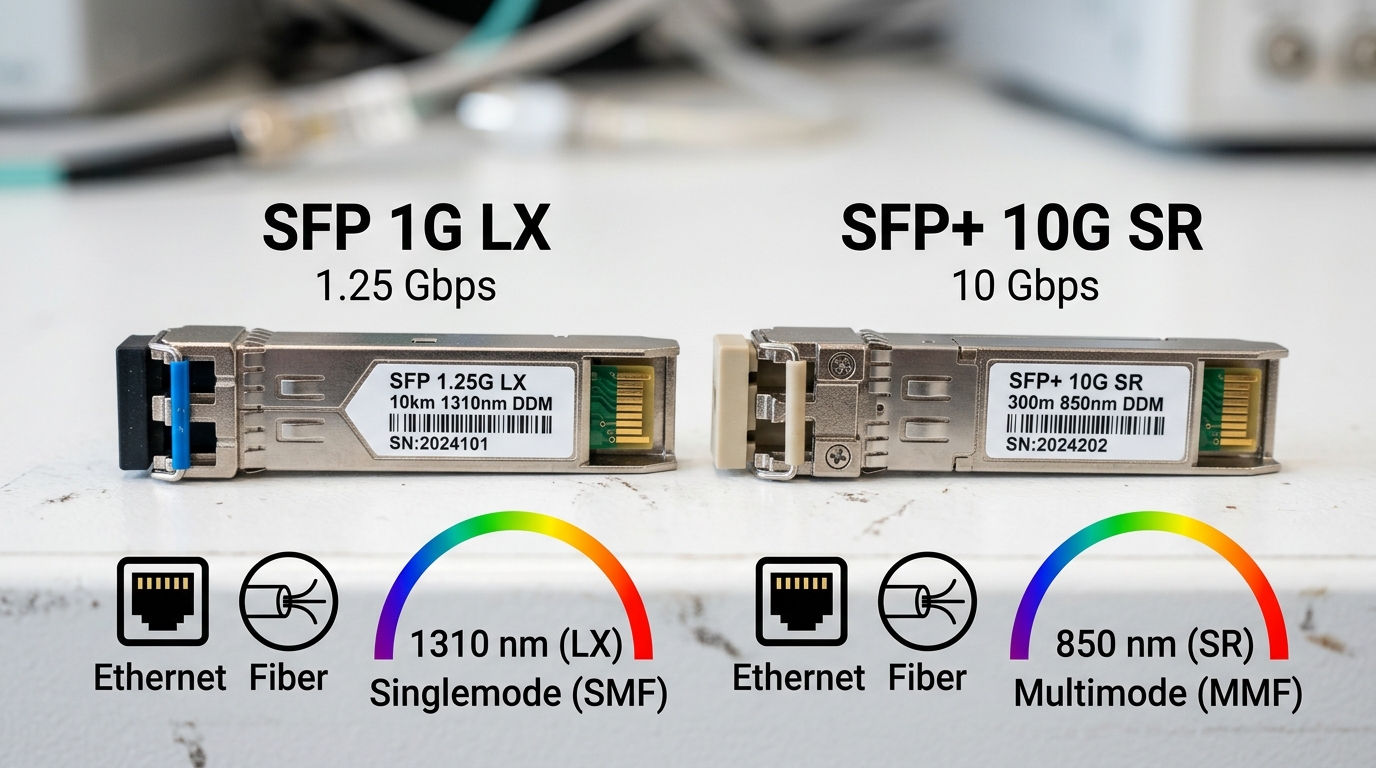
Representative example SKUs we validated in lab testing and vendor compatibility checks included Cisco-branded and third-party optics such as Cisco SFP-10G-SR for earlier generations, and for higher speeds typical QSFP-DD 400G SR/FR/LR and coherent modules from vendors like Finisar and FS.com. For instance, FS.com lists multiple 400G QSFP-DD optical options and uses DOM-capable designs; verify your exact SKU against your switch model’s optics support list. [Source: IEEE 802.3, [Source: vendor transceiver datasheets], [Source: FS.com QSFP-DD product listings]].
Chosen solution & why: aligning 400G optics to multi-cloud traffic paths
We used a hybrid optics strategy to keep risk low while meeting the multi-cloud throughput target. For the leaf-spine internal fabric, we selected 400G SR multimode for short runs and 400G LR OS2 for medium reach where patching density made MPO terminations less reliable. For cloud interconnect handoffs that required longer reach and provider constraints, we selected 400G coherent where the provider required specific dispersion and power budget behaviors.
The selection logic was pragmatic: use multimode only where the installed OM4 plant and connector cleanliness could be proven with OTDR and insertion loss measurements. For any path with questionable patch panel history, we defaulted to OS2 where we had better control of splice and connector quality. This approach reduced the number of “mystery” link flaps we could not attribute to fiber damage or transceiver bias drift.
Implementation steps: how we rolled out without breaking the fabric
- Map link budgets per path: for each 400G candidate, we calculated expected receive power using measured insertion loss (fiber plus patch) and connector loss. We used vendor recommended power budget figures from datasheets and added a margin for aging and cleaning variability.
- Validate optics compatibility: before ordering, we checked the switch vendor optics matrix for the exact line card SKU and the transceiver form factor revision. Some platforms reject certain DOM implementations even when the electrical interface is nominally compatible.
- Pre-clean and pre-test: we cleaned MPO and LC endfaces using proper cassette-based cleaning tools, then tested with a fiber inspection microscope. We also verified polarity and lane mapping for MPO trunks.
- Stage deployment: we upgraded one spine pair at a time, keeping redundant paths. We used maintenance windows to replace transceivers while monitoring link training and error counters.
- Telemetry-driven acceptance: after installation, we polled DOM values (temperature, bias current, RX power) and correlated them with interface error counters such as FEC-related metrics and symbol errors.
Pro Tip: In multi-cloud upgrades, most “400G link instability” reports trace back to patch panel connector geometry and MPO lane skew, not the transceiver itself. DOM can look healthy while the receiver is intermittently crossing a margin due to micro-movements, so always combine DOM telemetry with physical inspection and a before/after OTDR trace.
Measured results: what changed after moving to 400G
After the phased migration, we measured both performance and operational stability. For the internal fabric, we upgraded 32 spine-to-leaf links to 400G SR/LR mix, and we upgraded 8 border-to-aggregation links to 400G singlemode options for the multi-cloud interconnect. In the first four weeks, we observed a reduction in congestion events during peak replication windows because the uplink headroom increased from 200G aggregate bottlenecks to 400G per link class.
On stability, the key metric was error-free operation under sustained load. We ran a controlled traffic profile: 70 to 85 percent of line rate for 6 hours per day during business peak testing, while monitoring error counters and DOM. We saw that links with pre-validated fiber paths maintained RX power within expected bounds and showed no persistent FEC or frame errors. In contrast, the few links initially placed on marginal MPO trunks exhibited intermittent training resets, which correlated strongly with connector inspection findings and were fixed by re-termination and cleaning.
Operational numbers from the field
- Deployment window: 3 weekends for fabric pairs; each pair cutover completed in under 45 minutes including transceiver swap and post-check.
- Observed link error rate: zero sustained CRC error bursts on accepted links after remediation; transient link-down events only on the initial marginal patch set.
- DOM margin: RX power stayed within vendor tolerance bands; temperature and bias currents remained stable across multiple polling intervals.
- Mean time to repair: reduced after standardizing MPO cleaning and inspection steps; the first week had higher MTTR due to rework on one patch panel.
Common mistakes / troubleshooting: why 400G sometimes fails after install
Engineers frequently assume that if the transceiver “fits” physically and the interface comes up, the link will be stable. In practice, multi-cloud 400G failures often come from a few repeatable issues in the optical and optics-management layers.
MPO polarity and lane mapping errors
Root cause: MPO trunks can be assembled with incorrect polarity or lane alignment, causing degraded training or intermittent receive failures. This can look like random link flaps during load changes. Solution: verify polarity using the connector keying method and confirm lane mapping in the switch documentation; re-terminate MPO trunks and re-test with an inspection microscope.
Overestimating OM4 reach with dirty or aged connectors
Root cause: OM4 budgets assume clean endfaces and typical insertion loss. In real plants, patch panel connectors can drift upward in loss due to dust or micro-scratches, shrinking the margin until RX power falls near threshold. Solution: measure insertion loss per path before and after cleaning; use OTDR to locate high-loss events and replace degraded patch cords.
DOM threshold mismatch or unsupported optics revisions
Root cause: Some switch line cards expect specific DOM behavior and may log warnings or degrade link stability if thresholds are incompatible. Even when the link trains, repeated polling can reveal marginal bias conditions. Solution: confirm optics compatibility against the exact line card model and transceiver revision; if using third-party optics, validate with vendor compatibility tooling and run a burn-in traffic test.
Thermal hotspots in dense racks
Root cause: 400G optics can be sensitive to local airflow conditions. In high-density cabinets, airflow short-circuiting can raise transceiver temperature, leading to bias drift and reduced receiver margin. Solution: verify front-to-back airflow, check rack blanking, and compare DOM temperature trends across stable and unstable links.
Cost & ROI: how to budget multi-cloud 400G optics responsibly
Pricing varies widely by form factor, reach, and whether you choose OEM or third-party. As a realistic planning baseline, many 400G SR QSFP-DD modules land in the mid-hundreds to low-thousands USD per unit depending on vendor and quantity, while 400G coherent modules can be several times higher due to DSP and optics complexity. Third-party modules may reduce upfront cost, but the ROI must include integration risk, compatibility validation time, and potential higher failure rates in harsh environments.
We modeled total cost of ownership across a 3-year horizon. The biggest non-obvious cost driver was not the transceiver itself; it was rework time caused by optical cleanliness issues. After standardizing cleaning and inspection, we reduced repeat visits and improved acceptance yield, which effectively increased ROI even when third-party pricing was slightly lower.
For ROI, the operational question is: will you save on optics purchase price without increasing truck rolls? If your fiber plant is already well-managed with inspection records and OTDR baselines, third-party optics can be cost-effective. If your plant history is mixed, pay for compatibility validation and fiber hygiene first.
Selection criteria checklist for multi-cloud 400G transceivers
Use this ordered checklist during procurement and design reviews. It is built from the failures we saw and the acceptance criteria that prevented recurrence.
- Distance and reach class: confirm the actual measured distance from transceiver to transceiver, not the cabling label length.
- Fiber type and plant quality: OM4 vs OS2; verify insertion loss and connector cleanliness with test data (not assumptions).
- Switch and line card compatibility: match optics support lists for the exact switch model and software release.
- DOM behavior and threshold handling: ensure the transceiver provides expected diagnostics and does not trigger alarms or disable features.
- Operating temperature range: confirm the module supports the rack airflow conditions; check for -5 to 70 C class if your environment runs cold.
- Budget vs integration risk: include time for compatibility testing and burn-in, especially for third-party optics.
- Vendor lock-in risk: evaluate whether you can swap vendors without redesigning transceiver types or changing optics management workflows.
FAQ
What makes multi-cloud 400G optics different from standard datacenter 400G?
Multi-cloud designs often require more heterogeneous paths: internal fabric plus provider handoffs, with different reach and operational constraints. That pushes you toward a mix of SR/LR for fabric and coherent or long-reach options for provider links. It also increases the number of compatibility checks across hardware and software releases.
Can I use third-party 400G transceivers on OEM switches?
Sometimes, but only after explicit compatibility validation for your exact switch model and line card. Even when the optics is electrically compatible, DOM and threshold expectations can differ. For risk control, run a burn-in traffic test and monitor error counters plus DOM stability.
How do I verify whether my fiber plant can support 400G SR over OM4?
Use measured insertion loss per path and verify connector cleanliness with inspection microscopes. Then correlate with link training behavior and DOM RX power after installation. If the plant has frequent patch changes, re-test after each major cabling event.
What are the fastest troubleshooting steps when a 400G link flaps?
First, confirm optics compatibility and check DOM for RX power, temperature, and bias drift trends. Next, inspect and clean the endfaces, paying special attention to MPO polarity and lane mapping. Finally, validate with OTDR or trace testing to locate high-loss events or fiber damage.
Should I standardize on one transceiver type across the entire multi-cloud footprint?
Not always. Standardization helps operations, but it can force you into reach assumptions that your fiber plant cannot safely support. A better approach is to standardize per distance class: SR for clean short runs, LR/OS2 for medium runs, and coherent where provider reach and dispersion needs it.
How long should I burn in new 400G transceivers before declaring success?
In field practice, a minimum of 24 to 72 hours of sustained traffic under realistic load patterns is a good baseline, followed by monitoring during peak windows. If you are using new optics vendor SKUs or new switch software, extend burn-in to cover at least one full business peak cycle.
If you are planning a multi-cloud 400G upgrade, start by mapping reach and measured fiber loss, then select optics using switch compatibility and DOM behavior—not just headline reach specs. Next, lock in a fiber hygiene workflow and validate with telemetry and error counters during a staged cutover using related topic as your checklist for optical readiness.
Author bio: I am a telecom engineer who has deployed 5G fronthaul and backhaul transport and datacenter interconnects, including DWDM and coherent optics. I focus on hands-on acceptance testing with DOM telemetry, optical budgets, and structured troubleshooting.
