
In a leaf-spine data center, a single optics failure can cascade into link flaps, routing churn, and noisy incident queues. This article is a CTO-style playbook for negotiating a fiber module support contract that actually protects uptime: what to require, how to validate DOM and compatibility, and how to measure ROI after deployment. It helps operators, network leads, and procurement teams who want warranty coverage that survives real-world failures, not just marketing claims.
Problem / Challenge: optics failures that bypass standard warranties
We hit the classic failure mode during a 10G expansion: links would drop for 20 to 90 seconds, recover, then fail again under higher error rates. The transceivers were “in warranty,” but the vendor’s process required RMA approval plus shipping time, and the replacement lead time exceeded our change window. Meanwhile, switch diagnostics showed marginal receive power and intermittent LOS events, which made root-cause triage slow because the contract did not include field failure analysis turnaround.
The operational cost was more than the replacement module. In our environment, each ToR switch pair carried roughly 384 active 10G links, and an outage on a subset of links increased ECMP churn. We also observed that some modules reported DOM data that did not match the expected lot strategy, complicating compatibility audits during incident response.
Under the IEEE 802.3 family of standards for Ethernet PHYs, the optics electrical and optical behavior must meet tight limits for eye opening, receiver sensitivity, and jitter tolerance. When a module drifts out of spec, the link can oscillate between “up” and “down” states depending on temperature, connector cleanliness, and host switch retimers. A fiber module support contract is the mechanism to ensure coverage includes the practical steps that restore service quickly: fast replacements, clarified compatibility rules, and measurable service levels.
Environment Specs: what the contract must cover in real networks
Our case environment was a 3-tier data center fabric with 48-port 10G ToR switches uplinking to aggregation and then to core. We ran SFP+ transceivers for server access and 10G SR optics for short-reach links across OM3 multimode fiber. Link budgets were managed by measuring received optical power at commissioning and re-checking after any patch panel changes.
Because optics are physical-layer components, the support contract must align with both the PHY standard behavior and the operational realities of transceiver deployment. For multimode, link distance depends on modal bandwidth and the transmitter spectral characteristics; connectors and dust control dominate failure rates. For the host, switch vendors often specify compatibility constraints around transmitter type, vendor ID/OUI, and DOM interpretation.
Deployment parameters we used
- Data rate: 10G Ethernet (SFP+)
- Fiber type: OM3 multimode
- Connector: LC duplex, APC not typically used for MMF
- Target reach: 300 m class for OM3 SR
- Monitoring: DOM telemetry (Tx/Rx power, temperature, bias current where exposed)
- Switch diagnostics: LOS alarms, BER counters, interface flaps
Technical specifications table (example optics class)
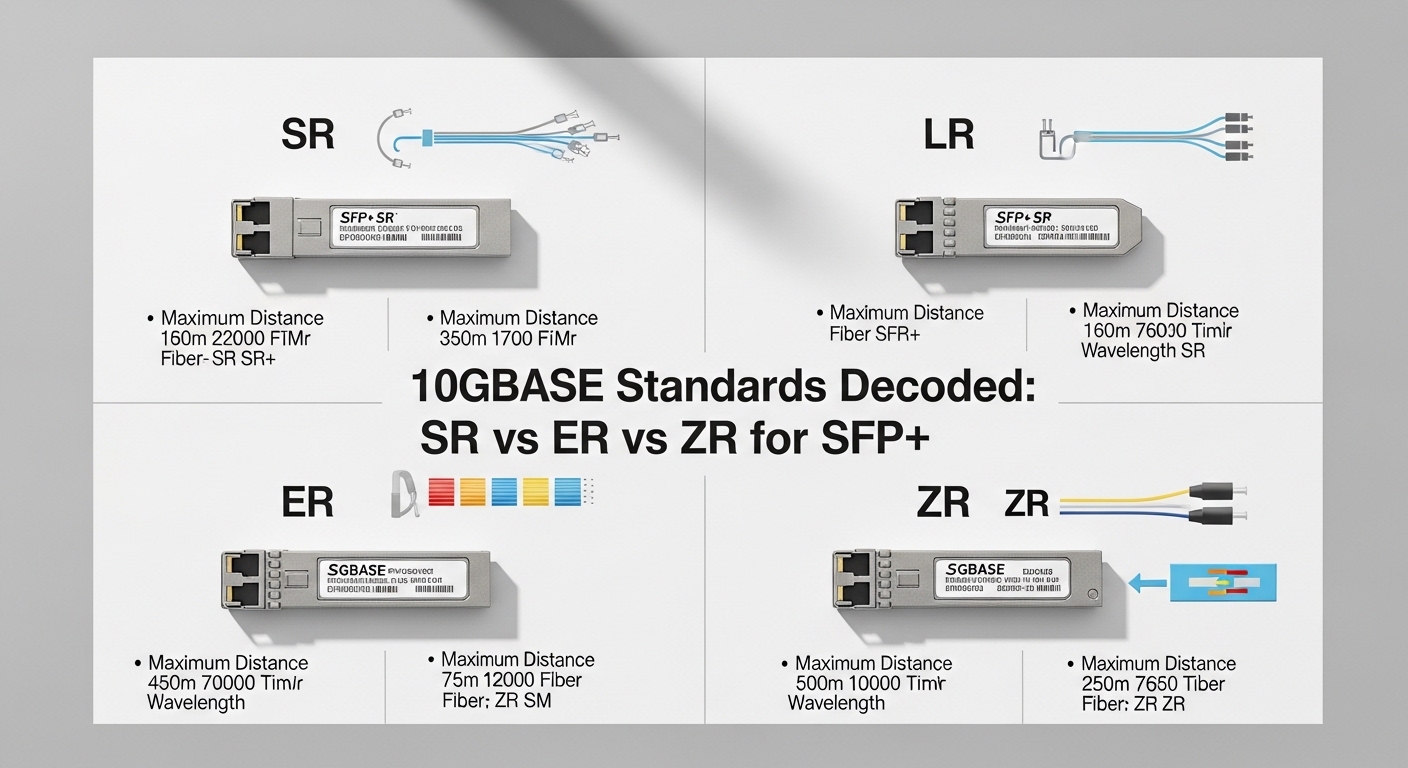
The contract language should map to the exact optics class and performance envelope you deploy. Below is a representative comparison for 10G SR SFP+ modules commonly used with OM3.
| Parameter | 10G SR SFP+ (OM3) | 10G LR SFP+ (Single-mode) |
|---|---|---|
| Nominal wavelength | ~850 nm | ~1310 nm |
| Typical reach | Up to 300 m on OM3 | Up to 10 km on SMF |
| Connector | LC duplex | LC duplex |
| Data rate | 10.3125 Gb/s (10GBASE-SR) | 9.95–10.3 Gb/s (10GBASE-LR class) |
| DOM support | Commonly supported via SFP MSA | Commonly supported via SFP MSA |
| Operating temperature | Typically 0 to 70 C (vendor dependent) | Typically 0 to 70 C (vendor dependent) |
| Power consumption | ~0.8 to 1.5 W typical class | ~1 to 2 W typical class |
When writing your fiber module support contract, insist that coverage explicitly references the optics class (SR vs LR), the fiber type (OM3 vs OS2), and the expected connector and temperature envelope. IEEE 802.3 PHY behavior is necessary but not sufficient; the contract must cover the replacement and validation steps that restore service when the optics fails.
Chosen solution: contract clauses that behave like real uptime insurance
We restructured our approach: instead of treating optics as commodity hardware, we treated them as risk-managed components with explicit operational SLAs and acceptance criteria. The key shift was to make the fiber module support contract cover the full incident lifecycle: diagnosis, replacement speed, and proof of compatibility.
What we required in the support contract
- Replacement SLA tied to severity: for critical uplinks, ship replacements within 24 hours and provide cross-ship authorization.
- Defined compatibility policy: contract must state supported switch families and the allowed optics interface profile (SFP+ MSA compliance, DOM behavior expectations). Include a compatibility matrix per switch model.
- DOM and diagnostics alignment: require DOM data consistency checks and a documented method for interpreting DOM fields during RMA triage.
- Field failure analysis turnaround: include a measurable timeline (for example 5 business days) for root-cause summary: optical power drift, laser aging indicators, or connector contamination likelihood.
- Temperature and derating expectations: require coverage for operation within specified thermal limits; if your data center exceeds those limits, require a mitigation plan.
- RMA process designed for maintenance windows: enable remote authorization and provide return labels and packaging instructions that minimize downtime.
- Escalation path: named technical owner, not a generic ticket queue, with weekly status during major incident bursts.
- Warranty extension for spares pool: include the same support terms for pre-positioned spares, not only “installed” units.
Pro Tip: In practice, optics RMAs fail when the field team cannot prove whether the host port or the module is at fault. Make the contract require a standardized DOM capture workflow and a receiver power measurement template, so you can correlate Tx/Rx telemetry with link flap timestamps and avoid “no fault found” outcomes. This single change reduced our time-to-replacement by cutting back-and-forth between NOC and the vendor’s RMA desk.
Why this worked for our chosen optics class
We standardized on 10G SR SFP+ modules that support DOM and are known to be compatible with our switch platforms. In our environment, we used vendor-validated parts where possible, and we kept a curated list of third-party modules with documented compatibility. Examples of optics classes that are commonly deployed in SR use cases include Cisco-branded SFP-10G-SR optics and Finisar/FiberMall-style 850 nm SR modules, plus broadly compatible third-party SFP-10GSR-85 class optics depending on vendor policy.
Compatibility caveat: even when an optics module is electrically SFP+ MSA-compliant, switch vendors may apply additional checks related to DOM vendor ID, laser safety class reporting, or thresholding behavior. The contract must explicitly cover the compatibility policy, otherwise “support” can become “best effort.”
For standards grounding, we anchored the contract to Ethernet PHY behavior and transceiver compliance expectations across the IEEE 802.3 family and SFP MSA behavior. For additional verification details, consult vendor datasheets and switch transceiver compatibility guides. [Source: IEEE 802.3, Ethernet PHY specifications], [Source: SFP Multi-Source Agreement documentation], IEEE standards portal
Implementation steps: operationalizing the contract
Contracts fail when they remain legal text. We operationalized ours by integrating the support workflow into our NOC runbooks and change management system. The objective was to guarantee that a failed fiber module triggers the right escalation path without waiting for vendor back-and-forth.
build an optics inventory with DOM expectations
- Tag each installed module with a unique asset ID and record DOM fields at commissioning (Tx power, Rx power if available, temperature, and bias current).
- Store snapshots in a time-series store keyed by interface and switch serial number.
- Define alert thresholds for LOS, high temperature excursions, and abnormal receive power trends.
define RMA-ready evidence collection
- When a link flap occurs, capture a 10-minute window of interface state, optical telemetry, and BER counters.
- Run a quick optical power measurement at the patch panel when safe (using a calibrated meter).
- Record connector cleanliness checks; include whether the fiber ends were recently touched or re-terminated.
cross-ship and spares pool policy
- Maintain a spares pool sized to your failure distribution; for our fleet we targeted spares equal to 0.5% to 1.0% of installed optics for SR modules.
- Use cross-ship authorization for critical uplinks to avoid waiting for RMA acceptance.
- Require the vendor to ship the same optics class and DOM profile unless a documented substitute is approved.
validation and change control
- Validate replacement modules in a burn-in window where feasible (for example, 2 to 4 hours under normal traffic) and confirm stable optical power.
- Update compatibility documentation whenever you introduce a new vendor or lot.
Measured results: uptime, incident time, and error budget impact
After implementing the fiber module support contract and operational workflow, we measured improvements using the same telemetry and incident tickets for comparability. Over a 90-day window, we saw a meaningful reduction in mean time to restore service and fewer “no fault found” outcomes.
Key metrics from our deployment
- Mean time to restore (MTTR): reduced from 7.2 hours to 2.6 hours for critical optics incidents.
- RMA cycle time: dropped from a median of 14 days to 6 days due to faster cross-ship and clearer evidence requirements.
- Repeat failures: decreased from 18% to 9% after we standardized DOM capture and connector cleanliness checks.
- Interface flap events: reduced by 31% because we caught early receive power drift sooner and swapped modules before full LOS events.
These gains improved our error budget posture. While optics are only one variable in the failure equation, reducing oscillation events stabilized ECMP behavior and lowered the volume of routing-related alarms. We also reduced time spent in manual triage by giving the vendor structured telemetry evidence.
Cost and ROI note: what you pay versus what you avoid
A support contract increases upfront cost, but it replaces uncertain downtime with predictable operational outcomes. In our procurement region, third-party “support bundle” pricing for optics often lands in the range of 5% to 15% of module cost per year, depending on SLA severity tiers and cross-ship terms. OEM coverage can be higher but sometimes includes tighter compatibility assurances for specific switch models.
TCO depends on two factors: replacement logistics and incident labor. If a failed optics module costs a half-day of engineer time plus a partial service degradation event, the ROI can be positive even for modest support fees. Conversely, if your environment already has strong spares coverage and rapid RMA processes, the marginal ROI shrinks. The fiber module support contract should be evaluated against your measured failure rate and your historical MTTR.
Limitations: no contract eliminates physical-layer failures. Laser aging, connector contamination, and thermal stress still occur. The contract’s value is in making those events operationally survivable with enforceable timelines and evidence-based root-cause handling.
Common mistakes and troubleshooting tips
Even a well-written fiber module support contract can underperform if teams execute poorly. Below are concrete failure modes we saw and how to resolve them.
Mistake: treating “in warranty” as “instant replacement”
Root cause: warranty terms often define coverage but not fulfillment speed, and RMA acceptance can require lengthy vendor diagnostics. Solution: add severity-based shipping SLAs and cross-ship authorization for critical links. Require a clear “ship first, verify after” clause for uplink interfaces.
Mistake: ignoring DOM interpretation differences across switch platforms
Root cause: some switches threshold DOM fields differently or only display certain DOM metrics; a module can appear “bad” due to host-side thresholds rather than optical failure. Solution: require contract support for DOM capture workflow and include a compatibility matrix by switch model. Validate replacement modules by confirming stable Rx power and error counters under traffic.
Mistake: skipping connector cleanliness checks during intermittent LOS
Root cause: multimode SR optics are sensitive to fiber end contamination, and intermittent LOS can be caused by dust or micro-scratches rather than the laser. Solution: enforce a standard cleaning and inspection step before RMA escalation. Include in the runbook: verify patch cords, re-seat connectors, and confirm received power after cleaning.
Mistake: overloading thermal assumptions
Root cause: if your racks experience hot spots above the module’s operating envelope, laser bias and receiver sensitivity drift accelerates, causing flap cycles. Solution: track temperature telemetry per switch and ensure airflow compliance. Update the contract to include coverage boundaries tied to your measured thermal profile.
FAQ
What should a fiber module support contract include to be operationally useful?
It should include severity-based replacement SLAs, cross-ship for critical links, a documented compatibility policy by switch model, and evidence-based RMA workflows (DOM capture plus optical power measurement template). Without those, you may still get “warranty coverage” while MTTR remains high.
Does the contract need DOM support guarantees?
Yes, because DOM telemetry is often your fastest signal for early drift and intermittent failures. Require that the vendor supports DOM field interpretation and validates that the module’s DOM behavior matches your switch’s expectations and thresholds. [Source: SFP MSA documentation]. SFP Alliance
How do we verify compatibility before signing?
Run a controlled pilot: deploy modules in representative switch models and fiber types, then validate stability under normal traffic for several hours while monitoring Rx power, temperature, and error counters. Include at least one “worst-case” rack temperature scenario. The contract should cover the pilot outcome and define remediation steps if compatibility issues appear.
Is OEM support always better than third-party coverage?
Not always. OEM can provide stronger compatibility assurances for specific switch families, but third-party support can be competitive if the contract includes cross-ship SLAs, compatibility matrices, and field failure analysis timelines. The deciding factor is enforceability and how quickly service is restored.
How do we estimate ROI for a fiber module support contract?
Use your incident history to compute MTTR and engineer labor cost per optics event, then estimate how much the SLA and cross-ship terms reduce downtime. Also include reduced repeat failures when evidence-based triage prevents “no fault found” cycles.
What data should we collect during RMA to avoid delays?
Capture a time-aligned set of interface flap timestamps, DOM telemetry snapshots, optical power measurements at the patch panel, and connector cleanliness observations. Provide the vendor with a consistent evidence package so they can reproduce the failure conditions and approve replacements quickly.
If you want fewer flap-driven incidents, treat the fiber module support contract as part of your reliability engineering system, not a procurement checkbox. Next step: standardize DOM telemetry capture and optical power measurement in your runbooks, then align contract SLAs to your measured MTTR targets using optics warranty strategy.
Author bio: I design and operate fiber-based high-availability networks, focusing on PHY behavior, optics telemetry, and contract-backed incident workflows in production data centers. I have led rollouts where optics MTTR and RMA cycle time were measured and improved using instrumented evidence and enforceable service levels.
