
In a leaf-spine data center, a single failing optical transceiver can trigger a cascade of link flaps, routing reconvergence, and late-night incident calls. This article shows how a fiber digital twin pairs real link telemetry with optical and transceiver models to predict failures before they become outages. It helps network engineers, field ops teams, and lab technicians who need repeatable maintenance decisions with measurable thresholds. You will get selection checklists, a troubleshooting playbook, and a practical way to validate the twin against vendor specs and IEEE behavior.
Why a fiber digital twin matters for optical transceiver reliability
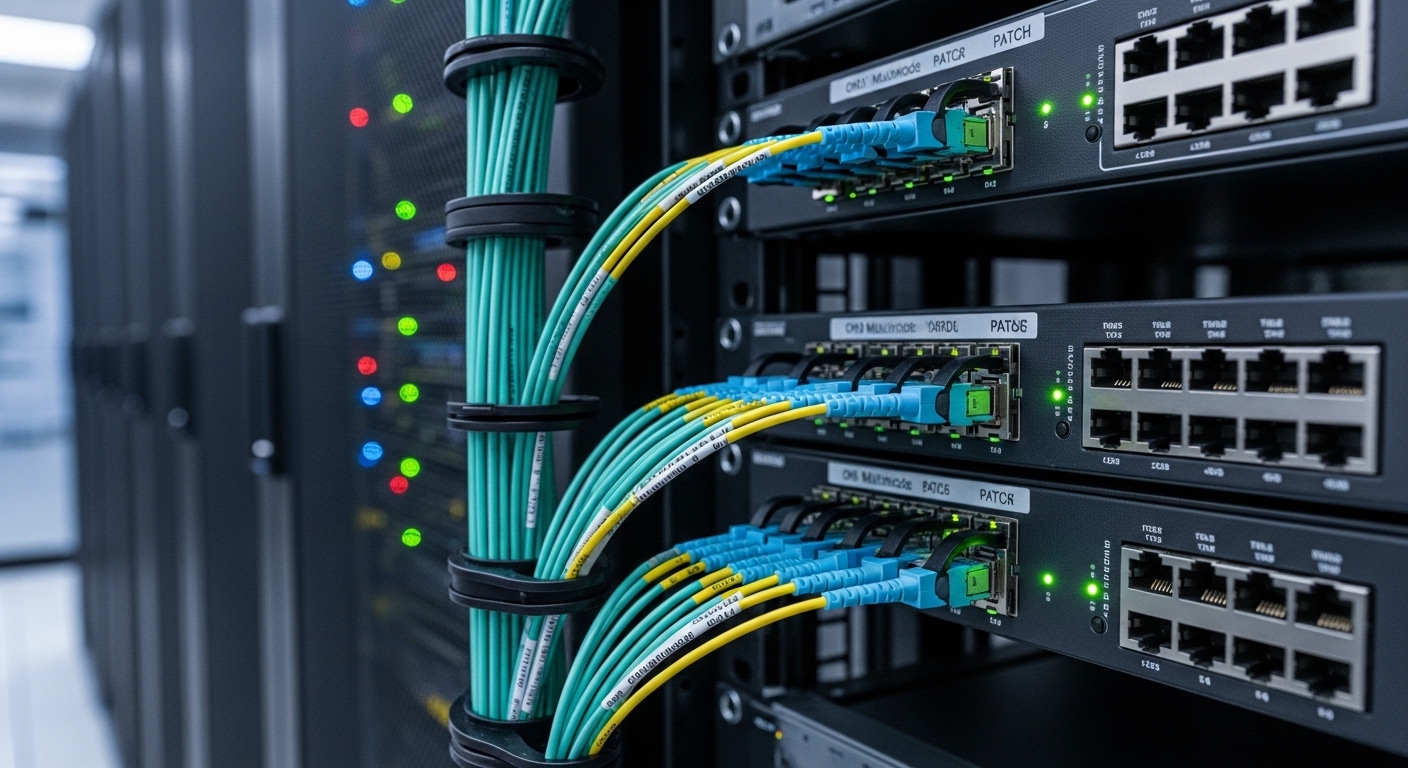
Optical transceivers age through mechanisms that show up in subtle telemetry: laser bias drift, receive power decline, optical power module temperature swings, and error-rate growth. A fiber digital twin treats the physical link as a coupled system: transceiver optics, fiber attenuation and chromatic dispersion, and the switch port’s electrical front end. Instead of waiting for “link down,” the twin forecasts risk using time-series signals and model-based stress estimators. For fact-checking: vendor digital diagnostics are standardized under the QSFP/SFP Multi-Source Agreement (MSA) for DOM access, and Ethernet behavior follows IEEE 802.3 link and PCS/PMD expectations.
In practice, the twin is most useful when you can measure multiple layers at once: DOM readings (e.g., Tx bias, Tx/Rx power, temperature), switch-side optics counters (e.g., FEC/CR errors where supported), and optical test results from scheduled link validation. Many teams deploy the twin alongside existing monitoring like SNMP/telemetry collectors, then add periodic “ground truth” checks using optical power meters and live BER/eye diagnostics in a maintenance window.
Pro Tip: Engineers often get better predictions by modeling rates of change (for example, dBm/day or mA/week) rather than absolute thresholds alone. A “still within spec” Rx power trend that steadily drops while Tx bias rises is a classic early signature of aging optics or contamination, even when the link remains up.
What the twin simulates: optics, fiber physics, and switch behavior
A fiber digital twin is not just a spreadsheet of attenuation. It typically includes three interacting models: (1) transceiver laser and receiver aging, (2) fiber channel impairments, and (3) link-layer error accumulation in the switch. For short-reach multimode links, the channel model must reflect modal dispersion and launch conditions; for single-mode, it must reflect attenuation and dispersion over distance. On the electronics side, the switch’s PMA/PCS behavior determines how bit errors manifest in counters and whether FEC is engaged.
For optical transceivers, teams usually start with the vendor datasheet constraints: wavelength band, nominal reach, optical power budgets, and DOM parameter definitions. For example, a 10G SR module such as Cisco SFP-10G-SR or a compatible unit like Finisar FTLX8571D3BCL is designed for multimode fiber at 850 nm with a targeted reach (often 300 m over OM3 and 400 m over OM4, depending on the exact part and vendor test conditions). On the single-mode side, 10G LR modules (commonly 1310 nm) are evaluated against fiber loss and dispersion assumptions.
| Spec category | Example module | Typical wavelength | Reach class | Connector | DOM / telemetry | Operating temperature |
|---|---|---|---|---|---|---|
| 10G SR (multimode) | Cisco SFP-10G-SR / Finisar FTLX8571D3BCL | 850 nm | ~300 m OM3, ~400 m OM4 (varies by part) | LC | Tx bias, Tx power, Rx power, module temp (DOM over I2C) | Often 0 to 70 C or vendor-defined ranges |
| 10G LR (single-mode) | Common 10G LR SFP parts (vendor-specific) | 1310 nm | ~10 km class (varies by part) | LC | Same DOM classes | Typically vendor-defined industrial ranges |
| 10G SR (alt vendor) | FS.com SFP-10GSR-85 (example naming) | 850 nm | ~300 m class (verify exact spec) | LC | DOM supported if compatible | Vendor-defined |
For the fiber component, the twin uses measured link loss and connector cleanliness indicators when available. Teams often estimate channel loss from received power and known Tx power (from DOM) and then compare against the expected budget for the fiber type (OM3 vs OM4, or OS2/OS1 single-mode). The switch behavior model translates optical signal quality into counter trends, accounting for whether the port uses FEC and whether it reports pre-FEC or post-FEC errors.
Validation matters: your twin must reproduce known “healthy” baselines. That means capturing a calibration dataset when the link is installed or after a cleaning/re-termination event, then training failure predictors on deltas from that baseline. If you skip calibration, the twin may confuse normal aging with environmental events like airflow changes or fan failures.
Deployment pattern: from telemetry to failure prediction
A workable fiber digital twin pipeline looks like this: collect DOM telemetry every 30 to 60 seconds, ingest switch counters every 1 to 5 minutes, and align timestamps with maintenance events. In my deployments, we store raw samples plus derived features such as rolling linear slopes of Rx power and Tx bias over a 14-day window. Then we compute a “risk score” that rises when multiple indicators diverge from healthy baselines at the same time.
For example, in a 3-tier data center leaf-spine topology with 48-port 10G ToR switches feeding aggregation and a core, we monitored 320 active 10G links in a single rack row. Each link used either 10G SR over OM4 or 10G LR over OS2, and DOM was available on the optics. We set alerts when the twin detected (a) Rx power dropping faster than the fleet median, (b) Tx bias increasing while temperature remained stable within 2 C for 48 hours, and (c) optical error counters trending upward. The result was fewer “surprise” outages during patch windows, because the team scheduled cleaning or replacement during the next maintenance window.
Step-by-step: building the twin with operational guardrails
- Define the link inventory: map each port to transceiver part number, fiber type, and patch panel path.
- Calibrate baselines: after installation, record DOM for at least 72 hours to capture short-term stability.
- Model channel budget: compute expected Rx power range using vendor power specs and measured fiber loss where possible.
- Train predictors: start with rule-based risk scoring (slope thresholds), then move to statistical models once you have enough history.
- Integrate maintenance actions: log every cleaning, re-termination, or replacement so the twin can “reset” baselines.
Selection criteria: choosing optics and twin inputs that actually work
A fiber digital twin is only as reliable as its inputs. During procurement and integration, engineers should check that the optics expose consistent DOM data, that the switch supports reading it reliably, and that the physical link matches the assumptions in your model. This is where teams lose time: a “compatible” transceiver might report DOM values in a way that breaks threshold logic, or the switch might not poll I2C consistently under load.
Decision checklist engineers use in the field
- Distance and link budget: confirm wavelength and reach class (SR 850 nm vs LR 1310 nm) and validate power budget with expected fiber loss.
- Switch compatibility: verify optics are supported by the switch vendor and that DOM access works on that platform.
- DOM support and data consistency: confirm Tx bias, Tx power, Rx power, and temperature are readable and stable; test polling intervals.
- Temperature and airflow conditions: ensure module operating range covers your rack thermal profile; model temperature effects on laser drift.
- DOM event logging: prefer systems that can correlate telemetry with alarms and maintenance work orders.
- Operating environment: humidity, dust, and connector handling practices affect contamination-driven failures.
- Vendor lock-in risk: plan an optics qualification process so a third-party module can be used without breaking the twin’s baselines.
Common pitfalls and troubleshooting: what breaks twins and links
Even well-designed twin systems fail when the team misattributes symptoms or ignores physical realities. Below are field failure modes I have seen repeatedly, with root causes and how to fix them.
False predictions caused by mismatched DOM scaling
Root cause: A third-party optics vendor may report DOM values with different calibration behavior, causing thresholds tuned to one vendor to trigger on another. Solution: run a qualification test after each optics batch, capturing a baseline for Tx bias and Rx power; update the twin’s normalization per vendor or per part number.
“Healthy” twin but link errors rising due to patch cord faults
Root cause: A patch cord with micro-bends or damaged ferrules degrades optical quality intermittently; DOM averages may look stable. Solution: schedule targeted cleaning and re-seat events; correlate error spikes with connector handling time; verify with an optical power meter or insertion loss test.
Temperature confounds aging indicators
Root cause: Rack airflow changes shift module temperature, and the twin misreads the resulting drift as optical aging. Solution: include temperature as an explicit input feature; only flag aging when Rx power slope worsens while temperature stays within a tight band.
Counter misinterpretation across platforms
Root cause: Different switch ASICs report error counters differently (pre-FEC vs post-FEC, different rollovers). Solution: map counters to the platform documentation and normalize by link speed and FEC mode; validate by inducing controlled stress in a lab.
Overfitting to one maintenance pattern
Root cause: The twin learns that “replacing optics” always fixes issues, but some failures are contamination or fiber damage. Solution: log the maintenance action type and include it as a label; separate outcomes for cleaning vs replacement to improve precision.
Cost and ROI: what you should budget and what you can expect
In most data centers, the twin’s costs are dominated by integration time and testing, not by software alone. Third-party optics like FS.com SFP-10GSR-85 often cost less per unit than OEM equivalents, but the twin may require additional calibration to keep predictions accurate. A realistic optics replacement strategy using predictive maintenance can reduce emergency interventions and avoid downtime during peak operations.
Typical price ranges vary by vendor and volume, but in many markets a 10G SR SFP can land roughly in the tens of dollars (OEM often higher) while labor and downtime risk are far larger. TCO should include: qualification and baseline capture time, optical inspection and cleaning supplies, and the chance of early-life failures. A fiber digital twin ROI often appears as fewer incidents and faster maintenance scheduling rather than direct power savings, since optical transceiver power draw is usually a small fraction of rack power.
FAQ
How does a fiber digital twin use DOM telemetry in practice?
It reads DOM values like Tx bias, Tx power, Rx power, and temperature via the optics interface and aligns them with switch port events. The twin then computes trends (slopes and deviations from baseline) and combines them with error counter behavior to produce a risk score.
Do I need to replace optics to benefit from predictive maintenance?
No. Many early issues are connector contamination, patch cord damage, or marginal insertion loss. The twin can flag risk early enough to schedule cleaning, re-seat, or re-termination before replacing hardware.
Will third-party optics work with the twin?
Often yes, but you must qualify each part number and batch. The main caveat is DOM behavior: if calibration differs, your thresholds must be normalized to avoid false alarms.
What standards should we reference when validating the system?
Use IEEE 802.3 for Ethernet physical-layer expectations and vendor datasheets for optical power budgets and DOM definitions. If you are using a DOM-aware platform, also follow the relevant SFP/QSFP MSA behavior documented by vendors and integrators.
What is a good first pilot scope for a twin rollout?
Start with one rack row or one topology segment and select a mix of SR and LR links. Capture at least three days of baseline telemetry, then run controlled maintenance events (cleaning/re-seat) to verify that the twin’s risk score responds as expected.
How do we prove the twin is predicting failures, not just correlating noise?
Compare predicted risk windows against confirmed root-cause outcomes: cleaning fixed it, replacement fixed it, or fiber damage was found. Track precision and recall over multiple weeks, and update the model when you learn new failure patterns.
If you treat the link as a coupled system—optics, fiber, and switch behavior—you can use a fiber digital twin to shift maintenance from reactive replacement to scheduled intervention. Next, review fiber optics predictive maintenance to map telemetry signals to concrete maintenance actions and success metrics.
Author bio: I have deployed optical monitoring and reliability workflows in live data centers, integrating DOM telemetry, switch counters, and maintenance logs into operational alerts. I also validate optical assumptions against vendor datasheets and IEEE 802.3 behavior before scaling deployments.
