
Engineers adopting disaggregated optics in open line systems often face a deceptively hard problem: the transceiver must satisfy not only optical reach and baud rate, but also interoperability constraints across vendor optics, line cards, and management domains. This article targets architects and field engineers designing leaf-spine, campus core, or metro transport builds where optics are decoupled from a specific line-card vendor. You will get a Top-N engineering checklist, a troubleshooting section grounded in common failure modes, and a practical selection guide aligned to IEEE Ethernet PHY behavior and vendor DOM realities.
The open line system model: where disaggregated optics actually plug in
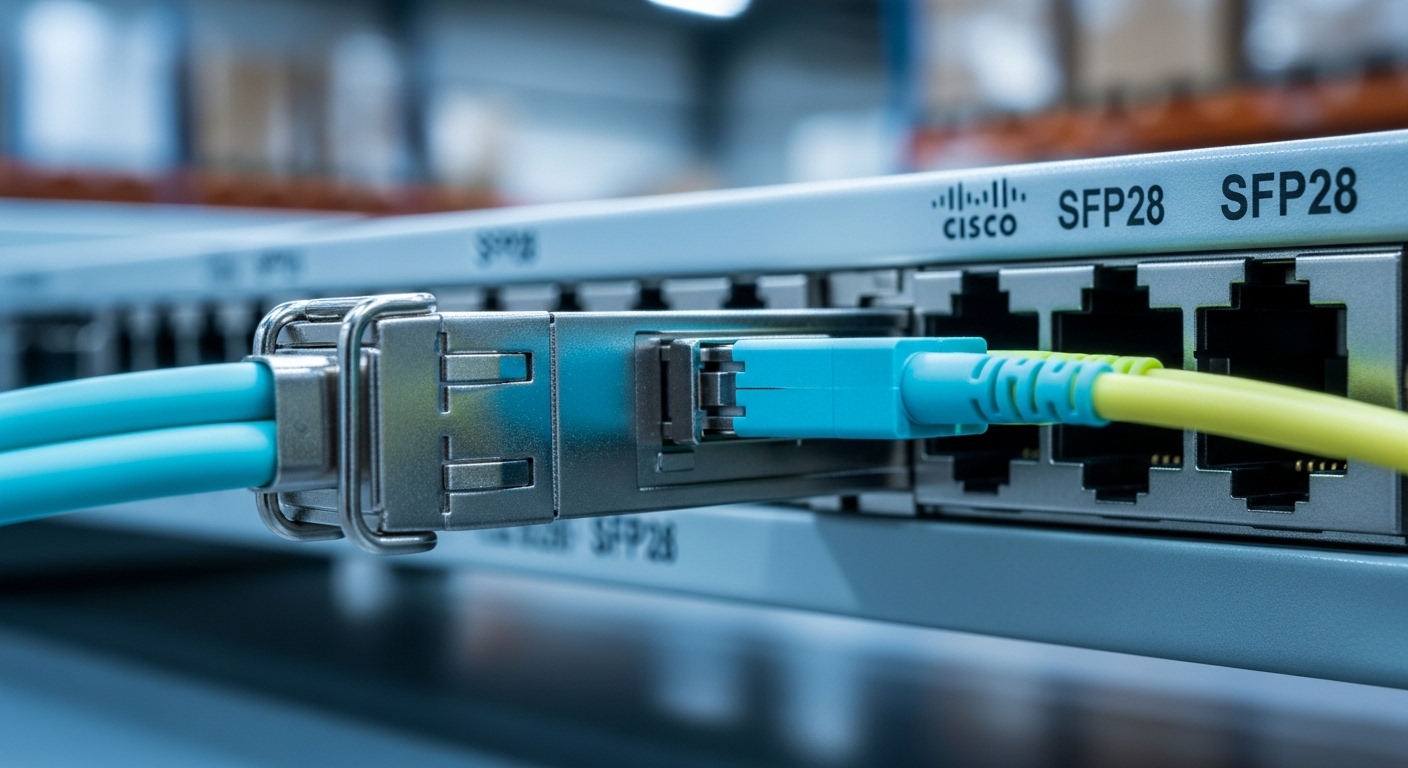
In an open line system, the “line” is assembled from interoperable components: a switching fabric or line-card host, optics that terminate specific fiber plant characteristics, and a management plane that may be vendor-agnostic. The disaggregated optics transceiver is the contract boundary: it must present a standards-compliant electrical interface (e.g., IEEE 802.3 Ethernet PHY expectations) and an optical output spectrum that matches the deployed fiber plant. In practice, the host may be a multi-vendor OLT/ROADM or a white-box IP transport router with modular line cards.
For transceiver selection, the most operationally relevant parameters are wavelength, signal format (NRZ vs PAM4), reach class, transmit power, receive sensitivity, and the host’s supported electrical lane mapping. Many open line hosts also enforce platform-specific constraints such as lane polarity, FEC mode, and digital diagnostic thresholds.
- Best-fit scenario: Multi-vendor builds where optics procurement is decoupled from the line-card OEM.
- Pros: Lower BOM lock-in; faster refresh cycles when optics density rises.
- Cons: More integration testing; interoperability varies by firmware and FEC configuration.
Top transceiver form factors in disaggregated optics deployments
Disaggregated optics are commonly deployed using pluggable modules that match the host’s mechanical and electrical envelope. The typical choices include SFP/SFP+ for 1G–10G, QSFP/QSFP+ for 10G–40G, QSFP28 for 25G–100G, and QSFP-DD/OSFP for higher density. In open line systems, the form factor is only half the problem: the host must also support the correct protocol profile and lane rate.
Field reality: engineers often discover that a “compatible form factor” still fails because the host expects a specific signal type (e.g., 25G KR vs 25G SR optics profile) or enforces DOM alarm thresholds differently. Always validate with the host’s release notes and optics compatibility guides when available.
- Best-fit scenario: Data center and metro builds requiring rapid optics swaps during upgrades.
- Pros: Hot-pluggability; standardized mechanical interfaces.
- Cons: Some hosts restrict third-party modules via firmware allowlists.
Core optical specs that decide reach and margin
At the PHY layer, reach is not a marketing number; it is the outcome of a link budget that includes fiber attenuation, connector loss, splice loss, modal effects (for multimode), and receiver sensitivity under the configured FEC. For disaggregated optics, the engineer must match wavelength and reach class to the actual plant: OM3/OM4 multimode grades for 850 nm short reach, and single-mode OS2 for 1310/1550 nm longer reach.
Below is a practical comparison for common Ethernet optics families engineers deploy when disaggregating optics across open line systems. Values vary by vendor and revision, so treat them as starting points for link budget calculations using the host’s FEC mode and the vendor datasheet.
| Parameter | 25G SFP28 SR | 100G QSFP28 SR4 | 100G QSFP28 LR4 | 400G QSFP-DD FR4 |
|---|---|---|---|---|
| Typical wavelength | 850 nm | 850 nm | 1310 nm (4 lanes) | 1310 nm range (4 lanes) |
| Reach target | ~100 m (OM4 typical) | ~100 m (OM4 typical) | ~10 km (OS2 typical) | ~2 km (OS2 typical) |
| Connector type | LC | LC | LC | LC |
| Data rate / signaling | 25G NRZ | 100G (4x25G) | 100G (4x25G) | 400G (4x100G) |
| Power use (ballpark) | ~1.0–1.5 W | ~3–4 W | ~3–5 W | ~8–12 W |
| Operating temperature | 0 to 70 C (typical) | 0 to 70 C (typical) | -5 to 70 C (typical) | 0 to 70 C (typical) |
| Compatibility risk | Medium (DOM thresholds) | Medium-High (FEC expectations) | Lower (mature profiles) | High (PAM4 lane mapping) |
Authoritative baseline standards include IEEE 802.3 Ethernet PHY behavior and optical module management expectations, while vendor datasheets define the concrete optical budget. For standards and interface behavior, consult IEEE 802.3 and vendor DOM documentation via the transceiver manufacturer’s interface guide. [Source: IEEE 802.3 Working Group drafts and approved standards portal]
- Best-fit scenario: Designing link budgets with explicit connector and splice counts rather than relying on “reach class.”
- Pros: Predictable behavior when reach and FEC mode match.
- Cons: PAM4-era optics amplify integration issues (lane mapping, equalization).
Pro Tip: In open line systems, the highest operational savings usually comes from treating optics selection as a budgeted margin exercise, not a part-number match. If you standardize on a small set of validated DOM alarm thresholds and FEC profiles per host firmware version, you reduce “random” link flaps during maintenance windows.
DOM, vendor diagnostics, and management-plane interoperability
Disaggregated optics typically expose digital diagnostic monitoring (DOM) over I2C: transmit laser bias/current, received power, supply voltage, temperature, and alarm/warning flags. The management plane may ingest these values through the host’s software stack, and mismatches can cause false positives (or missed degradation). For example, a host might set alarm thresholds assuming a specific vendor calibration, while third-party modules report slightly different scaling or default thresholds.
In field deployments, I have seen this manifest as frequent “module aging” alerts even when BER is within spec. The root cause was not optical failure but inconsistent interpretation of DOM scaling and units between the host’s DOM parser and the module’s EEPROM layout.
- Best-fit scenario: Multi-vendor operations where centralized monitoring is required for NOC workflows.
- Pros: Faster troubleshooting using real-time receive power and temperature.
- Cons: Requires validation of DOM parsing and threshold mapping.
Top selection criteria checklist for disaggregated optics in open line systems
When procurement and engineering teams separate optics from the host OEM, the selection process must be explicit. The ordered checklist below reflects what reduces field failures and rebuild time. Use it as a gate before you authorize deployment across racks.
- Distance and fiber class: confirm OM3/OM4 vs OS2, connector type, and counted splice losses.
- Data rate and PHY profile: verify the host supports the exact lane speed and modulation (NRZ vs PAM4).
- FEC mode alignment: ensure the host firmware and module profile are consistent for the selected reach.
- Optical power and receiver sensitivity: compute link margin using vendor datasheets, not only reach labels.
- DOM support and threshold behavior: validate I2C/EEPROM interpretation and alarm/warning mapping.
- Operating temperature: match the module temperature class to the enclosure airflow profile (front-to-back or side-to-side).
- Switch compatibility and allowlist risk: check platform notes for third-party module restrictions.
- Vendor lock-in risk and lifecycle: ensure second-source availability and confirm firmware update compatibility.
- Best-fit scenario: Rolling upgrades where you must keep optics interchangeable across multiple host models.
- Pros: Fewer disruptions; clearer acceptance testing criteria.
- Cons: Requires upfront engineering time for validation and documentation.
Common mistakes and troubleshooting in the field
Disaggregated optics integration fails for reasons that are often non-obvious: electrical lane mapping, DOM parsing, and FEC profile mismatch. Below are concrete pitfalls I have observed during deployments and migrations.
Pitfall 1: Reach class mismatch due to incorrect fiber plant assumptions
Root cause: Using OM4-rated optics on a patch channel that is effectively OM3 or has higher-than-expected insertion loss from dirty connectors or legacy splices. The link may come up intermittently under temperature variation.
Solution: Re-measure with an optical time-domain reflectometer or insertion-loss testing, then clean and re-terminate connectors. Recalculate link budget with measured loss and confirm receive power stays within the module’s recommended range.
Pitfall 2: FEC profile mismatch leading to high BER and link resets
Root cause: Host software selects a FEC mode incompatible with the module’s expected optical/electrical behavior, especially for higher-rate optics (e.g., 400G PAM4 families). Symptoms include link flaps, CRC spikes, or persistent LOS/LOF transitions.
Solution: Lock the host to the intended FEC configuration and verify with vendor interoperability notes. Capture PHY counters during the flap window to correlate BER/ES errors with FEC settings.
Pitfall 3: DOM alarms trigger NOC actions despite healthy optics
Root cause: The host’s DOM parser interprets EEPROM fields or scaling differently than the module’s implementation, causing false warnings. Operators then replace modules unnecessarily.
Solution: Compare raw DOM readings against vendor reference values and adjust threshold mapping if the platform supports it. Establish a baseline during burn-in and record temperature vs receive power correlations.
Pitfall 4: Lane polarity or mapping mismatch on pluggable-to-host electrical interfaces
Root cause: Some hosts require specific lane order for quad-lane or 16-lane optics; mismatches produce “up but unusable” behavior or severe error rates.
Solution: Confirm lane mapping configuration in the host driver or transceiver profile settings, and validate with a known-good optics module before scaling out.
- Best-fit scenario: Troubleshooting during staged rollouts where you need deterministic root cause analysis.
- Pros: Faster MTTR through counter-driven diagnosis.
- Cons: Requires disciplined telemetry collection and version control of host firmware.
Concrete deployment scenario: disaggregated optics across a 10G-to-100G upgrade
In a 3-tier data center leaf-spine topology with 48 top-of-rack (ToR) switches and 2 spine layers, the migration path often starts with 10G to the servers and 100G uplinks. In one operational build, each ToR used four 100G QSFP28 SR4 uplinks to spine switches over OM4 cabling, while server downlinks remained 10G SFP+. The engineering team adopted disaggregated optics to standardize procurement across multiple ToR vendors, while keeping the line-card host fixed per rack row.
They staged acceptance testing by validating DOM readings at idle and under traffic, then confirmed BER/CRC counters after enabling the same FEC mode across hosts. Measured receive power stayed within a 3 to 5 dB operational margin over measured channel loss, and the NOC stopped seeing false “aging” alerts after aligning DOM threshold handling. This approach reduced swap-out time during maintenance windows because optics part numbers were interchangeable across compatible line cards.
- Pros: Lower procurement lock-in; faster rollouts during density upgrades.
- Cons: Requires firmware-aligned validation per host model.
Cost and ROI considerations for disaggregated optics
Disaggregated optics can reduce upfront costs by leveraging broader vendor competition, but the total cost of ownership (TCO) depends on acceptance testing, interoperability risk, and failure handling. In typical enterprise and metro budgets, third-party optics for mature 10G/25G/100G links can be 10% to 35% cheaper than OEM-branded equivalents, while high-speed PAM4 modules (e.g., 400G) may narrow the gap or invert it if compatibility constraints demand OEM-only allowlisting.
Operationally, you should budget for burn-in testing, spares stocking, and a more rigorous telemetry workflow for DOM and PHY counters. If your open line system supports centralized optics inventory and automated DOM threshold normalization, the ROI can improve because you reduce MTTR and avoid unnecessary replacements.
- Best-fit scenario: Multi-vendor environments with stable host firmware and repeatable acceptance tests.
- Pros: Potential BOM savings; faster optics lifecycle refresh.
- Cons: Integration cost can erase savings if acceptance testing is skipped.
Summary ranking table: which disaggregated optics strategy fits your constraints?
Use the table below to rank your approach based on the constraints you likely face
