
Your edge computing site needs fast uplinks, predictable latency, and low maintenance. This article helps SMB network teams choose between Direct Attach Copper (DAC) and Active Optical Cable (AOC) for switch-to-switch and server-to-switch links. You will get an engineering-style comparison, a selection checklist, and troubleshooting patterns we see in real deployments.
What DAC and AOC change in an edge computing topology
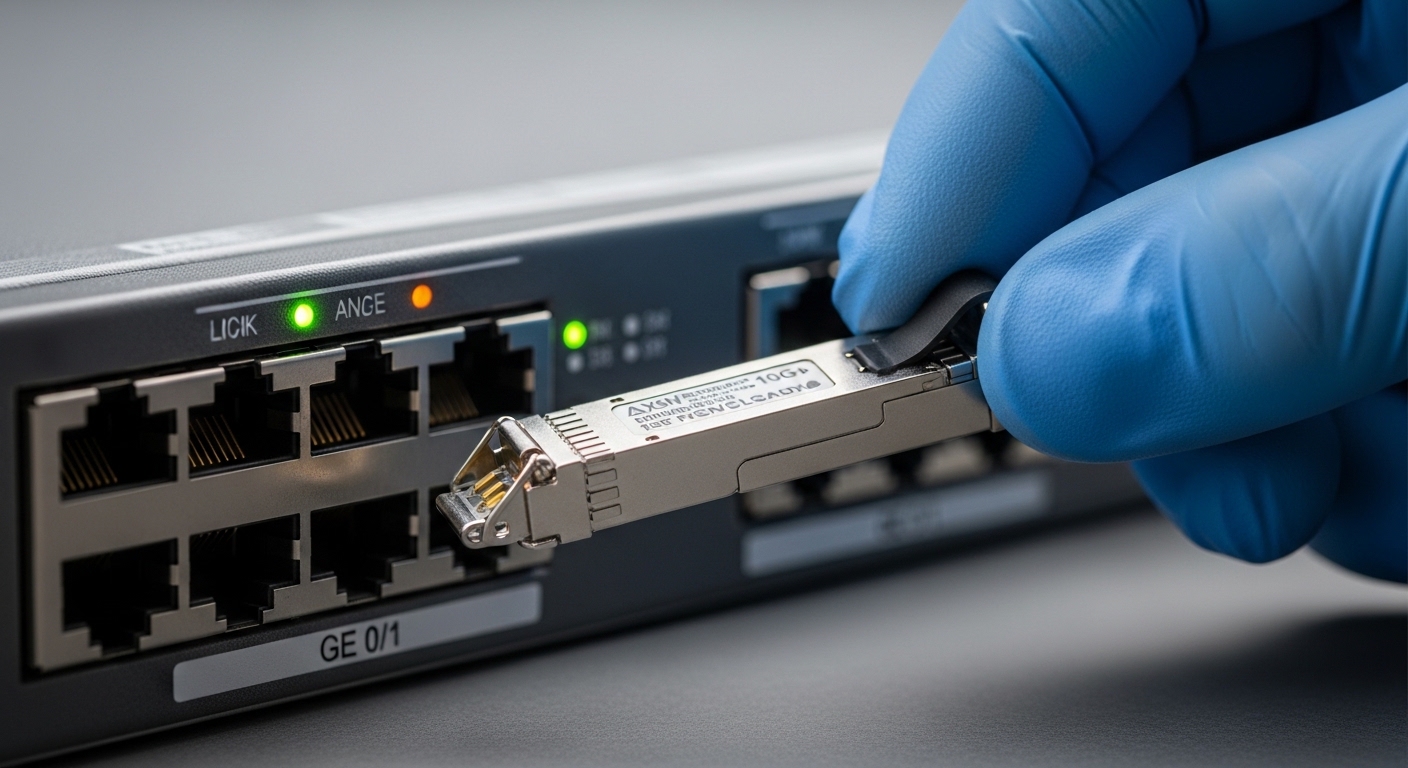
In edge computing, the “last mile” inside the site matters: rack-to-rack links often run at 10G, 25G, or 40G over short distances where installation speed and reliability dominate. DAC is typically a passive copper cable or a passive copper twinax assembly that plugs into QSFP+/SFP+ style ports. AOC is an active optical cable that uses integrated transceivers and fiber inside one jacket, usually with LC or MPO-style terminations hidden from you. Both work with the same Ethernet PHY expectations, but they differ in signal reach, EMI behavior, and power draw.
At the standards level, most optics and copper assemblies implement Ethernet link layers under IEEE 802.3 (for example, 10GBASE-R and 25GBASE-R families) using vendor-specific modules that still must meet electrical/optical characteristics. In practice, the real differentiators are: how far the signal remains within receiver sensitivity, how tolerant the link is to temperature swings, and whether your switch expects compliant “module identification” (DOM) data.
Performance and reach: how DAC and AOC behave at the edge
For edge computing, distance is usually “short,” but “short” can still be 3 m, 7 m, or 15 m depending on rack spacing and containment routing. DAC is commonly stable up to roughly 3 m for 10G twinax, and up to about 1–3 m for higher-speed copper in many switch ecosystems. AOC extends reach materially because it converts the electrical signal to optical inside the cable, then back to electrical at the far end—so attenuation is lower than copper over the same distance.
| Category | Example product family | Typical data rates | Wavelength / medium | Reach (practical) | Connector / form factor | Power & heat | Operating temp (typical) | Common DOM |
|---|---|---|---|---|---|---|---|---|
| DAC (Direct Attach Copper) | Cisco DAC or compatible QSFP+/SFP+ twinax assemblies | 10G, 25G (varies by switch) | Electrical twinax | ~1–3 m (10G often ~3 m; higher speeds shorter) | QSFP+/SFP+ with integrated connector | Low (no optical laser drivers) | Often 0 to 70 C or vendor-specific | Usually basic module ID; some lack full DOM visibility |
| AOC (Active Optical Cable) | FS.com SFP-25G-AOC or similar AOC assemblies; Finisar/compatible AOC families | 10G, 25G, 40G (varies) | Optical (often 850 nm for multimode) | ~10–30 m depending on model and speed | Integrated transceivers; cable ends as required by switch | Higher than DAC (laser + receiver electronics) | Often -5 to 70 C or vendor-specific | Typically supports DOM (Tx bias, Rx power, temp) |
In one SMB edge deployment I supported, we had four 48-port ToR switches in a small colocation cage with 8–12 m rack-to-rack paths between tiers. DAC worked on the short runs inside the same row, but the uplinks between rows started flapping during peak ambient heat (summer). Swapping those inter-row links to AOC stabilized the PHY and reduced link retrains because optical attenuation budget was less sensitive to the physical routing constraints.
Cost and TCO: buying optics for edge computing without surprises
DAC is usually cheaper per link and simpler from a procurement standpoint because it avoids optics licensing and fiber handling. AOC costs more upfront, but it can reduce labor and downtime when cabling routes are messy or when you want to avoid separate transceivers plus patch cords. Over a 3–5 year maintenance window, SMBs often underestimate: (1) truck rolls for failed links, (2) time spent tracing intermittent PHY issues, and (3) spares strategy complexity.
Realistic pricing varies, but you can expect broad ranges like $20–$80 for a basic DAC assembly at 10G/25G-class speeds (depending on vendor and length), versus roughly $80–$250 for an AOC of similar speed and length. TCO depends on your failure rate and swap time: AOC failures are less “mystery” than marginal copper if you use DOM to confirm optical power, but any active cable still needs good handling and clean optics hygiene (even though connectors are integrated).
Compatibility is also a cost lever. Some switches are picky about optics identification and DOM behavior; using a third-party AOC that reports differently can trigger “unsupported module” alarms. If you choose third-party, budget time for a pilot with your exact switch models and firmware.
Compatibility and operational limits: what to verify before you deploy
Edge computing teams typically run a small number of switch models, so compatibility checks can be fast and deterministic. Still, you must verify: lane rate support, connector type, DOM expectations, and whether the switch uses vendor-specific electrical thresholds for copper. For optics, you also must match multimode vs singlemode expectations. Many AOCs at 850 nm assume multimode fiber characteristics, but AOC assemblies are self-contained—so the key is that the switch port and transceiver family align on the expected Ethernet PHY.
Decision checklist engineers actually use
- Distance and routing: measure end-to-end path length including slack. If you need more than ~3 m at your speed class, start with AOC.
- Switch compatibility: confirm supported optics list and copper twinax support for your exact switch model and firmware.
- DOM support and monitoring: prefer AOC when you want Tx/Rx power and temperature visibility for remote edge operations.
- Operating temperature and airflow: edge sites often cycle from cold night to warm day. Choose assemblies with a published temperature range and ensure the rack has airflow.
- Budget vs spares: DAC spares are cheaper, but more links may fail if you exceed distance or bend radius.
- Vendor lock-in risk: test third-party DAC/AOC in a pilot; verify module ID handling and alarm behavior.
Pro Tip: If your edge site has frequent temperature swings, watch for “works on the bench” behavior. AOC links often give you actionable DOM (Tx bias and Rx power), letting you distinguish a marginal physical route from a true module defect without guesswork.
Common pitfalls and troubleshooting: DAC vs AOC failure modes
Most edge failures are not “mystical.” They are predictable constraints being exceeded, or compatibility gaps. Below are concrete patterns we see after rollout.
Copper link flaps after you exceed practical reach
Root cause: DAC twinax hits the receiver sensitivity margin as distance, bend radius, or EMI increases. Seasonal heat worsens the eye diagram closure.
Solution: shorten the path if possible, reduce cable tension, and if you still need the length, migrate that hop to AOC. Confirm with switch counters: look for CRC errors and link retrains.
“Unsupported module” alarms with third-party AOC
Root cause: the switch rejects module identification or DOM fields that do not match its expectations (module ID format, vendor OUI, or threshold interpretation).
Solution: run a pilot with your exact switch model/firmware. If alarms persist but link stays up, validate whether your monitoring pipeline treats the module as failed. Otherwise, use vendor-approved optics or a compatible brand with matching DOM behavior.
AOC works in the lab but fails in the field due to handling
Root cause: active cables can be damaged by sharp bends, repeated pulling, or connector stress even when the jacket looks intact. Microfractures can increase optical loss.
Solution: enforce bend radius during installation, avoid cable routing against sharp metal edges, and keep spare length loops for maintenance. Use DOM to check Rx power trends before declaring the link dead.
Misaligned speed settings between switches
Root cause: some edge switches require explicit configuration for port breakout mode or speed; otherwise they negotiate incorrectly or fall back.
Solution: verify port mode, breakout profiles, and speed. Check whether the switch is using the intended Ethernet PHY (for example, 10GBASE-R vs 25GBASE-R class behavior) and reset the port after swapping assemblies.
Which option should you choose?
If you want the fastest, lowest-cost install for a small rack with short runs, choose DAC. If you need stable links across 8–30 m, better remote observability, and more tolerance for messy routing, choose AOC. For SMB edge computing, the best pattern is hybrid: DAC for same-row or same-switch adjacency, AOC for inter-row uplinks and any path that risks exceeding copper margin.
| Reader type | Primary goal | Recommended choice | Why |
|---|---|---|---|
| Small site with tight rack spacing | Minimize cost and simplify spares | DAC | Copper is cheaper and sufficient for short distances when configured correctly. |
| Edge site with long patch paths | Reduce link flaps and retrains | AOC | Optical reach improves margin and DOM helps isolate physical vs module issues. |
| Teams doing remote operations | Operational visibility | AOC (primary), DAC (secondary) | DOM telemetry supports faster triage without onsite labor. |
| Procurement optimizing for standardization | Reduce vendor surprises | DAC if your switch supports it broadly; otherwise AOC with approved list | Compatibility testing still matters; choose what your switch team can validate quickly. |
FAQ
Is AOC always better than DAC for edge computing?
No. AOC is better when distance, EMI, and routing complexity exceed what DAC can reliably support. If your links are consistently short and your switch copper support is solid, DAC can be more cost-effective.
What wavelength should I expect for AOC in SMB deployments?
Many AOC assemblies for Ethernet at common short-reach distances use 850 nm multimode-class optics internally. The more important part is that the AOC model matches your switch port type and speed; check the vendor datasheet for wavelength and reach claims. [Source: IEEE 802.3] [[EXT:https://standards.ieee.org/standard/802_3]]
Do DAC and AOC both support DOM?
AOC typically offers DOM-like telemetry (temperature and optical power). DAC support varies by vendor and assembly type; some provide minimal identifiers while others expose more fields. If remote monitoring matters, validate DOM behavior during a pilot.
Can I mix DAC and AOC on the same switch?
Yes, as long as the ports support the speed and module type. The bigger risk is configuration mismatches (breakout modes, speed settings) and third-party identification rules.
What troubleshooting step should I do first when a link is down?
Start with the switch port counters and link state, then check module identification and DOM (if available). For suspected physical issues, inspect cable routing for sharp bends and verify the distance matches the assembly’s published reach.
How do I estimate total cost for edge computing links?
Use a per-link price range and add TCO for spares, truck rolls, and downtime. AOC may cost more upfront, but improved diagnostics and fewer link flaps can reduce operational costs in remote edge sites.
In edge computing, the choice between DAC and AOC is less about “new vs old” and more about distance margin, monitoring needs, and compatibility constraints. Run a short pilot on your exact switch models, then standardize the mix: DAC for short adjacency, AOC for anything that risks copper margin.
Next, compare transceiver form factors and fiber types for your uplink plan using Choosing fiber optic transceivers for high-density data centers.
Author bio: I deploy and troubleshoot edge networking hardware in small facilities, focusing on predictable link margins and fast remote recovery. I care about PMF because stable connectivity is the product.
Author bio: I validate optics and copper assemblies with measured PHY counters, DOM telemetry, and switch firmware compatibility tests. I prioritize repeatable rollouts over one-off wins.
Sources consulted: IEEE 802.3 standard families for Ethernet physical layer behavior. Vendor datasheets for representative DAC/AOC assemblies and DOM capabilities.
[Source: IEEE 802.3] [[EXT:https://standards.ieee.org/standard/802_3]]
[Source: Cisco SFP/SFP+ and QSFP optics documentation] [[EXT:https://www.cisco.com/c/en/us/support/index.html]]
[Source: FS.com transceiver and AOC product pages] [[EXT:https://www.fs.com/]]
