
AI clusters turn network throughput into a first-order constraint, so optical links often become the budget hinge. This article helps data center and network engineers run a realistic cost analysis for integrating AI infrastructure with optical networks, covering optics selection, power, reliability, and operational risk. You will get an engineer oriented top list, a specs comparison table, a decision checklist, and troubleshooting pitfalls that show up during rollout.
Start with your traffic math: bandwidth, oversubscription, and link count
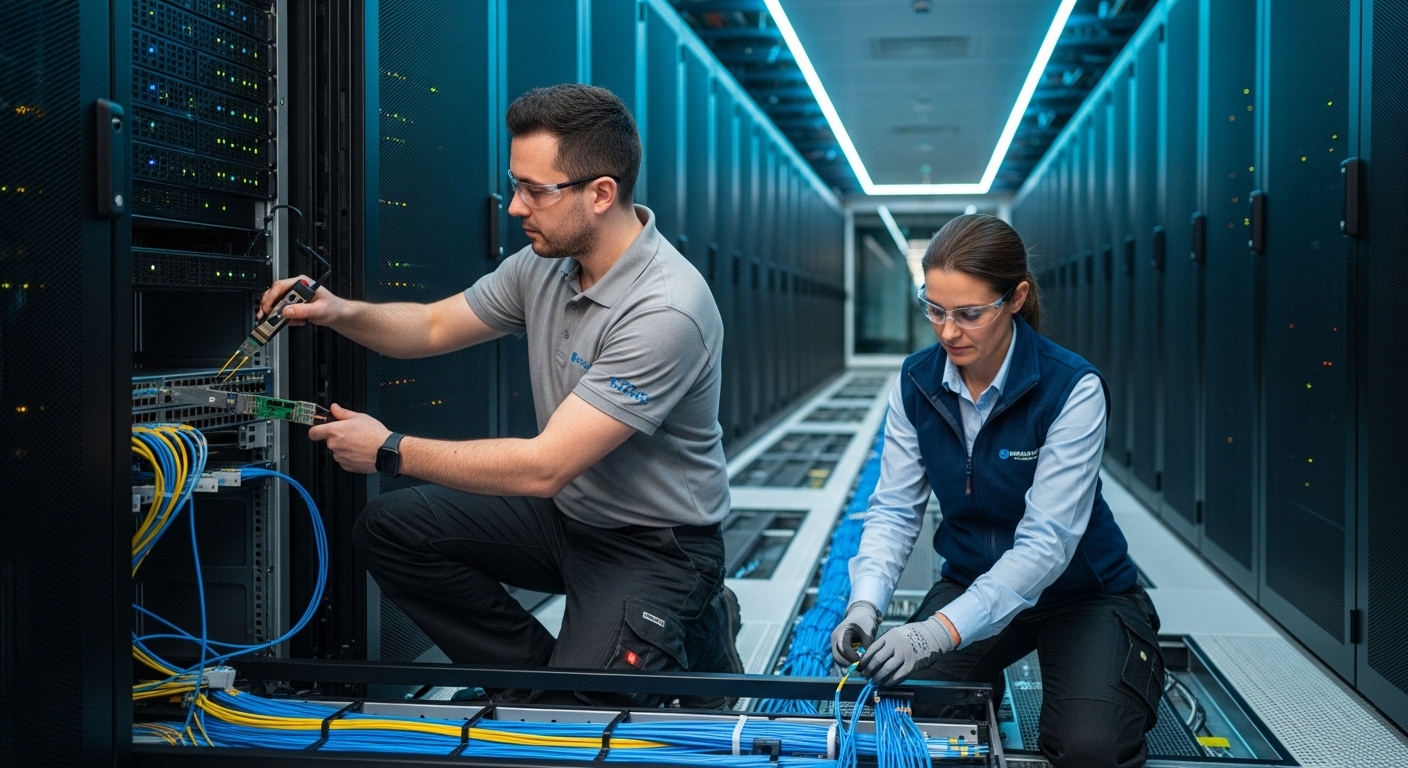
Before pricing optics, quantify required capacity using your job mix and topology. For example, in a 3-tier leaf-spine fabric with 48-port 10G leaf switches and 16-spine nodes, you may plan to move to 25G or 100G to reduce queueing during all-reduce phases. Engineers typically estimate bisection bandwidth needs from measured utilization (Grafana/telemetry) and then apply a safety factor for burstiness.
Key inputs for cost analysis include: number of ToR and spine ports, expected utilization, link speed (10G/25G/100G), and oversubscription ratio. A common mistake is pricing only transceivers while ignoring that higher-speed upgrades often require replacing optics, line cards, and sometimes cabling plant adapters.
- Best-fit scenario: You have traffic telemetry and a known upgrade target (e.g., 25G to 100G for AI training).
- Pros: Prevents underbuying and reduces rework.
- Cons: Requires data collection and careful modeling.
Price optics as a system: transceiver type, reach, and connector ecosystem
Optical cost analysis must treat transceivers as part of a compatibility matrix. In practice, you will compare standard pluggables like QSFP28 and OSFP for 25G/100G, plus legacy SFP+ for 10G. For AI clusters with short reach, most deployments use multimode fiber (MMF) with OM4/OM5, or single-mode (SMF) when topology or interference constraints push you beyond MMF reach.
Examples of widely used modules include Cisco SFP-10G-SR, Finisar/FS branded 10G SR variants such as FTLX8571D3BCL, and 10G/25G/100G SR optics from mainstream vendors. For 100G over MMF, you will often evaluate products such as FS.com SFP-10GSR-85 class optics for 10G SR; for 100G SR, you typically look for QSFP28 SR4 or OSFP SR4 depending on platform.
| Parameter | 10G SR (SFP+) | 25G SR (SFP28) | 100G SR4 (QSFP28 / OSFP) |
|---|---|---|---|
| Typical wavelength | 850 nm | 850 nm | 850 nm (SR4) |
| Fiber type | OM3/OM4 MMF | OM4/OM5 MMF | OM4/OM5 MMF |
| Reach (typical) | Up to ~300 m on OM4 (varies by vendor) | Up to ~100 m on OM4 (varies) | Up to ~100 m on OM4/OM5 (varies by vendor) |
| Connector | LC duplex | LC duplex | MT ferrules (varies: MPO/MTP on SR4) |
| Tx power class | Class 1 laser; vendor dependent | Class 1 laser; vendor dependent | Class 1 laser; vendor dependent |
| Operating temperature | 0 to 70 C typical (commercial) | 0 to 70 C typical (commercial) | 0 to 70 C typical (commercial) or wider for extended |
| Standards anchor | IEEE 802.3 (10GBASE-SR) | IEEE 802.3 (25GBASE-SR) | IEEE 802.3 (100GBASE-SR4) |
Best-fit scenario: You are staying within a campus or data center and can keep reach within OM4/OM5.
- Pros: MMF SR optics usually have lower cost per port than long-reach SMF.
- Cons: MPO/MTP polarity and cleaning practices become a reliability factor.
- Pros: Faster speeds reduce oversubscription pressure and can lower switching fabric utilization cost.
Pro Tip: In AI cluster rollouts, the cheapest optics often fail operationally first due to dirty MPO/MTP endfaces and polarity mismatches. The fastest path to stable performance is to standardize patch panel polarity, enforce fiber inspection with a scope, and log transceiver type plus serial/DOM readings per port for rapid rollback.
DOM and telemetry: factor supportability into the cost analysis
Optics cost is not only purchase price; it includes how quickly you can isolate link degradation. Digital Optical Monitoring (DOM) provides real-time metrics like laser bias current, transmit power, and receiver power, which helps predict failures before they cause job interruptions. For AI workloads, a link flap can translate into lost training efficiency, so supportability has measurable value.
In many environments, engineers pull DOM via switch telemetry (SNMP/streaming telemetry) and store it in time series databases. When you budget, include engineering hours, monitoring tooling, and the operational policy for thresholds and maintenance windows.
- Best-fit scenario: You run 24/7 workloads with strict change control and need early warning.
- Pros: Faster MTTR and fewer silent performance degradations.
- Cons: Some third-party optics may have incomplete DOM mappings on certain platforms.
Model power and cooling: optics and PHY power move your OPEX
AI infrastructure expands not just compute but also the energy footprint of networking gear. In cost analysis, include optics power draw (typically a few watts per pluggable, vendor dependent) plus the incremental switch line card power at higher data rates. Cooling impact matters: higher port density increases heat flux near the front-to-rear airflow path.
Engineers often correlate switch power readings with facility PUE and then translate optics density changes into estimated kWh and annual cost. When you migrate from 10G to 25G/100G, you may reduce the number of uplinks needed for the same aggregate bandwidth, but you still increase per-port PHY power and can increase switch fan and airflow demand.
- Best-fit scenario: You are optimizing for total cost of ownership (TCO) with measured power telemetry.
- Pros: Prevents surprises in power budgeting and improves sustainability reporting.
- Cons: Requires access to switch power and fan curves.
Reliability engineering: MTBF, vendor track record, and burn-in policy
During AI training, the networking layer is a dependency with hard performance consequences. Cost analysis should include field failure rates and the operational cost of downtime. Use vendor datasheets and published warranty terms, but also rely on your own acceptance test data: optics are frequently screened using a burn-in window and link parameter checks.
For example, you can implement a policy: test each transceiver batch for DOM stability under loopback, verify link negotiation at the intended speed, and monitor for elevated error counters. The IEEE 802.3 physical layer specifies electrical/optical behavior, but real-world outcomes depend on cleaning, temperature, and connector strain.
- Best-fit scenario: You run multi-month training cycles and cannot tolerate extended maintenance windows.
- Pros: Lower risk of job interruption and reduced engineering escalation.
- Cons: Burn-in adds time and lab cost.
Cabling plant economics: MMF/SMF choice, polarity, and labor costs
Optics are only one line item; cabling labor is often the hidden cost in AI upgrades. If you move from 10G SR to 100G SR4, MPO/MTP handling becomes critical, and you may need to re-terminate patch panels. Fiber plant assessment should include endface inspection results, bend radius compliance, and verification of OM4/OM5 attenuation and bandwidth parameters.
A practical approach is to inventory existing patch panels and adapters, then compute the cost of rework versus replacement. Engineers also include the time for staging, labeling, and change windows, since AI clusters often require maintenance orchestration.
- Best-fit scenario: You are upgrading link speed and connector type.
- Pros: Prevents expensive re-termination late in the project.
- Cons: Requires a disciplined cabling documentation process.
Vendor lock-in versus interoperability: include compatibility risk in the model
Third-party optics can reduce unit price, but cost analysis must include compatibility risk with your switch vendor and optics management stack. Many platforms maintain an “optics compatibility” behavior via vendor-specific checks; if a transceiver is not accepted, you lose time during rollout or must maintain a restricted SKU list.
For interoperability, validate: (1) transceiver recognition, (2) DOM telemetry field mapping, (3) supported speeds and FEC settings (where applicable), and (4) error counters under load. For AI networking, even small link-margin differences can matter during sustained all-reduce operations.
- Best-fit scenario: You have budget pressure but can run a staged pilot.
- Pros: Potentially lower CAPEX per port.
- Cons: Higher integration and qualification workload.
Summarize and rank: a cost analysis that survives procurement and ops
To finish your cost analysis, produce a ranked list with both financial and operational scores. A realistic TCO spreadsheet should include: optics and cabling CAPEX, expected spares inventory, power and cooling delta, and the labor cost for installation and troubleshooting. In AI environments, also include the business impact of reduced training efficiency during outages.
Below is a compact ranking table you can use as a starting point for internal reviews. Adjust weights based on whether your primary constraint is budget, downtime risk, or time-to-deploy.
| Rank | Factor | Typical cost impact | Operational risk if ignored |
|---|---|---|---|
| 1 | Traffic math and link count | High | High (underprovisioning) |
| 2 | Cabling plant and connectors | High | Medium to High (rework and outages) |
| 3 | Telemetry and DOM support | Medium | High (slow MTTR) |
| 4 | Power and cooling delta | Medium | Medium (OPEX overrun) |
| 5 | Reliability and burn-in | Medium | Medium to High (field failures) |
| 6 | Vendor compatibility risk | Medium | High (rollout delays) |
| 7 | Optics reach and transceiver ecosystem | Medium | Medium (link margin issues) |
| 8 | Procurement and qualification workflow | Low to Medium | Low to Medium (schedule slip) |
Common Mistakes / Troubleshooting
1) Buying optics by reach only, ignoring margin and fiber quality. Root cause: OM4/OM5 bandwidth assumptions differ from real installed plant; patch cord aging and microbends reduce receiver power margin. Solution: run fiber certification (attenuation and endface inspection), verify DOM rx power on a known-good baseline, and keep a buffer plan for re-cabling.
2) MPO/MTP polarity and cleaning failures leading to intermittent link drops. Root cause: polarity mismatch and dirty endfaces cause elevated bit error rates and link renegotiation. Solution: enforce polarity labeling conventions, use lint-free cleaning and inspection, and standardize patching guidelines for SR4 optics.
3) Overlooking platform-specific optics acceptance and DOM field mapping. Root cause: some switches check vendor IDs or require compatible DOM interpretation; telemetry can appear “present” but fields map incorrectly. Solution: validate in a pilot rack, confirm DOM fields and thresholds, and maintain a compatibility SKU list for each switch model.
4) Underestimating power and airflow changes at higher port density. Root cause: increased line card power and optics heat flux raise local temperatures, degrading laser performance. Solution: use temperature sensors and fan curve data, confirm optics operating temperature range compliance, and plan airflow rebalancing during cabinet upgrades.
FAQ
Q1: What should be included in a cost analysis for AI optical upgrades?
Include optics CAPEX, cabling labor and re-termination costs, spares inventory, power and cooling delta, acceptance testing, and expected downtime cost. For AI jobs, also factor reduced training efficiency during outages.
Q2: Are third-party transceivers worth it for cost analysis?
Often yes, if you run a qualification pilot and confirm optical acceptance plus DOM telemetry behavior on your exact switch models. If your environment requires strict vendor support, OEM optics may reduce integration risk even at higher unit price.
Q3: How do I choose MMF vs SMF for AI clusters?
Use MMF (OM4/OM5) for short in-rack and within-facility links where reach fits and you can maintain disciplined polarity and cleaning. Choose SMF when distance exceeds MMF budget, when you need higher tolerance to plant variance, or when you have long horizontal runs.
Q4: What telemetry signals matter most during troubleshooting?
Track DOM tx power, rx power, and laser bias current trends, then correlate with interface error counters. A slow drift in rx power often precedes hard failures, especially in high-temperature cabinets.
Q5: How should I plan spares in an AI environment?
Maintain spares for the optics SKUs used on critical paths, plus at least one spare patching kit (cleaning supplies, known-good cords) to accelerate MTTR. Your spare quantity should reflect failure rate history and your change window tolerance.
Q6: Where can I verify standards and baseline expectations?
Start with IEEE 802.3 clauses for 10GBASE-SR, 25GBASE-SR, and 100GBASE-SR4 behavior, then cross-check vendor datasheets for exact reach and temperature limits
