
AI/ML workloads stress networks differently than traditional enterprise traffic: microbursts, low-latency all-to-all patterns, and high port counts that magnify any optics mismatch. This article helps data center and network teams select the right SFP modules for AI/ML workloads by comparing performance, cost, and operational fit. You will get concrete specs, deployment realities, and a decision checklist you can apply to leaf-spine and server topologies.
SFP vs SFP+ for AI/ML workloads: performance and link budget fit
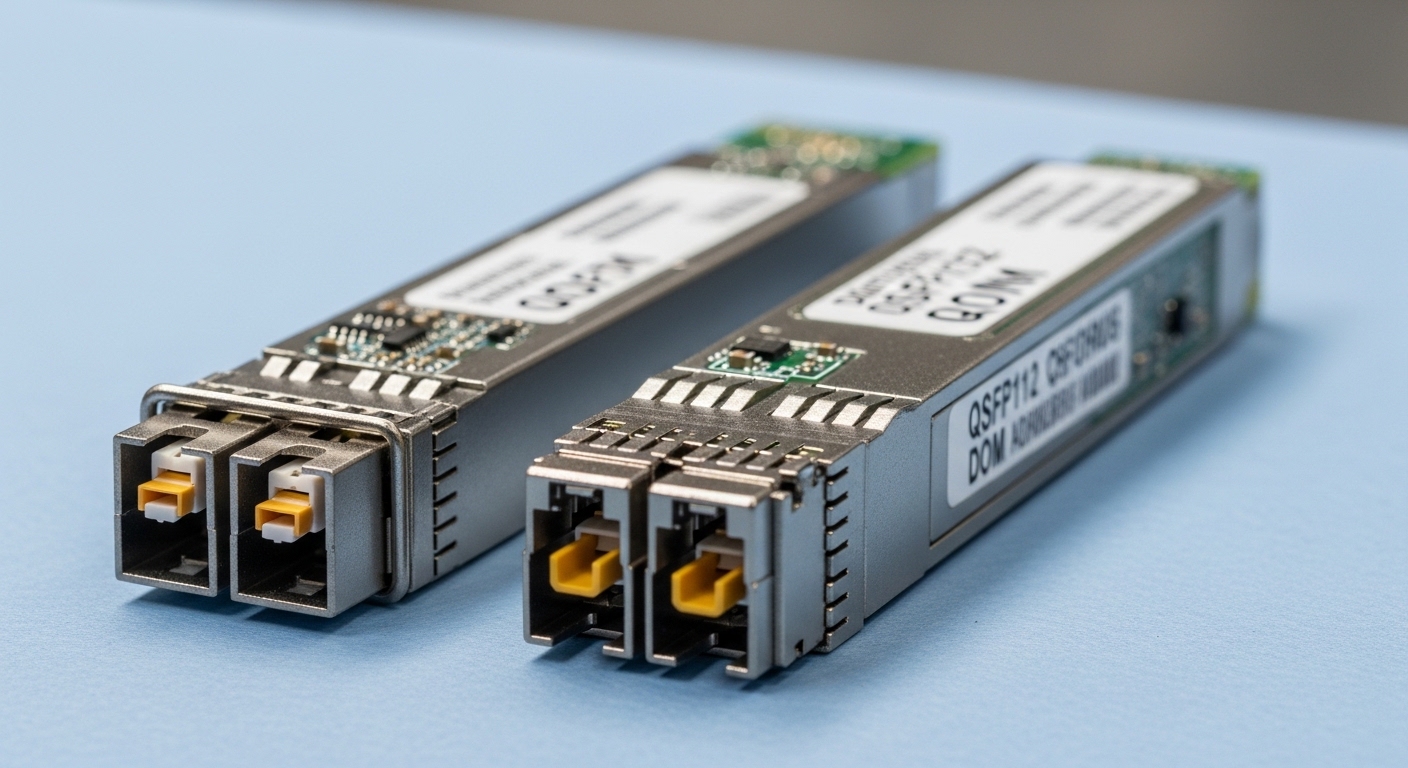
Before picking a vendor, confirm the physical layer you are actually standardizing on. Many AI/ML clusters still use 10G for storage and east-west traffic in smaller pods, while newer designs trend toward 25G/50G or higher; however, SFP modules remain common where switch silicon or BOM constraints limit optics upgrades. For AI/ML workloads, the key is not only raw data rate, but also how reliably the link maintains signal quality under temperature drift and fiber plant variability.
Start with the IEEE Ethernet PHY expectations. For 10GBASE-SR, IEEE 802.3 specifies optical reach and performance targets for multimode short-reach links, while 10GBASE-LR targets longer single-mode distances. If you are using SFP+ transceivers, ensure the module is intended for the exact link type supported by your switch ports and that the connector and fiber type match your planned topology.
What “best fit” means in practice
In AI/ML workloads, small packet timing variance can matter, but most failures come from physical layer mismatches: wrong fiber type, unsupported wavelengths, insufficient link budget, or optics that exceed the switch’s tolerance for transmit power and receive sensitivity. A practical approach is to treat module selection as a link-budget engineering task, not a purchase-order task.
- Multimode (OM3/OM4) short reach: typical for ToR-to-spine within a rack row or short aisle spans.
- Single-mode (OS2) longer reach: preferable for cross-room or longer spine fan-in where pulling multimode is expensive.
- Consistent transceiver class: avoid mixing “compatible” optics that have different vendor-specific behaviors under marginal conditions.
Example module families you may encounter
Common 10G SFP+ optics include Cisco-compatible SR modules such as Cisco SFP-10G-SR and third-party equivalents from Finisar (for example, FTLX8571D3BCL) or FS.com (for example, SFP-10GSR-85). For longer reach, you may see LR optics aligned with 10GBASE-LR expectations, though exact wavelength and reach claims vary by vendor datasheet.
Key specs comparison: wavelength, reach, power, and temperature
Engineers typically validate optics using vendor datasheets (and sometimes switch vendor compatibility guides) because “10G SR” is not a full specification. For AI/ML workloads, you want predictable eye-diagram margins, stable DOM telemetry, and thermal behavior that holds under high ambient temperatures in dense racks.
Use the table below as a selection baseline. Exact values must be confirmed against your switch model, transceiver SKU, and regulatory constraints in your region.
| Spec | 10GBASE-SR (SFP+) typical | 10GBASE-LR (SFP+) typical | Why it matters for AI/ML workloads |
|---|---|---|---|
| Data rate | 10G | 10G | Determines bandwidth for east-west traffic and storage bursts. |
| Wavelength | ~850 nm | ~1310 nm | Mismatch with fiber type causes immediate link failure. |
| Reach (marketing range) | Up to about 300 m on OM3 / ~400 m on OM4 | Up to about 10 km on OS2 | AI cluster topologies often require deterministic behavior across many hops. |
| Fiber type | Multimode OM3/OM4 | Single-mode OS2 | Wrong fiber type is a top root cause of intermittent or no link. |
| Connector | LC (typical) | LC (typical) | Connector mismatch forces expensive rework. |
| DOM / telemetry | Common: Digital Optical Monitoring | Common: Digital Optical Monitoring | Enables proactive detection of aging lasers and dirty connectors. |
| Tx power / Rx sensitivity | Vendor-specific; verify against switch requirements | Vendor-specific; verify against switch requirements | Determines link margin under worst-case temperature and fiber loss. |
| Operating temperature | Often 0 to 70 C or extended variants | Often 0 to 70 C or extended variants | AI racks run hot; thermal drift affects optical power and BER. |
| Power (module) | Typically a few watts; confirm datasheet | Typically a few watts; confirm datasheet | Aggregates into facility energy and cooling load at scale. |
What to check beyond the headline reach
In real AI/ML deployments, “reach” is not the only constraint. You also need to consider fiber attenuation at the specified wavelength, patch panel losses, connector insertion loss, splice loss, and the number of mated connectors. A module that barely meets reach on paper can fail during commissioning when a few connectors are slightly out of spec or when ambient temperatures rise above your design assumption.
Pro Tip: Treat DOM thresholds as an early-warning system, not just monitoring. In the field, teams that alert on “slow drift” in received optical power (rather than waiting for hard link flaps) reduce downtime during AI/ML training cycles, because dirty connectors and marginal alignment show gradual trends before total failure.
Compatibility and interoperability: switch behavior, DOM support, and vendor lock-in
AI/ML workloads often run for months with frequent maintenance windows, so optics compatibility becomes a reliability issue. Even when a module claims “SFP+ 10G SR compatible,” the switch may apply vendor-specific settings, optical power thresholds, or DOM parsing rules. Some platforms also enforce transceiver vendor policies that can disable ports or mark modules as “unsupported.”
To minimize risk, map your optics selection to the switch’s documented requirements. Look for compatibility lists, supported part numbers, or at least a stated tolerance for third-party optics. If you are using open networking or multi-vendor switches, verify how each vendor reports DOM fields, especially temperature, laser bias current, and received power.
Concrete compatibility checks you can run
- DOM validation: confirm the switch reads temperature and received power without alarms. If DOM is absent or malformed, some switches still link, but monitoring and alerting may be incomplete.
- Link training stability: during commissioning, observe link state over at least 30 to 60 minutes while toggling transceiver insertion and checking for CRC error counters.
- Power budget: ensure transmit power and receiver sensitivity meet the switch’s expected operating window; this is critical for mixed patch panel loss scenarios.
- Connector and polarity: verify LC polarity and MPO-to-LC adapter conventions if you have hybrid cabling.
Real-world deployment scenario
Consider a 3-tier data center leaf-spine topology for AI/ML workloads: 48-port 10G ToR switches in each rack, uplinked with 8 ports to the spine, and a storage tier using additional 10G links. A cluster team deploys 10GBASE-SR optics on OM4 within a row (about 120 m typical from ToR to spine row) and uses 10GBASE-LR on OS2 for cross-room links (about 3.5 km max). They standardize on LC connectors and require DOM support so that their monitoring system can alert when received optical power drops by more than a configured delta. During a hot-aisle expansion, they also switch to extended temperature variants to avoid link flaps when ambient rises above 30 C at the top of rack.
Cost and ROI: OEM vs third-party optics in high-port AI clusters
For AI/ML workloads, optics are a significant portion of the “network reliability budget” because you buy them in bulk and they sit in the path of every training job. OEM transceivers can be more expensive but sometimes reduce compatibility friction. Third-party optics can lower unit cost, but the ROI depends on your validation process, spare strategy, and failure rate under your temperature and cleaning regimen.
Typical street pricing varies by region, lead time, and vendor, but engineers often see OEM 10G SFP+ SR modules priced at roughly $80 to $200 per unit, while third-party options may land around $25 to $80 depending on reach and quality tier. Extended temperature variants and modules with strong DOM consistency can cost more. The TCO should include labor for validation, the cost of spares, and the operational cost of troubleshooting during peak training windows.
Risk-adjusted ROI factors
- Validation effort: third-party optics may require extra burn-in and compatibility testing per switch model.
- Spare stocking: if you standardize many models, your spare inventory grows, increasing capital tied up.
- Failure mode cost: intermittent link flaps can waste GPU hours; quantify downtime impact in your ROI model.
- Power and cooling: per-module power differences are usually modest, but at scale across thousands of ports they matter.
Selection criteria checklist: a field-ready ordering workflow
Use this ordered checklist when selecting SFP modules for AI/ML workloads. It is designed to reduce “surprise incompatibility” and to ensure your cabling plant supports the optical link budget with margin.
- Distance and fiber type: confirm OM3/OM4 vs OS2, then calculate attenuation at the target wavelength with connector and splice losses.
- Switch compatibility: verify the exact switch model supports the transceiver SKU or at least the optic type; check DOM behavior.
- Data rate and signaling mode: confirm the port is configured for the intended Ethernet speed and that the module is designed for that standard.
- Wavelength and connector: ensure the module wavelength matches the fiber plan and that you have LC vs other connector types correct.
- DOM support and monitoring: require Digital Optical Monitoring fields your operations tooling can ingest (temperature, bias, received power).
- Operating temperature: validate the module grade against your rack ambient and airflow assumptions; consider extended temperature where needed.
- Vendor lock-in risk: decide whether you will standardize on OEM or allow third-party modules, then align spares and validation accordingly.
Common mistakes and troubleshooting tips for SFP optics
Below are frequent failure modes teams see when deploying optics for AI/ML workloads. Each item includes a likely root cause and a practical solution.
“Module works in one switch but not another”
Root cause: DOM parsing differences or switch-specific optical power thresholds reject the module even though it is physically compatible. Some platforms are stricter about supported transceiver identifiers.
Solution: validate against the target switch model, not just the form factor. Use a small pilot batch, confirm link stability, and verify DOM fields are readable without alarms.
Intermittent link flaps during hot periods
Root cause: the module is operating near its temperature limits, causing transmitter power drift and increased bit error rate. This is common when airflow changes after rack expansions.
Solution: check module operating temperature grade, measure ambient near the cage, and ensure airflow paths are unobstructed. Consider extended temperature variants and retest under sustained load.
No link or high CRC errors after “successful insertion”
Root cause: dirty connectors, incorrect LC polarity, or a fiber plant with unexpected attenuation at the wavelength. Even one mis-mated connector can collapse the receive margin.
Solution: clean connectors using approved methods, verify polarity end-to-end, and re-measure with an optical power meter or OTDR where possible. Use DOM received power trends to confirm margin before declaring the fault resolved.
Mixed vendor optics causing inconsistent monitoring
Root cause: different vendor implementations expose DOM fields with different scaling or update rates, confusing alert thresholds and dashboards.
Solution: standardize on a single optics family per switch model where possible. If you must mix, calibrate alerting thresholds per vendor and confirm field semantics with captured telemetry samples.
Decision matrix: which SFP option reduces risk for AI/ML workloads
The matrix below summarizes trade-offs across the most common SFP optic choices for AI/ML workloads. Use it to align engineering confidence with budget constraints.
| Option | Best for | Strengths | Limitations | Risk level |
|---|---|---|---|---|
| OEM 10GBASE-SR SFP+ | OM4 intra-row links | Highest compatibility confidence; consistent DOM behavior | Higher unit cost; fewer alternates | Low |
| Third-party 10GBASE-SR SFP+ (validated) | OM4 intra-row links with budget pressure | Lower unit cost; can meet reach with proper validation | May require per-switch validation; DOM quirks possible | Medium |
| OEM 10GBASE-LR SFP+ | OS2 cross-room / campus extensions | Strong reliability track record; stable optical performance | Cost per port higher than multimode | Low |
| Third-party 10GBASE-LR SFP+ (validated) | OS2 links where multimode is impractical | Lower unit cost; suitable if link budget is engineered | Long-reach links amplify margin errors; validate carefully | Medium |
| Mixed-vendor optics across the same switch | Short-term migrations | Flexibility during upgrades | Monitoring inconsistency; harder troubleshooting | High |
Which option should you choose?
If you are running AI/ML workloads with strict uptime targets and limited maintenance windows, prioritize the option with the lowest compatibility and monitoring risk: validated OEM optics for your specific switch models. If you are scaling quickly and need to control capex, third-party optics can deliver strong ROI, but only after you complete a structured pilot that verifies DOM telemetry, link stability, and thermal behavior under your rack conditions.
For teams with mature optical test capability and well-defined cabling standards, third-party SFP modules are often the best value. For teams without that operational maturity, start with OEM for the first migration wave, then expand third-party coverage after you gather telemetry evidence and reduce troubleshooting variance via standardization.
FAQ
How do I confirm an SFP module is compatible with my switch for AI/ML workloads?
Check the switch vendor compatibility documentation for the exact module type and, ideally, the transceiver part number. Then run a pilot: insert into the target switch model, confirm link stability for at least an hour, and verify DOM telemetry fields are readable without alarms.
What is the biggest cause of SFP link failures in data centers?
In practice, the most common causes are fiber plant issues: wrong fiber type, incorrect polarity, or dirty connectors that reduce optical power margin. A secondary cause is thermal mismatch, where modules near their temperature limits drift and increase error rates during hot aisles.
Should I standardize on multimode or single-mode for AI/ML clusters?
Multimode (OM3/OM4) is usually cost-effective for short intra-row spans, while single-mode (OS2) is often required for longer distances or when cabling runs span multiple rooms. The best choice depends on your engineered link budget, patch panel losses, and the cost to pull new fiber.
Do DOM readings matter, or will the link just work?
DOM matters because AI/ML operations benefit from proactive alerting. Waiting for hard link failures wastes training time; monitoring received power and temperature trends helps teams address dirty connectors or aging optics before they cause outages.
Are third-party SFP modules safe for production AI workloads?
They can be safe if you validate them against your switch models and cabling assumptions, and if you maintain consistent cleaning and replacement practices. The risk increases when you mix vendors without calibrating monitoring thresholds or when you rely on unverified reach claims.
What should I include in an optics acceptance test during commissioning?
Include link stability checks, CRC/error counter observation under traffic load, and DOM telemetry verification. Also validate optical power margin with a meter or OTDR where feasible, and perform connector cleaning and polarity checks before escalating to module replacement.
Choosing SFP modules for AI/ML workloads is ultimately a reliability engineering task: align optics standard, fiber type, switch compatibility, and thermal behavior, then validate with telemetry-driven acceptance tests. Next step: review fiber optic link budget for data centers to translate reach claims into an engineered margin you can defend during deployment.
Author bio: I have deployed and validated Ethernet optical transceivers in leaf-spine data centers, including DOM telemetry integration and link-budget troubleshooting under live load. I focus on measurable reliability outcomes—error counters, optical power margin, and commissioning test plans.
Author bio: My work blends network hardware verification with operational runbooks for large-scale AI/ML environments, with emphasis on compatibility, spares strategy, and TCO modeling across thousands of ports.
[[EXT:https://standards.ieee.org/ieee/802.3 Ethernet standard references]]
