
In a leaf-spine or campus core, engineers often turn on LAG/LACP to increase throughput and resilience, then get surprised when optics mismatches, DOM quirks, or uneven link loss silently break the “bonded fiber links” promise. This article helps network leads, field engineers, and early-stage operators validate LAG behavior end-to-end using fiber transceivers, with practical selection criteria and troubleshooting playbooks. You will learn how to keep hashing, optics, and physical layer conditions aligned so traffic distribution stays stable under load.
Top 1: Understand what LACP actually bonds at Layer 2
LACP bonds member links at Layer 2 by creating an aggregated interface, but it does not “merge” optics into one larger physical pipe. The switch uses a hashing algorithm (often based on source/destination MAC, VLAN, IP, and sometimes ports) to choose which member carries each flow. That means bonded fiber links only look like one link when your traffic has enough flow diversity; otherwise, one member can carry most flows.
For best results, treat the optics and cabling as part of the LAG contract: same speed, same signaling, same lane behavior, and predictable link stability. IEEE 802.3 defines the physical layer behavior for Ethernet over fiber, while LACP is standardized in IEEE 802.1AX. If a member link flaps due to marginal optical power, the aggregated interface will converge and may reorder sessions, impacting latency-sensitive applications.
Operational check in the field
On the switch, verify each member shows Up and identical negotiated parameters (speed, duplex, FEC mode). Then confirm member counters increment consistently and that the hash distribution is not pathological (for example, by sampling interface byte counters per member over 10 to 30 minutes).
- Pros: Deterministic bonding behavior when members are truly equivalent
- Cons: No guarantee of per-packet load balancing; it is flow-based hashing
Top 2: Match transceiver type, reach class, and FEC behavior across all members
When bonded fiber links use LAG/LACP, member equivalence matters. Mix-and-match optics can still “link up,” but subtle differences in receiver sensitivity, FEC capability, and link training can cause uneven error rates. For example, a 10GBASE-SR module (850 nm multimode) should not be paired with a 10GBASE-LR module (1310 nm single-mode) even if the switch supports both; the physical layer will not be comparable.
At 25G/50G/100G, modern optics may include Forward Error Correction (FEC) schemes and different power budgets. If one member uses a module variant with different FEC expectations, you can see higher BER, more link retrains, or higher latency from retransmission behavior in upstream systems. Always align the transceiver family and specification as close as possible across members.
Concrete compatibility target
For 10G over multimode, align modules like Cisco SFP-10G-SR style optics with a known 850 nm multimode reach class, such as Finisar FTLX8571D3BCL or FS.com SFP-10GSR-85, and ensure the fiber plant (OM3 vs OM4) supports the specified reach. For single-mode 1310/1550 nm, align wavelength and reach class (for example, 10GBASE-LR vs ER) and ensure your attenuators and patching loss stay within the module’s optical budget.
| Parameter | 10GBASE-SR (850 nm MMF) | 10GBASE-LR (1310 nm SMF) | 25G/50G/100G note for LACP |
|---|---|---|---|
| Wavelength | 850 nm | 1310 nm | Match exact wavelength band and optic family |
| Typical reach class | Up to ~300 m (OM3) / ~400 m (OM4) depending on module | Up to ~10 km (module dependent) | Use vendor reach and power budget, not “market marketing” |
| Connector | Duplex LC | Duplex LC | LC is common; verify polarity and MPO breakout rules if using ribbon |
| Power / budget concept | MMF link loss must fit module budget; keep margin for patch cords | SMF budget includes mux/demux, patching, and splices | At higher rates, small power differences can move you from “comfortable” to “borderline” |
| DOM support | Usually supported (vendor-specific thresholds) | Usually supported | Ensure switch treats DOM consistently across modules |
| Temperature range | Commonly 0 to 70 C for commercial; industrial variants exist | Commonly 0 to 70 C / industrial options | Validate your rack inlet temps and airflow assumptions |
Field validation step
Use the module’s datasheet to extract receiver sensitivity and transmit power. Then measure real plant loss: include patch cords, couplers/splitters, and any splices. In practice, engineers treat the “last 10 percent” as the risk zone: a link that is 1 dB inside spec might become unstable during seasonal temperature shifts or after a maintenance event.
- Pros: Reduced member flaps and consistent error rates across the aggregate
- Cons: Requires discipline in procurement and inventory control
Top 3: Verify hashing stability and member equivalence under real traffic
Even perfect optics cannot guarantee balanced utilization if your traffic patterns collapse into few flows. LACP member selection is usually flow-based, so bonded fiber links may show one member dominating when applications use a small set of source-destination pairs. This is normal and not a failure, but it can look like “bonding is broken” during acceptance testing.
To validate, generate traffic that creates many distinct flows (for example, multiple TCP sessions with varied source ports and destination IPs), then compare per-member byte counters. If your switch supports per-member statistics visibility, you can confirm that the hashing function spreads flows rather than pinning them.
Acceptance test that catches real issues
In a 10G leaf environment, run a controlled workload for 15 minutes: 8 to 16 parallel streams per host pair, 1 to 2 minute warm-up, then steady-state. Record member counters at 60-second intervals. If one member stays near zero while others spike, you likely need to adjust hash policy (if supported) or accept that traffic patterns do not exercise the aggregate.
Pro Tip: Many engineers validate LACP with a single big flow and conclude the bonding is faulty. In production, real traffic often becomes flow-diverse only after applications ramp, so run a flow-multiplexed test early and re-check counters after traffic mix changes.
- Pros: Prevents false negatives during commissioning and reduces later “ghost” performance issues
- Cons: Requires test tooling and careful traffic design
Top 4: Treat optics telemetry and DOM thresholds as part of your LAG reliability plan
Digital Optical Monitoring (DOM) provides transmit power, receive power, temperature, and sometimes bias current. For bonded fiber links, DOM becomes an early warning system: if one member consistently reports lower receive power or higher temperature, it will be the first to retrain under stress. However, DOM behavior varies by vendor and switch implementation; some platforms enforce strict DOM compatibility rules.
Before rollout, check whether your switch supports DOM for third-party optics, and whether it applies any alarms or disables the port on “non-standard” readings. If the switch silently tolerates mismatched DOM interpretation, you may miss a developing marginal fiber issue.
Practical telemetry practice
Set alert thresholds for each member using the module’s datasheet typical values as a baseline. Track trends, not just absolute values. A common field pattern is “it passed yesterday” followed by a maintenance event that increases patch cord loss; telemetry will usually show drift before user complaints.
- Pros: Earlier detection of marginal fibers and failing optics
- Cons: Alert tuning is required to avoid noisy alarms
Top 5: Engineer the physical layer: polarity, patching loss, and connector cleanliness
Bonded fiber links amplify the impact of physical layer variance. If one member has a slightly dirty connector or an incorrect polarity swap, it can still link at first, then degrade due to higher bit errors. At higher speeds, small increases in insertion loss or reflectance can push the receiver into a noisy region.
Use consistent patching practices: duplex LC polarity must be correct, and for MPO-based trunks you must follow the polarity map your transceiver and breakout cable expect. Also, clean connectors every time you disconnect them. Field engineers often underestimate connector contamination because the link LEDs look normal.
Measurement checklist
- Confirm patch cord length and type match the module reach class
- Measure end-to-end loss with a certified light source and power meter (or OTDR where appropriate)
- Inspect ferrules with a fiber microscope before and after re-patching
- Document which patch cords belong to which LAG member for faster rollback
- Pros: Fewer flaps, stable BER, and predictable performance under load
- Cons: Requires process discipline and tooling
Top 6: Budget for optics quality and plan TCO across the LAG lifetime
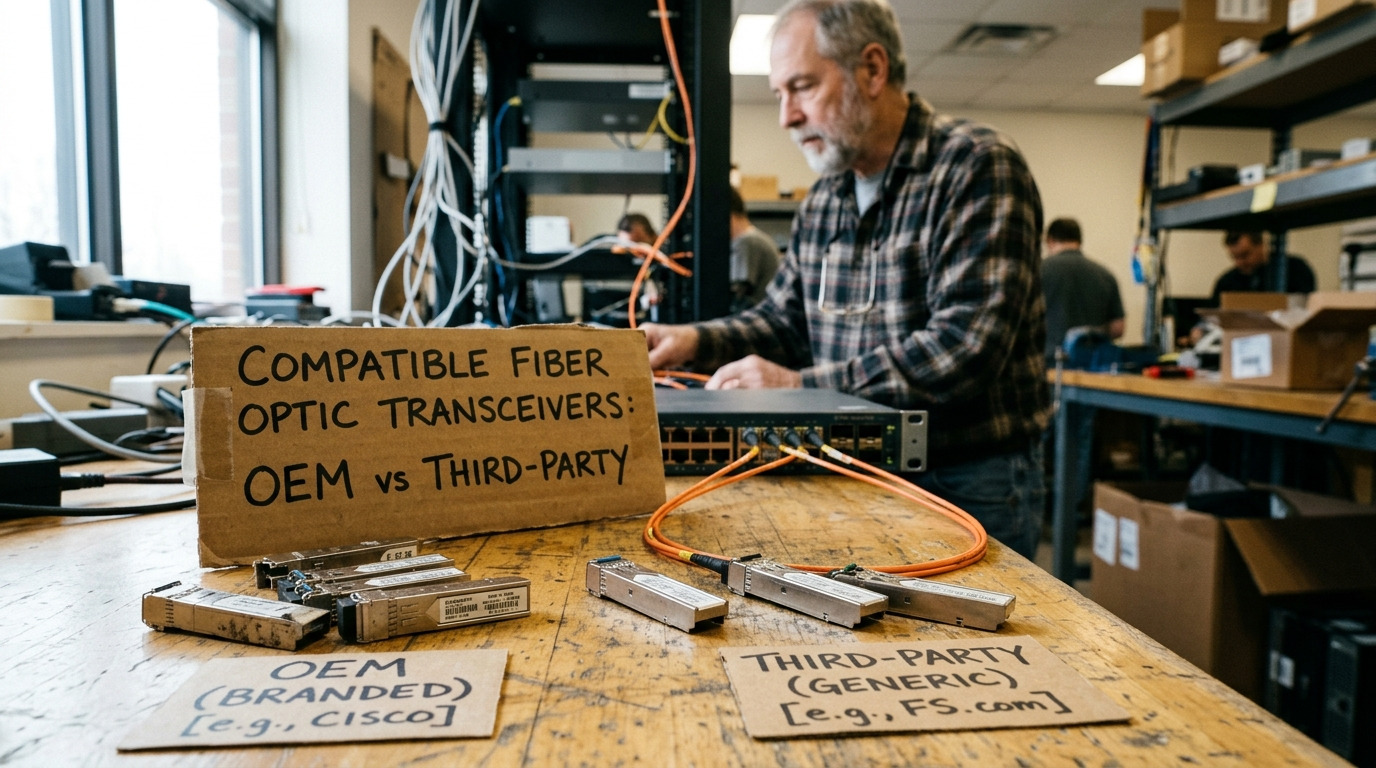
Optics cost is not just purchase price; it is also failure rate, downtime risk, and support friction. OEM modules can be more expensive but may have smoother DOM integration and vendor support pathways. Third-party optics can reduce upfront cost, but you must validate switch compatibility and DOM behavior during a pilot.
In typical market pricing, 10G SFP+ SR modules often land in a broad range depending on brand and temperature grade; budget categories commonly look like “OEM premium” versus “third-party value.” For TCO, include expected replacement cycles, labor for transceiver swaps, and the cost of maintenance windows. If your LAG is carrying production traffic, a single member flap can trigger session resets and cascading retries.
Decision framing
- OEM: Higher unit price, lower integration uncertainty, faster RMA pathways
- Third-party: Lower unit price, but higher validation burden and potential DOM quirks
For bonded fiber links, the “cheapest” optics can become the most expensive if they introduce instability or require frequent rework. Run a small pilot with at least 2 to 4 LAG member pairs before scaling.
- Pros: Better cost predictability and fewer surprises during expansion
- Cons: Requires upfront validation effort
Top 7: Common mistakes and troubleshooting that actually fixes bonded fiber links
Below are failure modes engineers see when deploying bonded fiber links with LACP and fiber transceivers. Each includes a root cause and a field-ready solution.
Member links flap only on one side of the LAG
Root cause: Unequal optical power margin, often from dirty connectors, longer patch cords, or a damaged fiber segment on only one member. Sometimes the issue is a single bad patch cord that still shows link up.
Solution: Swap the member optics with a known-good pair and re-measure receive power and temperature via DOM. Inspect both ends with a fiber microscope and replace patch cords. If needed, run OTDR to locate localized loss.
LACP shows “Up” but throughput never scales
Root cause: Traffic hashing concentrates flows onto one member due to limited flow diversity or an unfavorable hash key selection. This is especially common with single-source-to-single-destination patterns.
Solution: Validate with a flow-multiplexed test, then check switch LAG hashing configuration options. If supported, include Layer 3/4 fields in the hash or adjust policies to spread flows.
One member has higher CRC/FCS errors and rising BER
Root cause: Transceiver mismatch (different vendor family, marginal sensitivity), or inconsistent FEC handling. Also possible: incorrect MPO polarity mapping or swapped transmit/receive pairs.
Solution: Standardize optics models across members and confirm polarity and FEC mode. Check DOM for receive power and trend it over time. After re-patching, clear counters and re-test under representative load.
Ports refuse third-party optics or show DOM alarms
Root cause: Switch platform enforces DOM compatibility or applies stricter thresholds for unsupported vendor IDs. The port may still pass traffic but will alarm or intermittently degrade.
Solution: Use a compatibility list from the switch vendor where available, or run a controlled pilot. If alarms persist, tune alerting thresholds and confirm that the optical readings are within expected ranges for that module.
Top 8: Selection criteria checklist for LAG-ready fiber transceivers
Use this ordered checklist when choosing optics for bonded fiber links. It is optimized for engineers who need reliable LACP member behavior, not just “link comes up.”
- Distance and reach class: Verify end-to-end loss against the module optical budget, including patch cords and splices.
- Data rate and coding: Match the Ethernet speed (10G, 25G, 40G, 100G) and ensure the switch port supports that lane configuration.
- Connector and polarity: LC duplex polarity or MPO polarity map must match the transceiver and cabling plan.
- DOM support and telemetry behavior: Confirm switch handling, alarm thresholds, and whether DOM is used for port qualification.
- Operating temperature: Ensure the module temperature range matches rack inlet conditions and airflow profile.
- Vendor lock-in risk: Decide between OEM and third-party, then mitigate by running a pilot and standardizing part numbers.
- FEC and error correction expectations: For higher speeds, align optic families and FEC modes to avoid uneven retrains.
- Pros: Fewer member mismatches and less troubleshooting time
- Cons: Slows down procurement if you do not keep an approved parts list
Top 9: Summary ranking table for bonded fiber links with LACP
Use this table to quickly rank where to focus when you want bonded fiber links to behave consistently. The highest leverage items are typically physical-layer equivalence and telemetry-driven validation.
| Rank | Focus area | Why it matters for LACP | Quick check |
|---|---|---|---|
| 1 | Optics equivalence (type, reach, FEC) | Prevents member retrains and uneven error rates | Standardize module model numbers across members |
| 2 | Optical budget with real patching loss | Marginal links flap under temperature or after re-cabling | Measure loss; keep margin beyond datasheet |
| 3 | Hash distribution validation | Controls whether throughput scales with member count | Run flow-multiplexed load test |
| 4 | Connector cleanliness and polarity | Causes silent BER spikes and CRC errors | Microscope inspection and polarity verification |
| 5 | DOM telemetry and alarms | Detects drift before failures | Trend rx power and temperature per member |
FAQ
Do bonded fiber links require identical transceiver vendors?
Not always, but for reliability you should standardize at least the transceiver family, wavelength, reach class, and key DOM behavior. If you mix vendors, run a pilot that includes telemetry and error-rate monitoring before scaling.
Why does my LACP aggregate show traffic on only one member?
LACP uses flow-based hashing, so a small number of flows can concentrate traffic on a single member. Generate traffic with many concurrent flows and verify switch hash settings if your platform allows tuning.
What DOM metrics should I track for bonded fiber links?
Track receive power, transmit power, temperature, and any vendor-exposed alarm flags. The goal is trend detection: a gradual decline or rising temperature on one member often predicts future flaps.
Can I use multimode SR optics for longer distances by using higher-grade OM4?
Sometimes, but you must still respect the module’s specified reach and optical budget. Validate with measured end-to-end loss, including patch cords and any couplers, and keep margin for connector aging and seasonal temperature changes.
What is the most common physical mistake in LACP fiber deployments?
Incorrect polarity or a dirty connector on one member link. The link can come up, but BER and CRC errors will rise, causing intermittent retrains that disproportionately affect one member.
Are OEM optics worth the premium for bonded fiber links?
They often reduce integration friction and simplify support during failures, especially with strict DOM handling. If you choose third-party modules, treat it like a mini product validation: confirm DOM compatibility, run a pilot under load, and standardize part numbers.
Bonded fiber links succeed with LACP when optics, cabling, telemetry, and traffic hashing are engineered as a single system, not treated as independent components. Next step: use how to validate fiber link power budgets to turn datasheet reach into measurable, operational confidence.
Author bio: I build and validate LACP and fiber transport systems in production data centers, focusing on optics telemetry, BER/CRC observability, and fast rollback procedures. I write from field experience: measured loss budgets, DOM trend alarms, and acceptance tests that catch issues before uptime risk.
References: IEEE 802.1AX for LACP behavior; IEEE 802.3 for Ethernet PHY over fiber fundamentals; vendor datasheets for optics reach, receiver sensitivity, and DOM specifications. [Source: IEEE 802.1AX], [Source: IEEE 802.3], [Source: Cisco SFP-10G-SR datasheet], [Source: Finisar FTLX8571D3BCL datasheet], [Source: FS.com SFP-10GSR-85 datasheet]
