
If you are wiring ABB or Siemens automation controllers into a switched Ethernet plant network, the optics choice can make or break uptime. This article helps maintenance and network engineers select the right automation controller optics (SFP-class transceivers) by mapping real ABB/Siemens link needs to IEEE Ethernet physical-layer realities. You will get a practical checklist, a deployment scenario with measured link targets, and troubleshooting patterns seen in the field.
What “automation controller optics” means in ABB and Siemens networks
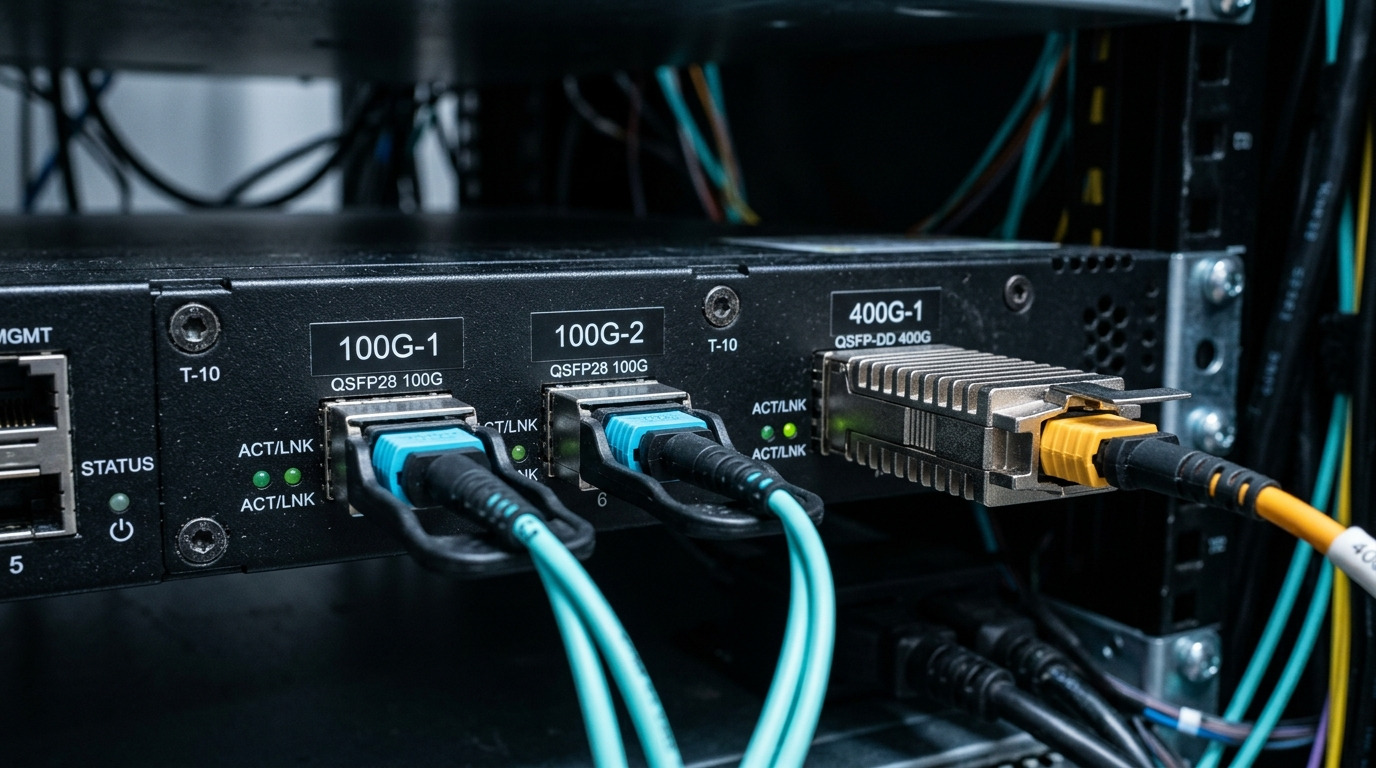
In most ABB and Siemens controller environments, the automation controller optics you care about are small form-factor pluggables (SFP or SFP-class) used for Ethernet links between controllers, industrial switches, and sometimes managed media converters. Even when the controller ports are “just Ethernet,” the physical layer depends on the transceiver’s wavelength, optical budget, fiber type, and the receiving switch or controller optics capability. Most ABB/Siemens deployments target 1000BASE-SX over multimode fiber or 1000BASE-LX over single-mode fiber, but you must confirm the exact port option in your controller and switch model.
From a standards perspective, the optical requirements align with IEEE 802.3 for the relevant 1GBASE variants (for example, SX and LX). From an installation perspective, the biggest variables are not only distance but also connector cleanliness, fiber modal performance (multimode), and transceiver temperature behavior in enclosures.
Key SFP optical specs to match ABB/Siemens port options
Engineers often start with “it fits the port,” then discover mismatches in wavelength class, fiber type, or DOM behavior. The safer approach is to match the SFP’s supported Ethernet standard, wavelength, reach, and connector style to the port’s expected transceiver class and the fiber plant design.
Typical 1G SFP candidates (SX and LX) for industrial links
The table below compares common SFP modules frequently used around automation controller ports. Always verify the controller’s and switch’s datasheets for supported optics, link speed, and whether the device expects digital optical monitoring (DOM).
| Module type | Data rate / standard | Wavelength | Fiber type | Typical reach | Connector | DOM | Operating temperature |
|---|---|---|---|---|---|---|---|
| SFP-SX (multimode) | 1G Ethernet (1000BASE-SX) | ~850 nm | OM3 or OM4 multimode | Up to 300 m (OM3) / 400 m (OM4) | LC | Common, but not universal | Often -10 to 70 C (some industrial -40 to 85 C) |
| SFP-LX (single-mode) | 1G Ethernet (1000BASE-LX) | ~1310 nm | Single-mode OS2 | Up to 10 km (typical) | LC | Common, but not universal | Often -10 to 70 C (some industrial -40 to 85 C) |
Real-world examples you may see in plant spares include Cisco SFP-10G-SR and Finisar/FS.com optics families, but for ABB/Siemens 1G controller links, focus on 1000BASE-SX/LX rather than higher-speed optics. If you are using 10G to aggregate segments, the selection logic expands to 10GBASE-SR or LR variants, but that is a different optics budget and often different SFP form factors (or QSFP+).
Authority references for the underlying Ethernet physical-layer behavior include IEEE 802.3 for the relevant 1GBASE optical specifications and vendor datasheets for transceiver reach and safety class. IEEE 802.3 standard and FS.com transceiver datasheets are practical starting points for interpreting reach, wavelength, and DOM expectations.
Pro Tip: In industrial enclosures, the transceiver temperature swing can drive DOM-reported Tx bias changes and marginal links that “work on the bench.” If your ABB/Siemens segment shows flaps only after thermal cycling, check vendor DOM thresholds and confirm the module’s operating temperature range matches the cabinet environment, not the office lab.
Deployment scenario: choosing SX vs LX in a leaf-spine plant
In a 3-tier data center leaf-spine topology with 48-port 10G ToR switches, you might typically use QSFP+ and SR optics. In a plant automation scenario, the topology is often “controller-to-access switch-to-line switch,” with many short runs and a few long ones. For example, in a mid-size manufacturing line, you may connect 12 ABB controllers and 8 Siemens PLC/IPC nodes to a pair of industrial access switches. The controller-to-switch fiber runs are 80 to 120 m across cable trays, while one remote skid uses 2.5 km of single-mode OS2.
In that case, selecting SFP-SX over OM4 for the 80 to 120 m links usually keeps optical margin while staying cost-effective. For the 2.5 km skid, selecting SFP-LX over OS2 avoids the multimode modal bandwidth constraints and reduces sensitivity to differential mode delay. Engineers commonly validate by checking connector loss, splice loss, and the transceiver’s specified optical budget in the vendor datasheet, then confirming link stability after real-world cleaning.
Selection criteria and decision checklist for SFP on controller ports
When you are selecting automation controller optics for ABB and Siemens, use an ordered decision process to reduce rework and avoid incompatible behavior.
- Distance and fiber type first: Map each link length to OS2 single-mode or OM3/OM4 multimode. Do not assume multimode will work beyond spec.
- Switch and controller compatibility: Confirm the exact controller port option and industrial switch model supports the transceiver standard (for example 1000BASE-SX vs 1000BASE-LX) and connector type (LC common).
- Wavelength and link partner expectations: Ensure both ends use compatible wavelengths (850 nm to 850 nm for SX; 1310 nm to 1310 nm for LX).
- DOM support and monitoring: If your Siemens/ABB management stack reads DOM, confirm the module provides compliant DOM behavior and that thresholds won’t trigger nuisance alarms.
- Operating temperature and enclosure airflow: Choose industrial-grade temperature range when cabinets exceed 50 C or experience hot spots near power distribution.
- Budget and total cost of ownership: Compare OEM vs third-party pricing, but include expected failure rate, warranty coverage, and inventory complexity.
- Vendor lock-in risk: Some managed switches log “unsupported optics” warnings depending on vendor. Decide whether warnings are acceptable or whether you need exact vendor matching.
Common pitfalls and troubleshooting tips
Most optics failures in ABB/Siemens automation networks are not “bad hardware” but avoidable physical-layer mismatches or installation issues. Here are concrete failure modes and fixes.
Link comes up briefly then drops after minutes
Root cause: Marginal optical power due to dirty connectors, high insertion loss, or a transceiver operating near temperature limits. DOM may show rising receive power alarms, but the link can still appear “mostly working” until thermal drift.
Solution: Clean and re-terminate LC connectors using lint-free wipes and an inspection scope. Verify splice loss and confirm the module’s temperature range fits the cabinet. If available, compare DOM Rx power values against the vendor’s recommended thresholds.
“No link” despite correct fiber length
Root cause: Wavelength or fiber-type mismatch (for example, using 850 nm SX on OS2 single-mode or swapping OM3/OM4 patch cords). Another frequent issue is reversed transmit/receive polarity in duplex fiber.
Solution: Confirm the SFP labels (850 nm vs 1310 nm) and validate fiber type at the patch panel. Check duplex polarity: Tx to Rx, and if needed, use a polarity switch or re-cable the patch cords.
Works on one switch but not on the other
Root cause: Compatibility differences in transceiver acceptance logic, DOM interpretation, or link training behavior between vendor switch models. Some industrial switches are stricter and may flag “unsupported” optics.
Solution: Test the exact optics SKU in a staging rack with the same switch model and firmware. If you need third-party optics, validate DOM behavior and acceptance logs during commissioning, not after production cutover.
Cost and ROI note: OEM vs third-party SFPs in automation
In industrial spares, SFP pricing often ranges from roughly $25 to $80 per module for common 1G SX/LX depending on temperature grade, DOM support, and warranty. OEM-branded modules can cost more, but the ROI depends on your downtime cost and how often you recycle optics across sites. Total cost of ownership should include: warranty terms, expected failure rate in hot cabinets, connector cleaning tooling, and time spent resolving “unsupported optics” warnings.
For teams optimizing PMF-style learning cycles, the practical ROI move is to standardize on one or two validated optics SKUs per distance class (for example, OM4-SX for 0 to 150 m and OS2-LX for 0 to 5 km) and keep a measured acceptance test procedure. That reduces incident variance and speeds commissioning.
FAQ
Which SFP type is most common for ABB and Siemens controller links?
Most often, teams use 1000BASE-SX on OM3/OM4 multimode for short runs and 1000BASE-LX on OS2 single-mode for longer runs. The exact choice depends on the controller port and the switch model in your cabinet.
Do I need DOM support for automation controller optics?
Not always, but it helps for monitoring and faster fault isolation. If your Siemens/ABB management expects DOM readings, choose an SFP that provides compatible DOM behavior and confirm thresholds in the vendor documentation.
Can I mix optics vendors on the same link?
In many cases, yes, because the optical standard is defined by IEEE 802.3 and the wavelength class matches. However, managed switches can log “unsupported optics” or behave differently, so validate with your exact switch firmware and acceptance criteria.
What fiber cleaning mistakes cause the most outages?
The most common issues are using uninspected connectors, reusing dirty patch cords, and skipping end-face inspection after repeated disconnects. Invest in an inspection scope and use a consistent cleaning procedure before swapping optics.
How do I prevent thermal-related link flaps?
Choose modules with an industrial temperature range when cabinets run hot, and confirm airflow around the switch and media modules. If DOM is available, track Rx power trends across thermal cycles and correlate with link drops.
What should I test during commissioning before going live?
Verify link up time, error counters, and stability over a thermal cycle. Also confirm the exact wavelength and polarity behavior using a staging rack that mirrors the final ABB/Siemens cabinet layout.
If you treat optics selection as a compatibility and optical-budget exercise, automation controller optics for ABB and Siemens becomes repeatable instead of reactive. Next, align your standard optics SKUs to link-budget and optical-budget basics for industrial Ethernet and lock the process into your commissioning checklist.
Author bio: I run field validation for industrial networking hardware and focus on rapid PMF-style learning loops: define acceptance tests, measure failure modes, then standardize. Author bio: I have deployed SFP-based links in plant cabinets with strict uptime targets and detailed optical monitoring workflows.
