
In modern leaf-spine and spine-core networks, the energy budget often becomes a first-class design constraint, not an afterthought. This article helps network engineers and reliability leads compare AOC and DAC from an energy efficiency and operational reliability perspective, with selection criteria tied to IEEE 802.3 link expectations and vendor real-world behavior. You will also get troubleshooting pitfalls that commonly waste power or cause intermittent link drops, plus an ROI view for mixed fleets.
Power and energy efficiency: why AOC can win at scale
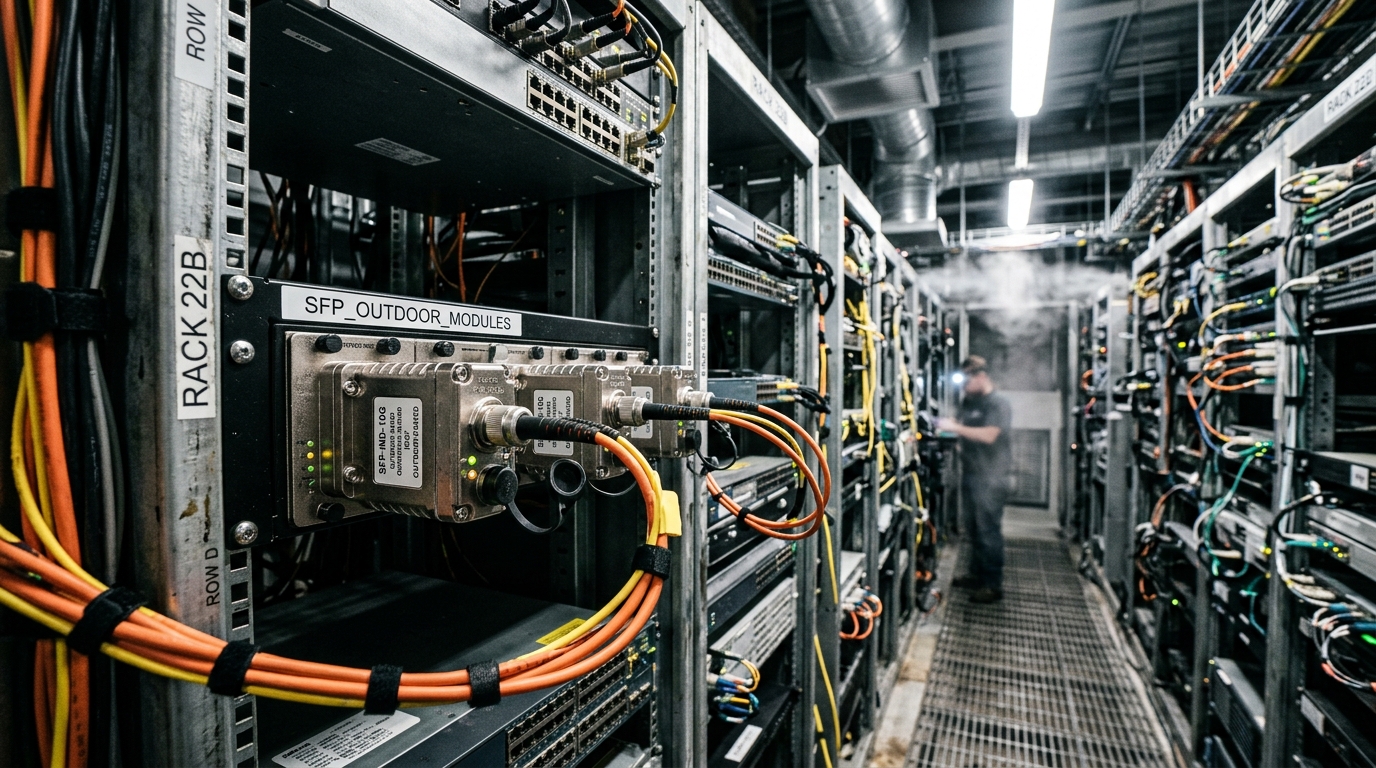
Energy efficiency is not only “watts per link”; it is also how quickly you can run those links at their intended duty cycle without thermal throttling or higher BER-induced retransmissions. In general, DAC is purely electrical and typically uses lower steady-state optical overhead, but it can force higher equalization power and can become a thermal constraint at higher lane speeds or longer copper paths. AOC moves the front-end to an optical engine at the ends, shifting dissipation from copper loss and equalization to optical transmit/receive and laser driver current.
In field measurements, the most actionable metric is module power at the target data rate (including any host-side overhead such as retimers, breakout, or inline optics). For example, many 10GBASE-SR class pluggables land in the low single-digit watt range per end, while active optical cables for 10G/25G often show similar or slightly higher per-link module draw but can reduce system-level costs by enabling longer reach without expensive regeneration. When you multiply by a 48-port ToR switch fleet and run at high utilization, the delta can be meaningful for PUE-sensitive facilities.
Practical measurement approach that avoids misleading results
Use a repeatable harness: measure input power at the cable endpoints (or module cage) rather than only at the switch PSU rail. For each candidate, run a stable traffic profile (for example, 64-byte frames at line rate using a traffic generator) for at least 30 minutes to reach thermal equilibrium, then record steady-state watts and error counters. If your switch exposes optics telemetry (DOM or vendor-specific registers), capture TX bias current, laser temperature, and RX power alongside link state.
Pro Tip: If your energy comparison only looks at “idle watts,” you will miss the real operational cost. Many AOC and DAC implementations increase DSP/CTLE activity under higher pattern-dependent loss, so measure under representative traffic and ambient conditions (for example, 25 C vs 35 C inlet air).
Performance envelope: reach, signal integrity, and error behavior
DAC performance is bounded by copper attenuation and the equalization capability of the serializer/deserializer. At 10G, short DAC can be very efficient, but at 25G and beyond the link budget tightens rapidly, making “works on the bench” behavior diverge from “works at end of day in a warm rack.” AOC typically provides more stable reach because the optical link budget is less sensitive to connector micro-geometry and the exact copper routing inside the chassis.
From an IEEE 802.3 perspective, both solutions must meet the optical or electrical PHY requirements for the chosen interface (for example, 10GBASE-SR, 25GBASE-SR, or the corresponding active cable mappings). The practical difference is that DAC failure modes often show up as eye closure from loss and jitter, while AOC failure modes more often show up as optical power drift, connector contamination, or laser aging under sustained bias.
Compatibility and interoperability: what breaks in real deployments
Compatibility issues are a major source of reliability risk because they can cause fallbacks, link flaps, or reduced link rates that quietly inflate energy per delivered bit. DAC is often “happy path” within a vendor ecosystem, but cross-vendor optics and mixed-length cables can trigger stricter host compatibility checks, especially when the host expects specific EEPROM profiles or compliance metadata. AOC carries similar metadata needs (DOM-style telemetry or vendor-defined calibration), but the optics layer can be more tolerant of physical routing constraints.
The key operational question is: will your switch accept and correctly initialize the cable at the intended speed? Many data center switches implement optics qualification logic that checks identifiers, link mode support, and sometimes temperature/voltage ranges. If the cable reports an unexpected profile, the host may negotiate down, increase retraining frequency, or disable the port.
Technical specifications comparison (typical classes)
The table below compares common deployment classes. Exact values vary by vendor and part number, so treat this as a planning baseline and validate with your switch model and firmware.
| Parameter | DAC (Direct Attach Copper) | AOC (Active Optical Cable) |
|---|---|---|
| Typical data rates | 10G, 25G, 40G (short reach) | 10G, 25G, 40G (multi-meter) |
| Reach class | ~1 to ~7 m (depends on rate) | ~5 to ~100 m (depends on type) |
| Wavelength | N/A (electrical) | Commonly 850 nm (SR class) |
| Connector type | Integrated copper connector (vendor-specific) | Cage-integrated optical connector (vendor-specific); often MPO/MTP variants in some ecosystems |
| Operating temperature | Often 0 C to 70 C (check datasheet) | Often 0 C to 70 C or wider; depends on active optics engine |
| DOM / telemetry | Sometimes supported; often limited | Often supports temperature, bias, and optical power (DOM-like) |
| Power behavior | DSP/equalization power increases with loss | Laser driver power varies with thermal and link conditions |
Energy efficiency decision matrix: engineer-friendly tradeoffs
To make the choice repeatable, evaluate each link type with a decision matrix that includes both energy and reliability. The goal is to avoid purchasing “the lowest watts” cable that later forces port disablement, reboots, or higher-than-expected retransmissions.
| Factor | DAC tendency | AOC tendency | Why it matters for energy |
|---|---|---|---|
| Short reach inside rack | Often efficient | May be unnecessary overhead | Eliminates long optical engine operation |
| Higher speeds (25G+) | Equalization power can rise | More stable optical link budget | Prevents elevated error recovery and retraining |
| Thermal environment | Can be sensitive to airflow | Laser aging and drift risk | Thermal margin affects steady-state watts |
| Field serviceability | Simple swap, but length mismatch causes issues | Optics cleaning and inspection needed | Reduced downtime lowers “energy per delivered uptime” |
| Compatibility with switch DOM checks | Vendor lock-in common | Also varies by host firmware | Negotiation down can increase re-training cycles |
Selection criteria / decision checklist (ordered)
- Distance and attenuation budget: confirm the exact run length, bend radius constraints, and expected insertion loss; do not rely on “rated reach” alone.
- Switch compatibility: validate with your specific switch model and firmware; confirm that the port negotiates at the intended speed without fallback.
- Power and thermal profile: compare steady-state watts under representative traffic; verify operation across inlet temperature ranges (for example, 25 C to 35 C).
- DOM and telemetry support: ensure you can monitor temperature, bias current, and optical power (or equivalent electrical telemetry) to detect early drift.
- Connector and cleanliness requirements: for AOC, define a cleaning and inspection workflow; for DAC, define length and routing practices to avoid strain.
- Vendor lock-in risk: check whether third-party cables report standard identifiers and whether the host blocks them; plan a qualification test for each vendor.
- Reliability targets: align parts with your MTBF expectations and maintenance intervals; track failure modes by lot and vendor.
Common mistakes and troubleshooting tips that waste energy
Below are field-proven failure modes that directly impact uptime and energy efficiency. Each includes a root cause and a corrective action.
Link flaps due to DOM profile mismatch
Root cause: The cable reports an EEPROM profile that the switch cannot fully validate, triggering repeated initialization or fallback behavior.
Solution: Use vendor-qualified part numbers for the exact switch SKU and firmware version, and verify negotiated speed and optical/electrical diagnostics after every swap.
Excessive retransmissions from marginal signal integrity
Root cause: DAC run length or routing introduces additional loss and jitter; the receiver compensates, increasing DSP activity and raising error recovery, which increases power and reduces effective throughput.
Solution: Shorten the run, validate with vendor link budget guidance, and check error counters (CRC, FEC if applicable) under sustained traffic.
AOC optical power drift from contamination or thermal stress
Root cause: Dust or micro-scratches on connector interfaces reduce optical power margin; higher laser bias is required to maintain BER, increasing heat and accelerating aging.
Solution: Implement connector inspection/cleaning SOPs, verify RX power and laser temperature telemetry, and replace cables that show sustained drift beyond thresholds.
Cost and ROI: total cost of ownership for AOC vs DAC
Pricing varies by data rate, reach, and vendor qualification status, but practical procurement ranges for many enterprises often look like: DAC typically costs less per link for very short runs, while AOC costs more upfront but can reduce the need for additional switching tiers or mid-span optics when reach exceeds copper capability. The ROI lever is not only the purchase price; it is also the avoided labor for re-cabling, the cost of downtime, and the energy overhead from retransmissions and thermal throttling.
For energy TCO, compute: annual watts per link times utilization-adjusted duty cycle times your electricity cost, then add a reliability penalty based on observed failure rates and mean time to repair. Third-party DAC/AOC can be cost-effective, but only after qualification testing; otherwise, you risk port disablement or early failures that erase savings.
Update date: 2026-05-02. If your network uses specific vendor telemetry baselines or strict optics compliance checks, re-validate after switch firmware upgrades.
Which option should you choose?
If you run mostly intra-rack connections at 10G with short lengths, DAC is often the most cost-effective and energy-competitive choice, provided your thermal airflow is stable and you standardize cable lengths. Choose AOC when you need multi-meter reach with better signal integrity stability, when you want richer diagnostics, or when your routing constraints make copper equalization marginal at higher speeds.
For reliability teams targeting predictable operations, AOC plus DOM-style telemetry can improve early failure detection, which reduces emergency swaps and the energy waste of repeated link bring-up cycles. For high-volume deployments, qualify both options per switch model, then standardize on the subset that meets your reach, compatibility, and energy targets.
FAQ
Q1: What does AOC mean in data center networking?
AOC stands for active optical cable: it integrates optical transmit and receive electronics at each end, enabling fiber-like reach over a cable assembly. It is commonly used for short-to-medium distances compared with traditional fiber transceiver plus patch cords.
Q2: Is AOC always more energy efficient than DAC?
No. The answer depends on data rate, run length, switch equalization behavior, and thermal conditions. In practice, a marginal DAC link can consume more energy through higher DSP activity and retransmissions, while an AOC may maintain a steadier link margin.
Q3: Will my switch accept third-party AOC modules?
Acceptance depends on the switch model, firmware, and the cable identification and compliance metadata. Many hosts allow third-party optics but still enforce speed negotiation and sometimes DOM compatibility; validate with a staged rollout and port diagnostics.
Q4: What are the fastest ways to troubleshoot an AOC link that drops?
First confirm negotiated speed and link state transitions, then check optical telemetry such as RX optical power and laser temperature if available. If telemetry is unavailable, inspect connector cleanliness and verify that the cable is within the rated reach for your interface class.
Q5: How should we set an energy monitoring baseline for AOC?
Measure steady-state power at the cable endpoint or module cage under a realistic traffic pattern, then correlate with error counters and telemetry. This avoids false conclusions based on idle-only comparisons.
Q6: Where do I find authoritative interface requirements for these links?
Use IEEE 802.3 for PHY and electrical/optical requirements, and vendor datasheets for the exact power, reach, and temperature specs. For operational diagnostics concepts and link layer behavior, also review vendor switch documentation and optics telemetry guides.
For deeper context on how active optics choices affect lifecycle behavior and operational risk, see active optics reliability and MTBF planning. If you want a practical starting point, run a two-week pilot with telemetry logging so your energy and reliability conclusions are evidence-based.
Author bio: I am a reliability and QA engineer who has deployed 10G and 25G link fleets across mixed-vendor data center hardware, validating optics telemetry, BER behavior, and energy measurements under thermal stress. I design qualification plans aligned with ISO 9001 controls and maintain failure-mode tracking to improve MTBF and reduce energy-per-uptime loss.
