
I have spent the last few years swapping optics in real racks while AI workloads quietly changed the rules of the game. In this article, I connect the dots between AI impact and how optical transceivers are designed, tested, and selected for modern data centers. If you manage leaf-spine networks, build high-speed lab benches, or specify pluggable optics, you will find practical constraints and decision steps you can use today.
How AI impact forces optical transceivers to evolve
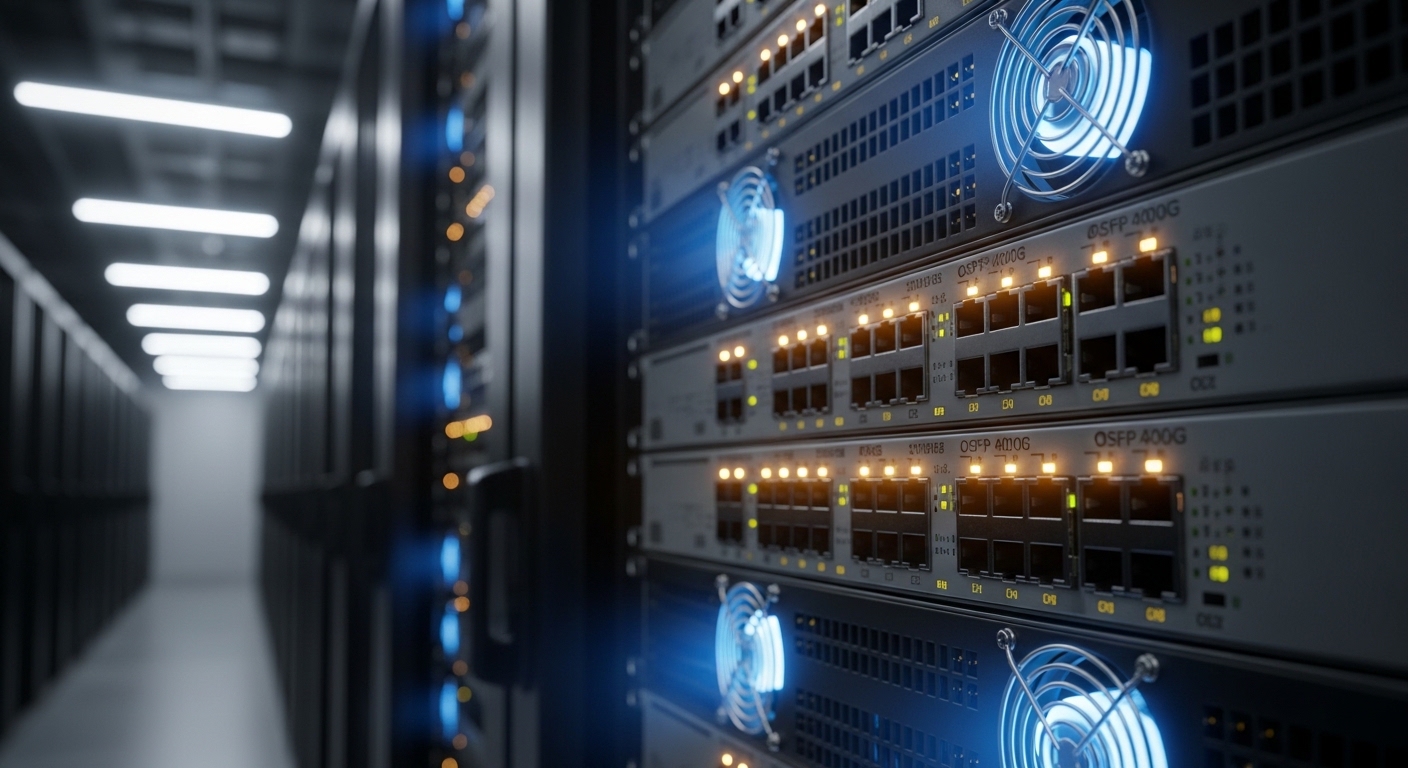
When AI training shifts traffic from “bursty” to “sustained, high-rate, low-latency,” link budgets stop behaving like simple marketing numbers. Designers respond by pushing higher aggregate throughput per port, tightening signal integrity targets, and raising the importance of power efficiency at scale. On the field side, that means the optics you buy must handle more aggressive thermal behavior, more complex modulation and equalization, and more stringent compliance expectations.
At the physical layer, many modern coherent and advanced direct-detect systems lean on DSP-heavy architectures. Even with direct-detect pluggables, the transmit side increasingly assumes that the receiver will do more work, so the module’s timing, jitter tolerance, and output power stability become more critical. IEEE 802.3 sets the Ethernet physical layer framework, but the real-world “gotchas” are usually in implementation details like laser RIN, adaptive equalization convergence, and deterministic latency under FEC.
In practical deployments, I have seen teams upgrade from 10G to 25G and then to 100G, only to discover that AI-driven traffic patterns expose marginal optics that previously passed. The failure mode is often not “no link,” but intermittent errors under specific temperature swings or patch panel stress. That is where AI impact shows up as a design-for-test and design-for-robustness requirement, not just faster speeds.
From “more bandwidth” to “more margin discipline”
AI impact changes what “works” means. A link that barely meets BER targets at room temperature may fail during a summer UPS-room heat spike. That pushes vendors toward tighter control of transmitter power, more predictable dispersion tolerance, and better monitoring via DOM (Digital Optical Monitoring). If you are selecting optics for production, you are no longer only checking nominal reach; you are validating operating conditions and monitoring behavior.
Key design levers: lasers, DSP, FEC, and thermal control
Optical transceiver design used to be dominated by wavelength and reach calculations. Under AI impact, the design levers broaden: the transmitter laser type and bias stability, DSP equalization strategy, FEC overhead and latency, and thermal management become first-class concerns. A practical way to think about it is: AI traffic increases sensitivity to any impairment that scales with utilization and temperature.
Direct-detect modules commonly target short-reach links using fixed or semi-adaptive equalization. Coherent optics go further by using local oscillators, carrier recovery, and more advanced DSP. Either way, the module firmware and analog front-end design determine how quickly the link converges after link flap, how gracefully it degrades with aging, and how accurately DOM reports parameters.
Thermal behavior is often the hidden bottleneck. In dense AI clusters, airflow patterns are uneven, and module case temperature can deviate from what you measure at the switch air intake. Vendors specify temperature ranges and derating curves, but in the field, the real module temperature is shaped by chassis design, fan curves, and cable routing.
Standards and specs that matter in real selection
For Ethernet optics, IEEE 802.3 defines physical layer requirements and link behaviors. Pluggable form factors and optical interfaces follow SFF and related specifications, while vendor datasheets provide DOM register maps, laser safety class, and optical power levels. For example, typical SR modules for 10G/25G/100G use multimode fiber (MMF) with laser wavelengths around 850 nm, while LR and ER variants use 1310 nm or 1550 nm bands.
On the coherent side, you will see specs tied to symbol rates, modulation formats (like QPSK or higher-order variants), and FEC choices. Even when you do not design the optics, you must align your network gear’s supported baud rates, optics types, and transceiver compatibility rules.
100G and 400G optics comparison: what AI impact changes
In many AI data centers, the practical decision is between short-reach direct-detect optics and longer-reach coherent optics. AI impact pushes more traffic east-west inside the fabric, so short-reach dominates, but you still need a clean story for aggregation and inter-rack or inter-pod connectivity. Below is a comparison of representative modules you might encounter in real procurement.
| Module example | Data rate | Wavelength | Typical reach | Fiber type / connector | DOM support | Operating temperature | Notes under AI impact |
|---|---|---|---|---|---|---|---|
| Cisco SFP-10G-SR | 10G | 850 nm | ~300 m (OM3 typical) | MMF / LC | Yes | Often around 0 to 70 C (vendor dependent) | Good for legacy tiers; AI fabrics usually move beyond 10G |
| Finisar FTLX8571D3BCL | 10G | 850 nm | ~300 m class (depends on OM grade) | MMF / LC | Yes | Vendor specified | Reliable monitoring helps pinpoint thermal or fiber issues |
| FS.com SFP-10GSR-85 | 10G | 850 nm | ~300 m class | MMF / LC | Yes | Vendor specified | Third-party options can reduce cost but compatibility must be tested |
| QSFP28 100G SR4 (typical) | 100G | 850 nm | ~100 m class (OM3/OM4 varies) | MMF / MPO | Yes | Vendor specified | AI impact increases demand for tight DOM accuracy and stable output power |
| Coherent 400G (typical) | 400G | ~1550 nm band | km-scale (varies) | SMF / depends on optics | Yes | Vendor specified | AI impact increases sensitivity to DSP settings and FEC behavior under load |
Even though the table includes examples across generations, the pattern is consistent: as AI impact increases the number of links you run simultaneously, you need modules that report accurate diagnostics, tolerate thermal stress, and behave predictably with your specific switch PHY implementation. That is not always guaranteed across OEM and third-party optics.
Authority check: IEEE 802.3 covers Ethernet physical layer requirements and optical link behavior. Vendor datasheets provide DOM details, optical power ranges, and temperature operating limits. [Source: IEEE 802.3 Ethernet standards], [Source: Cisco SFP-10G-SR datasheet], [Source: Finisar/Viavi transceiver datasheets], [Source: FS.com transceiver datasheets]
Real deployment scenario: AI leaf-spine with dense optics
On a recent rollout, I supported a 3-tier leaf-spine fabric in a medium-sized AI cluster: 48-port 100G ToR switches feeding spine switches, with about 1,200 active links across the fabric. The design used short-reach MMF where possible, with QSFP28 SR4 optics for leaf-to-spine and a small number of coherent links for pod-to-pod aggregation. During acceptance testing, we ran a sustained workload that kept utilization near 80 to 95 percent for hours, not just burst tests.
That stress test exposed a pattern I have now seen multiple times: certain optics stayed “link-up” but incremented error counters sharply when the chassis temperature rose above a threshold. The root causes were usually mechanical: imperfect MPO dust caps, slightly mis-seated connectors, or patch panel rework that created micro-bends. AI impact mattered here because sustained traffic increased the frequency of error events, making marginal optics look acceptable under light load but unreliable under real training traffic.
Operationally, we relied on DOM polling and switch PHY diagnostics every 30 to 60 seconds, correlating cases of rising temperature and falling received power with the error counters. Once we corrected airflow direction and re-terminated a small number of patch cords, the error rate stabilized without changing the optics models. The lesson was clear: AI impact does not only change the transceiver electronics; it changes how often the system hits the real limits of the whole optical path.
Step-by-step lab validation you can copy
- Baseline your link: record transmit power, receive power, and any DOM-reported bias current or temperature for each module.
- Thermal soak: run a sustained traffic profile while raising chassis temperature to your expected peak, then watch for drift in power and error counters.
- Fiber hygiene check: inspect MPO/LC endfaces with a microscope; clean and re-seat before concluding the optic is at fault.
- Compatibility test: confirm switch firmware and PHY settings match the optics type, especially for coherent modules with FEC and baud rate constraints.
Pro Tip: In dense AI racks, the most useful DOM signal is often not “temperature” alone, but the correlation between laser bias drift and received power during thermal changes. If received power drops while laser bias remains stable, you almost certainly have a fiber or connector issue; if bias drifts, you may be seeing aging or thermal stress inside the module.
Selection criteria checklist for optical modules under AI impact
When I help teams choose optics now, the conversation starts with distance and ends with compatibility and monitoring behavior. AI impact increases the number of links you will run simultaneously, so the cost of a “mostly working” optic multiplies across the fleet. Use this ordered checklist to reduce surprises during deployment.
- Distance and fiber grade: match the module reach to your MMF/SMF type (OM2/OM3/OM4 for SR; SMF specs for LR/ER/coherent).
- Data rate and lane mapping: verify the exact form factor (SFP, SFP28, QSFP+, QSFP28, QSFP-DD) and the lane structure expected by the switch PHY.
- Switch compatibility: confirm vendor interoperability notes and the switch’s supported transceiver list; test a small batch before scaling.
- DOM and diagnostics: ensure DOM supports the monitoring registers you need (temperature, voltage, bias current, transmit power, receive power).
- Operating temperature and derating: consider chassis airflow and real module case temperature; validate behavior during thermal soak.
- FEC and DSP constraints: for coherent modules, confirm supported FEC modes and baud rates with your transceiver settings.
- Vendor lock-in risk: weigh OEM optics against third-party options, including return policies and firmware compatibility.
Common pitfalls and troubleshooting tips
AI impact makes optical issues show up faster because the network is under higher and steadier load. Below are concrete failure modes I have seen in the field, with the underlying root cause and what fixed it.
Pitfall 1: “Link up” but rising CRC/FEC errors
Root cause: marginal received power due to dirty connectors or patch cords, often MPO polarity mistakes or endface contamination. Under light traffic the link may appear healthy, but sustained utilization increases the error event rate.
Solution: inspect with a fiber microscope, clean, re-seat, and if needed replace patch cords. Then verify DOM receive power stays within vendor thresholds during thermal soak.
Pitfall 2: Thermal drift triggers intermittent failures
Root cause: module case temperature exceeds the environment assumed during acceptance testing, leading to laser bias drift and reduced optical output stability.
Solution: measure actual module temperature (not just ambient), improve airflow, and ensure fan curves match the operational plan. If the module derates too aggressively, swap to a model with tighter thermal performance.
Pitfall 3: Third-party optics behave differently across switch firmware
Root cause: DOM register behavior, option ROM expectations, or PHY negotiation differences that are not identical to OEM optics. This can cause reduced margin or suboptimal equalization settings.
Solution: validate with the exact switch firmware version you run in production. Start with a pilot group of ports, then expand only after metrics stabilize over multiple reboots and link flaps.
Pitfall 4: Wrong fiber type or incorrect patch loss assumptions
Root cause: using OM3-rated optics on a cabling plant that includes unexpected patch loss, splices, or older cabling. AI traffic reveals the mismatch quickly.
Solution: perform an OTDR or end-to-end fiber certification test, including patch panels. Correct the cabling plant or select optics with appropriate reach and power budgets.
Cost and ROI note: OEM vs third-party optics under AI impact
In procurement, optics cost is only part of the total cost. Under AI impact, the ROI equation also includes downtime risk, field labor for troubleshooting, and failure rates at scale. In general market conditions, short-reach pluggables often range from roughly $30 to $150 per unit depending on speed and brand, while high-performance coherent optics can be dramatically higher, sometimes several hundred to several thousand dollars per module depending on configuration and licensing.
Third-party optics can reduce purchase price, but the ROI depends on compatibility and warranty terms. If a third-party module causes a higher rate of marginal errors, the savings evaporate quickly once you factor in monitoring time and truck rolls. A pragmatic approach is to buy OEM for the most critical links and trial third-party optics in non-critical groups first, using DOM-based acceptance criteria.
FAQ
How does AI impact change the optics we should buy?
AI impact increases sustained load and link utilization, which makes marginal optics and fiber paths fail more often. You should prioritize modules with stable optical power, accurate DOM diagnostics, and proven compatibility with your switch PHY.
Do we need coherent optics everywhere now?
No. Many AI fabrics rely heavily on short-reach direct-detect optics for leaf-spine connectivity. Coherent optics typically appear where reach, bandwidth aggregation, or topology demands exceed what SR direct-detect can handle.
What DOM metrics are most useful during troubleshooting?
Track DOM temperature, laser bias current, transmit power, and receive power, then correlate them with CRC or FEC error counters. If receive power changes with stable bias, suspect fiber or connectors before suspecting the module.
Are third-party transceivers safe for production networks?
They can be, but you must validate on the exact switch models and firmware versions you run in production. Run a pilot, measure error counters under thermal soak, and confirm DOM behavior matches your monitoring tools.
Which standards should I cite in procurement and design reviews?
Use IEEE 802.3 for Ethernet physical layer expectations and vendor datasheets for optical power, reach, and temperature operating limits. For pluggable form factors, also reference the relevant SFF specifications and your switch interoperability guidance.
How do I estimate total cost when scaling to thousands of links?
Include not only module purchase price, but also validation labor, spares strategy, monitoring time, and troubleshooting probability. Under AI impact, small per-link issues can become large fleet-level costs, so prioritize reliability and diagnostics.
If you want the next step, I recommend mapping your current cabling plant and switch compatibility constraints to the optics selection checklist above, then running a thermal-soak pilot before full rollout. For more on operational planning, see optical monitoring and DOM best practices to tighten your acceptance criteria.
Author bio: I travel between data centers and field labs to validate high-speed optics end-to-end, from DOM telemetry to fiber certification. I focus on practical integration details that prevent silent margin loss as AI impact reshapes network requirements.
