
When your leaf-spine upgrade plan hits procurement, the risk is not bandwidth itself; it is the quiet failures that follow mismatched optics, wrong fiber plants, or undocumented temperature limits. This article helps data center engineers and procurement leads make confident 400G investments by comparing transceiver options, compatibility realities, and cost tradeoffs. You will leave with selection checklists, deployment notes, and troubleshooting patterns drawn from field-style operations.
400G investments performance: coherent vs direct-detect optics reality
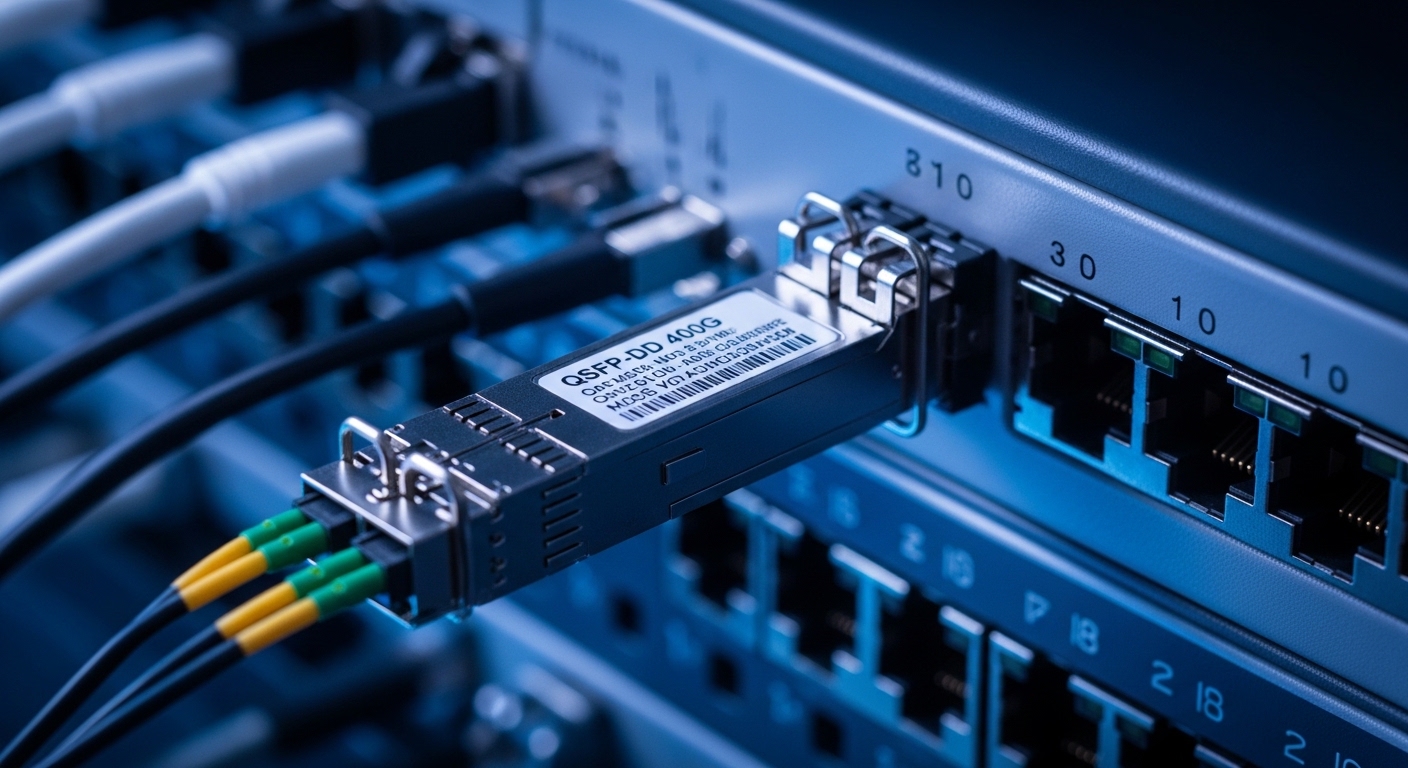
For short-reach 400G, most deployments start with direct-detect optics over multimode fiber (MMF) or single-mode fiber (SMF). For longer reach, coherent optics become the lever, but they bring DSP complexity, higher power, and tighter budgeting around link budgets. The key is aligning the transceiver type to your installed fiber and target link distance, not to marketing reach claims.
In practice, data centers often standardize on 400G Ethernet line rates that map to IEEE 802.3 specifications for 400GBASE-SR8 and 400GBASE-DR4 style variants. Your switch vendor may support multiple electrical interfaces, but the optics must still match the optics class, lane mapping, and DOM behavior expected by the host.
400G investments: spec comparison that actually affects links
Below is a practical comparison of common 400G optics families engineers see during procurement cycles. Treat this as a decision lens for wavelength, reach, connector type, and typical operating conditions; always confirm with the exact switch transceiver matrix.
| Option | Typical form factor | Wavelength | Reach target | Fiber type | Connector | DOM | Operating temperature |
|---|---|---|---|---|---|---|---|
| 400G SR8 | QSFP-DD | ~850 nm | Up to ~100 m (OM4) | MMF (OM4/OM5) | LC | Usually supported | Commercial to industrial variants |
| 400G DR4 | QSFP-DD | ~1310 nm | Up to ~500 m | SMF | LC | Usually supported | Commercial to industrial variants |
| 400G FR4 / LR4 class | QSFP-DD | ~1310-1590 nm band (varies) | ~2 km to 10 km class | SMF | LC | Often supported | Depends on vendor grade |
| 400G coherent | CFP2-DCO / OSFP-like (varies) | C-band (varies) | ~40 km and beyond | SMF | LC / MPO (varies) | Supported | Vendor dependent |
Concrete examples you might encounter in procurement scoping include Cisco optics such as Cisco SFP-10G-SR for 10G baselines, and for 100G/400G families you may shortlist vendor or third-party modules like Finisar FTLX8571D3BCL class parts for 10G optics, while 400G short reach often lands in QSFP-DD module catalogs. For 400G SR, some buyers compare OEM and third-party options like FS.com SFP-10GSR-85 style offerings in the ecosystem, but you must verify the exact 400G module part number family before purchase.
Authority references: consult IEEE 802.3 for 400G Ethernet link definitions and verify host compatibility in vendor transceiver support lists. [Source: IEEE 802.3] [Source: vendor transceiver compliance matrices and module datasheets]
Pro Tip: In many outages blamed on “bad optics,” the real root cause is not the transceiver at all, but a fiber plant mismatch: OM4 vs OM5 assumptions, dirty LC ends, or patch panel re-termination that shifts loss beyond the module’s receive budget. Always validate with an OTDR or at least a calibrated fiber loss report before swapping optics.
400G investments compatibility: the host switch decides what “works”
The most expensive mistake is buying correct-looking optics that your switch refuses to bring up. Host compatibility hinges on electrical lane mapping, firmware handshake behavior, and DOM interpretation. Even if a third-party module is “standards compliant,” it may not pass the vendor’s acceptance tests or may present DOM values outside expected thresholds.
Compatibility checklist you can run during procurement
- Confirm the switch transceiver matrix for the exact model and software release.
- Verify the form factor (QSFP-DD vs OSFP vs CFP2) and supported speed modes.
- Check DOM support and whether telemetry fields match your monitoring stack.
- Match operating temperature grade to your row and airflow reality, not the datasheet default.
- Assess vendor lock-in risk: OEM optics may be priced higher but sometimes reduce RMA churn.
400G investments deployment scenario: 3-tier leaf-spine with real numbers
In a 3-tier data center leaf-spine topology with 48-port 400G ToR switches, a common rollout pattern is to upgrade 16 uplinks per leaf first, then expand spine-side capacity after fabric validation. Suppose each leaf has 32 uplink fibers routed through patch panels with an average measured loss of 1.2 dB per link segment, plus 0.6 dB patch overhead. If the target is 400G SR8 over OM4, procurement aligns modules to the switch matrix and pairs them with verified cleaned LC connectors and a documented fiber loss report.
Operationally, you schedule optics burn-in windows during a maintenance window, then confirm link training stability and error counters under load. Engineers often validate with continuous traffic (for example, line-rate iperf-style tests) and watch for CRC and symbol error increments, because a “link up” state can still hide marginal receive conditions.
Common mistakes and troubleshooting: where 400G investments go to die
Even disciplined teams hit predictable failure modes. Here are field-style patterns with root cause and a practical fix, designed for fast isolation.
“Link down” after insertion
Root cause: Wrong transceiver type for that port speed mode, or host firmware rejects the module ID. This happens when a module is compatible with one switch model but not another, or when software release differs.
Solution: Check the exact vendor support list for your switch model and software version, then confirm the module form factor and lane mapping.
“Link up but errors climb”
Root cause: Fiber loss exceeds the module budget, or connectors are contaminated. Dirty LC ends can create intermittent reflections that elevate error rates without fully dropping the link.
Solution: Clean connectors with proper procedures, then measure with an OTDR or calibrated loss test. Replace patch cords only after verification.
DOM/telemetry mismatches trigger alarms
Root cause: Some third-party modules report DOM fields differently, and monitoring systems may mark them as out-of-range even when the link is healthy.
Solution: Validate DOM thresholds in your monitoring workflow. Prefer modules explicitly listed for your environment, and test in a pilot rack before scaling.
Cost and ROI note: budgeting beyond unit price
For short-reach 400G optics, realistic purchase prices often vary widely by OEM vs third-party sourcing, volume, and temperature grade. As a planning order of magnitude, many teams see unit costs that can range from roughly $1,000 to $3,000+ per module depending on brand, reach class, and approved status. Coherent optics can be far higher, and the total cost of ownership (TCO) includes higher power draw, cooling impact, and more complex spares handling.
ROI comes from fewer truck rolls and less downtime. OEM optics may cost more, but if they reduce RMA rates and speed up acceptance testing, the avoided labor and maintenance window risk can outweigh the premium. Third-party optics can be rational when you run a pilot, validate DOM behavior, and lock to a tested vendor catalog for the entire 400G investments program.
Decision matrix for 400G investments: choose the path that fits your constraints
Use this matrix as a practical filter before you request quotes.
