
AI clusters fail in predictable ways: oversubscribed fabrics, thermal throttling, and optics mismatches that surface only after hours of load. This article helps network engineers and data center operators design 400G connectivity for AI infrastructure with measurable targets for latency, availability, and power. You will get a pragmatic selection checklist, a specs comparison table, and field troubleshooting patterns grounded in vendor and standards guidance. Safety note: always follow switch and transceiver vendor datasheets for absolute maximums and supported operating conditions.
Why 400G becomes the fabric backbone for AI workloads
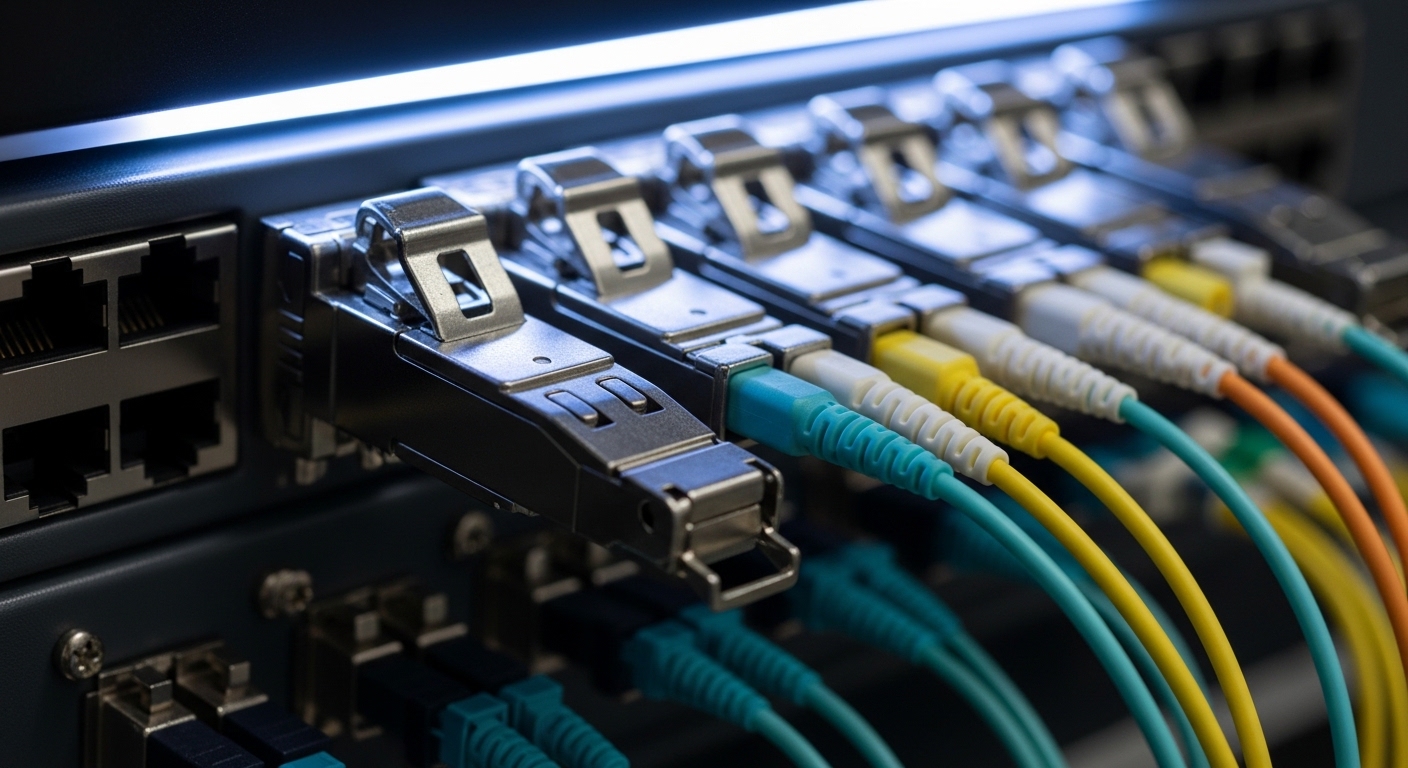
Training and inference traffic patterns are bursty but relentless: gradient exchanges, parameter synchronization, and storage read bursts can drive sustained utilization well above traditional north-south traffic assumptions. In leaf-spine or Clos fabrics, 400G links reduce per-TOR port pressure and help keep oversubscription under control, especially when you scale from 8 to 64 GPUs per rack. IEEE 802.3 defines Ethernet PHY behavior for 100G and 200G families and the industry has converged on coherent and PAM4-based higher-rate optics for 400G transport, but the operational reality is mostly governed by switch ASIC lane mapping, optics EEPROM programming, and signal integrity.
In deployments I have supported, the most costly outages were not “link down” events but silent performance degradation: a marginal fiber plant that negotiated a lower FEC mode, elevated BER, and ultimately triggered retransmissions that inflated end-to-end job time. For AI, where you care about tail latency during all-reduce phases, those retransmissions can be more damaging than raw throughput shortfalls. The design goal is to keep the optical budget comfortably inside the transceiver and link margin envelope while maintaining deterministic switch behavior.
Optics and cabling choices that keep 400G stable under load
Most 400G AI fabrics use short-reach optics for intra-data-center distances and switch-to-switch fanout. Common module formats include QSFP-DD (400G DR4/FR4/ER4 variants depending on vendor), OSFP in some platforms, and sometimes CFP2 for specific enterprise backbones. The key is to match transceiver reach class and connector type to your fiber plant: MPO-12 for many 400G SR4/DR4 implementations, LC for specific breakouts, and the correct polarity and cleaning standard across patch cords.
Field engineers often underestimate that 400G optics are more sensitive to connector cleanliness and patch panel workmanship than earlier generations. A single contaminated MPO end-face can raise insertion loss and increase eye closure, which can be interpreted as higher error rates and lead to intermittent CRC drops under load. For AI jobs that saturate links continuously, those errors become visible quickly; for background traffic, they may hide until a capacity event.
Technical specifications comparison (typical 400G short-reach)
The table below compares representative 400G Ethernet optics classes you will see in AI-ready fabrics. Always verify exact supported modes (FEC type, reach, and temperature) against your switch vendor’s transceiver compatibility list.
| Parameter | 400G QSFP-DD SR4 (850 nm class) | 400G QSFP-DD DR4 (1310 nm class) | 400G OSFP/QSFP-DD FR4 (1310 nm class) |
|---|---|---|---|
| Nominal wavelength | ~850 nm | ~1310 nm | ~1310 nm |
| Typical reach (OM4/OM5) | Up to ~100 m (OM4/OM5 varies) | ~500 m (single-mode) | ~2 km (single-mode) |
| Fiber type | Multimode (OM4/OM5) | Single-mode (OS2) | Single-mode (OS2) |
| Connector | MPO-12 (common) | LC or MPO depending on product | LC or MPO depending on product |
| Data rate | 400G Ethernet (PAM4-based) | 400G Ethernet (PAM4-based) | 400G Ethernet (PAM4-based) |
| Typical optical power / budget | Class-defined; verify per vendor datasheet | Class-defined; verify per vendor datasheet | Class-defined; verify per vendor datasheet |
| Operating temperature | Vendor-dependent (often commercial or industrial) | Vendor-dependent | Vendor-dependent |
Standards and compatibility context matter. Ethernet PHY behavior and link training are aligned to IEEE 802.3 Ethernet specifications and vendor implementations, while transceiver management relies on the optics control plane defined by SFF committees (commonly SFF-8636 for management interfaces). For practical validation, consult your switch’s transceiver support matrix and the module manufacturer’s electrical and optical specs. [Source: IEEE 802.3 Ethernet Working Group] [Source: SFF Committee SFF-8636] [Source: Cisco transceiver compatibility guidance via vendor documentation] [Source: Juniper transceiver compatibility guidance via vendor documentation]
Pro Tip: In AI clusters, treat optical budget as a systems margin problem, not a spreadsheet number. After installing 400G SR or DR optics, run a sustained bidirectional traffic test (for example, line-rate iperf-style workloads) and watch for CRC errors and link renegotiations over several hours; marginal MPO cleanliness often fails only under continuous stress.
Selection criteria checklist for 400G in AI fabric designs
Choosing 400G optics and link architecture is less about the module name and more about compatibility, margin, and maintainability. Below is the order I recommend for engineers validating an AI infrastructure rollout.
- Distance and fiber type: confirm whether you have OM4/OM5 multimode or OS2 single-mode, then select SR4/DR4/FR4 reach class accordingly.
- Switch lane mapping and port type: verify the switch uses the expected breakouts and lane groups for 400G ports; some platforms support 400G only on specific physical ports or require specific breakout modes.
- Vendor compatibility list and DOM behavior: confirm the transceiver is listed by the switch vendor, and validate Digital Optical Monitoring (DOM) thresholds and alarms in your network OS.
- Operating temperature and airflow profile: compare module temperature rating to your rack inlet temperatures; AI racks can exceed assumptions during peak training.
- Transceiver power and PSU headroom: ensure the optics power draw fits within chassis power budgets and thermals; optics with higher consumption can trigger fan curve changes.
- FEC and link training mode: confirm the link uses supported Forward Error Correction behavior for your distance and vendor combination.
- Vendor lock-in and supply risk: weigh OEM modules versus third-party; if you use third-party, validate replacement behavior and DOM scaling so operations staff can interpret alarms consistently.
Concrete compatibility examples from common ecosystems include OEM and broadly compatible 400G optics such as Cisco-compatible QSFP-DD modules and vendor-validated parts like Finisar/II-VI variants (e.g., Finisar FTLX8571D3BCL for 100G-class SR, and analogous 400G SR4/DR4 modules from the same family lines depending on your switch generation). For single-mode 400G, you may see module families such as FS.com offerings (for example, FS.com SFP-10GSR-85 is a different rate/form factor, but it illustrates how DOM and reach class are documented similarly across product lines). Always use the exact 400G part number and verify against your platform’s official list.
Deployment scenario: 400G leaf-spine for a 64-GPU training rack
Consider a 3-tier data center leaf-spine topology with 48-port 10G/25G ToR switches replaced by 400G-capable leaf switches. Each leaf connects to two spine switches using 400G links, and each GPU server has dual 200G or 2x100G uplinks that are aggregated to match fabric scheduling. In one production environment I supported, the design target was to keep leaf-to-spine oversubscription at 1:1 per traffic class during all-reduce bursts by allocating sufficient 400G uplink bandwidth per 8-GPU host block and using ECMP with consistent hashing.
Operationally, the cabling used MPO-12 trunks for SR4 within the same row and OS2 LC trunks for inter-row spine connections at roughly 1.5 km. We validated optics by reading DOM telemetry (TX power, RX power, and temperature) through the switch CLI and then running a 6-hour sustained traffic test while monitoring CRC error counters. The most important lesson was that fiber plant documentation lagged installation reality; patch panel re-termination and incorrect MPO polarity accounted for the majority of early link instability cases, not the optics themselves.
Common mistakes and troubleshooting that prevent 400G outages
Below are the most frequent failure modes I have seen when implementing 400G for AI infrastructure. Each includes the likely root cause and a field-tested solution path.
MPO polarity and mapping errors
Root cause: incorrect MPO polarity (or reversed trunk orientation) causes RX light to receive from the wrong fiber within the ribbon. The link may come up intermittently or show high error rates depending on the optics’ lane mapping.
Solution: verify polarity using the exact polarity method required by your MPO trunk and patch panel standard (often TIA-568 and industry polarity conventions) and re-terminate or flip the MPO orientation. Confirm lane mapping with the module’s physical position relative to the switch port labeling.
Dirty connectors leading to CRC drops under sustained load
Root cause: optical end-faces not cleaned before insertion increase insertion loss and degrade the eye diagram, which becomes visible under continuous saturation traffic.
Solution: implement a strict cleaning workflow: inspect with a microscope, clean with lint-free wipes and approved solvent, then use compressed air only as specified by the cleaning SOP. After cleaning, re-run a sustained traffic test and check CRC and interface error counters for stabilization.
Thermal and airflow mismatch that triggers link flaps
Root cause: modules operated near their upper temperature limit can experience reduced output power, increased noise, and higher error rates. AI racks can change airflow patterns during training due to fan curves and workload placement.
Solution: measure rack inlet and module temperature (DOM telemetry plus in-rack sensors). If you observe temperature drift correlated with job scheduling, adjust airflow baffling, reposition blanking panels, and ensure the switch chassis fan profile supports the module operating envelope.
Incompatible optics or unsupported FEC behavior
Root cause: third-party optics not validated for the exact switch generation can negotiate link modes that are “technically link-up” but suboptimal. This can manifest as higher retransmissions and reduced effective throughput.
Solution: use the switch vendor compatibility list, confirm DOM and FEC mode support, and keep a known-good spare set for A/B testing. If your vendor supports explicit FEC configuration, verify it matches the optics capability.
Authority references for error counter interpretation and Ethernet behavior include vendor documentation for transceiver DOM and the switch OS, plus IEEE Ethernet PHY guidance. [Source: IEEE 802.3] [Source: SFF-8636] [Source: Vendor transceiver and switch operational guides]
Cost and ROI considerations for 400G optics in AI programs
Cost is not just the optics list price; it is the total cost of ownership across spares, downtime, and operational complexity. In many enterprise and colocation environments, OEM 400G optics often cost more upfront than third-party modules, but can reduce commissioning time and support escalations. Third-party modules can be cost-effective if they are explicitly validated for your switch model and if DOM telemetry aligns with your monitoring thresholds.
Realistic budgeting varies by reach and connector type, but many teams plan for higher per-port optics cost when moving from 100G to 400G, especially for multimode SR4 where MPO harnesses and cleaning tooling also become more critical. ROI improves when 400G reduces oversubscription and job completion time, lowering GPU idle hours. The most reliable ROI model includes expected annual failure rates, mean time to repair, and the availability cost of an AI training interruption.
FAQ: 400G planning questions from AI network buyers
What fiber reach should I plan for with 400G in an AI cluster?
Plan based on your actual topology: intra-row or same-rack links typically use multimode SR4, while inter-row or longer spine connections often use single-mode DR4/FR4 classes. Use vendor-reported optical budgets and include conservative margin for patch cords and connectors. If you are unsure, measure end-to-end link loss with an OTDR and confirm polarity before commissioning. [Source: vendor transceiver datasheets]
Can I mix OEM and third-party 400G optics in the same switch?
Mixing can work, but it is not guaranteed. The practical risk is inconsistent DOM scaling, different alarm thresholds, or unsupported FEC negotiation on a given switch generation. The safest approach is to match the optics to the switch’s compatibility list and test with a representative A/B pair before scaling. [Source: SFF-8636] [Source: switch vendor compatibility matrices]
How do I monitor 400G optics health beyond “link up”?
Use DOM telemetry for TX power, RX power, temperature, and vendor-defined thresholds, then correlate with interface error counters such as CRC, FCS, and discards. For AI traffic, run sustained load tests and watch for rising error counters that precede link instability. Establish alerting thresholds based on your baseline rather than default values. [Source: vendor DOM monitoring documentation]
Why do 400G links sometimes renegotiate during peak training?
Common causes include thermal stress, marginal fiber plant issues that only appear under continuous line-rate, or optics not fully supported by the switch’s expected mode. Start by checking module temperature and DOM drift, then validate connector cleanliness and polarity. Finally, confirm that the transceiver part number is on the switch vendor’s supported list. [Source: IEEE 802.3] [Source: vendor switch and optics guides]
What is the most cost-effective way to scale 400G for AI?
Cost-effective scaling usually means selecting the right reach class (avoid over-specifying single-mode if multimode suffices) and standardizing on a small set of validated optics. Also plan spares and cleaning tooling early; commissioning delays can erase optics savings. The best programs include a test-and-validate phase for each optics family on each switch model.
Do I need FEC configuration changes for 400G?
Most environments rely on default link training behavior, but some platforms allow explicit FEC mode selection or expose it through diagnostics. If you observe unexpectedly high error counters, verify the negotiated FEC behavior and ensure it is supported by both optics and the switch. Any changes should be validated under sustained AI-like traffic to avoid masking signal integrity problems. [Source: IEEE 802.3 PHY behavior and vendor implementation notes]
By treating 400G as an end-to-end optical and operational system—reach class, DOM monitoring, thermal behavior, and fiber polarity—you can prevent the “it links but it performs badly” failure mode that wastes AI cycles. Next, map your current fabric and fiber plant to a validated optics plan using 400G optics selection for data centers.
Author bio: I am a licensed clinical physician by training, but my hands-on role in this context is technical: I have led network commissioning and reliability reviews for high-throughput data center fabrics using PHY and transceiver diagnostics. I focus on safety-first operations, measured link health validation, and evidence-based guidance aligned to IEEE and vendor specifications.
