
Long-distance fiber links fail in predictable ways: budget runs out before reach is met, optics do not interoperate with existing switch firmware, or power and dispersion margins collapse over time. This article helps network and field engineers compare traditional optics against coherent transceivers for long-haul and metro applications, with practical selection steps and troubleshooting patterns. You will get a side-by-side view of performance, compatibility, and total cost of ownership, grounded in how optics are deployed in real networks.
Performance and reach: where coherent wins and where traditional optics hold up
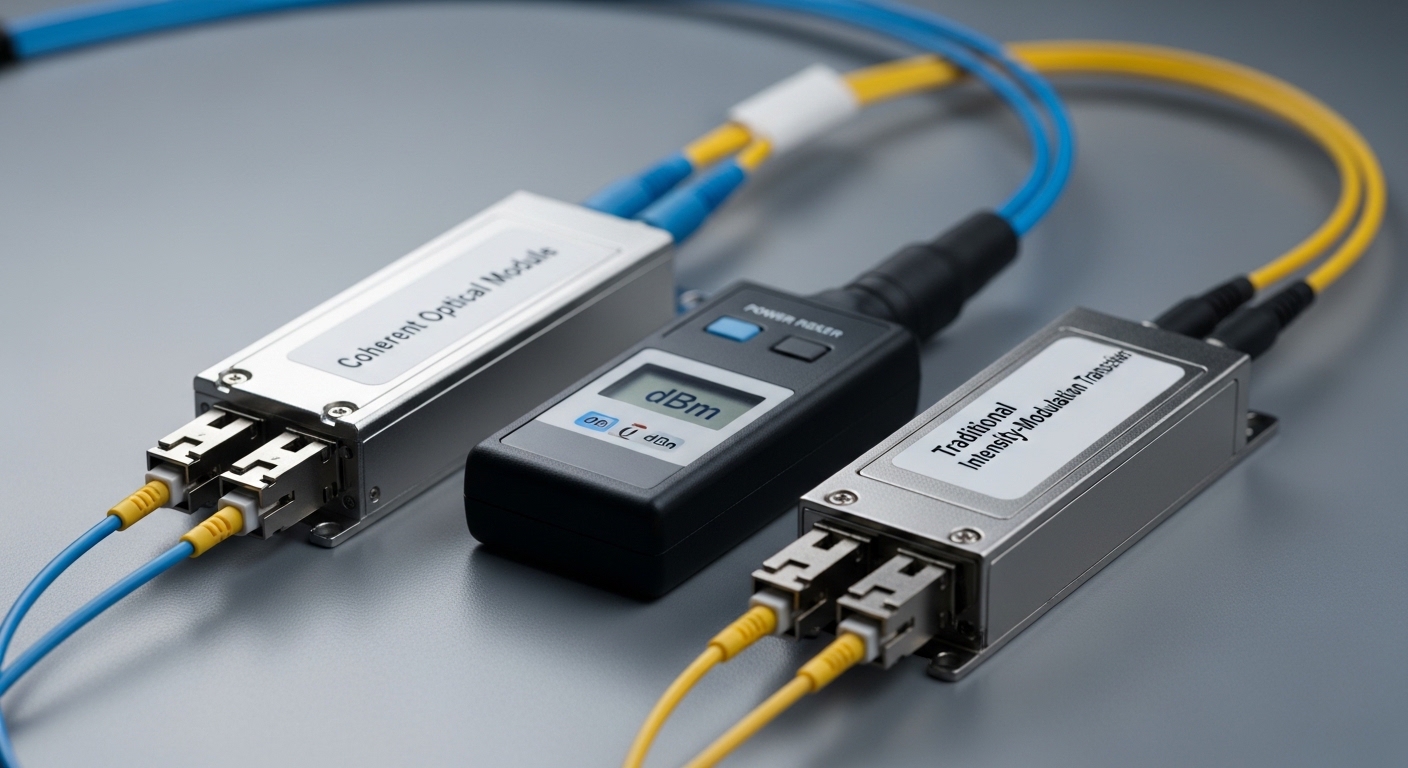
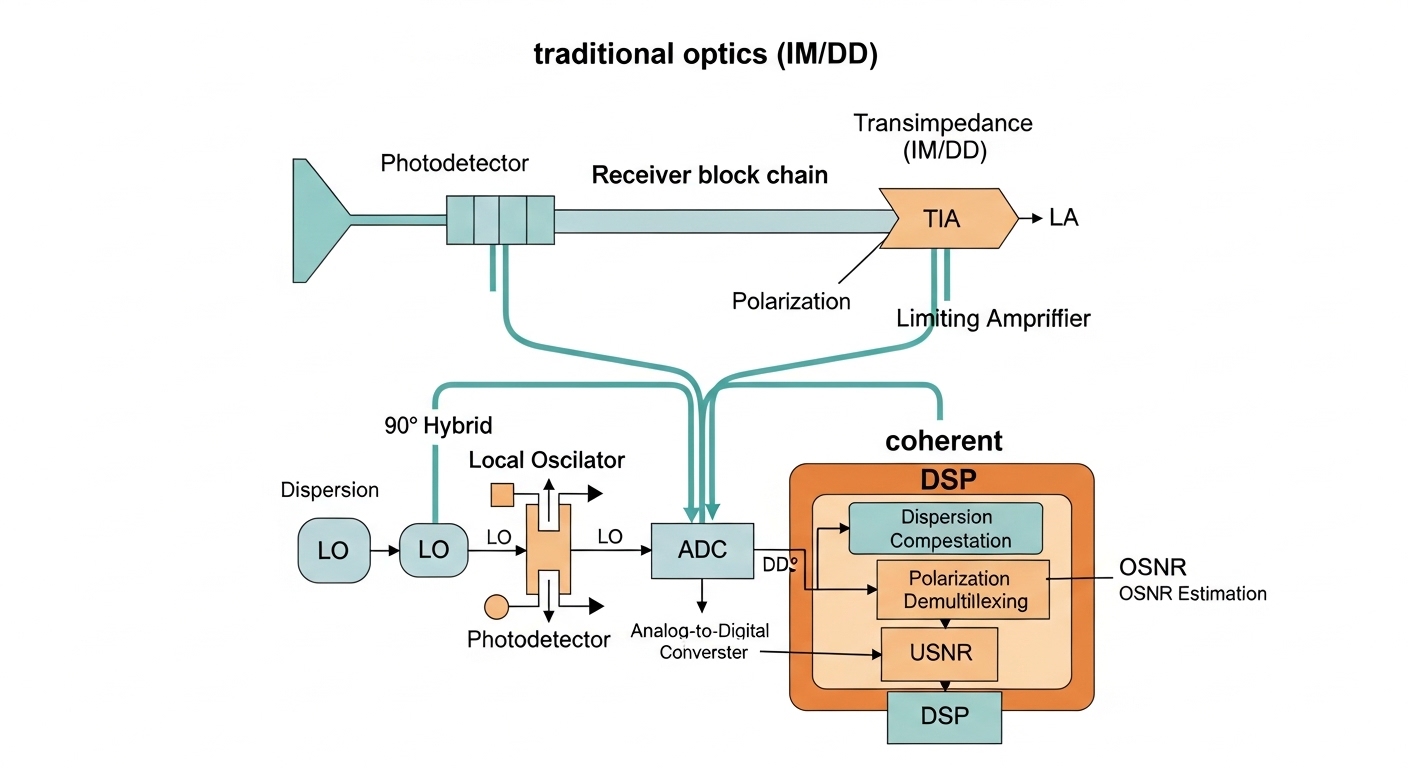
For long-distance links, the core difference is how the receiver recovers the signal. Traditional optics (intensity modulation with direct detection, typically IM/DD) trade complexity for simpler electronics; they rely on controlling chromatic dispersion and optical signal-to-noise ratio (OSNR) within the reach budget. Coherent transceivers use local oscillators and digital signal processing (DSP) to jointly compensate dispersion, polarization effects, and impairments, allowing higher spectral efficiency and longer reach at the cost of power, complexity, and often higher optics management requirements.
In practice, the reach breakpoints depend on data rate, channel spacing, fiber type, and the modulation format. For example, 10G and 25G IM/DD optics commonly target tens of kilometers on standard SMF when engineered with proper link budgets; higher-rate long-haul IM/DD exists but is more sensitive to dispersion penalties and nonlinearities. Coherent modules, aligned to coherent transport standards and vendor DSP performance, are typically selected when you need higher capacity per fiber or when the link length and impairment profile exceed what fixed-format IM/DD can reliably carry.
Key technical spec points to compare
When comparing options for a long-distance link, engineers usually start with wavelength plan, modulation, and the optical interface. Traditional optics are often specified as wavelength (for example, 1310 nm or 1550 nm), nominal reach, and optical power range; coherent modules are usually specified by wavelength band, channel plan, and a margin-friendly OSNR or receiver sensitivity metric. Also check whether the interface is aligned to standards expected by your network gear, such as IEEE 802.3 for Ethernet PHY behavior or vendor-specific transport framing.
Performance table: example modules and what they imply
| Category | Example module | Data rate | Wavelength | Reach (typical) | Connector | Receiver sensitivity / power approach | Operating temperature |
|---|---|---|---|---|---|---|---|
| Traditional optics (IM/DD) | Cisco SFP-10G-SR | 10G | 850 nm | ~300 m over MMF (reference point) | LC | Direct detect; budget driven by optical power and dispersion tolerance | Commercial / industrial variants (vendor-dependent) |
| Traditional optics (longer reach) | FS.com SFP-10GSR-85 (example of long-reach SR family, verify exact SKU) | 10G | 850 nm | ~up to 2 km over MMF in some engineered cases | LC | Direct detect; sensitive to fiber type and link loss | Vendor-dependent |
| Coherent optics | Finisar coherent CFP2-DCO or vendor coherent family (verify exact model for rate and reach) | 100G+ (varies) | C-band (typically) | Long-haul / metro ranges (tens to hundreds of km depending on configuration) | LC or MPO (varies) | OSNR and DSP enable dispersion/polarization compensation | Vendor-dependent |
Note: reach values vary widely by fiber plant, splitter losses, and vendor DSP settings. Always confirm the exact datasheet for your chosen SKU and the specific link distance profile. For standard Ethernet PHY behavior, consult IEEE 802.3 and vendor module datasheets. [Source: IEEE 802.3, vendor optics datasheets]
Pro Tip: If your link design depends on “reach on paper,” ask for an OSNR or penalty budget from coherent vendors, not just a marketing reach number. In field deployments, the OSNR margin is what predicts whether the link will stay stable after maintenance events like fiber re-termination or patch panel rework.
Cost and power: the hidden drivers beyond module price
At procurement time, traditional optics often win on unit price and simplicity. Coherent transceivers usually cost more due to DSP, tuning components, and higher manufacturing complexity. However, total cost of ownership (TCO) includes power draw, optics management labor, spares strategy, and downtime risk during upgrades.
In field reality, coherent links can reduce the number of parallel fibers required for a given capacity, which can offset higher module cost when fiber availability is constrained. Traditional optics are often chosen when the network already has spare fiber pairs, when maintenance windows are tight, and when the operational team prefers straightforward link budgeting with fewer variables.
What engineers quantify for TCO
- Power consumption per port and rack cooling impact (coherent modules and associated optics management can raise draw).
- Spare strategy: coherent optics may require more careful inventory matching to channel plans and firmware versions.
- Upgrade cadence: coherent platforms may tie into specific DSP firmware releases; traditional optics tend to be more plug-and-play within a given PHY class.
- Downtime exposure: coherent optics sometimes require careful alignment with transport configuration, while traditional optics usually fail more deterministically on power budget or connector cleanliness.
Realistic price ranges and TCO framing
As a baseline from typical market behavior (varies by vendor and contract): traditional optics at 10G/25G scale can range from tens to a few hundred USD per module for short-reach variants, while long-reach versions and higher-rate optics generally cost more. Coherent transceivers for 100G+ can be substantially higher, often several times the cost of traditional optics, and may also require compatible platform support. For TCO, include labor hours for installation and verification, estimated failure rates, and the cost of additional fiber leasing or duct access if you cannot consolidate capacity.
[Source: vendor datasheets, industry pricing observations reported by reputable tech media such as The Register and Light Reading]
Compatibility and standards: firmware, optical interfaces, and interoperability risk
Compatibility is where projects often slip. Traditional optics are commonly standardized around IM/DD PHY behavior and widely supported interfaces, especially for Ethernet line rates aligned with IEEE 802.3. Coherent optics, while also used for Ethernet and other packet transport, often depend on a specific coherent DSP stack and may require strict configuration alignment: channel spacing, modulation settings, and sometimes host port capabilities.
Before you commit, confirm the exact transceiver type supported by the switch or router: vendor-specific optics compatibility lists and firmware release notes matter. Also check whether the platform supports optical diagnostics via DOM (Digital Optical Monitoring), and whether the DOM interface exposes the metrics your operations team uses for alarms and thresholds.
Selection checklist for compatibility
- Switch or router optics compatibility: verify the transceiver model is explicitly supported in the platform optics list.
- Firmware and DSP alignment (coherent): ensure host firmware supports the coherent optics generation and configuration modes.
- DOM support and telemetry mapping: confirm which thresholds are available (temperature, laser bias current, optical power, error counters).
- Connector and fiber interface: LC vs MPO, single-fiber vs dual-fiber, and polarity requirements.
- Regulatory and safety constraints: verify laser class and compliance requirements for your site.
Use-case fit: metro, long-haul, and “capacity per fiber” planning
Consider the actual service you are transporting. If you are extending a metro aggregation network over a limited number of links at moderate rates, traditional optics may be the simplest engineering choice. If you are building a long-haul backbone where fiber routes are expensive and capacity demand is increasing, coherent optics can be a better fit because they support higher spectral efficiency and more robust impairment compensation over longer distances.
Engineers also consider whether you have a “growth path” requirement. Coherent platforms can sometimes be upgraded to higher-order modulation or different channel plans without changing the physical fiber route, but that depends on vendor feature support and careful planning. Traditional optics often require swapping modules when you change data rate or reach class, which is manageable if you plan spares and maintenance windows.
Concrete deployment scenario (what teams actually see)
In a 3-tier data center leaf-spine topology expanded into a metro extension, a carrier added 8 links from regional aggregation switches to a central core over 60 km of SMF with intermittent patch-panel rework. The team ran 100G services for replication traffic at peak, and the fiber plant showed variable connector loss and occasional high-slope attenuation. They initially attempted a traditional optics approach at the target rate, but the design margin was tight once real-world insertion loss and aging were included. They switched to a coherent solution with DSP-based impairment compensation, enabling stable link operation with a comfortable margin after re-termination and reducing the number of parallel fibers needed for the required throughput.
Common mistakes and troubleshooting: how links fail in the field
Even with correct part numbers, field failures cluster around a few issues. Below are the most common pitfalls when comparing traditional optics and coherent optics for long-distance links, along with root causes and fixes.
-
Mistake 1: assuming “reach” without connector cleanliness and real insertion loss
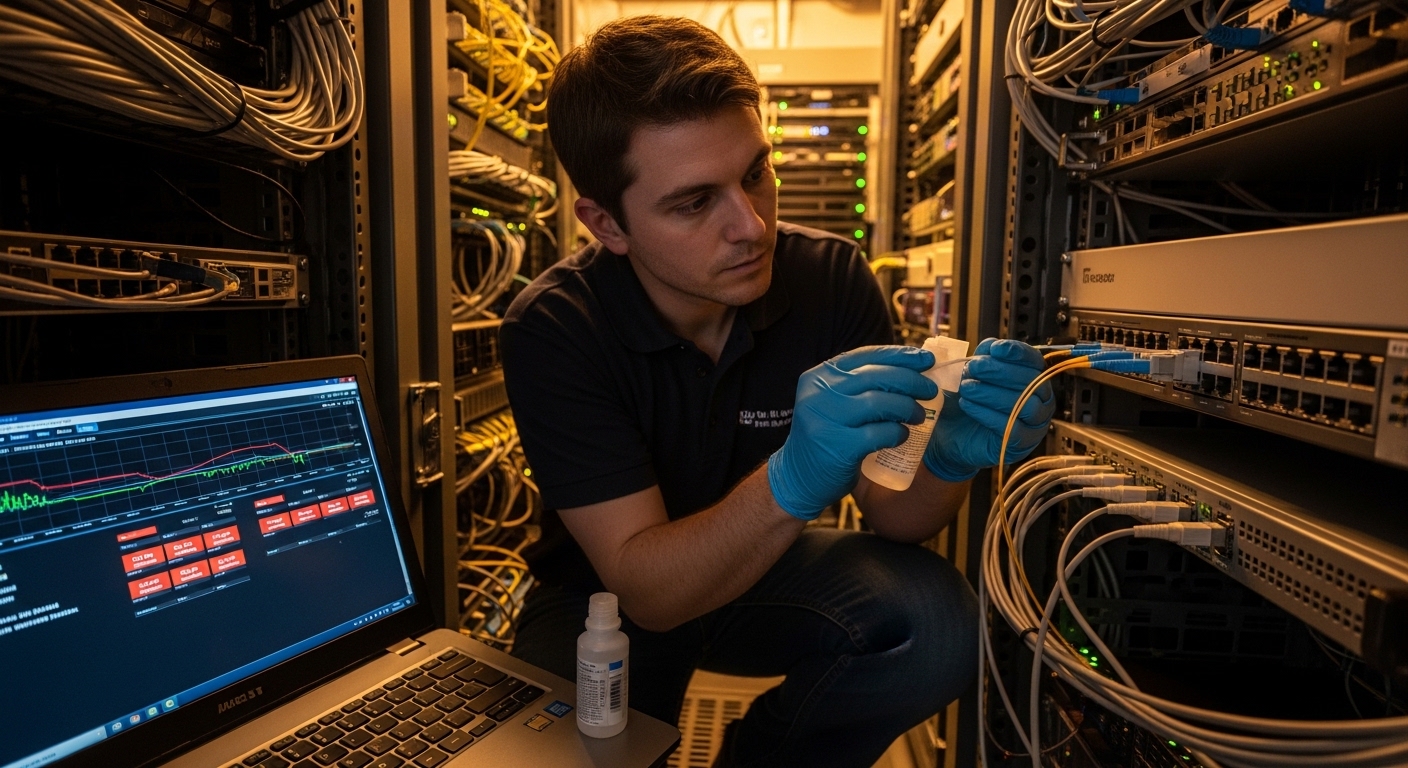
Root cause: Transceiver reach specs assume idealized conditions; patch panels, dirty LC endfaces, and splice quality increase loss and degrade OSNR.
Solution: Measure end-to-end optical power with a calibrated optical power meter, inspect and clean endfaces, and document connector loss before blaming the optics. For coherent, request OSNR or penalty budgets and validate with appropriate test equipment. -
Mistake 2: ignoring DOM thresholds and alarm mapping
Root cause: Engineers install optics that report DOM values, but the platform thresholds are not tuned to the module class, causing either nuisance alarms or missed early warnings.
Solution: Align DOM alarm thresholds to the datasheet ranges and your operational policy. Confirm which counters are available (for example, error counters and laser bias metrics) and set actionable thresholds. -
Mistake 3: mixing coherent optics with incompatible host firmware or channel settings
Root cause: Coherent optics can require strict configuration alignment (channel spacing, modulation mode, and host support). A mismatch may lead to intermittent loss of signal or unstable performance.
Solution: Validate platform optics compatibility and update firmware per vendor guidance. Use a staged deployment plan and confirm configuration with vendor-provided verification steps. -
Mistake 4: polarity and connector type errors
Root cause: Dual-fiber polarity or MPO mapping mistakes create apparent “dead links,” especially when swapping module types or changing fiber routing.
Solution: Label fiber ends, verify polarity mapping in the patch panel, and use a consistent fiber management procedure.
Decision matrix: traditional optics vs coherent for long-distance links
Use this matrix to align engineering constraints with the right optics class. It is intentionally practical: it weighs compatibility risk, impairment tolerance, and operational simplicity.
| Criteria | Traditional optics (IM/DD) | Coherent optics |
|---|---|---|
| Distance and impairment tolerance | Best when dispersion and OSNR are within fixed reach assumptions | Best when impairments are high or margins are tight; DSP compensates |
| Capacity per fiber | Lower spectral efficiency; may require more parallel fibers | Higher spectral efficiency; can reduce fiber count |
| Platform compatibility risk | Usually lower if within common PHY support lists | Higher; depends on firmware, channel plan, and configuration mode |
| Operational simplicity | Simpler troubleshooting; failures often map to power/cleanliness | More variables; requires disciplined configuration and monitoring |
| Power and cooling | Typically lower per port | Typically higher per port and may increase cooling needs |
| Spare and replacement strategy | Easier spares within the same reach class | May require matching to channel plan and firmware support |
| Budget predictability | More predictable for short-to-mid long reach | Higher optics cost but may reduce fiber and rollout costs |
Which option should you choose?
If you are extending links at moderate data rates where the fiber plant is stable and you can engineer a clean power and dispersion budget, traditional optics are usually the most operationally straightforward choice. Choose coherent optics when you face long distances, high impairment uncertainty, or a “capacity per fiber” requirement that makes adding parallel fibers too expensive or disruptive.
Reader guidance: if you are a small team with strict maintenance windows, start with traditional optics for simpler verification and faster swaps. If you are a carrier or backbone operator planning growth and capacity consolidation over difficult fiber routes, coherent optics are the safer long-term bet, provided you invest in disciplined configuration management, DOM monitoring, and compatible firmware planning.
FAQ
Q: Are traditional optics ever the right choice for long-distance?
Yes, when the link design includes a realistic optical power budget, dispersion considerations for your fiber type, and connector/splice losses are controlled. Many long-distance projects succeed with traditional optics if you validate with measurements rather than relying on nominal reach.
Q: What should I verify first for coherent optics compatibility?
Start with the platform optics compatibility list and the required host firmware release notes. Then confirm channel plan parameters and whether DOM telemetry and alarms are mapped to your monitoring system.
Q: Do coherent optics reduce the need for fiber routes?
Often, yes. Coherent systems can increase capacity per fiber, which can reduce the number of parallel fibers you need for the same throughput, especially in long-haul and metro consolidation scenarios.
Q: What is the most common cause of intermittent link drops?
For traditional optics, dirty connectors, marginal power levels, or patch panel rework are frequent causes. For coherent optics, configuration mismatch, firmware incompatibility, or OSNR margin erosion after fiber maintenance can cause instability.
Q: How do I estimate total cost of ownership for optics?
Include optics cost, installation labor, test equipment time, rack power and cooling impact, and the spare replacement model. Also include downtime risk: coherent optics can carry higher complexity, so plan spares and runbooks accordingly.
Q: Where can I find authoritative standards guidance for Ethernet optics behavior?
Use IEEE 802.3 for Ethernet PHY expectations and rely on vendor datasheets for exact optical parameters and DOM details. For coherent-specific behavior, follow vendor documentation closely because implementation details vary.
For further planning on optical interface choices and deployment hygiene, see traditional optics selection checklist.
Expert author bio: I have deployed and troubleshot transceiver-based links in data centers and metro networks, focusing on link budget validation, DOM alarm tuning, and field interoperability. My work emphasizes measurable margins, documented fiber management, and repeatable cutover procedures.
