
AI training and inference clusters stress the interconnect more than classic enterprise traffic. When you map workloads onto leaf-spine fabrics, you quickly discover that choosing SFP+ or QSFP+ affects port density, cabling, transceiver power, and even failure domains. This article helps data center and telecom engineers pick the right pluggable optics for GPU clusters, 5G fronthaul aggregation, and high-throughput backhaul designs.
Why AI/ML fabrics care about SFP+ versus QSFP+
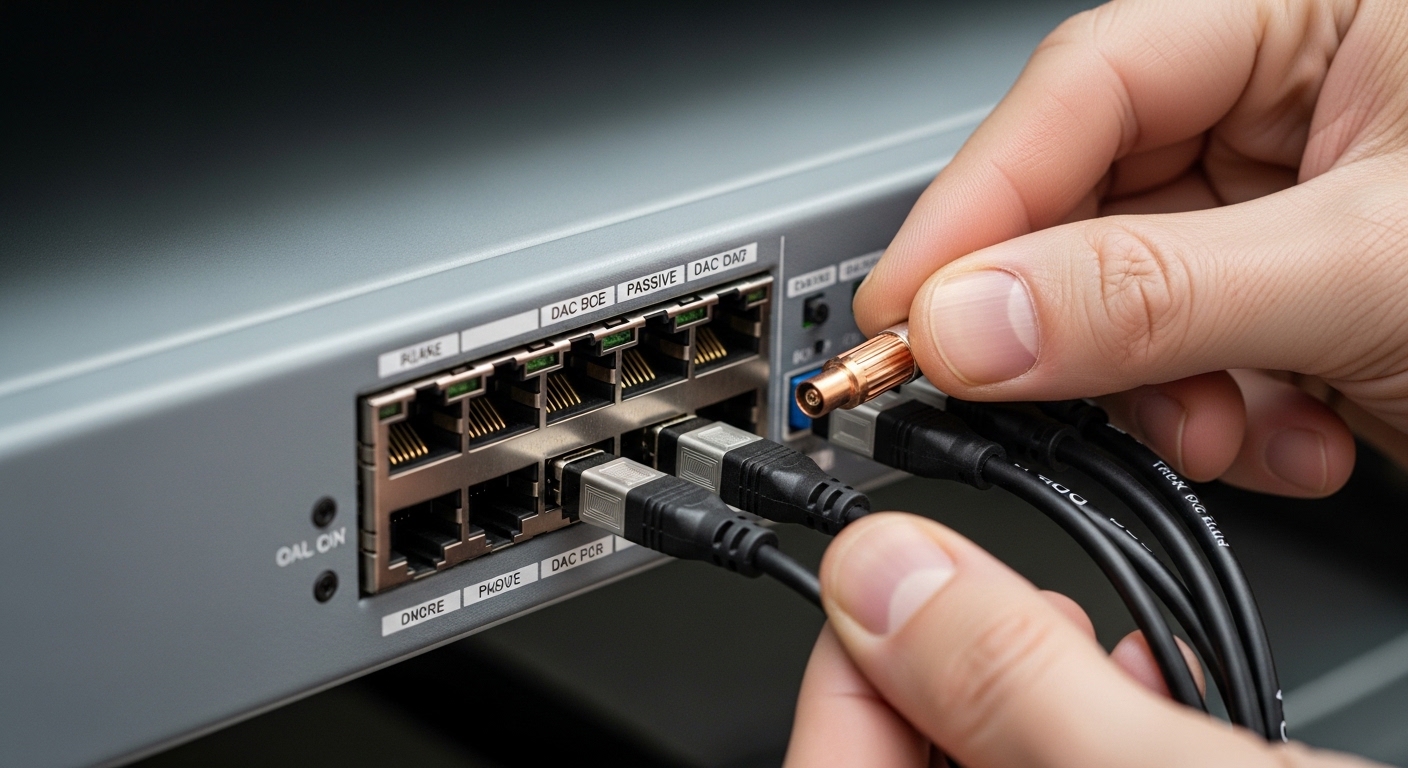
Both SFP+ and QSFP+ are widely deployed optical interfaces, but they differ in lane count and effective bandwidth per physical port. SFP+ typically carries 1x10G electrical lanes, while QSFP+ aggregates 4x10G lanes into a 40G interface. In AI/ML, the choice changes how many switch ports you consume for a target bisection bandwidth and how much power you draw from the top-of-rack (ToR) and leaf switches.
From an optics perspective, both form factors support short-reach multimode (MMF) and long-reach single-mode (SMF) variants. However, the practical “reach you actually get” depends on transceiver class, fiber type, and link budget, including connector loss and patch cord quality. Engineers often validate with vendor link budgets and then verify with optical power measurements after installation.
Operationally, QSFP+ can reduce the number of switch ports required for a given throughput, but it may increase per-port complexity in cabling and optics inventory. In contrast, SFP+ provides finer-grained scaling: you can populate only what you need per rack without committing to 40G per uplink.
Electrical and optical fundamentals that drive the trade-off
At the physical layer, SFP+ uses a smaller footprint and a single 10G lane set. QSFP+ uses a larger housing and supports four lanes that are typically mapped to a 40G data path by the switch ASIC. In most modern AI fabrics, this impacts how you design oversubscription ratios and how you place uplinks between tiers.
For optics, the industry aligns with IEEE Ethernet specifications and common optical class definitions. For 10GBASE-SR and related Ethernet PHY behaviors, engineers reference IEEE 802.3 clause sets and vendor datasheets for exact reach and signaling. For pluggable management, you should also check whether your switch supports DMI/DOM (Digital Diagnostics Monitoring) and whether it expects a particular DOM implementation.
| Parameter | SFP+ (typical) | QSFP+ (typical) |
|---|---|---|
| Nominal data rate per port | 10G | 40G |
| Lane structure | 1x10G electrical lane | 4x10G electrical lanes (mapped to 40G) |
| Common optics types | SR (MMF), LR/ER (SMF) | SR (MMF), LR/ER (SMF) |
| Typical connector | LC (MMF/SMF variants) | LC (MMF/SMF variants) |
| Typical SFP+ reach example | ~300 m SR on OM3, ~400 m on OM4 (varies by vendor) | ~100 m SR on OM3, ~150 m on OM4 (varies by vendor) |
| Transceiver power (order of magnitude) | ~0.9 to 1.7 W (depends on SR vs LR) | ~3 to 4.5 W (depends on SR vs LR) |
| DOM / diagnostics | Commonly supported (check switch compatibility) | Commonly supported (check switch compatibility) |
| Operating temperature | Typically 0 to 70 C or industrial variants | Typically 0 to 70 C or industrial variants |
Because AI links are often numerous and short, power and thermal behavior are non-trivial. A 40G uplink using QSFP+ may cost more watts per transceiver, but it can reduce the number of physical ports and sometimes overall optics count for the same aggregate throughput. The “best” choice depends on your switch port map and how your cabling plant scales.
Deployment math for AI/ML clusters: where each wins
In AI/ML, you often target specific oversubscription ratios and consistent east-west traffic patterns. Suppose you run a leaf-spine design where each GPU server needs sustained throughput for gradient exchange and parameter synchronization. If your leaf has 48 or 64 downlink ports, selecting optics that maximize usable uplink bandwidth can reduce oversubscription and improve tail latency.
Scenario: GPU leaf-spine with mixed uplink density
In a 3-tier data center leaf-spine topology with 48-port 10G ToR switches, a common approach is to use SFP+ for server downlinks (10G NICs or 10G breakout from higher-speed NICs) and aggregate uplinks. If you have 8 uplinks at 10G each, you get 80G per leaf. If instead your uplink hardware supports 40G QSFP+ interfaces, you might use 2 uplinks at 40G each to reach 80G with fewer physical optics.
Now consider power and cabling. If your QSFP+ SR optics draw ~4 W each and your SFP+ SR optics draw ~1.5 W each, two QSFP+ optics consume ~8 W while eight SFP+ optics consume ~12 W. The difference matters when you scale to hundreds of leaves. However, QSFP+ SR reach on OM3 may be shorter than SFP+ SR reach depending on vendor and optics class, so you must validate patch cord lengths and transceiver type.
For longer reach between rooms or across aisles, both form factors can use SMF LR/ER optics, but the cost per transceiver can rise quickly. In practice, engineers often standardize on one optics class per tier (for example, MMF SR within a row, SMF LR between rows) to simplify inventory and reduce mis-match risk.
Pro Tip:
In many switch platforms, QSFP+ ports can share lane resources with other physical ports. Before you decide “40G equals fewer ports,” verify the port bifurcation map in the switch datasheet; otherwise, enabling QSFP+ on one slot can silently disable adjacent SFP+ ports, forcing a worse overall uplink layout.
Selection criteria and decision checklist
Choosing between SFP+ and QSFP+ is not just about bandwidth. Engineers weigh link budget, switch port mapping, optics availability, and operational constraints like maintenance windows and spares stocking.
- Distance and fiber type: confirm MMF grade (OM3 vs OM4) or SMF span length; validate vendor reach and worst-case link budget including connectors and patch cords.
- Switch compatibility and port breakout rules: check whether QSFP+ uses lane sharing and whether SFP+ and QSFP+ coexist as expected.
- DOM support and monitoring: confirm the switch accepts DOM and that you can read temperature, bias, and optical power thresholds for alarm automation.
- Operating temperature and airflow: ensure transceivers stay within rated temperature under maximum load; AI racks can elevate ambient near the top of rack.
- Power budget and thermal density: estimate watts per link and per chassis; compare transceiver count for the same aggregate bandwidth.
- Vendor lock-in risk: verify whether third-party optics pass compatibility checks; test in a staging rack and record alarm behavior.
- Inventory strategy and failure domain: QSFP+ failures can remove 40G capacity at once; SFP+ failures may be smaller but more frequent in count.
For concrete optics examples, many engineers source known-good parts such as Cisco-branded or OEM-validated optics and third-party modules with documented compatibility. Examples include Cisco SFP-10G-SR and Finisar FTLX8571D3BCL for common 10G SR use cases, and FS.com variants like FS SFP-10GSR-85. Always cross-check exact wavelength, DOM type, and compliance mode with your switch.
Common pitfalls and troubleshooting tips in the field
Even when optics are “compatible,” real deployments fail in predictable ways. Below are common mistakes that field engineers see during AI cluster bring-up and subsequent maintenance.
Pitfall 1: Link works on day one, then degrades with temperature
Root cause: marginal optics bias current or insufficient airflow causes elevated laser temperature, shifting optical power and triggering link flaps. This is more likely with higher-density QSFP+ deployments where transceivers cluster near hot zones.
Solution: measure DOM values (temperature and received power) during peak load; compare to vendor thresholds; improve airflow with baffles and confirm the switch fan profile is correct.
Pitfall 2: Wrong fiber grade assumption (OM3 vs OM4)
Root cause: engineers assume “SR equals 300m,” but patch cords may be OM3 while the design budget expects OM4, or vice versa. Connector cleanliness and added splice loss further reduce margin, especially for QSFP+ SR where vendor reach can be shorter.
Solution: verify fiber type at the MPO/LC termination points, inspect cleanliness, and re-run link validation with conservative margins. Use an optical power meter and, if available, an OTDR for troubleshooting.
Pitfall 3: QSFP+ lane sharing disables neighboring ports
Root cause: port bifurcation rules can disable adjacent SFP+ ports when a QSFP+ port is populated in a certain slot. This creates “mystery missing links” during cabling changes.
Solution: consult the switch port mapping table before installing optics; document enabled ports in the change ticket; confirm link state after every transceiver swap.
Pitfall 4: DOM alarms but traffic still passes
Root cause: some third-party optics report DOM fields differently or use threshold defaults that trigger warnings. The link may pass, but monitoring systems can page operators unnecessarily.
Solution: align threshold configuration with the optics vendor’s DOM behavior; if the switch supports it, lock alerts to calibrated thresholds rather than generic defaults.
Cost and ROI considerations for AI/ML interconnect planning
Cost is more than the transceiver sticker price. Typical street pricing varies by vendor, but engineers often see SFP+ SR modules priced noticeably lower than QSFP+ SR modules, while SMF LR/ER modules cost more due to tighter optical requirements and optics complexity.
Example TCO thinking: if QSFP+ optics reduce optics count by 4x for the same aggregate uplink bandwidth, you may reduce replacement inventory and reduce incremental power. However, higher per-transceiver cost can increase the financial impact of a single failure if your design relies heavily on a small number of QSFP+ uplinks.
In AI clusters, also account for operational cost: downtime during optics swap, time spent validating DOM alarms, and the risk of incompatibility when using non-OEM optics. A pragmatic strategy is to buy a small batch of any new third-party model, test it for stability over multiple temperature cycles, and confirm alarm behavior in your monitoring stack before scaling.
FAQ
Is SFP+ sufficient for most AI/ML east-west traffic?
Often yes for early-stage deployments or when GPU NICs are 10G. But if your workload demands high bisection bandwidth, QSFP+ 40G can reduce oversubscription by increasing per-uplink throughput while using fewer ports. Validate with traffic engineering and measure tail latency during a benchmark.
Which is better for maximizing port density on a switch?
QSFP+ typically offers better aggregate throughput per physical port slot because each QSFP+ carries four 10G lanes. However, check the switch’s port bifurcation map; QSFP+ may disable adjacent SFP+ ports, reducing effective density if you do not plan the layout.
Do I need to worry about DOM compatibility?
Yes. Many operators rely on DOM telemetry for proactive failure detection and automated ticketing. Confirm your switch supports the transceiver’s DOM implementation and that threshold alarms behave correctly with your chosen optics model.
How do I choose between MMF SR and SMF LR for AI racks?
If your spans are within a row and you have properly installed OM3/OM4 cabling, MMF SR is usually cost-effective and fast to deploy. Use SMF LR/ER for longer distances between rooms or across structured cabling pathways where link budget margin for MMF is uncertain.
Are third-party SFP+ or QSFP+ optics safe to deploy?
They can be safe when the vendor provides compatibility documentation and you validate in a staging environment. The key risks are DOM differences, transceiver compliance modes, and occasional optics that pass link but misreport telemetry or trigger alarms.
What troubleshooting step should I do first when links won’t come up?
Start with physical and mapping checks: confirm the correct port type is enabled, verify cabling polarity and connector cleanliness, and validate the port bifurcation rules for QSFP+ deployments. Then check DOM for optical power and temperature to distinguish between fiber loss and transceiver health issues.
In AI/ML networks, SFP+ and QSFP+ are both viable, but the “right” choice depends on distance, switch port mapping, power/thermal density, and optics reach margins. If you are standardizing a multi-tier fabric, the next step is to align optics choice with your cabling plant and uplink oversubscription targets via 5G fronthaul backhaul optics planning.
Author bio: I have deployed and troubleshot SFP+ and QSFP+ optics across leaf-spine fabrics and aggregation layers, validating DOM telemetry and link budgets in production. My work spans DWDM and PON-adjacent transport designs, with a focus on operational reliability and compatibility testing.
