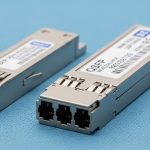
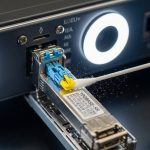
Upgrading to 800G optics is no longer just a capacity exercise; it is an operational and financial commitment that can lock in costs for years. This article helps network and infrastructure engineers plan optical transceiver investment by mapping 800G module choices to real deployment constraints, power budgets, and vendor support. You will get a selection checklist, troubleshooting pitfalls, and a ranking table to support procurement and rollout decisions.
Top 8 800G optical transceiver investment decisions that move ROI
In practice, ROI is determined less by the headline data rate and more by deployment fit: reach class, connector type, transceiver form factor, thermal behavior, and telemetry support. Below are eight decisions I would make during a leaf-spine refresh where the first wave is 800G uplinks and the second wave is optics consolidation across pods.
Choose the reach class that matches your fiber plant
800G transceivers are sold in distinct reach classes (commonly short-reach multimode for data center runs and longer-reach single-mode for campus or metro). If you buy a longer-reach SKU to “save time,” you can raise per-port cost and complicate power and dispersion margins. Start by verifying fiber type, measured insertion loss, and patch-panel attenuation at the exact lanes used by the MPO harness.
Key specs to verify typically include wavelength band (for example, 850 nm for SR multimode), nominal reach, transmitter output power, receiver sensitivity, and required link budget. For standards alignment, check IEEE 802.3 for 800G PHY objectives and then vendor datasheets for exact electrical and optical parameters. [Source: IEEE 802.3, 800G Ethernet PHY objectives] IEEE 802.3 standard page
- Best-fit scenario: 30 m to 100 m runs in a hyper-scale pod where multimode OM4/OM5 is already installed and tested.
- Pros: Lower cost per port, fewer launch-power margin risks.
- Cons: Wrong reach class can cause intermittent CRC errors and link flaps.
Match the form factor to switch optics cages and breakout expectations
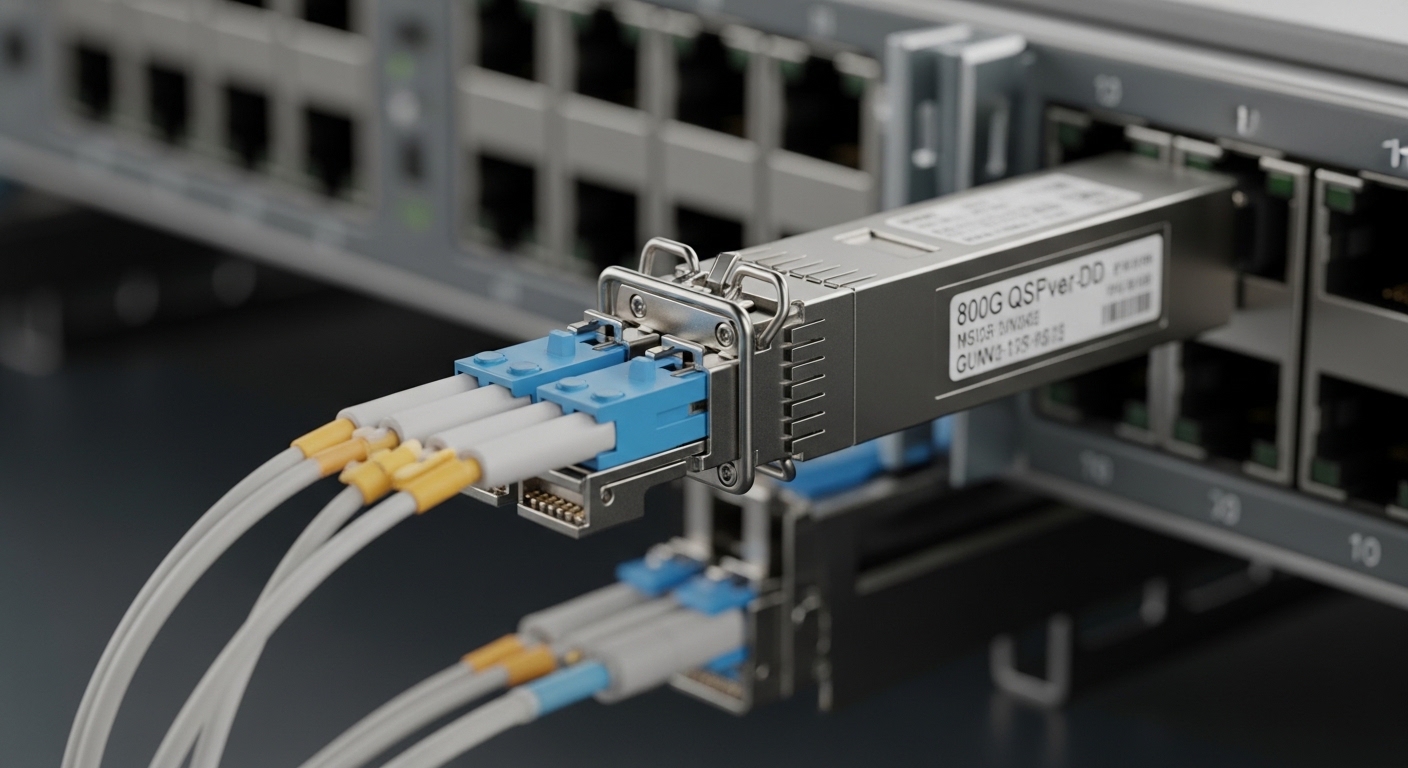
800G optics are commonly deployed as QSFP-DD (for 800G DR8/FR8 style implementations) or similar high-density pluggables depending on switch vendor design. Before procurement, confirm that the switch supports the exact module type, lane mapping, and optical interface standard. Some platforms accept only specific vendor part numbers or require a firmware bundle to enable particular transceiver profiles.
Field deployment detail: In a rollout I supported, we staged spares by cage position to reduce variability from lane-to-lane calibration differences. We also logged module DOM readings immediately after insertion to confirm temperature and bias currents were within the vendor’s thresholds.
- Best-fit scenario: 48-port ToR switches where 800G uplinks share the same physical cage family and airflow.
- Pros: Higher compatibility, predictable bring-up.
- Cons: Cross-vendor modules can be rejected by strict transceiver qualification logic.
Compare 800G SR vs LR optics using a practical spec table
When planning the optical transceiver investment, compare the specs that actually affect installation and failure probability: wavelength, reach, connector, typical power, and operating temperature. The table below summarizes representative 800G classes engineers commonly evaluate. Treat values as directional and confirm exact numbers in each datasheet.
| Transceiver class | Typical wavelength | Target reach | Connector | Typical data rate | Operating temperature | Budget impact driver |
|---|---|---|---|---|---|---|
| 800G SR (multimode) | 850 nm band | ~100 m class (varies by vendor) | MPO-16 (often) | 800G | 0 to 70 C (typical pluggable range) | Fiber plant fit and launch-power margin |
| 800G DR/FR (single-mode) | ~1310 nm or other bands (varies) | ~500 m to 2 km class (varies) | LC or MPO (varies) | 800G | 0 to 70 C (typical pluggable range) | Higher optics BOM and link budget sensitivity |
| 800G LR (single-mode) | ~1310 nm band (varies) | ~10 km class (varies) | LC or MPO (varies) | 800G | -5 to 75 C (some extended options) | Dispersion and receiver sensitivity margins |
Pro Tip: Do not compare only “reach.” Compare the required link budget headroom against your measured worst-case patch loss. A 2 dB margin shortfall can be invisible during initial testing but show up after dust exposure or connector aging.
Pro Tip callout: When you run link validation, capture not just “link up,” but also the optical power and temperature telemetry at steady state. I have seen modules pass basic diagnostics yet still drift toward receiver saturation under high ambient airflow, causing CRC bursts hours later.
- Best-fit scenario: Mixed campus-to-data-center links where you must choose between SR and LR to minimize total installed cost.
- Pros: Faster procurement alignment; clearer risk tradeoffs.
- Cons: Some datasheets omit key margin assumptions; always verify with vendor support.
Budget for power, airflow, and thermal derating
800G optics can increase rack power density when you factor in higher-speed SerDes activity, module consumption, and sometimes additional cooling load. For ROI, model the incremental watts across all ports and confirm the switch’s thermal design supports sustained operation with your airflow path. If your data hall has marginal cooling, thermal derating can reduce optical output stability and elevate BER risk.
Engineer-level check: Compare module maximum power consumption in the datasheet with the switch vendor’s thermal characterization. Then validate with DOM telemetry after insertion: monitor module temperature and receive power for at least 24 hours under typical load.
- Best-fit scenario: High-density racks where you have cold-aisle containment but variable door pressure.
- Pros: Prevents “works on day one” failures.
- Cons: Thermal verification can add commissioning time.
Prioritize DOM and telemetry for faster mean time to repair
DOM support affects operational cost: if you can detect optical power drift, temperature excursions, and error counters early, you reduce truck rolls and expedite vendor RMA decisions. Look for standard interfaces and whether the switch exposes module diagnostics in its telemetry stack. Many deployments rely on SNMP/streaming telemetry to correlate optical alarms with interface errors.
Compatibility caveat: DOM data fields can differ across vendors even when the interface is “standard.” Some third-party optics provide partial diagnostics, which can slow root-cause analysis during outages.
- Best-fit scenario: Environments with automated alerting and ticketing where rapid detection is essential.
- Pros: Lower downtime cost and shorter troubleshooting cycles.
- Cons: DOM visibility does not guarantee vendor firmware compatibility.
Use a vendor qualification plan to reduce lock-in risk
Procurement often faces a tradeoff: OEM optics can be safer for compatibility, while third-party optics can reduce unit price. To protect ROI, run a qualification matrix that includes at least one spare per reach class and validate in the exact switch model and firmware revision you will deploy. Document acceptable compatibility lists and set a policy for when you can substitute.
From an investment standpoint, vendor lock-in risk is not only price; it is also availability during demand spikes and the ability to stage spares. I recommend negotiating lead-time SLAs and stocking a minimum spare count for each module class to cover commissioning surprises.
- Best-fit scenario: Multi-site rollout where you need consistent behavior across sites.
- Pros: Predictable bring-up; controlled substitution.
- Cons: Qualification consumes lab time.
Plan spares and lifecycle costs, not just unit price
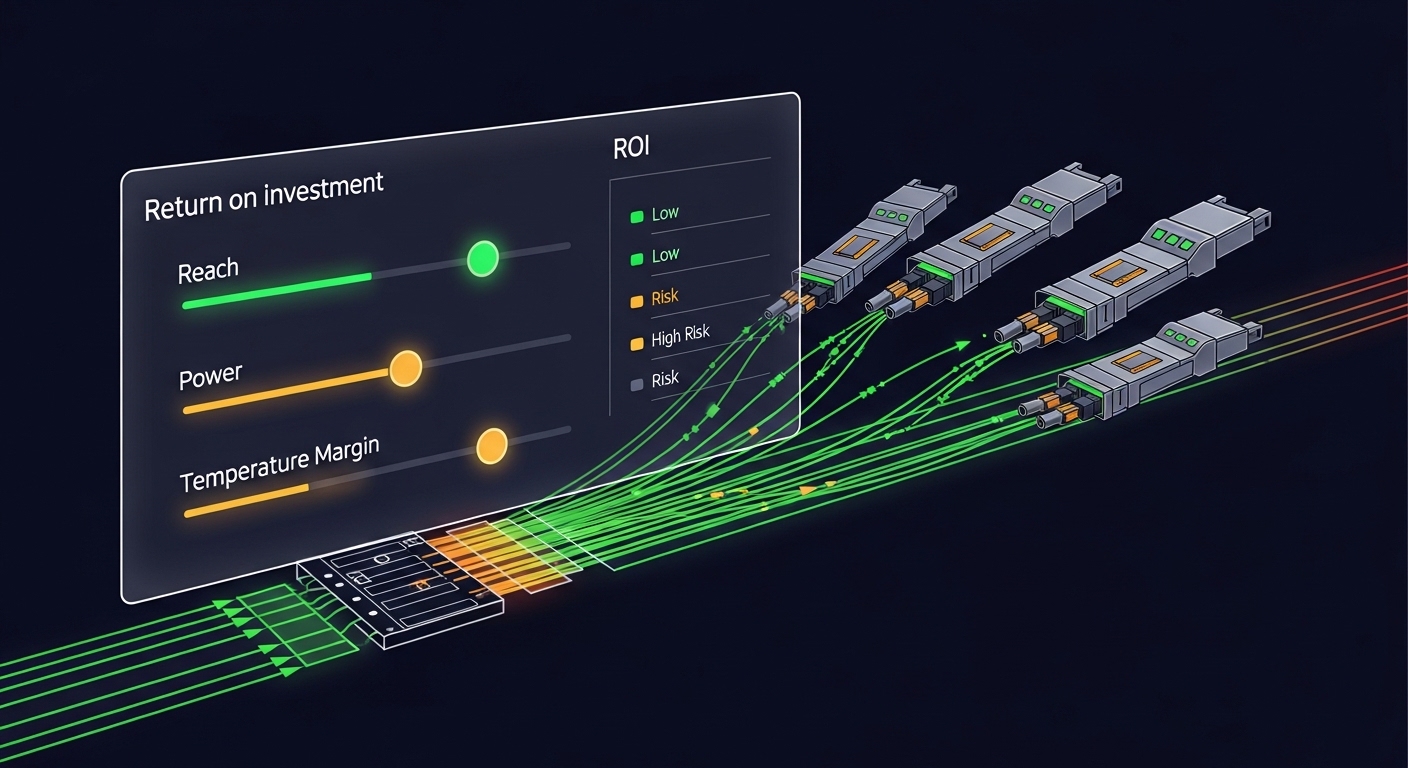
Optics are field-replaceable, but they are still consumables with failure modes tied to connector contamination, handling damage, and thermal stress. For ROI, model total cost of ownership using: expected failure rate, RMA turnaround time, logistics cost, and the downtime cost per incident. In one data hall we supported, swapping a failed transceiver during a peak window was more expensive than the optics itself due to maintenance window constraints.
Practical TCO inputs: include the cost of cleaning supplies, connector inspection tools, and the labor for planned re-cleaning at each maintenance cycle. If you can reduce avoidable faults through process, third-party optics can still outperform OEM on net ROI.
- Best-fit scenario: Sites with strict uptime requirements and established maintenance playbooks.
- Pros: Lower incident cost; better service continuity.
- Cons: Requires disciplined inventory management.
Align upgrade sequencing with traffic growth and error budgets
800G upgrades often happen alongside firmware changes, optics enablement, and sometimes line-card reconfiguration. To protect optical transceiver investment, stage upgrades in phases that isolate variables: first validate optics in a limited set of links, then expand once you confirm stable error performance. Track interface error counters and optical telemetry against an error budget so you can detect “slow failures.”
Operational method: In the first wave, I target representative links across all cages and airflow zones. After 72 hours, we compare BER/CRC trends and confirm there is no systematic bias tied to specific cages.
- Best-fit scenario: Data center migrations where firmware and optics are both changing.
- Pros: Minimizes rollback risk and speeds acceptance.
- Cons: Staging requires careful change control.

Selection criteria checklist for optical transceiver investment
- Distance and link budget: measure worst-case patch loss and confirm receiver sensitivity margins for the exact fiber type and harness.
- Switch compatibility: verify the module form factor, lane mapping, and supported transceiver list for your switch model and firmware.
- DOM and telemetry support: confirm the switch exposes optical power, temperature, and error counters in your monitoring system.
- Operating temperature and airflow: validate thermal design, then confirm steady-state DOM temperatures under load.
- Connector and handling constraints: ensure you can maintain MPO cleanliness and inspection workflow at scale.
- Operating mode requirements: confirm whether the platform expects specific calibration profiles or transceiver EEPROM settings.
- Vendor lock-in risk: negotiate lead times, validate third-party substitutes through a qualification matrix, and stock spares per class.
- Lifecycle and RMA realities: include logistics, downtime impact, and expected repair turnaround in TCO.
Common mistakes and troubleshooting tips in 800G optics
These failure modes show up repeatedly in the field, especially during 800G cutovers where multiple variables change at once.
Buying the wrong reach class for the installed fiber
Root cause: Procurement assumes “within spec” reach based on nominal cable lengths, but ignores patch-panel loss, splice loss, and connector insertion variance. Symptom: link flaps under temperature swings or after re-seating connectors.
Solution: perform a link budget calculation using measured insertion loss at the specific MPO pairs and validate with optical receive power telemetry after warm-up.
Contamination on MPO connectors causing intermittent CRC errors
Root cause: MPO ends get dust during cable management, and cleaning is skipped or performed with inconsistent technique. Symptom: rising CRC counts without obvious physical damage.
Solution: enforce a cleaning SOP: inspect with a fiber scope, clean with approved wipes and isopropyl-free methods where required, then re-test and document before/after optical power readings.
Firmware or transceiver profile mismatch after deployment
Root cause: transceiver EEPROM settings or platform firmware does not align with the optical module’s expected operating mode. Symptom: module shows “present” but links fail to come up, or only a subset of ports work.
Solution: update switch firmware to a version validated for the module class, and confirm the platform’s transceiver qualification requirements. Keep a known-good OEM module as a control during acceptance testing.
Thermal issues from blocked airflow or wrong cage usage
Root cause: cable routing blocks airflow, or a cage population pattern differs from what thermal validation assumed. Symptom: gradual degradation: higher error rates over hours, then hard failures.
Solution: measure inlet and exhaust temperatures, verify cold-aisle containment, and monitor DOM temperature trends. Re-seat modules and adjust airflow baffles if the platform supports it.
Cost and ROI note for 800G optical transceiver investment
In current market conditions, pricing varies by reach class, form factor, and vendor qualification. As a planning range, many teams see OEM 800G optics often costing several hundred to over a thousand USD per module, while qualified third-party options can be meaningfully lower. The ROI impact comes from the combination of unit price, installation labor, failure probability, and downtime cost.
TCO framing I use: include spares inventory carrying cost, cleaning and inspection labor, and the cost of extended maintenance windows. If third-party optics reduce unit cost by 20% but increase RMA frequency or compatibility risk, net ROI can erode quickly.
For authoritative module and interface expectations, consult IEEE 802.3 PHY guidance and vendor datasheets for power and optical parameters. [Source: IEEE 802.3] IEEE 802.3 working group resources
Summary ranking table: best 800G choices by deployment goal
The table below ranks decision paths based on common buyer priorities. Use it to start a short list, then validate with your measured link budget and switch compatibility list.
| Priority goal | Best-fit decision path | Typical tradeoff | Risk level |
|---|---|---|---|
| Lowest installed cost | 800G SR multimode where fiber plant supports margin | Higher sensitivity to connector cleanliness | Medium |
| Lowest downtime | OEM optics with full DOM visibility and validated firmware | Higher unit cost | Low |
| Balanced ROI | Qualified third-party optics after a switch and firmware lab matrix | Requires disciplined acceptance testing | Medium |
| Campus or metro reach | 800G single-mode LR/FR with verified link budget and dispersion assumptions | Higher BOM and planning

🍪 We use cookies to improve your browsing experience and analyse site traffic.
Privacy Policy
|