Open RAN deployments live or die by timing: fronthaul and midhaul links must stay stable under tight power, latency, and environmental constraints. This article helps network and field teams select transceivers for optical networking in Open RAN sites, from radio units to distributed units, without guessing. You will get a practical spec comparison, a distance-and-compatibility checklist, and troubleshooting patterns seen during commissioning. Updated: 2026-05-01.
Open RAN link realities that drive optical networking choices
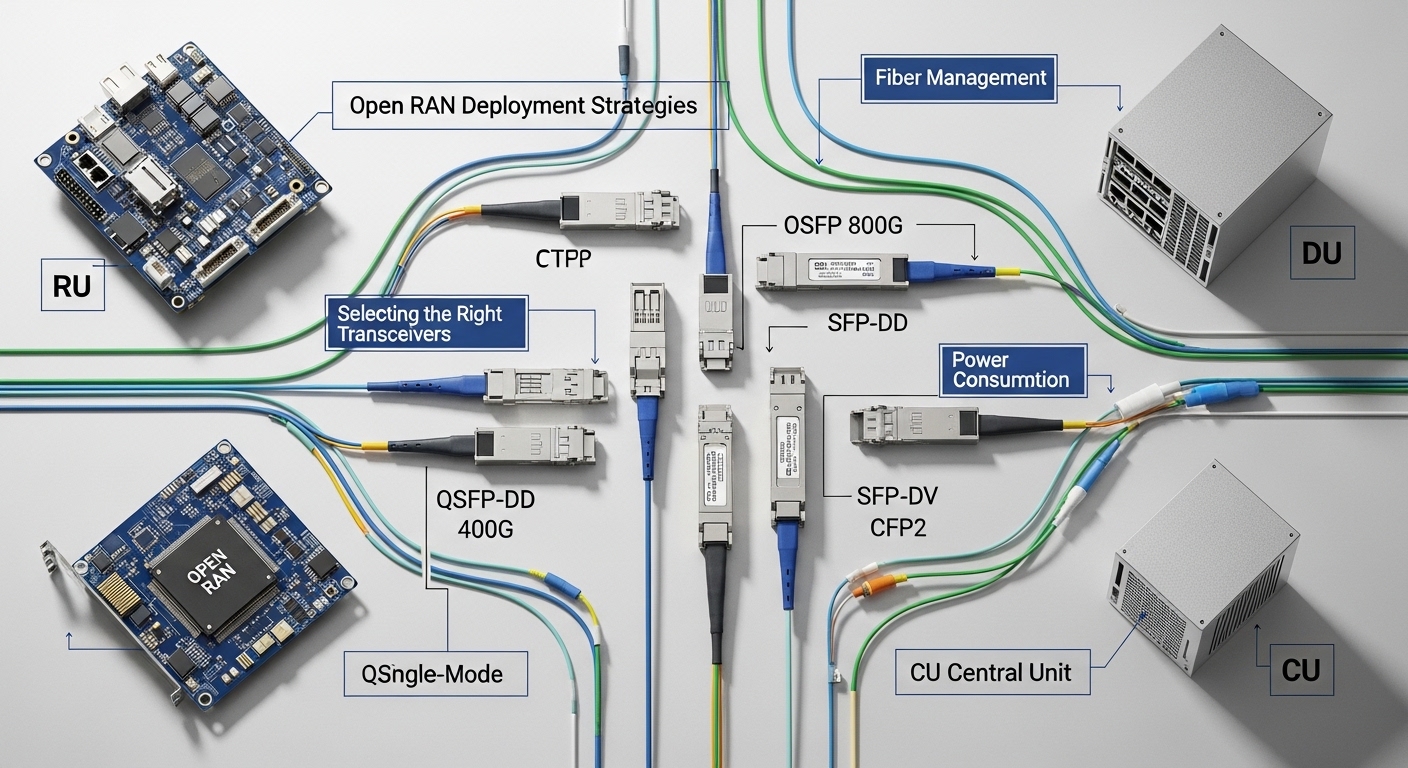
In Open RAN, the “radio to compute” path is typically split into functional layers: RU to DU (fronthaul) and DU to CU or transport (midhaul/backhaul). Optical networking is favored because it supports deterministic latency budgets better than congestible copper, and it scales cleanly for dense cell sites. The selection pressure is not only reach; it is also deterministic performance under vendor-specific optics, DOM behavior, and transceiver wake-up timing. If your transceiver choices ignore link budget or temperature derating, you can pass day-one tests and still fail during seasonal extremes.
Fronthaul vs midhaul: what changes in the transceiver decision
Fronthaul is commonly aligned with stringent timing expectations and often uses higher-rate optics depending on the functional split. Midhaul typically tolerates more variability but still demands stable optical power and consistent link monitoring. Practically, fronthaul links often end up with short-reach optics such as 10G, 25G, or 100G short-reach variants over multimode fiber, while midhaul may shift to single-mode for longer spans. Your optics must match not just the wavelength and data rate, but also the transceiver form factor supported by your switch, OLT, or white-box transport gear.

Standards and what they mean for interoperability
Most pluggable optics follow IEEE 802.3 PHY specifications for Ethernet signaling and optical interfaces, with additional vendor constraints in the transceiver firmware. For example, 10GBASE-SR and 25GBASE-SR are defined around multimode optics behavior in IEEE 802.3, while long-reach and single-mode variants map to other published optical interface definitions. Even when two optics both “say SR,” their exact link budget assumptions (laser launch power, receiver sensitivity, and allowed attenuation) can differ by vendor. Always validate against the switch or router optics compatibility list and confirm DOM interpretation by your network management system.
For reference, see IEEE 802.3 for the base Ethernet optical interface expectations: IEEE 802.3 Standards. For DOM and management behavior, vendor datasheets remain the most reliable source in real deployments: a “compatible” optic that reports DOM fields differently can still trip alarms or be blocked by strict monitoring policies.
Choosing optics for Open RAN: a spec-first, fiber-budget mindset
Engineers often start with the data rate and wavelength, but optical networking selection should begin with the fiber plant and the link budget. In the field, the fastest path to success is to compute expected attenuation end-to-end and then choose a transceiver whose transmit power and receiver sensitivity give margin across temperature and aging. You also need to check connector type (LC vs MPO), fiber grade (OM3/OM4), and whether your patching uses tight bends that increase modal loss. A clean link budget prevents mysterious flaps that only occur after a few weeks of thermal cycling.
Technical specs comparison: common short-reach and long-reach options
The table below compares representative transceiver families commonly considered in Open RAN transport. Model numbers vary by vendor, but these examples show typical operating parameters and practical constraints. Use them as a starting point, then confirm exact figures from the module datasheets for your chosen vendor.
| Optics type | Typical data rate | Wavelength | Connector | Typical reach | Operating temperature | Power / notes |
|---|---|---|---|---|---|---|
| 10GBASE-SR SFP+ | 10G | 850 nm | LC | Up to 300 m (OM3) / 400 m (OM4) class | -5 C to 70 C (varies by vendor) | Low power pluggable; multimode launch power assumptions apply |
| 25GBASE-SR SFP28 | 25G | 850 nm | LC | Up to 100 m class on OM4 for many modules | -5 C to 70 C or -10 C to 70 C | Higher bandwidth; more sensitive to patch cord and insertion loss |
| 100GBASE-SR4 QSFP28 | 100G | 850 nm | MPO/MTP (4 lanes) | Up to 100 m class on OM4 (varies) | -5 C to 70 C | Lane alignment and polarity are critical for MPO harnesses |
| 10GBASE-LR SFP+ | 10G | 1310 nm | LC | Up to 10 km class | -5 C to 70 C (varies) | Single-mode; requires correct fiber type and cleanliness |
| 25GBASE-LR SFP28 | 25G | 1310 nm | LC | Up to 10 km class | -5 C to 70 C | Often used for midhaul when single-mode is available |
Concrete module examples you may encounter
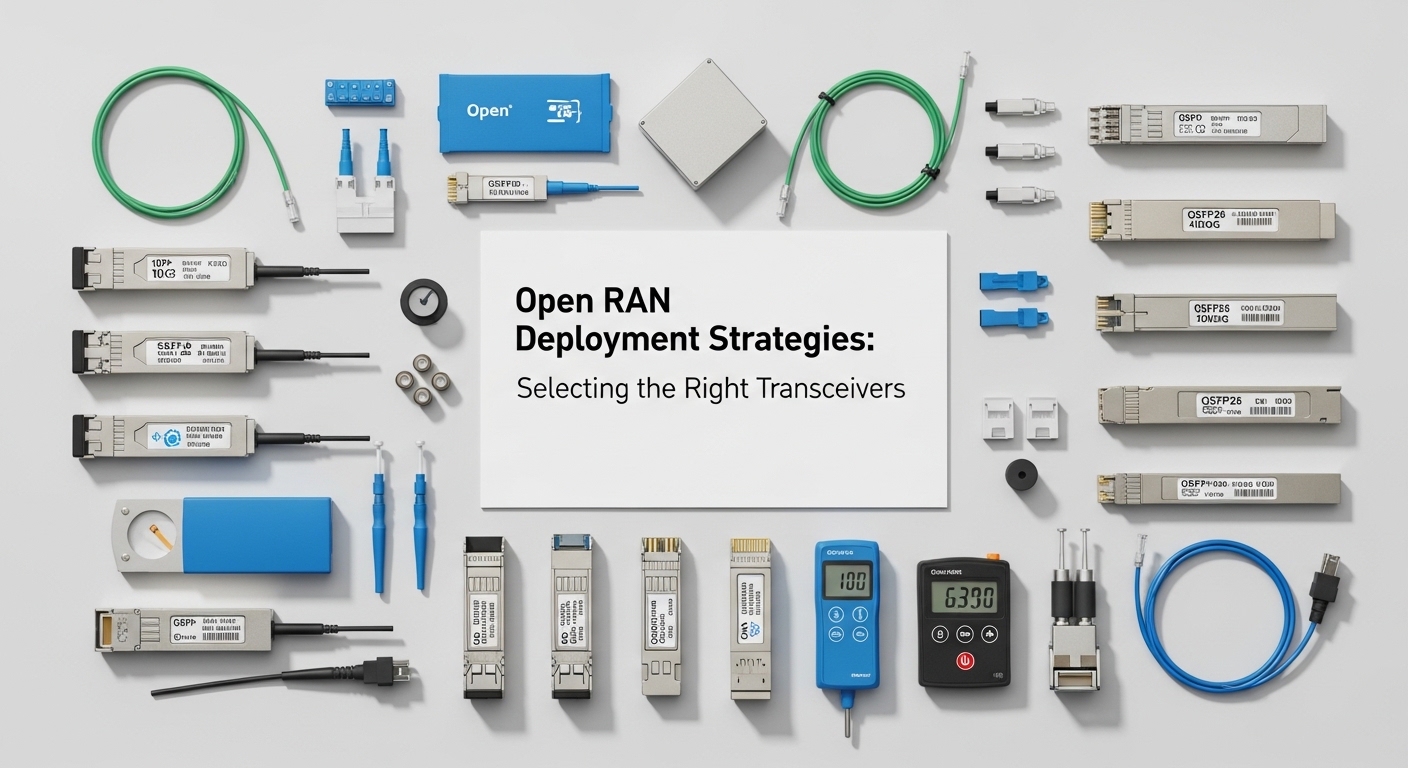
In production, you may see vendor modules such as Cisco SFP-10G-SR for 10GBASE-SR, Finisar FTLX8571D3BCL for certain 850 nm short-reach configurations, or FS.com SFP-10GSR-85 as a third-party short-reach option. For Open RAN transport equipment, the exact compatibility depends on the host device’s optics matrix and whether it enforces vendor-specific transceiver identifiers. When the host uses strict allowlists, third-party optics can be electrically compatible yet administratively rejected.
Pro tip: Before you order spares, confirm whether your network management stack reads DOM fields for alarms and thresholds, and whether it expects vendor-specific ranges. A module that “works” at Layer 1 can still trigger false optical power alarms that degrade operational trust during large rollouts.
Pro Tip: In many Open RAN sites, the biggest hidden failure mode is not the transceiver; it is the patching strategy. If you use high-loss patch cords or non-compliant MPO polarity adapters, you can still meet headline reach on paper while failing link stability during power cycling. Measure insertion loss with a certified meter, then validate with an end-to-end optical test after every patch change.
Real-world Open RAN deployment scenario: what teams actually do
Consider a 3-tier data center style Open RAN transport setup: 48-port 10G ToR switches at the edge connect to mid-tier aggregation switches using 10GBASE-SR over OM4 within the room, and uplinks use 10GBASE-LR over single-mode to a regional transport ring. In one rollout, each rack carried 16 RU-facing links and 8 DU-facing uplinks, totaling 24 optics per rack. The team targeted 220 m typical fronthaul patch distances through a controlled patch panel path, then reserved margin for maintenance re-cabling by keeping measured insertion loss under 1.5 dB per mated segment. During commissioning, they observed that replacing two “generic” patch cords with certified low-loss cords improved link error stability without changing transceivers, because the receiver margin was tight at temperature extremes.
Selection checklist: ordered factors that prevent rollout pain
Engineers can reduce optical networking risk by following a consistent evaluation order. The goal is to avoid late surprises in the field where optics are swapped under time pressure.
- Distance and fiber type: Confirm OM3 vs OM4 vs OS2, and measure end-to-end insertion loss and connector losses.
- Data rate and interface match: Ensure the transceiver matches the host PHY expectation (10G, 25G, 100G) and the optics type (SR, LR, ER as applicable).
- Connector and harness readiness: LC vs MPO/MTP; confirm MPO polarity and lane mapping for SR4-style optics.
- Switch and DU equipment compatibility: Use vendor optics compatibility lists and verify allowlist behavior for transceiver IDs.
- DOM support and monitoring: Validate that your management system reads DOM correctly and thresholds align with your operational alarms.
- Operating temperature and derating: Compare module spec temperature range to enclosure extremes and airflow assumptions.
- Budget and vendor lock-in risk: Model total spares cost, replacement lead times, and whether third-party optics are permitted by policy.
Common mistakes and troubleshooting tips in optical networking
Open RAN optical networking failures often cluster into a few repeatable patterns. Below are field-proven mistakes, their likely root causes, and practical fixes.
“It links up, but it flakes after a reboot”
Root cause: DOM alarm thresholds or transceiver initialization timing mismatches with the host. Sometimes the optic reports optical power or temperature fields outside the host’s expected ranges, causing the host to cycle the interface.
Solution: Compare DOM readings versus host expectations; try a known-good vendor module; update host firmware if the optics behavior changed. Confirm transceiver is within the host’s supported temperature and speed mode.
“Multimode SR works in the lab, fails in the cabinet”
Root cause: Patch cords and connector cleanliness drive modal loss and insertion loss. OM4 can be unforgiving when patch cords are longer than planned or when connectors were not cleaned after repeated maintenance.
Solution: Clean connectors with proper fiber cleaning tools, then re-test with a certified optical power meter and OTDR where available. Replace suspect patch cords with certified low-loss assemblies and verify fiber grade labels.
“100G SR4 shows errors even though SR4 optics are installed”
Root cause: MPO polarity or lane mapping errors. SR4 uses multiple lanes; a single miswired lane can create persistent CRC errors.
Solution: Verify MPO polarity scheme end-to-end, then test each lane continuity if your test gear supports it. Use standardized harnesses and document polarity in your change management system.
“Single-mode LR links show high attenuation or intermittent loss”
Root cause: Dirty LC connectors or incorrect fiber type mixing (e.g., OM mistakenly used where OS2 is expected). Single-mode also magnifies small contamination and connector end-face damage.
Solution: Inspect and clean LC end faces, then re-measure optical power. Confirm fiber type on the fiber records and re-terminate only if inspection shows end-face defects.
Cost and ROI: what to budget for optical networking in Open RAN
Transceiver pricing varies by data rate, reach, and vendor policy. In typical enterprise and carrier procurement, 10G SR optics may be relatively inexpensive per unit compared to 100G QSFP28 optics, while single-mode LR optics usually cost more than SR for the same form factor. In practical TCO terms, you should budget not only the module cost but also spares, failure logistics, and downtime risk during maintenance windows. OEM modules can reduce compatibility risk, while third-party optics can cut unit price but may increase operational overhead if allowlists, DOM interpretation, or warranty processes are strict.
As a planning heuristic, many teams consider the lifetime cost of optics to be dominated by replacement frequency and truck-roll time, not by the initial purchase price. If your environment runs hot or experiences frequent re-cabling, the cheapest optic can become the most expensive after repeated failures. Factor in power draw differences when you scale: even small watt changes across hundreds of ports can matter for enclosure cooling and backup power sizing.
FAQ: Open RAN optical networking transceiver buying questions
What fiber type should I assume for Open RAN fronthaul SR optics?
Assume your design will dictate OM4 (common in modern data center patching) for short-reach SR, but do not assume. Verify fiber grade in the field records and confirm with optical tests, because mislabeled fiber and non-compliant patch cords cause most SR failures.
Can I mix third-party transceivers with OEM switches for optical networking?
Sometimes yes, but compatibility is not guaranteed. Many hosts use allowlists or strict transceiver identification; even if the link comes up, monitoring and alarm thresholds may behave differently. Validate with your specific host model and firmware.
How do I confirm DOM support before scaling an Open RAN rollout?
Collect DOM readings from a few test optics and compare them to what your monitoring system expects. If your system alarms on out-of-range fields, you can get noise during stable operation and lose trust in alerts.
What is the biggest practical risk when choosing MPO-based 100G optics?
MPO polarity and lane mapping. A correct-looking installation can still deliver persistent errors if polarity adapters are reversed or if lane ordering differs from your harness standard. Standardize harnesses and document polarity in change tickets.
Should I buy spares of every transceiver type or only the most common ones?
Buy spares for the optics that represent your critical paths and highest-risk environments, such as hotter cabinets or links with tight optical margins. Also keep at least one “known-good” optic per form factor for rapid field diagnosis.
How can I reduce optical troubleshooting time during commissioning?
Use a repeatable test sequence: verify connector cleanliness first, then measure optical power/attenuation, and only then swap optics. Maintain a bench checklist with expected DOM readings and link status patterns for each module type.
If you want a next step, map your Open RAN topology to a clear optics inventory and document the fiber budget assumptions, then validate with end-to-end optical testing before scaling. For related planning, see optical networking reach planning for a practical method to translate reach specs into real acceptance criteria.
Author bio: I have deployed and troubleshot optical networking in Open RAN and carrier transport environments, including DOM-based monitoring validation and field optical budget verification. My work focuses on repeatable commissioning procedures and compatibility-aware optics procurement.