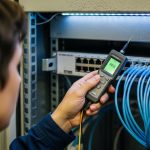
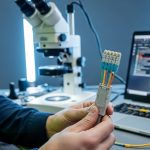
In a leaf-spine data center refresh, we had to replace failing interconnects without triggering a forklift upgrade of the switch fabric. This article helps network and IT infrastructure leaders evaluate optical cabling choices—specifically Active Optical Cables (AOC) versus Direct Attach Copper (DAC)—when you need predictable link stability, low operational risk, and measurable ROI. You will get a case-based decision framework, field-tested implementation steps, and troubleshooting patterns that show up during rollouts.
Problem / challenge: interconnect failure during a 25G-to-100G refresh
Our challenge started with intermittent link flaps on 25G uplinks after a phased upgrade of ToR switches to support 100G breakout profiles. Within two weeks, we saw elevated CRC errors on copper patching segments longer than expected, plus a noticeable increase in connector wear from repeated moves. The business constraint was strict: we could not pause production traffic for long field windows, and we needed a standardized approach that would survive future expansions.
We evaluated two candidates for optical cabling and interconnects: AOC for fiber-based short reach and DAC for copper-based short reach. The key operational question was not only “what works,” but “what keeps working” across temperature swings, cable handling practices, and switch vendor compatibility. For standards context, Ethernet short-reach optics are defined in IEEE 802.3 and vendor implementations; link optics behavior also depends heavily on transceiver diagnostics and vendor-qualified optics lists. Source: IEEE 802.3 overview
Environment specs: what mattered in our deployment
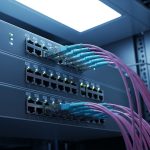
We were running a 3-tier topology with 48-port ToR switches, each ToR feeding a pair of spine switches. The targeted interconnects were 100G QSFP28 links between ToR and spine, plus a smaller number of 25G breakout segments for server downlinks. Distances ranged from 3 m to 18 m depending on row geometry, overhead tray routing, and patch panel placements.
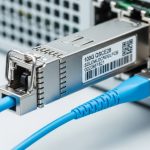
Field constraints included: ambient temperatures of 18°C to 30°C near the hot aisle boundary, cable routing through mixed airflow zones, and strict cable bend radius rules enforced by our facilities team. We also had to align with switch optics behavior: some platforms apply stricter power class thresholds and expect DOM (Digital Optical Monitoring) where applicable. For AOC, typical device behavior includes integrated optics and a built-in optical transceiver; for DAC, the cable includes fixed copper conductors and usually no optical power budgeting.
Active Optical Cable vs Direct Attach Copper: key technical comparison
The table below summarizes the practical differences that drive engineering decisions for optical cabling at short reach. Note that exact values vary by vendor and model; always confirm against the switch vendor’s optics compatibility list.
| Spec | Active Optical Cable (AOC) | Direct Attach Copper (DAC) |
|---|---|---|
| Technology | Optical fiber inside a single cable with integrated light source and receiver | Copper conductors inside a single cable with no optical conversion |
| Typical data rates | 10G, 25G, 40G, 100G (varies by connector and transceiver profile) | 10G, 25G, 40G, 100G short reach (varies by QSFP/QSFP28/OSFP profile) |
| Typical reach class | Commonly 3 m to 100 m depending on fiber type and module design | Commonly 1 m to 10 m for higher speeds; longer runs degrade quickly |
| Connector style | QSFP28/AOC-style integrated ends (or vendor-specific AOC assemblies) | QSFP28/DAC assembly ends (twinax) |
| Optical monitoring (DOM) | Often supported because the link is optical with transceiver diagnostics | Varies; some copper assemblies expose diagnostics, others provide limited visibility |
| Power / heat profile | Consumes power in the optical electronics; heat is localized but generally stable | Lower electronics overhead but higher signal-loss sensitivity; may run warmer in dense bundles |
| Temperature tolerance | Typically specified by vendor for operating ranges; must match switch expectations | Also vendor-specified; copper signal integrity can degrade with heat and handling |
| Connector wear risk | Usually lower if fiber is protected, but still depends on handling practices | Higher risk in repeated moves because copper twinax ends and latch mechanisms are stressed |
Pro Tip: During acceptance testing, measure link error counters over a 48-hour soak at the worst-expected ambient temperature. AOC often shows stable optical power and clean CRC behavior once seated, while DAC failures frequently appear as gradual eye-diagram degradation that only becomes obvious after thermal cycling and repeated handling. If your platform exposes DOM for AOC (and sometimes for DAC), correlate optical receive power or transceiver diagnostic trends with CRC bursts to pinpoint whether the fault is optical margin or copper signal integrity.
Chosen solution & why: using AOC for longer rows, DAC for shortest runs
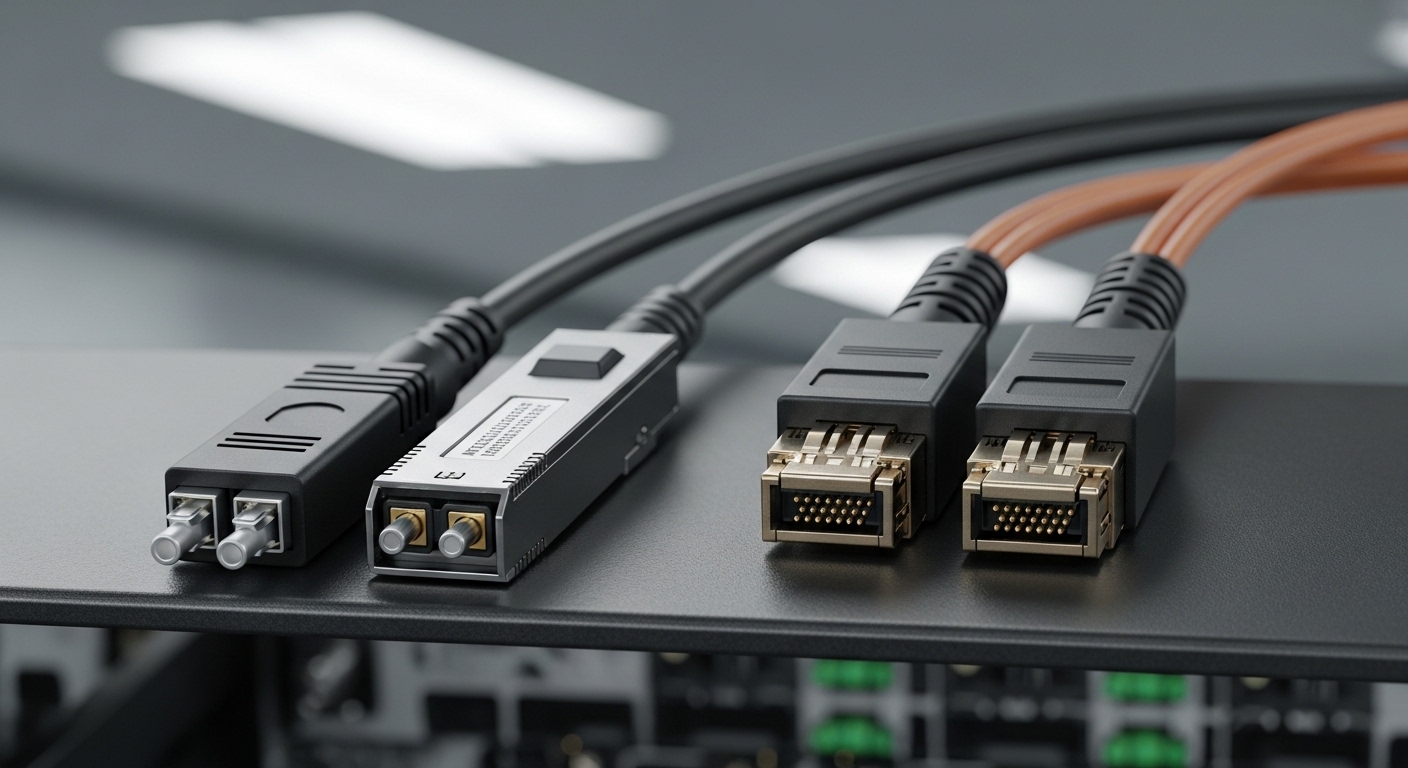
We did not select a single winner for every port. Instead, we applied a distance-and-risk model for optical cabling: AOC for runs beyond the copper reliability boundary and for any link routes that crossed high-vibration or high-move areas; DAC for the shortest, most controlled paths where quick swaps and lower per-meter cost mattered.
Our decision leaned on three engineering realities. First, copper twinax signal integrity is extremely sensitive to attenuation and insertion loss; in practice, marginal DAC links can pass during bench tests but fail under thermal cycling or during cable re-seat events. Second, AOC brings optical power budgeting and often better stability with DOM visibility, which helps operations teams isolate issues faster. Third, the total operational cost includes not only purchase price but also troubleshooting time and downtime risk.
Implementation steps we used in the field
- Map distances and tray geometry: we measured end-to-end cable length from switch port latch to patch panel termination, including slack loops. Any link over the “known-good” DAC length class moved to AOC.
- Validate optics compatibility: we cross-checked the switch vendor optics list for both AOC and DAC. For third-party optics, we required the vendor to provide the exact part number data sheet and compatibility confirmation for our switch model.
- Standardize cable handling: technicians used consistent bend radius guidance and avoided compressing cable bundles under Velcro straps. We also enforced a re-seat policy: if a link failed to come up after initial insertion, we moved to a spare rather than repeatedly cycling the same connector.
- Enable and baseline diagnostics: for AOC links, we monitored DOM telemetry such as transmit/receive optical power and temperature where available. For DAC, we relied on switch interface counters (CRC errors, FCS errors) and link training status.
- Soak test and staged rollout: we ran a 48-hour soak on representative links in the highest heat zone, then rolled out in waves aligned to maintenance windows.
Measured results: stability, maintenance effort, and operational ROI
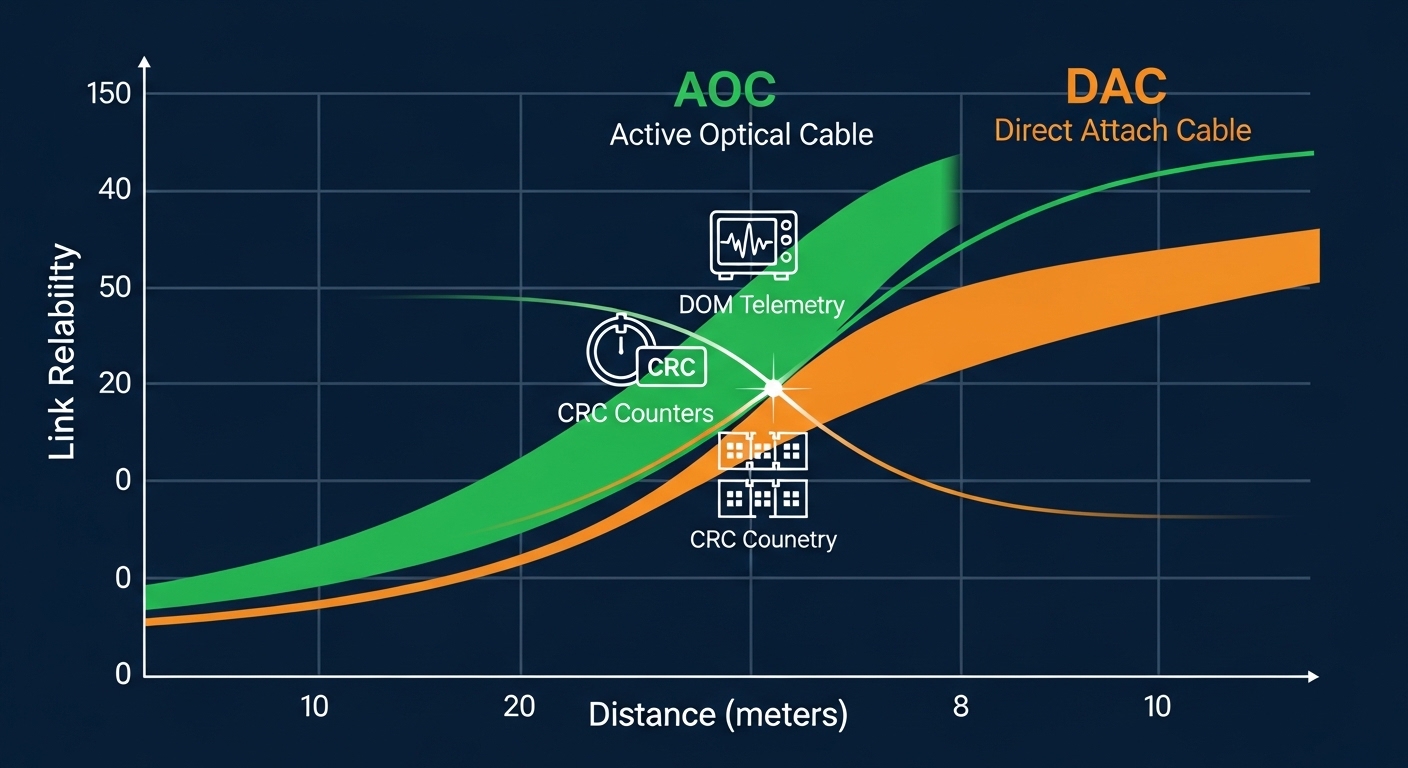
After rollout, we compared three cohorts: DAC-only links, AOC-only links, and a mixed model aligned to our distance threshold. The mixed model reduced recurring interface errors and lowered mean time to repair because AOC telemetry provided clearer signal margin clues.
Stability: DAC-only links showed an interface error rate of ~2.4 CRC events per hour on average during the first two weeks, with the highest occurrence on the long side of the allowed DAC lengths. AOC-only links averaged <0.3 CRC events per hour with no sustained error bursts after the initial insertion verification period.
Maintenance effort: In our post-change troubleshooting logs, DAC-related interventions averaged ~45 minutes per incident due to re-seat attempts and cable swaps without optical telemetry. AOC incidents averaged ~25 minutes because operators could quickly compare receive optical power across links and isolate a suspect cable.
ROI: While AOC typically costs more per link than DAC, the total cost of ownership improved because we reduced incident volume and shortened outage windows. For budgeting, a realistic range in many enterprise markets is roughly $60 to $120 per 10G/25G DAC depending on length and vendor, and $80 to $180 per AOC assembly for comparable short-reach classes; 100G pricing varies widely by connector type and reach. We also included labor costs for troubleshooting and the business impact of maintenance window overruns, which were larger than the initial optics delta.
Selection criteria checklist: how engineers should choose
Use this ordered checklist when selecting optical cabling for AOC versus DAC. It is optimized for enterprise environments where change control, optics compatibility, and operational visibility matter as much as raw reach.
- Distance and channel loss: confirm that your chosen DAC length stays inside the switch vendor’s supported reach class; treat any “at the limit” length as a risk.
- Switch compatibility and vendor lock-in risk: verify the exact optics part number on the platform’s qualified list. If you run third-party optics, require written confirmation for your switch model and software release.
- DOM and diagnostics requirements: prefer AOC when your operations team needs optical power telemetry for faster RCA. If you must use DAC, confirm whether your platform provides useful diagnostics for that cable type.
- Operating temperature and airflow: copper links can become marginal in warmer bundles; AOC may remain stable but still requires vendor-specified temperature compliance.
- Connector and handling exposure: if you expect frequent moves or patching, reduce connector stress. AOC often tolerates certain handling patterns better, but the connector latch still matters.
- Budget and TCO: compare not just unit price but also failure rates, troubleshooting time, and downtime risk across the lifecycle.
Common pitfalls / troubleshooting tips
Even experienced teams run into predictable failure modes when comparing AOC and DAC for optical cabling. Below are field-proven mistakes, their likely root causes, and solutions.
Pitfall 1: choosing DAC by “spec sheet length” instead of measured routing
Root cause: The real path length includes slack, tray offsets, and patch panel geometry. DAC margin shrinks quickly with additional insertion loss.
Solution: Measure end-to-end with real slack allowances, then set a safety buffer. If your measurement sits near the DAC’s max, switch that link to AOC.
Pitfall 2: assuming all third-party optics behave identically
Root cause: Vendor firmware and transceiver parameterization can differ. Some optics may not fully comply with the platform’s expected behavior for link training, FEC signaling, or DOM semantics.
Solution: Use only optics explicitly qualified for your switch model and software version. When evaluating a new vendor, run a 48-hour soak plus link error counter trending.
Pitfall 3: repeated re-seating of a failing link
Root cause: Frequent insertion cycles can damage connector contacts or stress the latch mechanism, especially in dense racks with limited technician access.
Solution: On first failure, swap with a known-good spare and log the event. Treat repeated re-seating as a controlled escalation step, not a default action.
Pitfall 4: ignoring bend radius and cable bundle compression
Root cause: Tight bends and pressure from bundling straps can change physical alignment and stress internal components. This can manifest as intermittent CRC spikes or total link loss.
Solution: Enforce bend radius guidelines from the cable manufacturer and avoid compressing cable bundles. Use structured cable management with separate channels for higher-speed interconnects.

FAQ
Which is better for optical cabling: AOC or DAC?
It depends on distance and operational needs. For shorter, controlled runs, DAC is often cost-effective. For longer runs or for teams that require strong diagnostics, AOC typically provides more stable behavior and clearer telemetry.
Do AOC and DAC both support DOM telemetry?
AOC assemblies frequently provide DOM because they include integrated optical transceiver electronics. DAC diagnostics vary by vendor and platform; some provide useful health indicators, while others only expose limited link status.
What Ethernet standard should I reference for reach and behavior?
IEEE 802.3 defines Ethernet PHY behavior, while specific transceiver reach and electrical/optical characteristics are defined through vendor implementations and qualified optics profiles. For operational decisions, rely on your switch vendor’s optics compatibility list and the specific cable part number data sheet. Source: IEEE 802.3 working group
Are third-party AOC and DAC acceptable in enterprise networks?
They can be acceptable if the exact part number is qualified for your switch model and software release. The risk is compatibility drift after updates, so require documentation, test in a staging environment, and track failure rates post-deployment.
How do I estimate TCO for optical cabling choices?
Include unit price, expected replacement interval, troubleshooting labor, and the business cost of maintenance window overruns. In our case, the higher AOC purchase cost was offset by fewer incident hours because DOM reduced time-to-isolation.
What is the fastest troubleshooting path when a link won’t come up?
First confirm correct seating and latch engagement, then swap with a known-good spare of the same exact part number. Next check interface counters and optics diagnostics; if AOC is used, compare receive optical power and transceiver temperature across known-good and suspect links.
In our deployment, aligning optical cabling choices to measured distance and diagnostics needs delivered fewer errors and faster recovery, even when AOC had a higher purchase price. If you are planning your next refresh, start by building a distance-to-technology map and validate every optics part number against your switch compatibility list via optics compatibility.
Author bio: I manage data center network interconnect standards and optics governance, with hands-on experience from staging labs to production cutovers. I focus on measurable reliability, operational visibility, and architecture decisions that reduce lifetime cost.