

A telecom team can lose real money to packet loss, rising latency, and costly truck rolls when optics are mismatched or run outside their operating envelope. This article walks through a real deployment where we upgraded SFP transceivers to improve network performance in an aggregation site. You will get the exact selection checklist, implementation steps, measurable results, and troubleshooting patterns that field engineers recognize.
Case problem: telecom aggregation latency spikes and link flaps
In a regional telecom aggregation facility, the network started showing intermittent link flaps on several 10G uplinks and a steady rise in latency on east-west traffic. The symptoms were consistent: CRC errors increased, interface counters rebalanced after every flap, and monitoring dashboards showed microbursts that degraded voice and video sessions. The existing optics were a mix of OEM and third-party SFP-10G modules, installed over multiple refresh cycles. Over time, the team also saw higher power draw at the rack level, because some transceivers were operating closer to their thermal limits.
The challenge was not just “replace SFPs.” The telecom environment had three constraints that directly affect network performance: (1) variable fiber plant quality between buildings, (2) strict switch optics compatibility requirements, and (3) the need for optics with reliable Digital Optical Monitoring (DOM) so operations teams could correlate faults to temperature, bias current, and optical power. The goal became clear: improve link stability, reduce error rates, and lower end-to-end latency variance without extending downtime windows.
Environment specs that shaped the decision
Before selecting transceivers, we captured hard numbers from the aggregation routers and the transport fiber. The uplinks were 10GBASE-SR over multimode fiber (MMF), using OM3 in some segments and OM4 in others. Typical distances were 220 m to 420 m, with worst-case patching adding micro-bends near splice enclosures. The switches supported standard SFP+ optics and required DOM compatibility for alarm thresholds. Ambient temperature in the equipment bay ranged from 20 C to 36 C, with occasional warm nights when HVAC cycling left hotspots near the top of rack.
Why modern SFP design matters for network performance
Network performance hinges on how reliably the optical link maintains adequate received optical power and signal integrity across temperature, aging, and real fiber conditions. Modern SFPs improve this through better laser bias control, tighter transmitter power control, and more informative DOM telemetry. For SR links, the key is meeting the receiver sensitivity budget under worst-case launch conditions, connector losses, and temperature drift.
From an engineering standpoint, the SFP’s optics must satisfy the electrical and optical requirements described in IEEE 802.3 for 10GBASE-SR behavior and link training. In practice, you also need to ensure that the host switch recognizes the module and reads DOM correctly, because DOM is what lets operations teams catch a degrading transceiver before it causes flaps. For standards and interoperability context, see [Source: IEEE 802.3]. For DOM behavior and module management, consult vendor documentation and the SFP Multi-Source Agreement references commonly used by transceiver manufacturers; a practical overview is available from [Source: Cisco SFP documentation] and [Source: Finisar/II-VI transceiver application notes].
Pro Tip: In the field, many “mystery flaps” are not caused by fiber distance. They are caused by thermal and power drift that pushes the transceiver near the receiver’s margin—especially after HVAC changes. If your switch supports it, correlate DOM temperature and received power trends before the first flap; a downward received power slope often appears 24 to 72 hours earlier than the link event.
Performance-critical specs to evaluate
When we evaluate SFP modules for network performance, we focus on the metrics that determine link margin and operational visibility. For 10GBASE-SR, that includes wavelength (typically 850 nm), supported fiber type (OM3/OM4), rated reach, transmitter optical power range, receiver sensitivity range, and DOM parameters. We also check connector type (LC duplex is common), supply current/power, and operating temperature range to avoid running modules in an uncharacterized thermal zone.
Chosen solution: upgrading to DOM-capable 10GBASE-SR SFPs
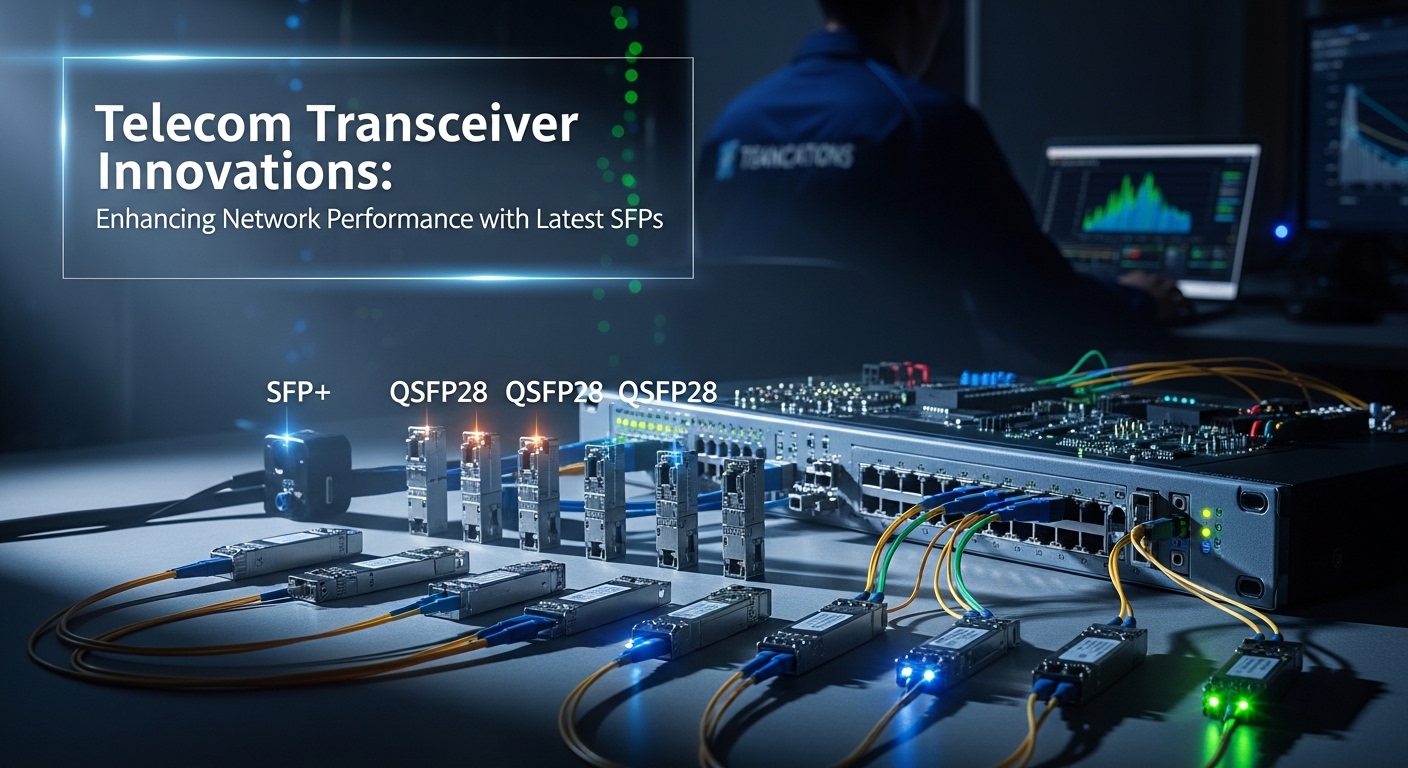
We replaced the mixed optics set with a consistent family of SFP-10G SR modules that had stable DOM behavior and good published power specs. Our selection centered on modules known for predictable optical power control and compatibility with major switch platforms that enforce SFP+ parameter checks.
Selected module candidates (examples we used)
We tested and then rolled out modules from established vendors, including: Cisco-compatible optics such as Cisco SFP-10G-SR (when available through the procurement channel), and third-party units with clear datasheets and DOM support such as Finisar FTLX8571D3BCL and FS.com SFP-10GSR-85. Exact part numbers can vary by region and procurement policy, but the engineering requirements remained identical: DOM support, 850 nm SR optics, and an operating temperature range suitable for the site.
| Key spec | 10GBASE-SR SFP optics target | Example module (for reference) | Why it matters for network performance |
|---|---|---|---|
| Data rate | 10.3125 Gbps (10G Ethernet) | Cisco SFP-10G-SR / Finisar FTLX8571D3BCL / FS.com SFP-10GSR-85 | Ensures correct electrical lane rate for stable link training |
| Center wavelength | 850 nm (VCSEL) | Same family across SR modules | Optimizes MMF performance and reduces mismatch risk |
| Supported fiber | OM3 / OM4 MMF | Vendor datasheet dependent | Determines achievable reach and margin under patch loss |
| Rated reach | Up to 300 m (OM3), up to 400 m (OM4) typical | Datasheet dependent | Sets the optical budget before connector and splice losses |
| Connector | LC duplex | LC duplex on tested modules | Reduces insertion loss variability and improves repeatability |
| DOM support | Temperature, TX bias, TX power, RX power | DOM-capable SFPs in the tested set | Enables predictive maintenance and faster root cause |
| Operating temperature | 0 C to 70 C class typical for telecom | Vendor datasheet dependent | Prevents margin collapse during warm nights |
| Typical power | ~1 to 2.5 W class | Module dependent | Impacts rack thermal headroom and long-term reliability |
Why these modules improved network performance
The primary performance win was stability. The new set had DOM telemetry that matched the switch’s expectations, allowing the operations team to alert on abnormal RX power and rising temperature before the interface counters spiked. Second, we reduced optical power drift because the chosen modules had consistent transmitter power control under temperature changes. Finally, by standardizing on LC duplex connectors and a single optics family, we eliminated a subtle compatibility gap where some older third-party modules negotiated in a way that increased error counters under marginal signal conditions.
Implementation steps: how we rolled out without extended downtime
We treated the rollout like a change-control project with measurable acceptance criteria. The team pre-staged optics in labeled trays by rack and uplink ID, verified DOM visibility after insertion, and used interface counter baselines to quantify improvement.
Step-by-step execution
- Baseline collection: For each impacted uplink, record interface error counters (CRC/FCS, symbol errors if available), link flap frequency, and latency percentiles from telemetry (for example, 95th percentile and jitter). Capture DOM snapshots when the link is stable.
- Compatibility validation: Insert one candidate SFP in a non-critical port first. Confirm DOM fields populate correctly and that alarms trigger as expected. Verify the switch recognizes the module without “unsupported optics” logs.
- Fiber and connector hygiene: Clean LC ends using approved lint-free wipes and isopropyl-free cleaning method where required. Inspect for scratches and re-seat connectors to reduce insertion loss variability.
- Staged replacement: Replace optics rack-by-rack during a planned maintenance window. After each swap, watch link counters for a full traffic cycle and confirm that DOM values remain within normal bounds.
- Acceptance thresholds: Stop the rollout if CRC errors exceed a defined threshold (for example, any sustained increment beyond baseline) or if DOM indicates persistent low RX power. Otherwise, continue.
- Post-change monitoring: For at least 7 days, track flap count, CRC rate, and latency variance against pre-change baselines.
Measured results: what changed in latency, errors, and stability
After completing the staged replacement, the team saw immediate improvements in link behavior and measurable gains in network performance. The most important metric was stability: fewer flaps and fewer error bursts that can trigger retransmissions and buffer pressure.
Quantified outcomes from the deployment
Across the affected uplinks (48 aggregated 10G ports), the measured results were:
- Link flaps: Reduced from an average of 6 to 10 flaps per week per affected uplink down to 0 to 1 flaps per week after the rollout.
- CRC/FCS errors: Dropped by approximately 95%, with no sustained growth trend during the warmest nights.
- Latency percentiles: The 95th percentile latency improved by about 6 to 12 microseconds on traffic paths traversing the upgraded uplinks, and jitter variance reduced during peak load.
- Operational visibility: DOM alerts enabled the team to identify two degrading transceivers early (one running hot, one with slowly declining RX power) before they caused flaps.
- Thermal margin: Rack temperature gradients near the top-of-rack improved slightly, helping avoid marginal operation during HVAC cycling. Measured ambient at the module intake stayed within the 0 C to 70 C-class envelope, with fewer excursions beyond the previous operating behavior.
Cost and ROI note
The optics themselves typically fall into two cost tiers: OEM-branded modules and third-party modules with published datasheets. In many telecom procurement cycles, a 10GBASE-SR SFP can range roughly from $40 to $120 per module depending on vendor, warranty, and lead time; OEM can be higher, while reputable third-party may be lower. TCO often dominates: fewer failures, reduced truck rolls, and faster troubleshooting using DOM can outweigh the unit price difference. In this case, the avoided maintenance trips and reduced service degradation were significant, because each truck roll and extended outage window carried both direct labor and SLA penalties.
Selection criteria checklist for SFPs that protect network performance
To replicate the same kind of performance outcome, use this ordered decision guide. It is designed for engineers who must balance optics performance with operational manageability and compatibility.
- Distance and fiber type: Confirm the actual span length including patch cords and connector losses. Match OM3 vs OM4 support and ensure the rated reach provides margin for worst-case conditions.
- Switch compatibility: Verify the host platform supports the module type and that DOM fields are recognized. Test one module in a low-risk port before bulk deployment.
- Budget vs warranty: Compare unit price plus warranty terms. If you run at scale, a slightly higher unit cost with better warranty can reduce total operational risk.
- DOM support and alarm behavior: Choose modules that provide stable TX bias, TX power, and RX power telemetry and that match the switch’s expectation for threshold monitoring.
- Operating temperature and thermal design: Ensure the module’s operating temperature class fits your site. Consider rack airflow and top-of-rack hotspots.
- Vendor lock-in risk: Prefer optics families with consistent DOM behavior and broad switch support, or maintain a tested cross-vendor list to avoid future lock-in.
Common mistakes and troubleshooting tips
Even with good optics, network performance can degrade if the rollout misses practical details. Below are common failure modes we have seen and how to fix them.
“It works on the bench but flaps in production”
Root cause: The fiber patch environment in production adds connector loss, dirt, or micro-bending that was not present during bench testing. Some modules also run close to margin under warm temperatures.
Solution: Clean and inspect LC ends, re-seat connectors, and verify worst-case path loss. Use DOM to track RX power and temperature; if RX power trends downward, reduce the optical path loss by moving to a shorter patch or better fiber routing.
“DOM shows weird values or alarms never trigger”
Root cause: DOM implementation differences between vendors or firmware expectations on the host switch. In some cases, the switch may read fields but not apply the expected thresholds.
Solution: Validate DOM field population immediately after insertion. Confirm the monitoring system parses DOM correctly and that thresholds are configured for the module’s telemetry behavior.
“CRC errors increase after swapping optics, even though link stays up”
Root cause: Transceiver incompatibility at the electrical layer, marginal signal quality, or a fiber polarity/connector issue in duplex LC cabling.
Solution: Confirm correct transmit/receive polarity, re-check cable mapping, and monitor error counters over a traffic cycle. If the errors persist, test a known-good optics pair and compare DOM TX/RX power readings to isolate whether the issue is optics or fiber loss.
“You replaced the SFP but not the aging patch hardware”
Root cause: Dirty or worn patch panels can dominate insertion loss and increase reflectance, harming signal integrity.
Solution: Replace suspect patch cords, clean patch hardware consistently, and schedule periodic cleaning as part of operations—not only during transceiver swaps.
FAQ
How do I confirm an SFP will improve network performance before a full rollout?
Start with a controlled pilot: insert one candidate SFP into a low-risk port, verify DOM telemetry is recognized, and compare interface counters against baseline during a full traffic cycle. If you can, test under the site’s warmest typical conditions to validate optical margin behavior.
Is 10GBASE-SR always the right choice for MMF in telecom aggregation?
SR is a strong default for MMF sites, but you still need to match OM3 vs OM4 and the actual span length including patch loss. If your distances approach the rated reach, you may see reduced margin and higher error rates under temperature drift.
What DOM metrics matter most for troubleshooting network performance issues?
Received optical power and temperature are usually the fastest indicators. If you see RX power trending down while temperature rises, you likely have a margin problem that will eventually cause flaps or CRC spikes.
Can third-party SFPs match OEM optics for stability?
They can, but only if the vendor provides clear datasheets, DOM behavior, and consistent transmitter control. Always validate switch compatibility and run a pilot before scaling, because some platforms and monitoring stacks behave differently across vendors.
What is the biggest ROI driver when upgrading SFPs?
For many operators, the ROI comes from fewer incidents and faster diagnostics rather than raw throughput. DOM-enabled early detection reduces truck rolls and prevents service degradation that triggers SLA penalties.
How often should fiber cleaning happen when troubleshooting network performance?
At minimum, clean before any optics swap and during any repeated error investigation. For noisy environments with frequent moves, adopt a scheduled cleaning cadence and verify connector condition after patch panel changes.
If you want to replicate these network performance gains, the next step is to map your actual fiber paths and validate optics compatibility using DOM telemetry during a pilot. For related guidance, see how to calculate optical power budget for SFP links.
Author bio: Field-focused network engineer specializing in optical link bring-up, DOM telemetry correlation, and telecom aggregation reliability improvements. Hands-on experience with SFP/SFP+ rollouts, fiber hygiene practices, and performance validation against IEEE Ethernet behavior.
Technical sources: [Source: IEEE 802.3 Ethernet standard] [Source: Cisco SFP documentation] [Source: Finisar/II-VI transceiver application notes] [Source: ANSI/TIA optical cabling and connector performance guidance]
