In 2026 Open RAN rollouts, transceivers often become the hidden pacing item for network evolution: they determine link reach, latency budget, thermal margin, and interoperability across vendors. This article helps telecom and data center engineers select the right optics for fronthaul, midhaul, and backhaul when building toward a multi-vendor, disaggregated radio access network. You will get a head-to-head comparison, a decision checklist, and field-tested troubleshooting patterns tied to real module families.

Fronthaul vs midhaul optics: performance limits that drive network evolution
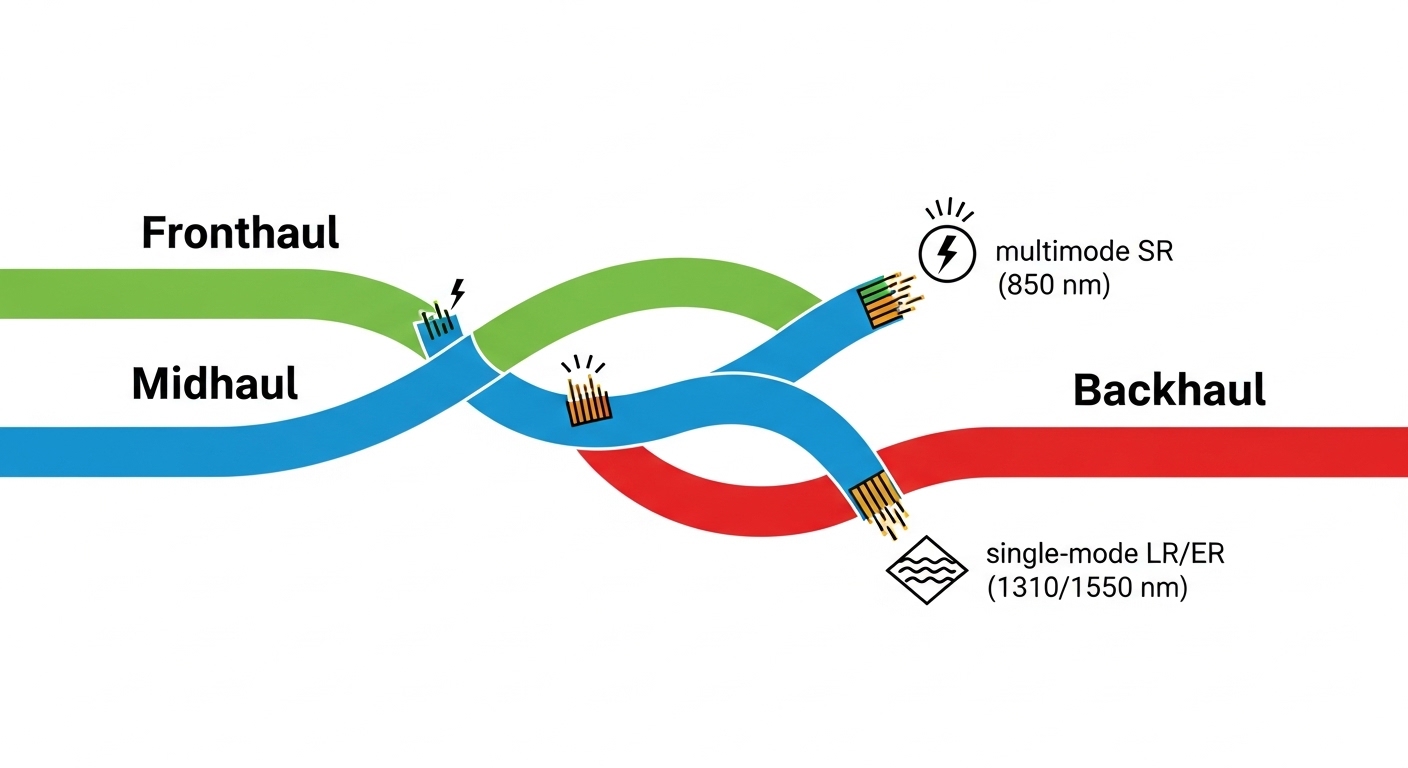
For Open RAN, the biggest trap is assuming all “fiber links” behave the same. Fronthaul commonly uses tighter timing and deterministic transport needs, while midhaul/backhaul focus more on throughput and operational efficiency. In practice, the transceiver data rate, optical wavelength, and link budget (including connector loss and fiber attenuation) determine whether you meet BER targets and receiver sensitivity.
Most deployments map to standard Ethernet optics: 10GBASE-SR for shorter reach multimode, 25G/40G/100G variants for higher capacity, and long-reach single-mode options when you must cross buildings or meet campus reach. For example, 10GBASE-SR typically uses 850 nm with multimode fiber and is often paired with modules such as Cisco SFP-10G-SR or Finisar-compatible SR offerings. For single-mode, 1310 nm or 1550 nm options typically support much longer reach, but with different power consumption and optics cost.
Head-to-head: multimode SR vs single-mode LR/ER
Engineers usually choose multimode SR when structured cabling distance is short and cost matters. Single-mode is favored for higher reach, campus aggregation, and future bandwidth scaling during network evolution.
| Spec | 10GBASE-SR (MMF) | 10GBASE-LR (SMF) | 25G/100G SMF (example) |
|---|---|---|---|
| Wavelength | 850 nm | 1310 nm | 1310 nm or 1550 nm |
| Typical reach | ~300 m (OM3), ~400 m (OM4) depending on module | ~10 km (varies by vendor) | 10 km to 40 km depending on module class |
| Fiber type | OM3/OM4 multimode | OS2 single-mode | OS2 single-mode |
| Connector | LC (common) | LC (common) | LC or MPO (higher density) |
| Typical module examples | Cisco SFP-10G-SR, FS.com SFP-10GSR-85 | Vendor LR 10G SFP+ | QSFP28/CFP2 long-reach families |
| Operating temp | Often 0 to 70 C (check datasheet) | Often 0 to 70 C or industrial variants | Varies; telecom-grade often wider |
Cost and TCO: where third-party optics help and where they hurt
On paper, optics are “just” transceivers, but network evolution changes the economics. In Open RAN, you may deploy thousands of links across sites, and a small per-module price delta becomes material. Field experience shows third-party modules can cut upfront cost, yet the real TCO hinges on compatibility, failure rate, and whether you can maintain spares without vendor-specific lock-in.
Typical market pricing (varies by volumes, lead times, and temperature class) often looks like: multimode SR modules are the lowest cost per port, while long-reach single-mode modules cost more due to higher-performance optics. OEM modules (from the switch/router vendor) tend to carry the highest price but usually minimize interoperability surprises with DOM thresholds and vendor-specific transceiver validation. Third-party modules can be cost-effective when they match the exact standards profile and are validated with your specific switch line cards.
Decision checklist (ordered by what breaks first in production)
- Distance and fiber type: confirm OM3 vs OM4 vs OS2, and include connector and patch cord loss.
- Switch compatibility: verify the exact transceiver form factor and vendor qualification list for your model.
- DOM support and thresholds: ensure your platform reads temperature, voltage, bias, and optical power without alarms.
- Operating temperature: telecom huts and outdoor cabinets can exceed lab assumptions; target telecom-grade ranges.
- Link budget and BER expectations: confirm receiver sensitivity and transmitter launch power align with your fiber plant.
- Vendor lock-in risk: plan spares and procurement flexibility across at least two qualified suppliers.
Deployment reality: a 2026 Open RAN site with measurable constraints
Consider a 3-tier topology in a regional telecom lab-to-field pipeline: 48-port 25G leaf switches at the aggregation layer, paired with baseband units connected over fronthaul bundles, and separate 100G uplinks to a metro router. In one rollout pattern, engineers used OM4 for short indoor runs (targeting ~400 m class links) and OS2 single-mode for cross-building segments (targeting ~2–10 km class reach). They scheduled optics inventory by temperature class for cabinets that cycled from 5 C to 55 C, and they enforced connector hygiene using pre-terminated LC jumpers with measured insertion loss.
Operationally, the biggest time sink was not the initial install; it was the first week of monitoring when DOM alarms triggered due to mismatched threshold interpretation across switch firmware versions. After aligning optics to the correct DOM handling behavior and updating the platform to a compatible release, link stability improved and transceiver replacements dropped.

Common mistakes and troubleshooting: failure modes you can prevent
Network evolution projects fail in predictable ways. Here are concrete pitfalls that field teams repeatedly encounter, with root causes and solutions.
- Mistake: Using an SR multimode module on a single-mode fiber path. Root cause is fiber mismatch that may still show a faint optical signal but fails BER under load. Solution: label fiber types, verify with an OTDR and wavelength-appropriate test, and enforce patch panel labeling audits.
- Mistake: Ignoring connector cleanliness and end-face damage. Root cause is excessive insertion loss and micro-scratches that raise error rates. Solution: clean with lint-free swabs and approved solvent, inspect with a fiber microscope, and re-test with a calibrated power meter.
- Mistake: DOM alarms after switch firmware updates. Root cause is threshold behavior changes or stricter transceiver validation. Solution: compare DOM values against the module datasheet ranges, update vendor firmware notes, and qualify the exact optics part number with that platform release.
- Mistake: Overlooking temperature class and cabinet airflow. Root cause is transmitter bias drift and thermal derating that leads to intermittent link drops. Solution: measure actual module temperature, improve airflow, and choose modules with a telecom-grade operating range.
Pro Tip: In Open RAN monitoring, treat DOM “warnings” as early failure indicators, not noise. I have seen links fail first via rising Tx bias current and falling Rx optical power, even while the link stays up; proactive replacement based on trend thresholds reduces truck rolls.
Which option should you choose? (recommendations by reader type)
If you are optimizing for near-term cost on short indoor runs, choose multimode SR with OM4 plant validation and strict connector controls. If you are building for campus reach, resilience across buildings, or future capacity scaling, choose single-mode long-reach optics and plan for OS2 spares and procurement diversification. If you run a multi-vendor Open RAN program with strict compliance timelines, prioritize switch-qualified modules and validate DOM behavior in a staging lab before scaling.
| Reader type | Primary goal | Best-fit transceiver strategy | Why |
|---|---|---|---|
| Field installer | Fast, low-risk turn-up | Switch-qualified SR modules for short runs | Fewer firmware and validation surprises |
| Network planner | Reach and evolution readiness | Single-mode LR/ER for longer segments | Distance headroom and scaling path |
| Procurement / TCO owner | Lower unit cost without downtime | Third-party only after DOM and BER validation | Controls failure rate and spare interchangeability |
| Operations / NOC | Predictable alarms and MTTR | Consistent module family across sites | Stabilizes monitoring runbooks and thresholds |
FAQ
What does network evolution change about transceiver selection in Open RAN?
It increases the number of sites, vendors, and firmware combinations, so compatibility and monitoring behavior become as important as raw reach. You should validate DOM trends and platform qualification early to avoid cascading alarms and late-stage truck rolls