
When a long-haul fiber link starts showing rising error rates, slack on OPEX, or limits from dispersion and nonlinear effects, teams often look for an upgrade path that avoids rebuilding the plant. This article explains how coherent transceivers create long-haul benefits by using coherent detection, digital signal processing, and adaptive equalization. It is written for network engineers and infrastructure managers planning upgrades across metro-to-regional distances, especially where legacy optics struggle. You will get an implementation-style checklist, a specs comparison table, and practical troubleshooting for real deployments.
Prerequisites: what you must know before choosing coherent
Before shopping for coherent optics, confirm the link physics and the interface expectations at both ends. Coherent systems are typically packaged as pluggable transceivers (QSFP-DD/CFP2-DCO class) or as vendor-specific modules that pair with supported coherent line cards. Start by collecting fiber plant data, target modulation format, and switch/router compatibility constraints so you do not discover mismatches during acceptance testing.
Data to collect from the field
- Route distance (km) and whether it includes splices, bends, and ROADM nodes.
- Fiber type (e.g., ITU-T G.652D vs G.654E), typical attenuation near 1550 nm, and dispersion coefficient (ps/nm/km).
- Existing optical budget including connector loss, splice loss, and any inline amplifiers.
- Expected wavelength plan and grid spacing (common references include 50 GHz or 100 GHz channel spacing in DWDM).
- Host interface (common Ethernet client rates via coherent platforms, plus the module form factor required by your line card).
Expected outcome: you can map each link to a coherent reach class and confirm the host equipment supports the module type and control interface.

How coherent transceivers produce long-haul benefits
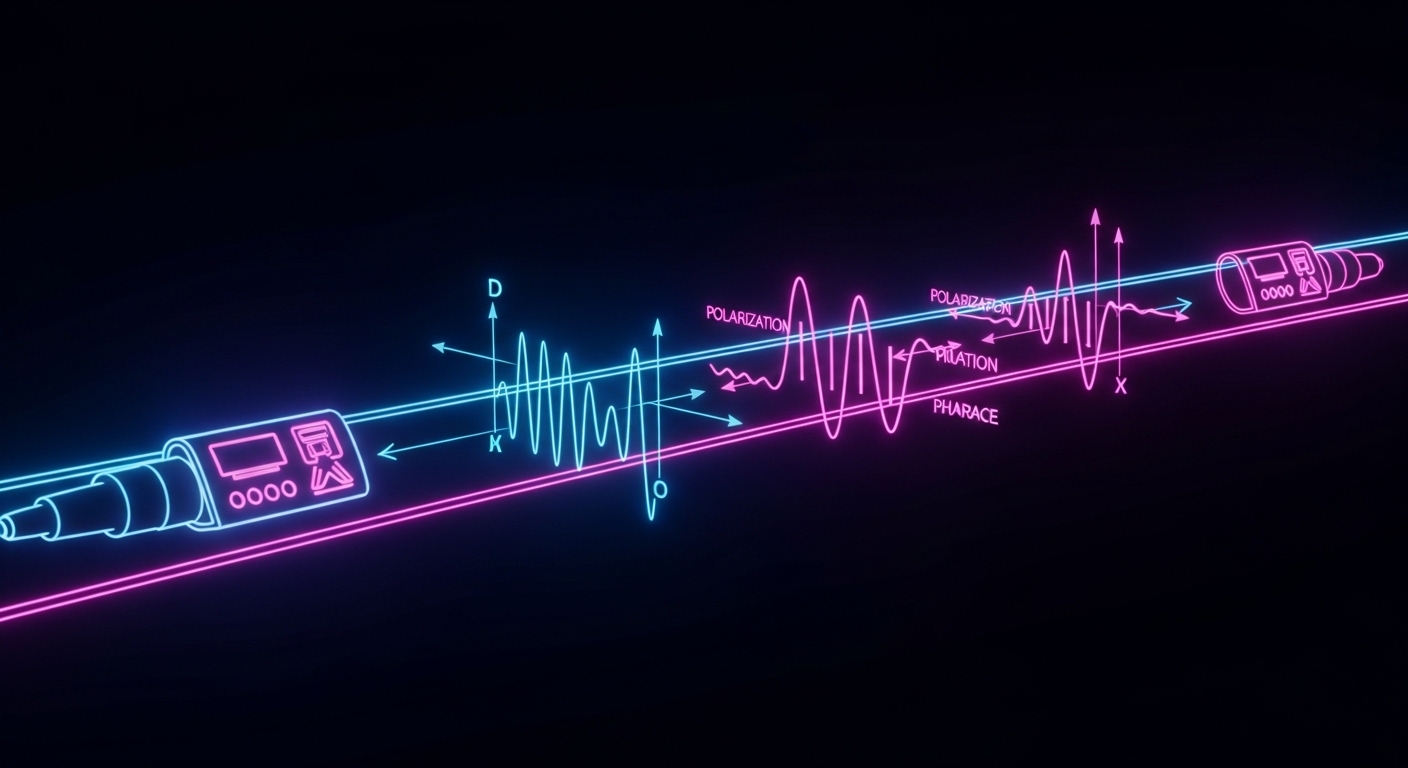
Coherent transceivers use a local oscillator and coherent detection so the receiver recovers not only intensity, but also phase and polarization information. That enables advanced DSP such as polarization demultiplexing, chromatic dispersion compensation, and adaptive equalization, reducing sensitivity to plant impairments. In practice, this is what delivers long-haul benefits: longer reach, better spectral efficiency, and higher tolerance to dispersion and nonlinear penalties than direct-detection systems.
Key mechanisms that matter in deployed networks
- Digital coherent detection: improves receiver sensitivity and supports higher-order modulation formats under realistic fiber conditions.
- Chromatic dispersion compensation: DSP corrects dispersion accumulated over distance, reducing the need for manual dispersion planning.
- Polarization handling: coherent receivers track polarization changes, improving stability on routes with temperature variation.
- Adaptive optics: many systems implement decision-directed algorithms that converge after installation and re-converge after events.
Pro Tip: In field acceptance tests, do not judge a coherent link solely by initial BER at turn-up. Many coherent platforms show “converged” performance only after full DSP training and polarization lock; schedule a 30 to 60 minute post-install observation window and log alarms continuously.
Coherent vs direct detection: specs that drive real selection
Engineers selecting coherent optics typically compare wavelength, reach, power budget behavior, and operational environment limits. The table below uses representative coherent module and common direct-detection references to highlight what changes when you move to coherent. Always validate exact compatibility with your line card vendor and software release, because coherent control and optics calibration are often tightly coupled.
| Category | Coherent transceiver (representative) | Direct-detection pluggable (representative) |
|---|---|---|
| Typical wavelength | 1550 nm DWDM band (C-band) | 850 nm or 1310/1550 nm depending on model |
| Reach class | Often 80 km to 400 km and beyond (platform dependent) | Commonly 10 km to 80 km for common long-reach variants |
| Data rate / modulation | High client rates with coherent modulation formats (platform dependent) | Intensity-based modulation; fixed modulation formats |
| Connector / form factor | Pluggable coherent optics; connector depends on platform | SFP+/SFP28/QSFP+/QSFP28/CFP2 variants depending on rate |
| Operating temperature | Usually commercial/industrial grades depending on SKU; confirm datasheet | Varies by SKU (often -5 to 70 C or -40 to 85 C for extended) |
| Control and monitoring | Often includes coherent DSP telemetry and advanced alarms | Standard digital optical monitoring (DOM): Tx power, Rx power |
| Compatibility caveat | May require specific line card firmware and optical calibration | Usually more tolerant when using standard transceiver profiles |
Expected outcome: you can articulate why coherent is chosen for long-haul benefits: higher reach tolerance, better spectral efficiency, and stronger DSP-based compensation.
Standards and references to anchor expectations
- Ethernet and optical PHY behaviors are governed by IEEE Ethernet standards for client interfaces and vendor-specific coherent implementations; verify with your platform manuals. For baseline Ethernet PHY references, see [Source: IEEE 802.3].
- Coherent optics planning often aligns with DWDM channel grid practices; verify your network planning documents and ITU grid usage. For background on optical channel concepts, see [Source: ITU-T recommendations on DWDM principles].
- For module-level optics and monitoring expectations, consult vendor datasheets and DOM support documentation. For a DOM reference concept, see [Source: SFF Committee transceiver monitoring specifications].
Step-by-step implementation guide for a coherent long-haul upgrade
This section is written as an actionable sequence you can run during a planned window. Use it to minimize downtime and to prove the long-haul benefits with measurements, not assumptions.
Prerequisites checklist
- Confirm the coherent line card firmware version and supported module SKUs in the release notes.
- Verify the host port mapping (which physical slot connects to which optical channel) to avoid channel misassignment.
- Ensure you have optical connectors cleaned and inspected (use IEC-compliant cleaning practices for your connector type).
- Prepare remote monitoring access (telemetry export, alarm thresholds, and log retention window).
Validate link budget and channel plan
Model the link budget including span losses, connector/splice contributions, and any inline amplification assumptions. For coherent, also confirm dispersion and nonlinear tolerance assumptions used by your vendor planning tool.
Expected outcome: the vendor reach class and modulation format selection are consistent with your installed fiber properties.
Select module SKU and verify compatibility
Choose modules that match the coherent platform requirements. Even when two vendors claim the same general reach, differences in DSP configuration, control plane expectations, and optical calibration can cause instability. If your environment uses vendor-specific management, prioritize the OEM or an explicitly certified compatible vendor.
Expected outcome: a documented compatibility matrix for each end-to-end pair (transceiver type, line card type, firmware).
Install and configure client and optical parameters
During the maintenance window, insert modules into the correct slots, connect patch fibers, and verify optics power levels. Then configure the coherent parameters using the platform CLI or GUI: wavelength/channel assignment, expected grid spacing, and any required protection or transponder mapping.
Expected outcome: the system shows “optical lock” and “DSP training complete” states without persistent alarms.
Prove long-haul benefits with convergence and stability tests
Collect telemetry for at least 30 minutes after training. Validate key indicators such as received optical power, SNR metrics (if exposed), FEC status (and whether FEC is operating within nominal margins), and BER/FER trends.
Expected outcome: stable error correction performance and alarm-free operation under normal traffic load.
Operationalize monitoring and rollback readiness
Set alarm thresholds for receive power drift and DSP convergence failures. Keep a rollback plan: preserve the previous direct-detection configuration or spare optics so you can revert quickly if convergence fails under real traffic patterns.
Expected outcome: reduced MTTR via clear alarms and a tested rollback path.

Selection criteria and decision checklist for engineers
Use this ordered checklist to decide on coherent optics for long-haul benefits. It is optimized for real procurement and engineering sign-off workflows.
- Distance and impairment profile: confirm km range plus dispersion and expected nonlinear regime.
- Budget and TCO: include not just optics cost, but line card compatibility, power draw, and maintenance spares.
- Switch and line card compatibility: confirm exact module type and firmware support.
- DOM and telemetry depth: coherent platforms often provide richer DSP telemetry; ensure your NMS can ingest it.
- Operating temperature and environmental exposure: confirm extended temperature specs for outdoor cabinets or industrial rooms.
- Vendor lock-in risk: evaluate whether third-party modules are certified and whether firmware updates impact optics behavior.
- Testing and acceptance criteria: define what “pass” means (FER/BER, alarm counts, stabilization time).
Common mistakes and troubleshooting tips
Coherent deployments often fail for reasons that are not obvious at first glance. Below are three top failure points with root causes and practical solutions.
Channel misassignment or wavelength mismatch
Root cause: the module is inserted correctly, but channel/wavelength settings do not match the DWDM plan at the far end. DSP cannot converge consistently.
Solution: verify channel ID, grid spacing, and wavelength mapping on both ends. Confirm no ROADM reconfiguration occurred during the window.
Inadequate fiber cleaning or damaged connectors
Root cause: coherent receivers are sensitive to optical return loss and insertion loss; dirty connectors can cause low received power and unstable lock.
Solution: clean and inspect connectors with the correct method for your connector type, then re-seat fibers. Re-check received optical power immediately after cleaning.
Firmware mismatch between line card and optics
Root cause: the host platform firmware may not support the module’s DSP configuration, leading to persistent training failures or degraded FEC performance.
Solution: align to the OEM supported firmware release for the module SKU. If using third-party optics, confirm explicit certification with the exact host software version.
Expected outcome: faster isolation of optical, configuration, or compatibility issues during the acceptance window.
Cost and ROI note: where coherent pays off
Coherent optics typically cost more per module than direct-detection long-reach optics, and they may require specific line cards. However, the ROI can be strong when long-haul benefits reduce the need for additional regeneration sites, lower maintenance burden from dispersion-related issues, or improve capacity without new fiber builds. In many carrier and enterprise backbone scenarios, the TCO advantage comes from fewer truck rolls and fewer planned outages due to more stable DSP compensation.
Practical price bands: OEM coherent transceivers vary widely by data rate and reach, but it is common to see higher single-unit costs than long-reach direct-detection optics; third-party certified modules can reduce unit cost but may increase compatibility and testing effort. Model TCO including spares, training time, and the operational cost of firmware validation. If you have to upgrade hosts anyway, coherent can be cost-effective by avoiding parallel regeneration infrastructure.
FAQ
What are long-haul benefits I can measure after switching to coherent?
Look for improved reach margin and stability: stable lock status, reduced alarm counts, and consistent FEC performance over time. Measure convergence time and track received power and error correction metrics during a 30 to 60 minute post-install window to confirm real-world behavior.
Do coherent transceivers require DWDM amplifiers on every link?
Not always. Some routes remain within budget for shorter spans, but many long-haul designs use inline amplification to maintain optical power and support the intended modulation formats. Confirm with your vendor planning tool using your fiber loss and span layout.
Are third-party coherent modules safe for production?
They can be, but only if the vendor explicitly certifies compatibility with your exact line card model and firmware version. Otherwise you may see training issues, telemetry mismatches, or delayed convergence that increases operational risk.
How do I verify DOM support and telemetry for coherent optics?
Check the module and platform documentation for supported monitoring fields and whether your NMS can ingest them. Coherent systems often expose additional DSP and optical metrics beyond standard Tx/Rx power.
What is the most common reason coherent links fail during acceptance?
The most frequent issues are channel/wavelength mismatches and optical connectivity problems like dirty connectors. A close third is firmware mismatch between line card and optics, which prevents stable DSP configuration.
