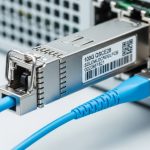
If your SFP ports keep going “link down” or you are refreshing a data center cabling plant under time pressure, connector choice matters as much as optics. This article compares LC connector SFP with SC and MPO/MTP-style approaches across performance, density, and compatibility. It helps network engineers, cabling techs, and procurement teams validate reach, polarity, and transceiver fit before ordering.
LC connector SFP in practice: what changes vs other connector families
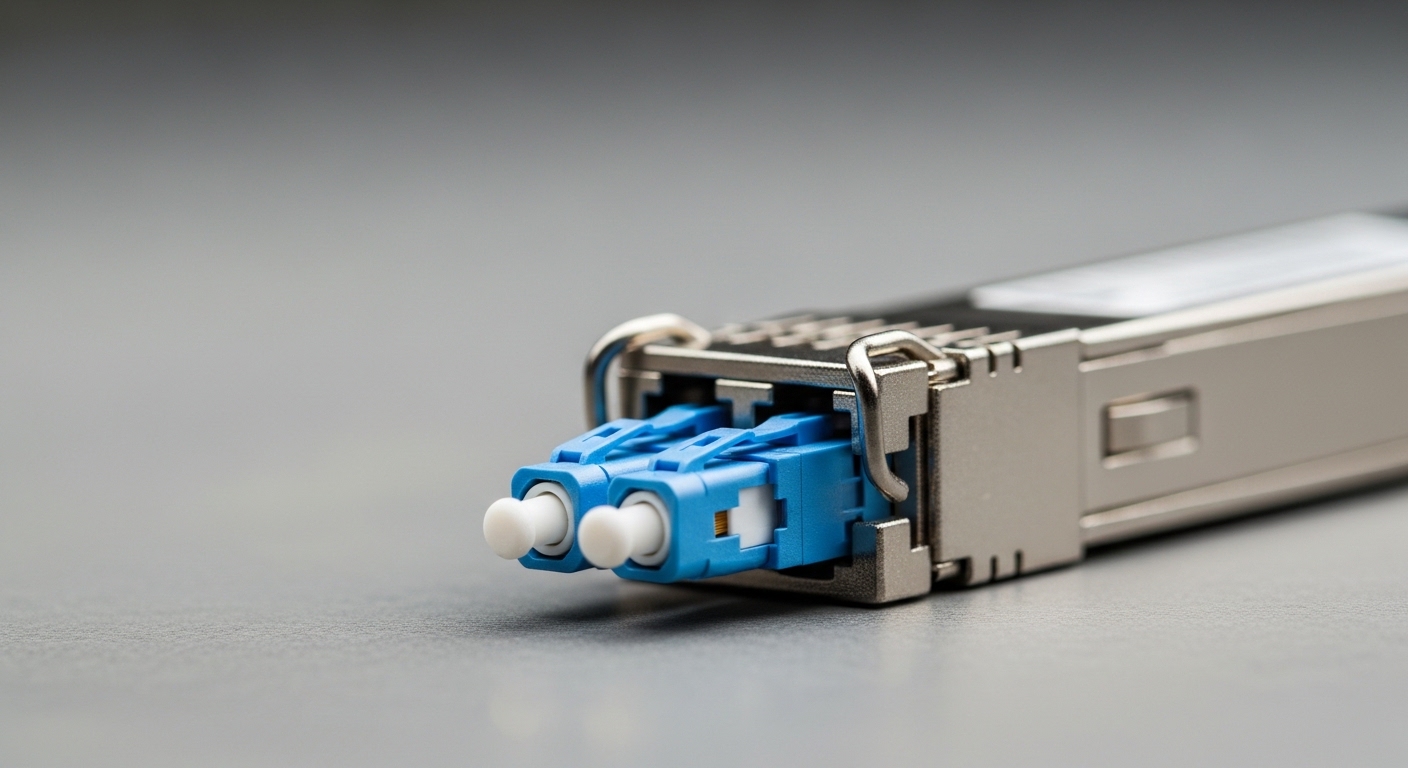
An LC connector SFP uses a small form factor ferrule (typically 1.25 mm) with a duplex arrangement for transmit and receive. In day-to-day operations, that duplex geometry reduces cross-connection errors compared with older simplex styles, especially in patch panels with dense labeling. Most modern 10G/25G/40G SFP and SFP28 optics use LC duplex for fiber runs and patching, aligning well with ANSI/TIA-568.3-D practices for structured cabling. For authority on connector/ferrule families and general connector standards, see [Source: ANSI/TIA-568.3-D].
Compared to SC, LC is smaller and typically increases port density per rack unit in patching. Compared to MPO/MTP, LC is lower density but easier to troubleshoot one lane at a time. In the field, I have seen MPO-based trunks shine in 100G/400G topologies where lane mapping and polarity kits are standardized, while LC wins when you need straightforward patching for 10G/25G leaf-spine links.
Pro Tip: Before you blame the transceiver, verify patch-panel polarity and lane mapping against the exact transceiver labeling (A/B or Tx/Rx). Many “bad optics” returns are actually flipped polarity caused by mixing duplex LC patch cords with a polarity scheme designed for MPO trunks.
Performance and reach: LC vs SC vs MPO/MTP for SFP-class links
At the optical layer, connector type alone does not determine whether you can reach 300 m or 10 km; the governing factors are the SFP transceiver type (SR/LR/ER), wavelength band (typically 850 nm for SR, 1310 nm for LR, and 1550 nm for ER), and link budget. However, connector implementation affects practical performance via insertion loss and reflection control, plus patching complexity. LC and SC connectors are both widely specified for low insertion loss and repeatability, but MPO/MTP systems introduce multi-fiber alignment constraints that can increase operational complexity if not managed correctly.
Below is a comparison table showing typical SFP optics families commonly deployed with LC, along with connector implications. Note that exact specs vary by vendor; always confirm against the specific datasheet and the switch or host transceiver compatibility list.
| Connector approach | Typical SFP optic family | Wavelength | Common reach (example) | Fiber type | Power class (typical) | Operating temp (typical) | Connector geometry |
|---|---|---|---|---|---|---|---|
| LC connector SFP (duplex) | 10G SR, 25G SR, 1G/2G SFP | 850 nm (SR) | ~300 m on OM3/OM4 (varies) | OM3/OM4 MMF | ~0.3 W to ~1.5 W | 0 to 70 C or -40 to 85 C (grade dependent) | 1.25 mm ferrule, duplex Tx/Rx |
| SC connector (often simplex or duplex adapter-based) | Legacy 1G/10G optics | 850 nm or 1310 nm | ~550 m (OM2 example) up to ~10 km (varies by LR) | MMF or SMF | ~0.3 W to ~1.5 W | 0 to 70 C or -40 to 85 C | 2.5 mm ferrule, typically larger footprint |
| MPO/MTP (often not SFP; used with multi-lane optics) | 100G/400G breakouts via parallel optics | 850/1310/1550 nm (varies) | ~100 m to 2 km depending on model | MMF/SMF | ~2 W to ~8 W (higher density optics) | Commercial or industrial grade | 12/24-fiber array alignment |
In real deployments, LC connector SFP modules typically pair with duplex LC patch cords and LC duplex bulkheads. That makes end-to-end verification faster: you can test each direction without unpacking an MPO polarity cassette. MPO trunks can reduce cabling bulk in high-density rows, but you must manage polarity with consistent MPO-to-LC breakouts and documented lane mapping.
Compatibility and wiring: why connector choice affects link stability
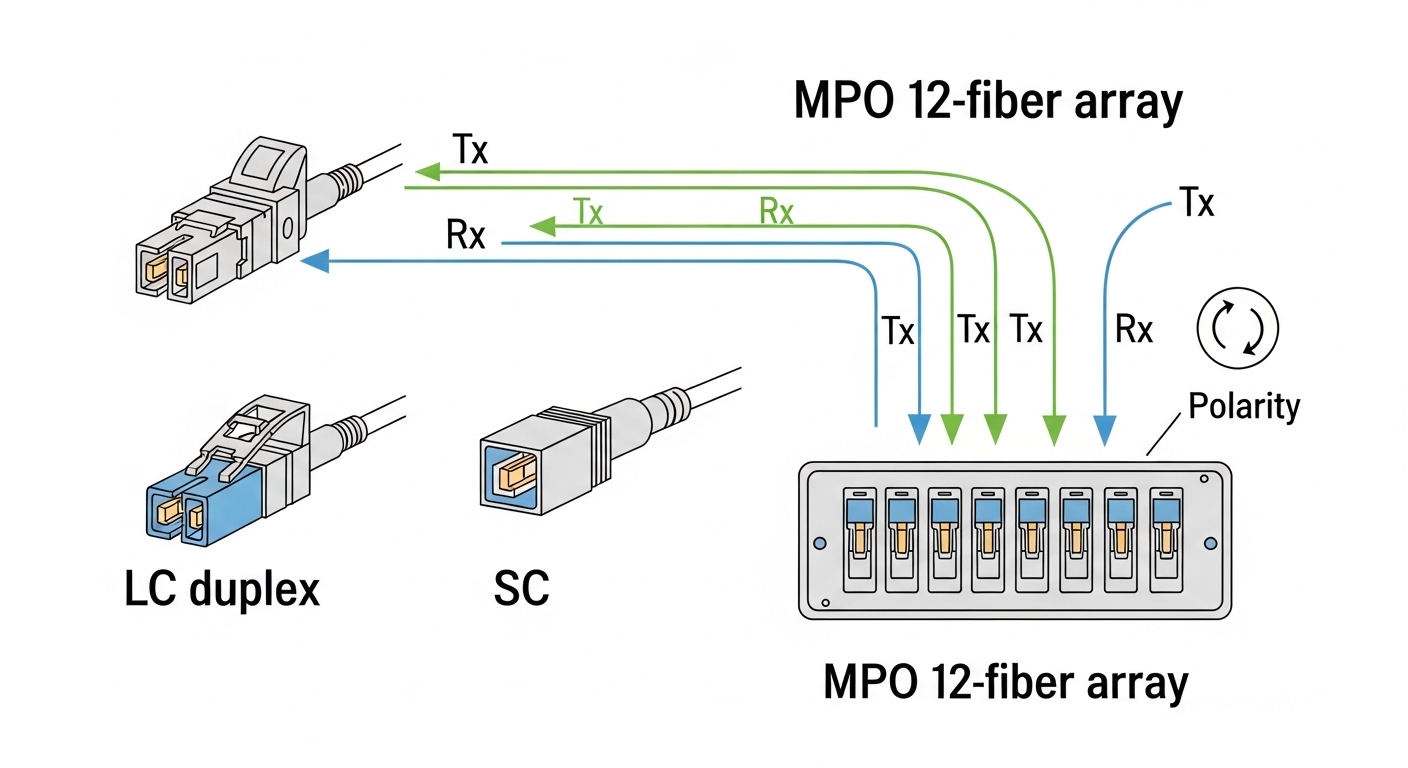
Connector choice impacts compatibility through both physical fit and the cabling conventions used in your plant. An LC connector SFP expects LC duplex cabling (or a compatible adapter path). If you use SC patch cords without correct adapters, you can end up with incorrect alignment, swapped transmit/receive, or excessive insertion loss. For MMF links, ensure your patch cords match the fiber type (OM3 vs OM4) and your system uses the vendor’s specified launch conditions.
Polarity and naming: the hidden source of “it should work” failures
In duplex fiber systems, polarity is typically handled by using consistent “A to A” and “B to B” conventions—or by using polarity converters designed for your connector type. In MPO systems, each polarity strategy (for example, two common MPO polarity methods) depends on how the array is mapped end-to-end. I have debugged cases where LC duplex breakouts were correct individually, but the upstream MPO trunk polarity was reversed, causing intermittent BER issues after a maintenance visit.
DOM and host expectations
Modern SFPs usually support Digital Optical Monitoring (DOM) via an I2C management interface described in transceiver standard documentation. In practice, switch vendors vary in how they validate DOM and how they handle vendor-specific thresholds. Always check the host switch’s transceiver compatibility list and whether it requires specific DOM behavior, especially for third-party optics.
For standards context on transceiver electrical interfaces and management behavior, consult [Source: SFF-8472] and vendor-specific DOM guidance from the transceiver manufacturer.

Cost and ROI: LC connector SFP economics vs higher-density alternatives
Connector type drives total cost indirectly by influencing how many patch cords, adapters, and polarity components you need, and how quickly technicians can troubleshoot. In many enterprise and data center environments, LC connector SFP modules are cost-effective because they are widely available, standardized, and reduce downtime during swap-and-test operations. MPO-based solutions can reduce rack space and cabling labor for large-scale 100G/400G upgrades, but the initial engineering effort for lane mapping and polarity validation often increases project cost.
Typical street pricing (ballpark, varies by volume and grade): OEM or OEM-compatible LC connector SFP modules frequently fall in a range of $30 to $150 per module for common 10G/25G variants, while industrial temperature (-40 to 85 C) and long-reach optics can be higher. Third-party optics may be lower cost, but total cost of ownership (TCO) should include return rates, support time, and potential compatibility limitations. If your swap rate is high due to aggressive burn-in policies, buying higher-quality modules with consistent DOM behavior can reduce mean time to repair.
For TCO modeling, include: expected failure rate over your warranty period, labor cost per incident, and the cost of patching errors. A single miswired polarity event can consume more labor than the price delta between OEM and third-party optics.
Selection criteria checklist for LC connector SFP purchases
Use this ordered checklist to avoid rework. It is the same logic I apply when commissioning leaf-spine fabrics and when validating retrofit transceiver inventories.
- Distance and fiber type: confirm MMF vs SMF and your planned reach vs the transceiver’s spec (include margin for patch cords).
- Wavelength and speed: match SR/LR/ER and 10G/25G/1G requirements to the host port.
- Switch compatibility: verify the exact switch model’s transceiver list; check DOM requirements if enforced.
- Connector and cabling plan: ensure LC duplex bulkheads, patch cords, and adapters match the transceiver connector type with correct polarity.
- DOM support and thresholds: confirm whether the host reads DOM normally and whether it enforces vendor-specific alarms.
- Operating temperature grade: validate commercial vs industrial range for your ambient and airflow conditions.
- Vendor lock-in risk: evaluate whether third-party modules have consistent behavior across your fleet and whether you can standardize on one optic vendor.
- Return and warranty terms: prioritize clear RMA handling and documented optical performance criteria.
Common pitfalls and troubleshooting tips (connector-related)
Below are field-tested failure modes I have seen repeatedly in mixed connector plants. Each includes a root cause and a practical fix.
- Pitfall 1: “Link up, but traffic fails” after a patch change
Root cause: Transmit/receive polarity flipped due to mixing duplex LC patch cords with an MPO polarity scheme or inconsistent A/B labeling.
Solution: Perform an end-to-end polarity verification using the documented patch panel labeling; correct directionality or use a polarity converter matched to your connector family. - Pitfall 2: “Link down” immediately after installing an LC connector SFP
Root cause: High insertion loss from dirty ferrules or micro-scratches, often worsened by repeated insertions during troubleshooting.
Solution: Inspect with a fiber microscope, clean with lint-free wipes and approved cleaning tools, and re-test. Replace patch cords if ferrules show damage. - Pitfall 3: Intermittent CRC errors on MMF links
Root cause: Fiber grade mismatch (for example, OM2 cabling reused where the design assumed OM3/OM4), or excessive patch cord length reducing optical margin.
Solution: Measure and document the installed plant length and patch cord composition; re-validate against the transceiver’s optical budget and vendor reach conditions. - Pitfall 4: Host rejects third-party DOM or logs “unsupported transceiver”
Root cause: DOM behavior differences or strict compatibility checks in the host switch firmware.
Solution: Use the switch vendor compatibility list; if allowed, update switch firmware and confirm DOM alarm thresholds match your optic’s published behavior.
Real-world deployment scenario: 48-port ToR with LC connector SFP uplinks
In a 3-tier data center leaf-spine topology, imagine 12 top-of-rack (ToR) switches, each with 48x 10G SFP+ uplinks to a pair of spine switches. The cabling plan uses LC duplex patch cords into labeled patch panels, with OM4 MMF runs capped at 250 m including patch cords, leaving margin for maintenance re-termination. During a refresh, the team swaps failing modules during a 2-hour maintenance window, relying on quick visual confirmation of LC duplex polarity and consistent transceiver labeling. This approach minimizes downtime because technicians can isolate a single duplex channel without opening MPO cassettes or re-mapping lane order.
Decision matrix: LC connector SFP vs SC vs MPO/MTP by project type
Use this matrix as a fast pre-approval for your order. Score is directional; confirm with the exact transceiver and cabling design.
| Criteria | LC connector SFP | SC-based approach | MPO/MTP approach |
|---|---|---|---|
| Ease of field troubleshooting | High | Medium | Medium to Low (lane mapping) |
| Patch density per rack space | High | Medium (larger footprint) | Very High |
| Compatibility with common SFP speeds | High | High for legacy gear | Usually not SFP-class (more 100G/400G) |
| Polarity management complexity | Low to Medium | Medium | High |
| Typical BOM cost impact | Often best | Neutral to higher | Can be lower for trunks, higher for engineering/polarity kits |
Which Option Should You Choose?
If you are deploying or maintaining 10G or 25G SFP links with standard patch panels, choose LC connector SFP for the best blend of density, compatibility, and troubleshooting speed. If you are operating legacy equipment with established SC cabling, stick to SC where it is already standardized, but plan a migration path to LC to reduce footprint and operational risk. Choose MPO/MTP-based systems only when your target is 100G/400G parallel optics and your team can enforce polarity and lane mapping discipline with documented procedures.
FAQ
Q: Do LC connector SFP modules require LC duplex patch cords?
Most LC connector SFP optics are designed for duplex LC cabling (Tx/Rx). If your patch plant uses simplex or SC, you must use appropriate adapters and confirm polarity directionality before commissioning.
Q: Will switching from SC to LC affect optical reach?
Reach is driven by transceiver optics (wavelength, laser type, and optical budget) and fiber quality, not the connector family. However, connector and patching practices can change insertion loss and overall margin, so validate with installed plant measurements.
Q: Are MPO/MTP connectors compatible with SFP ports?
MPO/MTP is typically used with multi-lane optics for higher speeds (for example, 100G/400G). SFP ports generally use single-lane transceivers that favor LC or SC; MPO usually appears via breakout assemblies rather than directly inside an SFP.
Q: How do I prevent dirty-fiber issues with LC connector SFP links?
Use a fiber inspection microscope, adopt a cleaning workflow before every replacement, and protect ferrules with dust caps when modules are removed. Dirty ferrules commonly cause link flaps and rising error counters even when the transceiver is correct.
Q: Should I buy OEM or third-party LC connector SFP modules?
OEM modules often provide the most predictable DOM and compatibility behavior, which can reduce downtime risk. Third-party optics can be cost-effective, but validate against your switch compatibility list and run a controlled burn-in and error-rate test.
Q: What temperature grade matters for data center optics?
Choose commercial (0 to 70 C) or industrial (-40 to 85 C) based on your ambient conditions and airflow. In constrained racks, heat soak can push modules beyond spec, causing throttling or intermittent failures.
For related planning, see fiber connector types for transceivers to align connector strategy with your speed roadmap and patching standards.
Author bio: Field-tested network hardware engineer with 10+ years deploying SFP/SFP28 and higher-speed optical links across enterprise and data center environments. Hands-on with connector polarity verification, optical budget validation, and production troubleshooting workflows.