In multi-cloud strategies, the fastest plan often fails at the first cutover: latency spikes, optics mismatch, or a transceiver that works on the bench but flaps in the field. This article helps network and infrastructure teams choose hybrid links for connecting on-prem, public cloud, and partner networks using fiber optics. You will get practical selection criteria, a specs comparison table, and troubleshooting patterns seen in real deployments.
Why hybrid links matter in multi-cloud architectures
Hybrid links combine different physical media and/or link types—most commonly mixing fiber-based Ethernet (SFP/SFP+/QSFP) with other transport boundaries like routed WAN segments, dark fiber, or partner handoffs. In multi-cloud, you typically need consistent L2/L3 behavior while meeting distance limits and interoperability constraints across vendors. The “hybrid” part is rarely about optics alone; it is about aligning distance, reach budget, and operational temperature with how your clouds actually attach to your network.
In practice, teams use hybrid links to keep core switching stable (leaf-spine in data centers) while scaling access and interconnects through regional points of presence. A common pattern is 10G/25G/40G/100G fiber inside the facility, then separate connectivity at the edge or in colocation for cloud gateways. IEEE Ethernet behavior still matters, but optics details like wavelength, connector type, and DOM monitoring often decide whether links run for months or collapse during seasonal temperature swings.
Pro Tip: When teams say “it should work,” they usually test only wavelength and rate. In real cutovers, the hidden risk is DOM and vendor EEPROM compatibility plus link margin under worst-case temperature and aging—so validate with the exact switch vendor optics compatibility matrix and measured receive power targets, not just nominal reach.
Technical building blocks: wavelengths, reach, and connector reality
Hybrid links in multi-cloud setups usually rely on two optical families: short-reach multimode (MMF) for intra-site runs and long-reach single-mode (SMF) for inter-site or cloud edge paths. For Ethernet over fiber, the transceiver and fiber plant must align with IEEE 802.3 standards for the given data rate and reach class. For example, 10GBASE-SR and 10GBASE-LR define optical performance envelopes, while 25G/40G/100G variants define wavelength and modulation requirements.
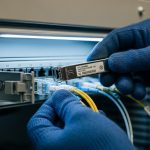
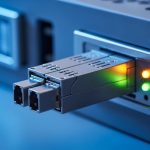
At the hardware layer, you will pick a transceiver form factor (SFP, SFP+, QSFP+, QSFP28, CFP2) that matches the port on your switches and routers. You will also decide connector style (LC is most common for duplex fiber) and whether the optics are active (pluggable transceivers) or based on external optics with media converters. DOM (Digital Optical Monitoring) is a frequent requirement for operations teams because it supports monitoring of Tx bias, laser temperature, and received power.
| Parameter | Example MMF Short-Reach (SR) | Example SMF Long-Reach (LR) | What to check for hybrid links |
|---|---|---|---|
| Target use | ToR to aggregation within building | Colo to cloud edge or inter-site | Keep “reach class” consistent with actual fiber runs |
| Wavelength | ~850 nm (typical SR) | ~1310 nm (typical LR) | MMF vs SMF mismatch is a hard failure |
| Reach | ~300 m (10G SR class examples vary by spec) | ~10 km (common LR class target) | Budget includes connector loss, splices, and aging |
| Connector | LC duplex (typical) | LC duplex (typical) | Confirm patch panel and polarity handling |
| Data rate | 10G, 25G, or 40G (rate depends on module) | 10G, 25G, or 100G (rate depends on module) | Match transceiver speed to switch port capabilities |
| DOM support | Usually supported on enterprise optics | Usually supported on enterprise optics | DOM compatibility with the exact switch platform |
| Operating temperature | Commercial (0 to 70 C) or extended ranges | Commercial or industrial options | Edge cabinets can exceed commercial assumptions |
| Compatibility risk | Lower if OEM optics used | Higher when mixing third-party optics without validation | Validate with compatibility matrices and DOM behavior |
For concrete examples, many teams deploy modules such as Cisco SFP-10G-SR, Finisar FTLX8571D3BCL (10G SR variants), or FS.com SFP-10GSR-85 for MMF segments, and corresponding LR-class optics for SMF. Always verify the exact part number matches the switch’s required electrical interface and DOM expectations.

Deployment scenario: hybrid links across leaf-spine and cloud edge
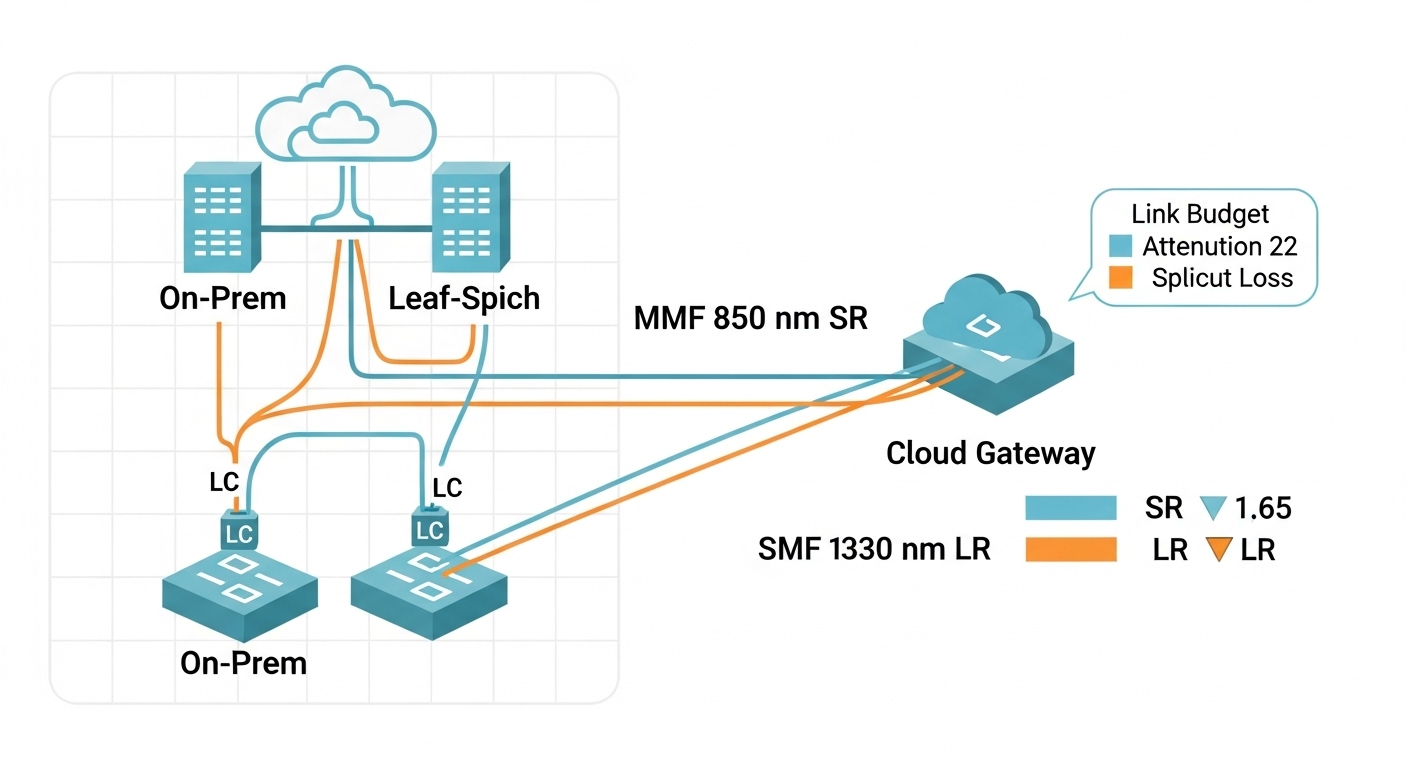
Consider a regional multi-cloud setup with a 3-tier data center leaf-spine topology. The leaf switches are 48-port 10G ToR models, uplinking to spine with 40G optics for aggregation. Within the facility, you run MMF for patch-panel to rack runs at about 90 m average, using 10G SR-class transceivers. For the cloud edge, you extend connectivity from a colocation cage to a cloud gateway device over SMF with a total measured path of 6.5 km including splices and patching.
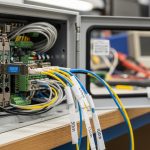
To make this hybrid, you deploy SR optics on the leaf-to-top-of-rack and patching side, then use LR optics on the long-haul or inter-cage segments. In the first cutover, the team targets a steady-state error-free run and monitors receive power thresholds via DOM. During onboarding, they enforce a fiber plant validation step: OTDR traces confirm splice loss and end-to-end attenuation, and polarity is verified using visual and test patterns. This is where hybrid links earn their keep: it prevents the “one optics type everywhere” fantasy that usually breaks at distance or connector/plant mismatches.
Selection criteria checklist for hybrid links in multi-cloud
Engineers typically weigh the following factors in order. The list below is what I would use when validating a design before it reaches production and impacts uptime.
- Distance and reach class: compute link budget using fiber attenuation plus connector and splice loss; confirm you are inside the optical power budget for the selected transceiver class.
- Data rate alignment: match the transceiver speed (10G/25G/40G/100G) to the switch port and the optics specification; avoid downshift surprises during negotiation.
- Fiber type and wavelength: ensure MMF vs SMF and the expected wavelength family (850 nm vs 1310 nm/1550 nm) match the installed plant.
- Switch compatibility: use the vendor optics compatibility matrix for the specific switch/router model; validate third-party optics if you must.
- DOM and monitoring requirements: confirm DOM works on your platform and that thresholds are readable; check whether alarms trigger correctly in your NMS.
- Operating temperature and enclosure constraints: edge cabinets often exceed nominal assumptions; pick extended temperature optics if needed.
- Vendor lock-in risk: OEM optics reduce uncertainty but increase unit cost; third-party may reduce cost but raise validation time and RMA complexity.
- Operational turnaround: plan replacement availability and lead times; a hybrid design with two optics classes should still have a consistent spares strategy.
Common mistakes and troubleshooting patterns
Hybrid links fail in predictable ways. Here are concrete pitfalls I have seen during rollouts, along with likely root causes and fixes.
-
Mistake: Installing an MMF SR transceiver on an SMF path (or vice versa).
Root cause: Wavelength and fiber modal properties do not align; the receiver saturates or the link never comes up.
Solution: Verify fiber type at the patch panel, label fibers consistently, and confirm wavelength class before energizing ports. -
Mistake: Link flaps only under high ambient temperature in an edge cabinet.
Root cause: Laser output power and receiver sensitivity drift beyond margins; optics are in commercial temperature range but the enclosure overheats.
Solution: Measure ambient temperature, check module temperature via DOM, and replace with extended-temperature optics if alarms show thermal excursions. -
Mistake: “Works in one switch, fails in another” with third-party optics.
Root cause: DOM EEPROM behavior or vendor-specific threshold expectations; some platforms are stricter on transceiver ID and diagnostics.
Solution: Validate optics against the exact switch models, test with production firmware, and monitor DOM fields during link training. -
Mistake: High CRC errors after a migration despite “link up.”
Root cause: Polarity reversal, excessive patch loss, or damaged connectors; hybrid designs often involve multiple patch panels and splices.
Solution: Reseat LC connectors, verify polarity end-to-end, and run OTDR or at least insertion loss checks at both ends.
If you need authority for the underlying Ethernet-over-fiber behavior, review IEEE Ethernet physical-layer definitions and vendor datasheets. For standards context, see IEEE 802.3 for link behavior and optical reach definitions. For operational details, use transceiver vendor datasheets and your switch vendor’s optics guidance. [Source: IEEE 802.3] [Source: Cisco SFP module documentation] [Source: Finisar and FS.com transceiver datasheets]
Cost and ROI: balancing OEM certainty with third-party speed
Hybrid links often look cost-effective at the BOM level but can cost more in validation and downtime if optics choices are inconsistent. In many enterprise environments, OEM optics (Cisco-branded or equivalent OEM) can cost roughly 1.5x to 3x compared to reputable third-party modules, depending on speed and reach. Third-party optics (including many FS.com classes) can reduce unit cost, but you may spend engineering time on compatibility testing and may see higher failure rates for poorly matched lots.
TCO should include labor for validation, spares inventory strategy, and RMA logistics. A hybrid design with both SR and LR optics typically doubles the “optics SKUs” you must stock, but it can reduce overall cabling complexity by allowing the right technology for each distance segment. If you can standardize on a small set of transceiver types that are already validated with your switch fleet, you usually improve mean time to recovery during incidents.
FAQ
What are hybrid links in a multi-cloud context?
Hybrid links are connectivity designs that mix fiber link types and/or transport boundaries to meet different distance and policy constraints across on-prem and cloud sites. In practice, they often combine short-reach MMF segments with long-reach SMF segments while keeping switching behavior consistent. The goal is predictable performance across heterogeneous network boundaries.
Do hybrid links require different transceivers at each segment?
Usually yes. Short intra-site runs often use SR-class optics (commonly around 850 nm), while longer inter-site or cloud edge runs use LR-class optics (commonly around 1310 nm). The exact data rate and reach class determine the module selection. Mixing the wrong optics family is a common outage cause.
Will third-party optics work with my switches?
They can, but success depends on the specific switch model, firmware, and DOM expectations. Many vendors publish compatibility matrices; validate against your exact platform and test in a staging environment before production. If you must move fast, start with the optics SKUs already proven in your environment.
How do I validate link budget for hybrid links?
Use measured fiber attenuation plus connector and splice losses to ensure you remain within the transceiver power budget for worst-case conditions. OTDR is ideal for plant verification, especially when splices and patch panels are involved. Then confirm receive power and error counters via DOM and interface telemetry after cutover.
What is the fastest troubleshooting workflow for a link that won’t come up?
First confirm the transceiver is supported and properly seated, then verify fiber type and polarity, and finally check receive power via DOM. If the link trains but errors spike, inspect connector cleanliness and patch loss, and compare OTDR traces to expected values. Always repeat tests with known-good jumpers to isolate the failing segment.
How should we plan spares for hybrid links?
Stock spares by the optics SKUs you actually use: one set for SR segments and another for LR segments, plus any special temperature-rated optics if edge conditions require them. Keep spares compatible with your switch DOM behavior and firmware generation. This reduces mean time to recovery during incidents.
Hybrid links can make multi-cloud connectivity more resilient, but only when you treat optics selection, fiber validation, and DOM monitoring as first-class engineering tasks. Next, review how to choose fiber optic transceivers for data centers to tighten your selection loop before the next cutover.
Author bio: I build and validate network connectivity designs end-to-end, from optical budget math to switch telemetry during migrations. I focus on PMF for infrastructure choices by shipping fast pilots, measuring failure modes, and iterating based on field data.